Free printable practice
Telling Time Practice Activities
Printable Class 1 maths worksheets for reading clocks, drawing hands, ordering days and months, and understanding daily time words.
Explore Telling Time
Free printable worksheet PDFs
Preview every available page, then download the free worksheet PDF for home, homeschool, tutoring, or classroom practice.
Preview the exact activity before downloading it.
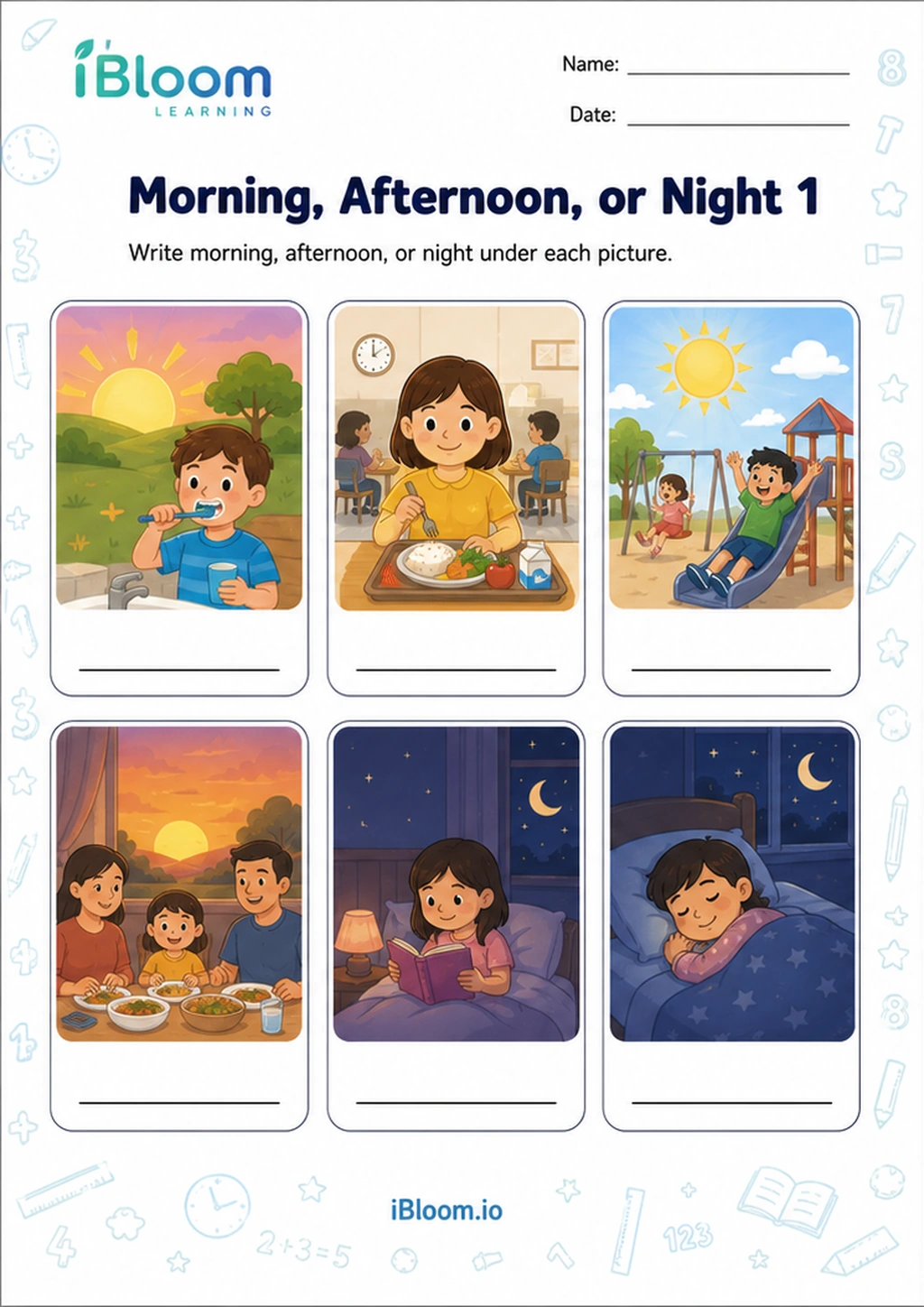 Morning, Afternoon, or Night 1Class 1 printable practice for morning afternoon and night using a clear, age-appropriate learning task.Class 1Free PDF preview
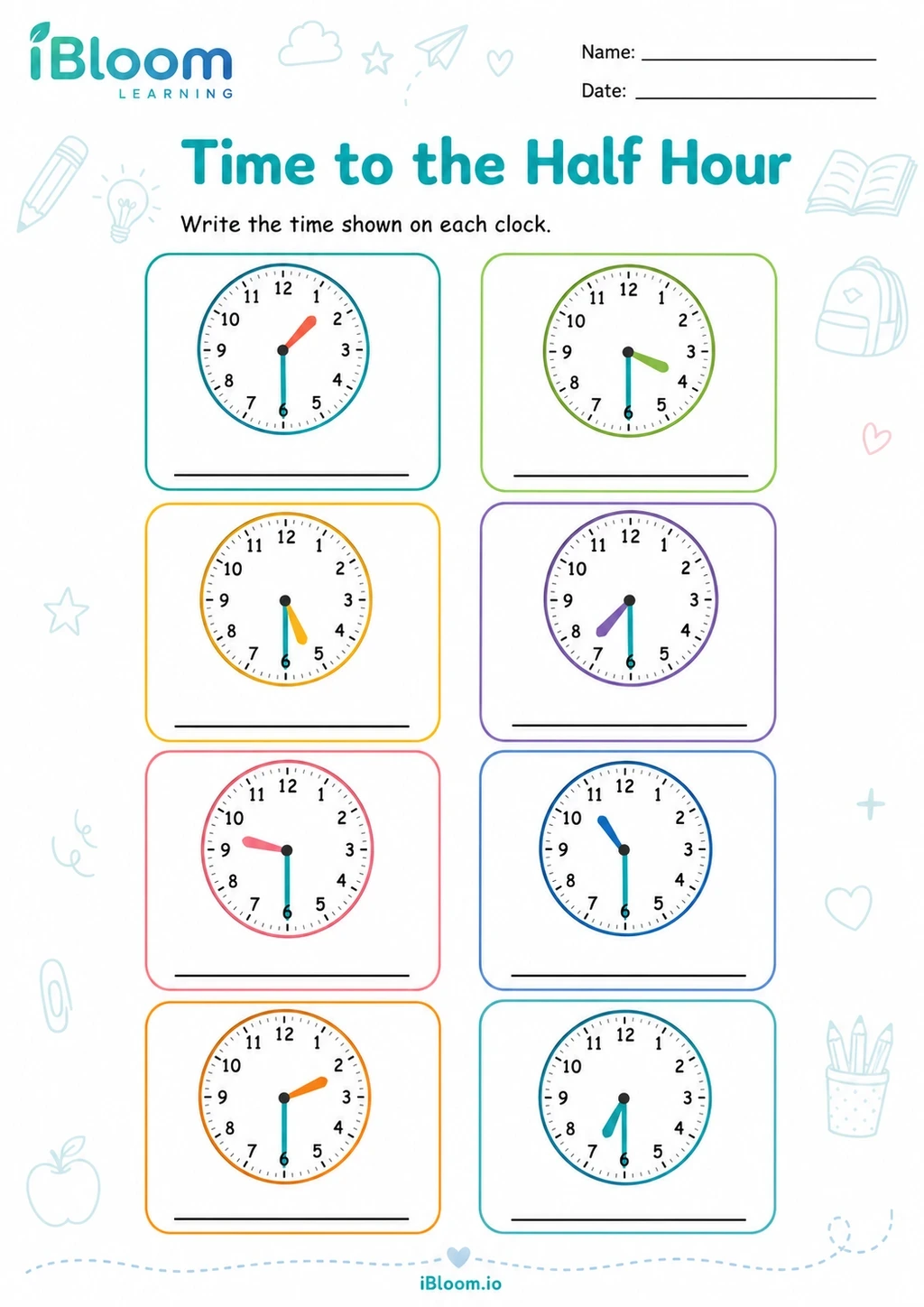 Time to the Half HourA Class 1 telling-time worksheet where children read analog clocks showing half-hour times.Class 1Free PDF preview
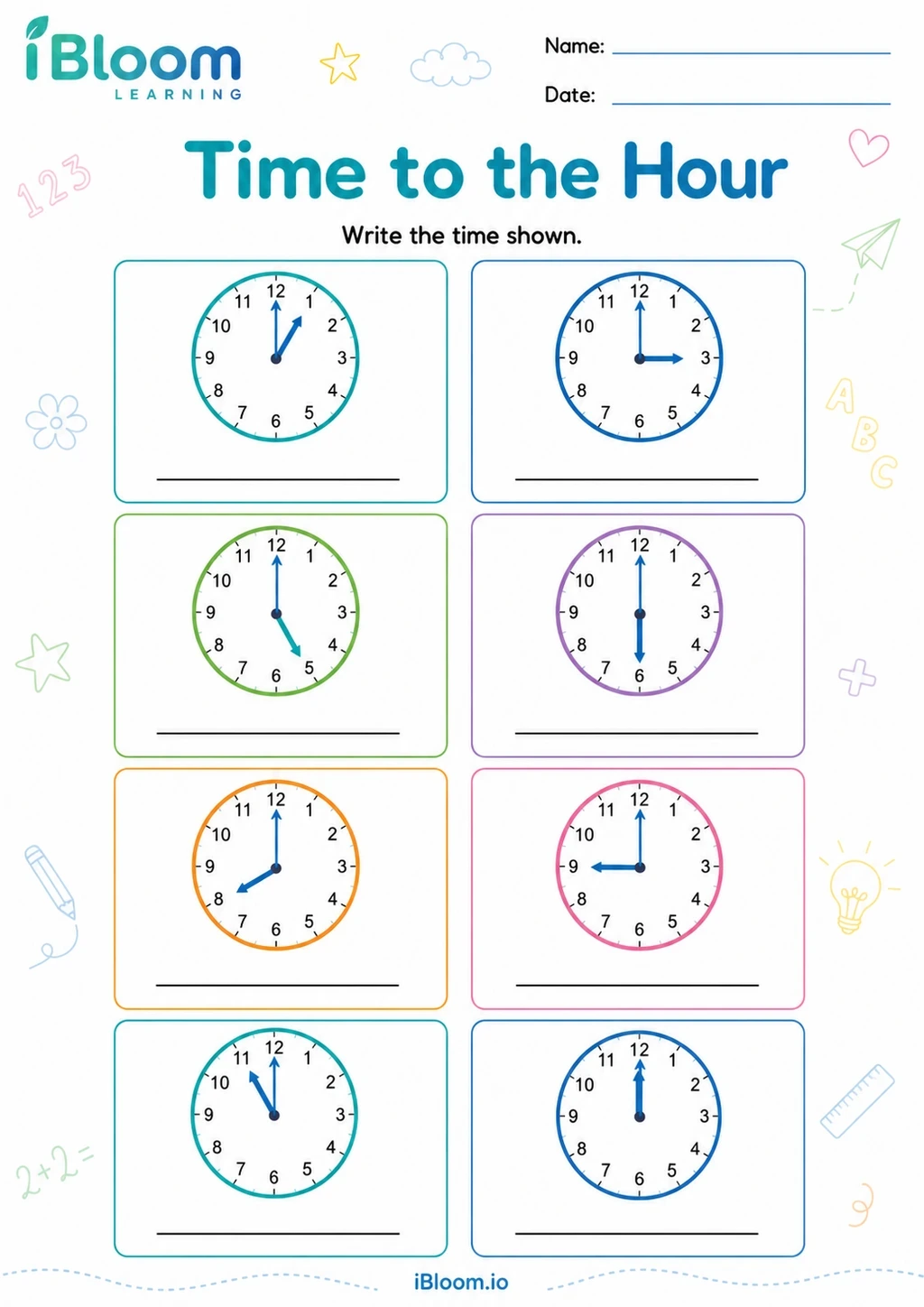 Time to the HourA Class 1 telling time worksheet where children read analog clocks showing times to the hour.Class 1Free PDF preview
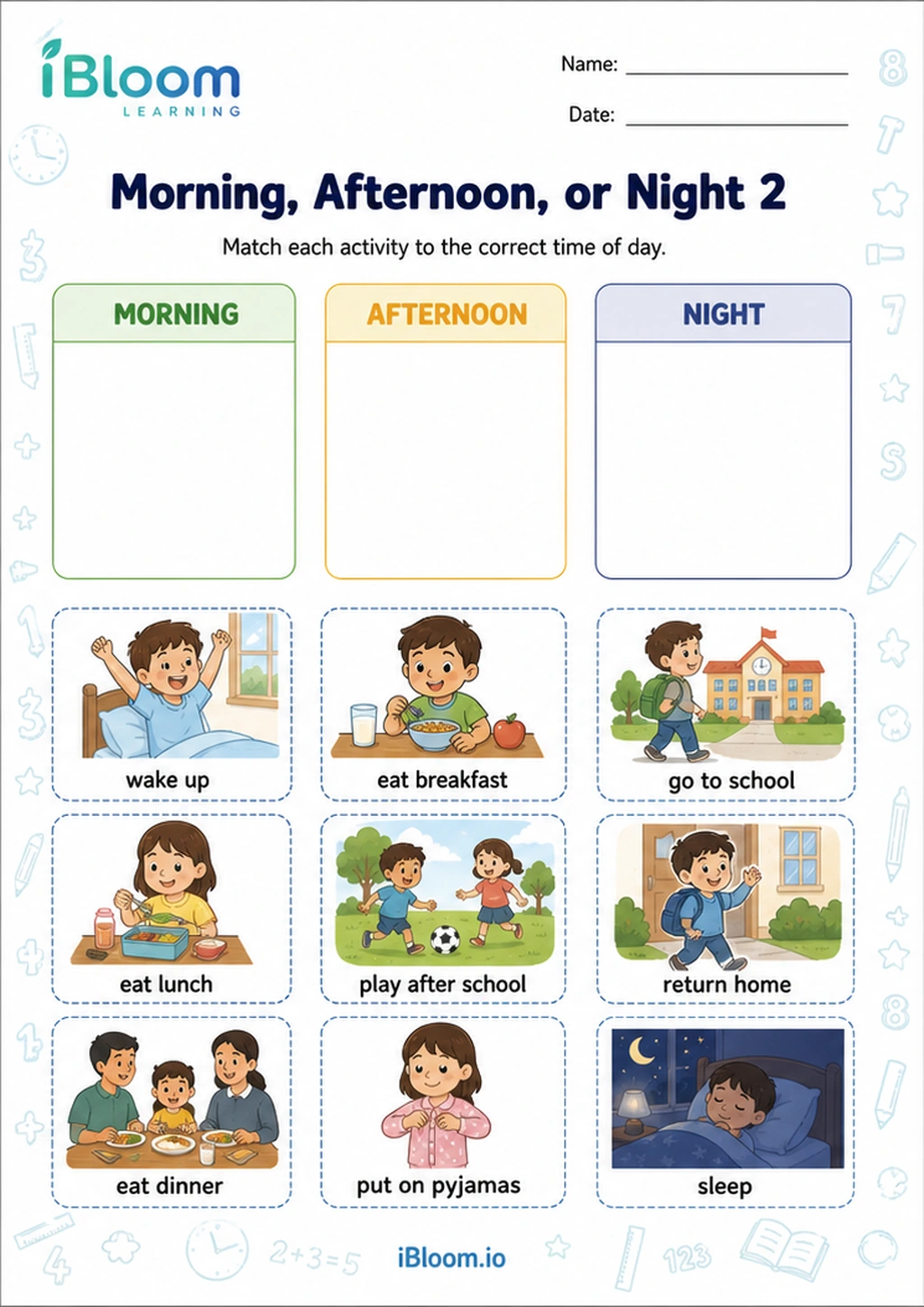 Morning, Afternoon, or Night 2Class 1 printable practice for morning afternoon and night using a clear, age-appropriate learning task.Class 1Free PDF preview
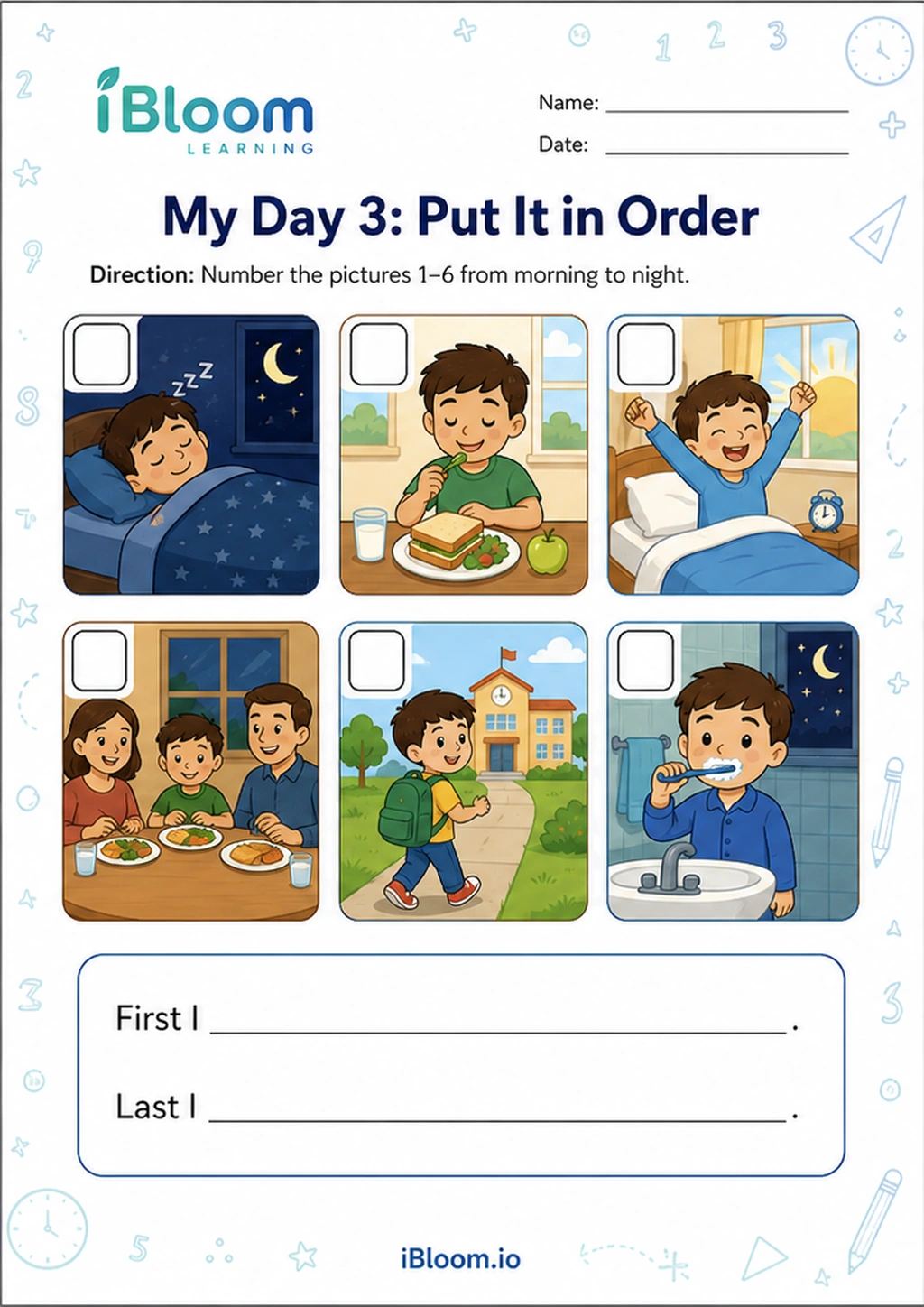 My Day 3: Put It in OrderClass 1 printable practice for morning afternoon and night using a clear, age-appropriate learning task.Class 1Free PDF preview
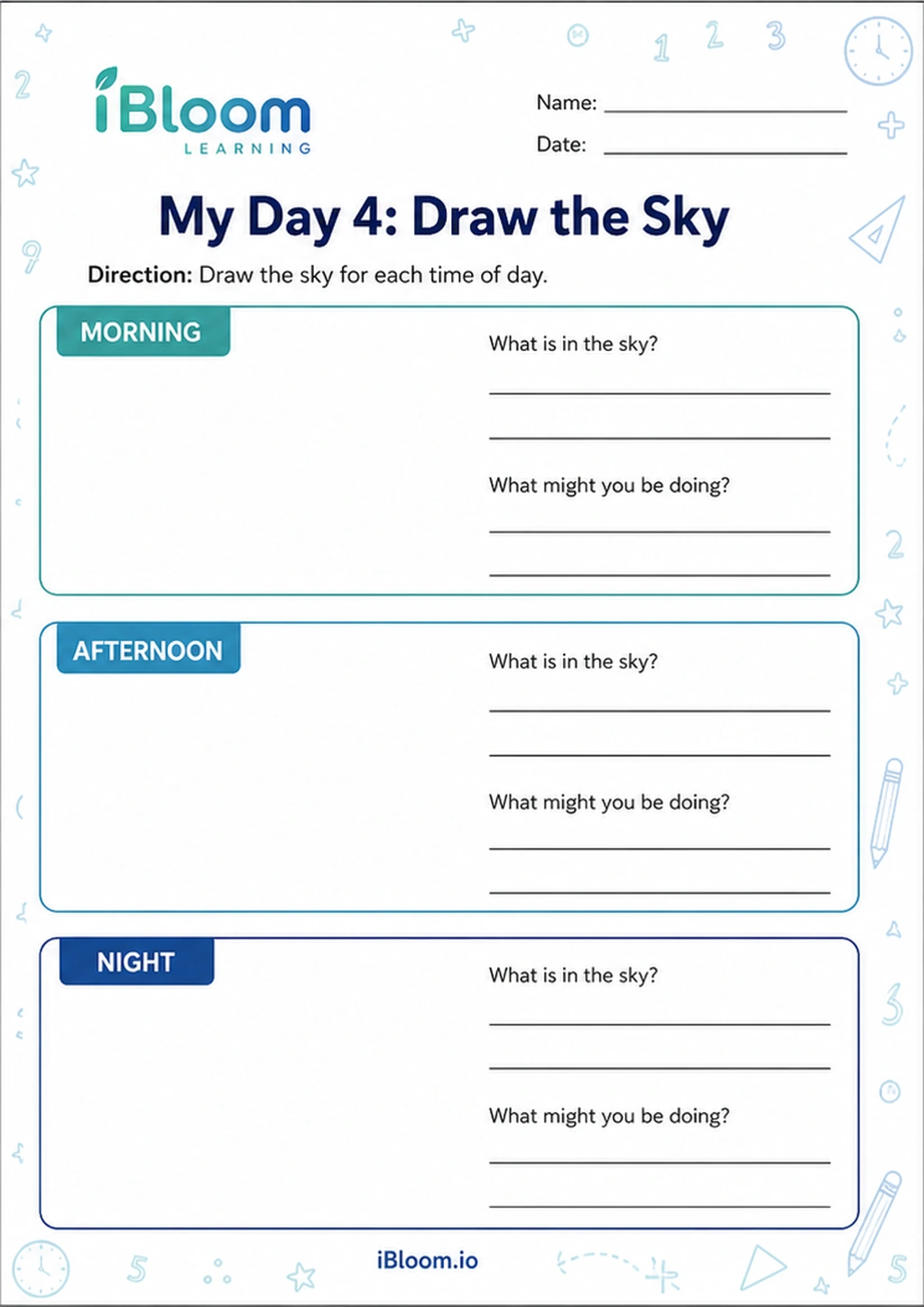 My Day 4: Draw the SkyClass 1 printable practice for morning afternoon and night using a clear, age-appropriate learning task.Class 1Free PDF preview
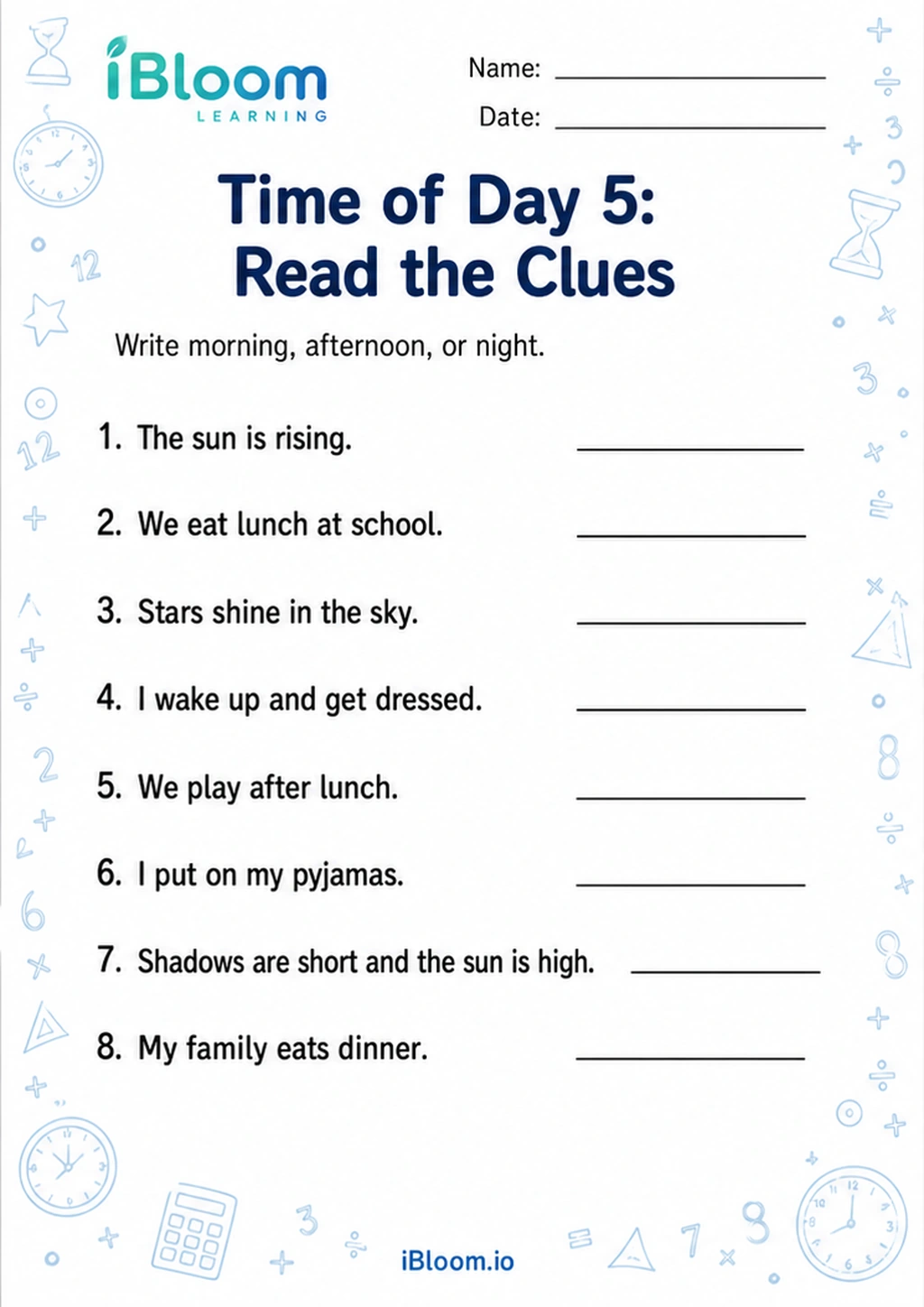 Time of Day 5: Read the CluesClass 1 printable practice for morning afternoon and night using a clear, age-appropriate learning task.Class 1Free PDF preview
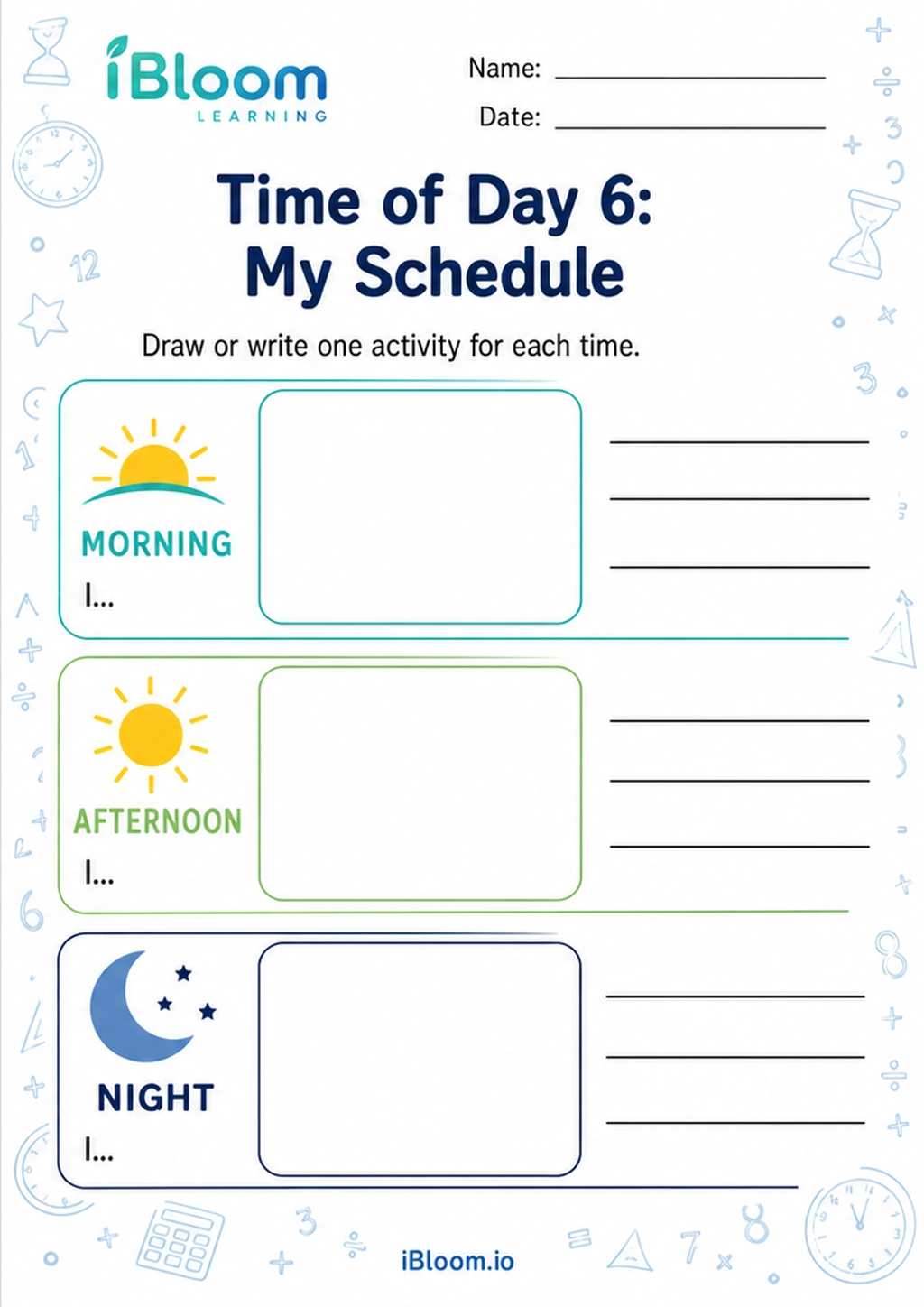 Time of Day 6: My ScheduleClass 1 printable practice for morning afternoon and night using a clear, age-appropriate learning task.Class 1Free PDF preview
 Telling Time Half Hours — Concept FoundationsConcept Foundations for telling time half hours in Class 1. Identify half past as 30 minutes, then choose and complete correct half-hour times from hand clues.Class 1Free PDF preview
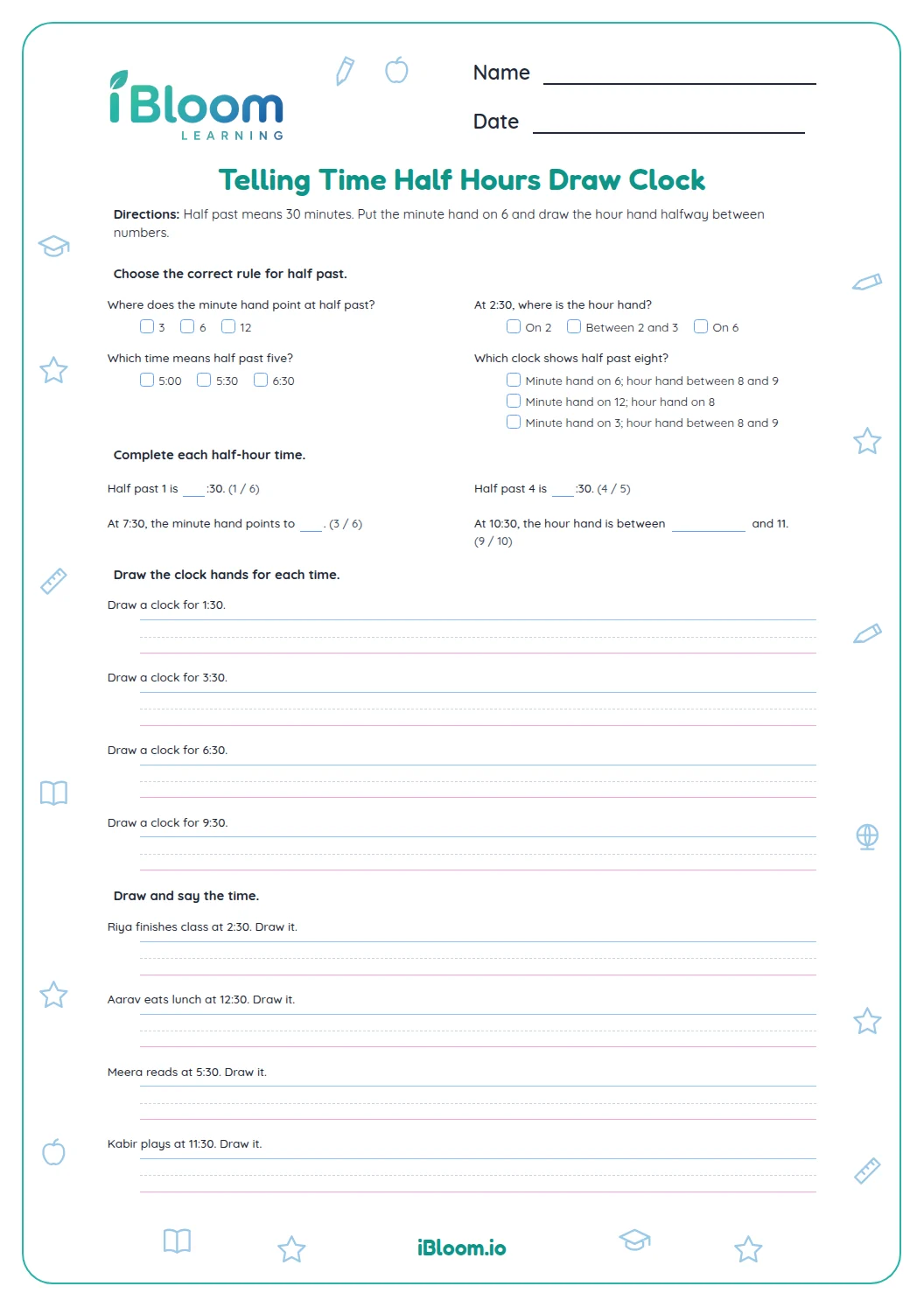 Telling Time Half Hours Draw Clock — Concept FoundationsConcept Foundations for telling time half hours draw clock in Class 1. Learn that half past means the minute hand points to 6, then draw clock hands for twelve half-hour times.Class 1Free PDF preview
 Telling Time Quarter Hours — Concept FoundationsConcept Foundations for telling time quarter hours in Class 1. Identify quarter past, half past, and quarter to times, then match digital times with words and complete time facts.Class 1Free PDF preview
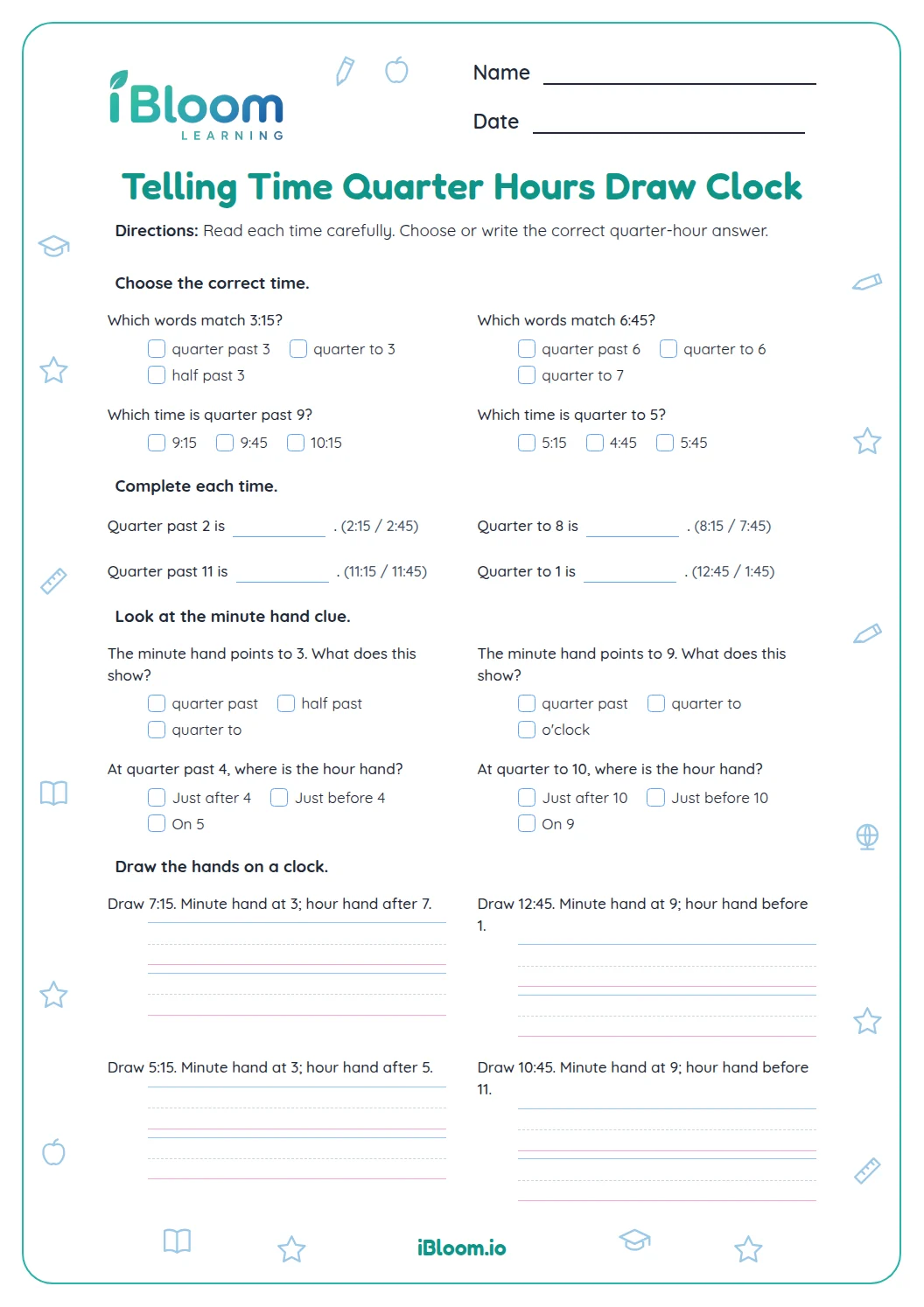 Telling Time Quarter Hours Draw Clock — Concept FoundationsConcept Foundations for telling time quarter hours draw clock in Class 1. Identify quarter past and quarter to times, then write the matching time and draw each clock hand position.Class 1Free PDF preview
 Telling Time Whole Hours — Concept FoundationsConcept Foundations for telling time whole hours in Class 1. Identify the hour hand, match whole-hour times with o’clock language, and write digital times for simple clock descriptions.Class 1Free PDF preview
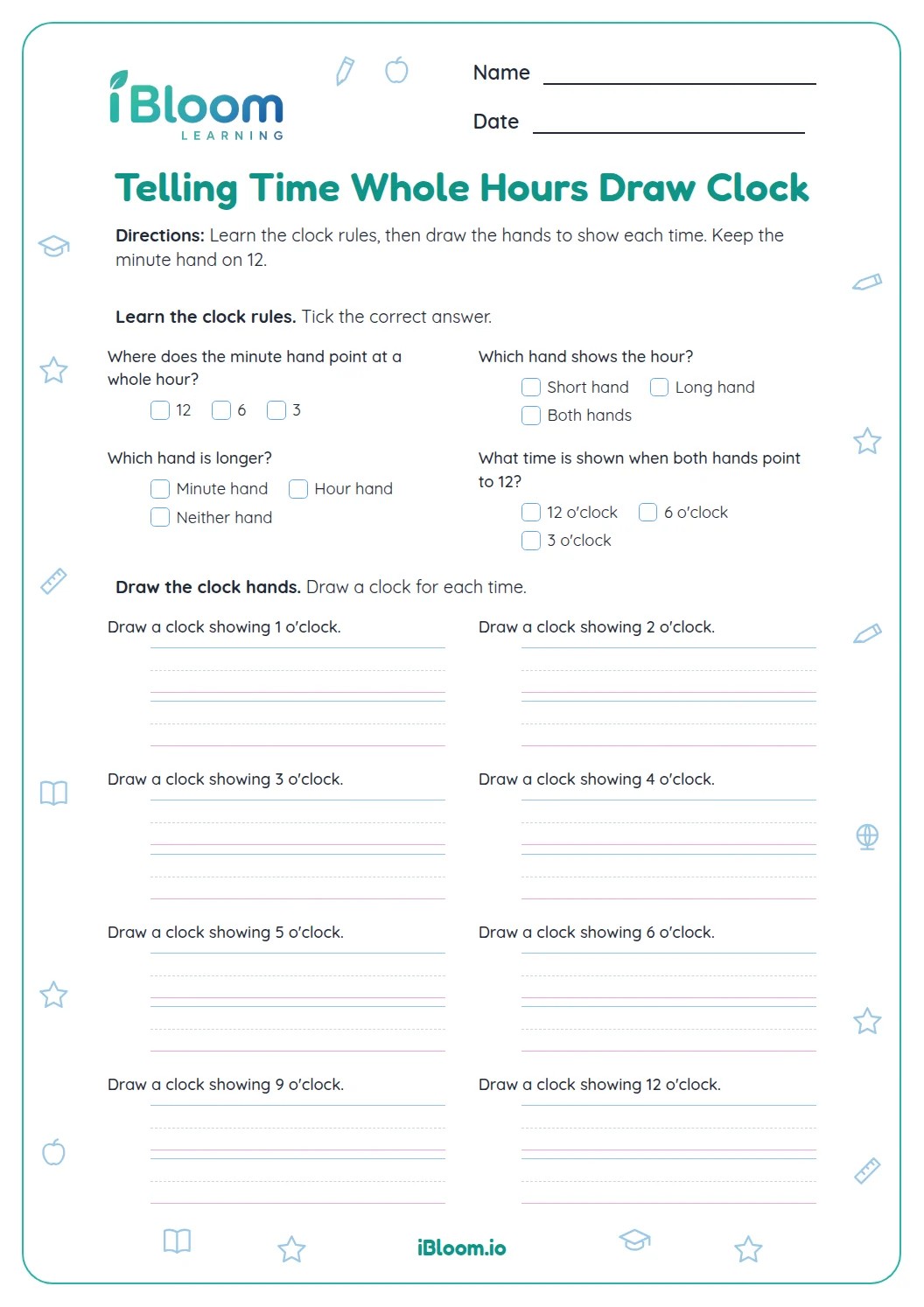 Telling Time Whole Hours Draw Clock — Concept FoundationsConcept Foundations for telling time whole hours draw clock in Class 1. Learn that whole hours use minute hand at 12, then draw hour hands for twelve o’clock times.Class 1Free PDF preview
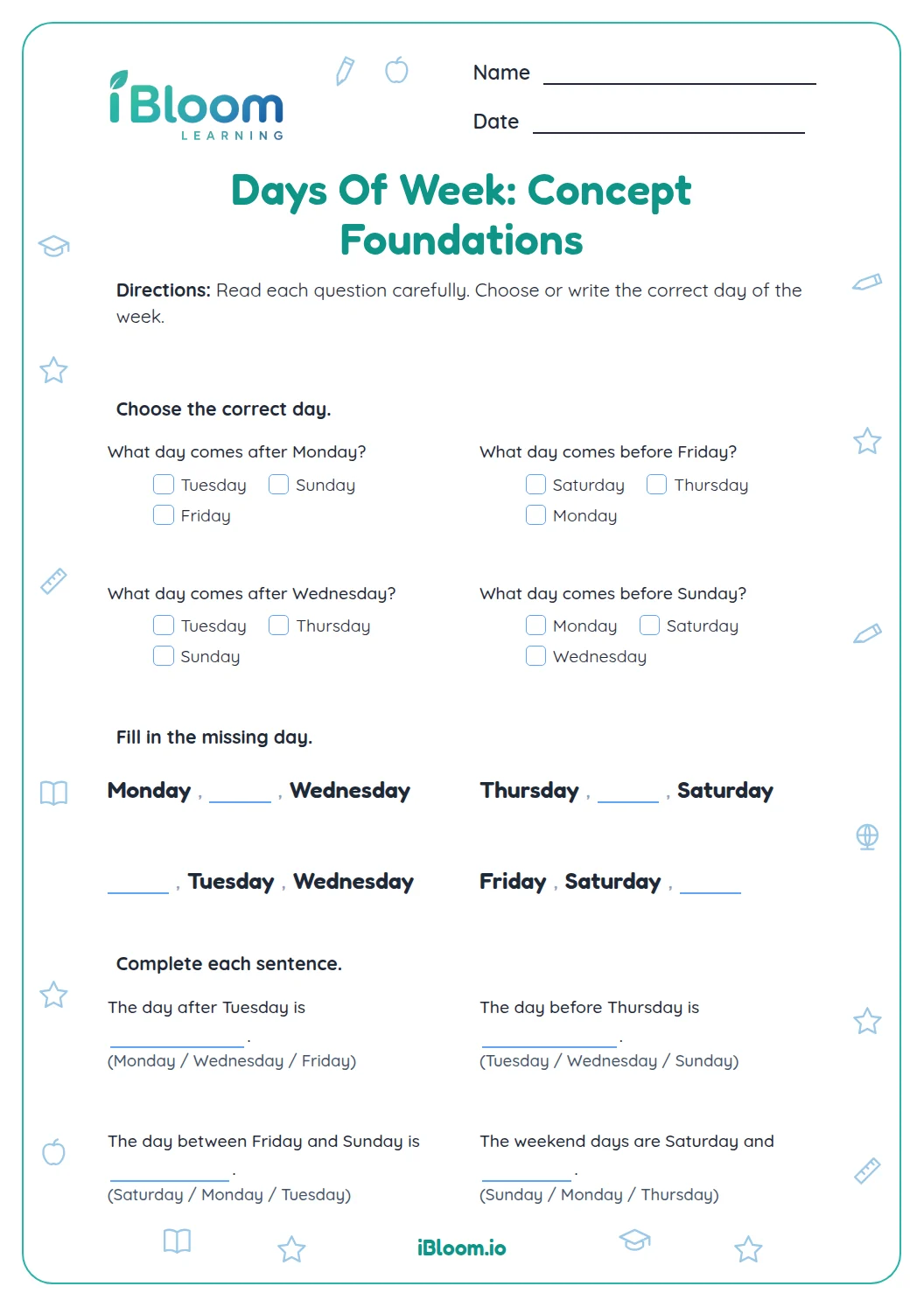 Telling Time: Days Of Week — Concept FoundationsConcept Foundations for telling time: days of week in Class 1. Name, order, and identify the day before, after, and between familiar days of the week.Class 1Free PDF preview
 Telling Time: Elapsed Time One Hour — Concept FoundationsConcept Foundations for telling time: elapsed time one hour in Class 1. Use a number line, then find one hour later and one hour earlier for o’clock times.Class 1Free PDF preview
 Telling Time: Elapsed Time X Hours — Concept FoundationsConcept Foundations for telling time: elapsed time x hours in Class 1. Read whole-hour times, count forward by the given hours, and complete elapsed-time questions.Class 1Free PDF preview
 Telling Time: Fast Slow — Concept FoundationsConcept Foundations for telling time: fast slow in Class 1. Look at familiar actions and choose whether each one is fast or slow.Class 1Free PDF preview
 Telling Time: Months Of Year — Concept FoundationsConcept Foundations for telling time: months of year in Class 1. Choose, complete, and order month names.Class 1Free PDF preview
 Telling Time: Units Of Time — Concept FoundationsConcept Foundations for telling time: units of time in Class 1. Choose and complete basic facts about seconds, minutes, hours, days, weeks, months and years.Class 1Free PDF preview
Practice that builds confidence
Building a first time vocabulary
These Class 1 telling time worksheets help children connect clock faces with everyday routines. Learners practise whole hours, half hours and quarter hours, draw clock hands, and use words such as morning, afternoon, night, fast, slow, day, week, month and hour.
The printable activities include matching, circling, drawing, sequencing and simple elapsed-time questions. Children work with analogue clocks, days of the week, months of the year, units of time and one-hour or few-hour changes in a clear, age-appropriate way.
At this stage, children need both clock skills and real-life language. Worksheets move from familiar ideas such as morning, afternoon and night to units of time like hour, day, week and month. Fast and slow comparisons help children describe duration before they calculate it.

Reading and drawing analogue clocks
The clock activities focus on whole hours first, where the minute hand points to 12 and the hour hand points to a number. Children then practise half hours and quarter hours by reading the minute hand position and drawing both hands carefully. Examples may include 4 o'clock, half past 7, quarter past 2 or quarter to 6, depending on the worksheet.
Days, months and sequence
Days of the week and months of the year are practised through ordering, missing-name and matching tasks. This helps children understand that time has a repeating pattern: days make a week, months make a year, and daily events happen in a sensible order.
A simple home routine
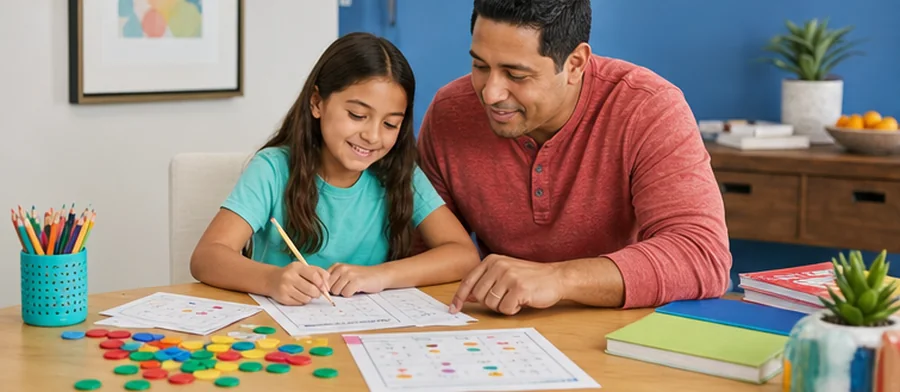
Parents can link one worksheet question to the child’s day. Ask, “What do you do in the morning?” or “If it is 5 o'clock now, what time will it be after one hour?” Use a wall clock, school timetable or calendar. Let the child move a pencil as the hour hand before writing the answer.
Classroom use and common errors
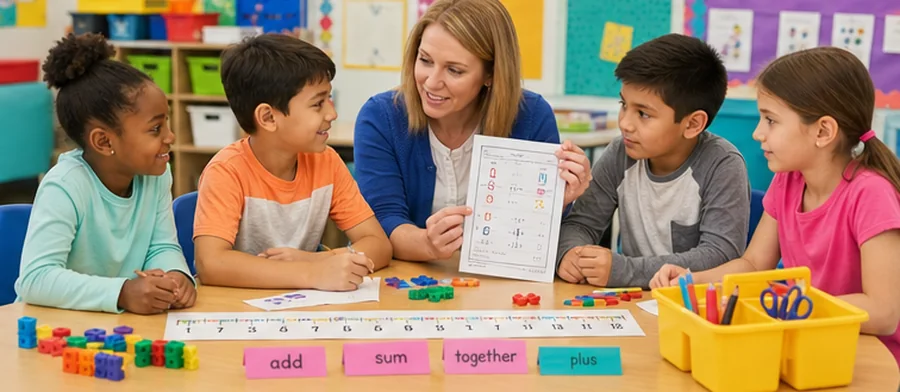
Teachers can use these pages for maths practice, calendar corners, early-finisher tasks or small-group support. Watch for reversed clock hands, placing the hour hand exactly on a number during half past, mixing up yesterday and tomorrow, and reciting months without understanding order.
Free printable PDF download
Use this Class 1 telling time worksheet page to preview the activity, print it, or download it as a PDF for quick practice. It works well for homework, homeschool lessons, tutoring, morning work, revision, and classroom centers.
Answers and answer key support
After the child completes the worksheet independently, parents and teachers can use the answer support or answer key information to check the work, review mistakes, and choose the next practice step.
Why iBloom worksheets help
The collection progresses from everyday time words to drawing and reading clocks, then to elapsed time such as one hour later or several hours later. A child-friendly strategy is: check the long hand first, name the minute part, then look where the short hand is pointing or moving. This keeps clock reading calm and visual.
Helpful answers
Frequently asked questions
What time skills are covered in these Class 1 worksheets?
They cover whole hours, half hours, quarter hours, drawing clock hands, days of the week, months of the year, morning-afternoon-night, units of time, fast and slow, and simple elapsed time.
Should children learn whole hours before half hours?
Yes. Whole hours are easier because the minute hand stays on 12. Once children understand that, they can see how the minute hand moves to 6 for half past and to 3 or 9 for quarter hours.
How can I help my child draw clock hands correctly?
Ask your child to draw the minute hand first because it shows o'clock, half past or quarter time. Then place the shorter hour hand carefully, especially between numbers for half past and quarter times.
Do these worksheets include calendar practice?
Yes. Children practise days of the week and months of the year through ordering, matching and missing-word activities so they can understand time beyond the clock.
What is a common mistake in elapsed time questions?
Many children count the starting hour as one hour. For example, from 3 o'clock to one hour later is 4 o'clock, not 3 o'clock. Moving the hour hand forward helps make this clear.
Is this Class 1 telling time worksheet free?
Yes. You can preview it for free and use the printable worksheet for home or classroom practice.
Can I download this Class 1 telling time worksheet as a PDF?
Yes. Use the worksheet download option to save a printable PDF, or print the worksheet directly from the page.
Does this Class 1 telling time worksheet include answers or an answer key?
When the activity has fixed answers, iBloom includes answer support so parents and teachers can check the completed worksheet.