Free printable practice
Adding Whole Hundreds Multiple Terms Practice Activities
Printable maths drills for adding three or more whole-hundred numbers using place value and mental addition strategies.
Free printable worksheet PDFs
Preview every available page, then download the free worksheet PDF for home, homeschool, tutoring, or classroom practice.
Preview the exact activity before downloading it.
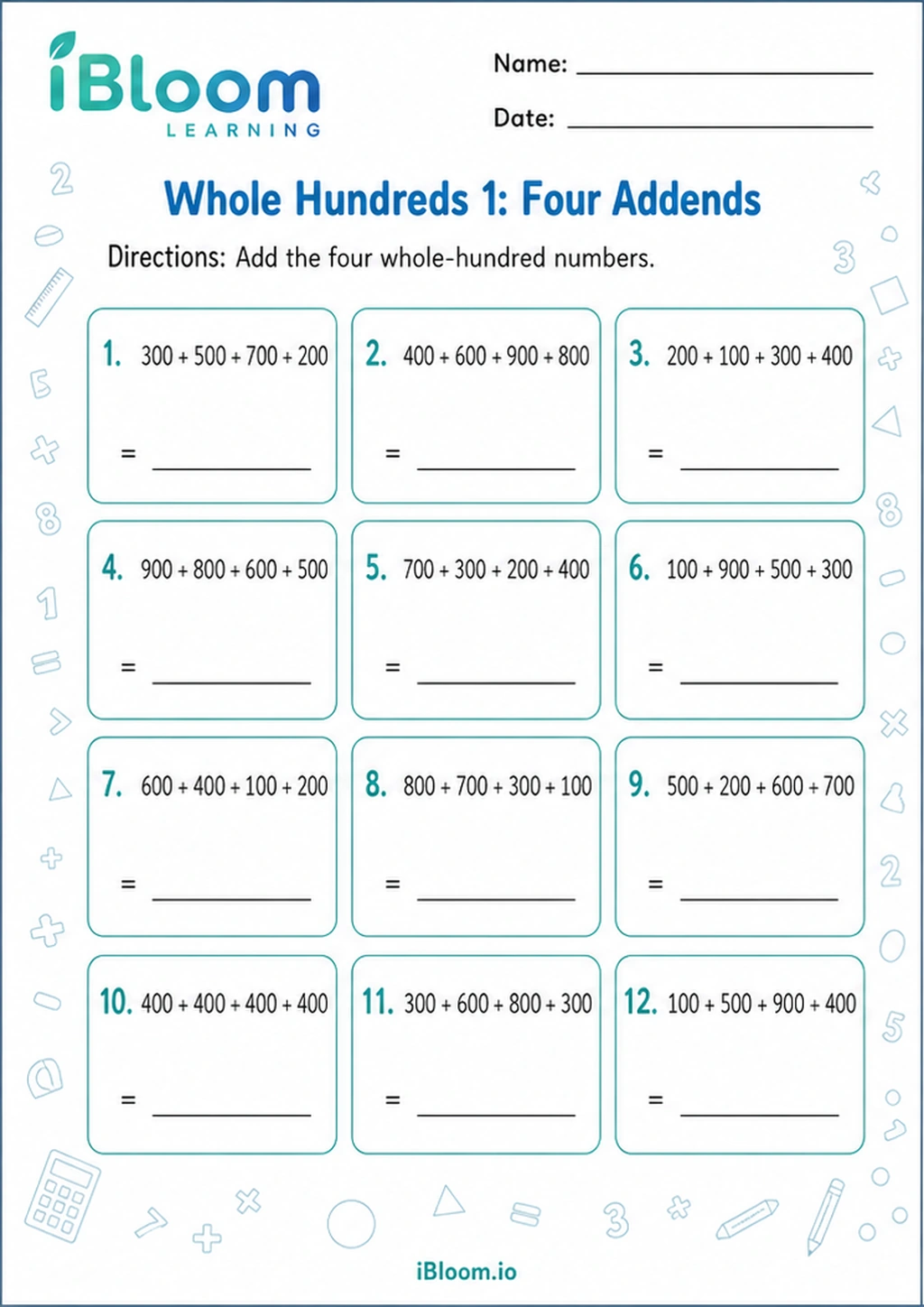 Whole Hundreds 1: Four AddendsClass 5 printable practice for Adding Multiple Whole Hundreds.Class 5Free PDF preview
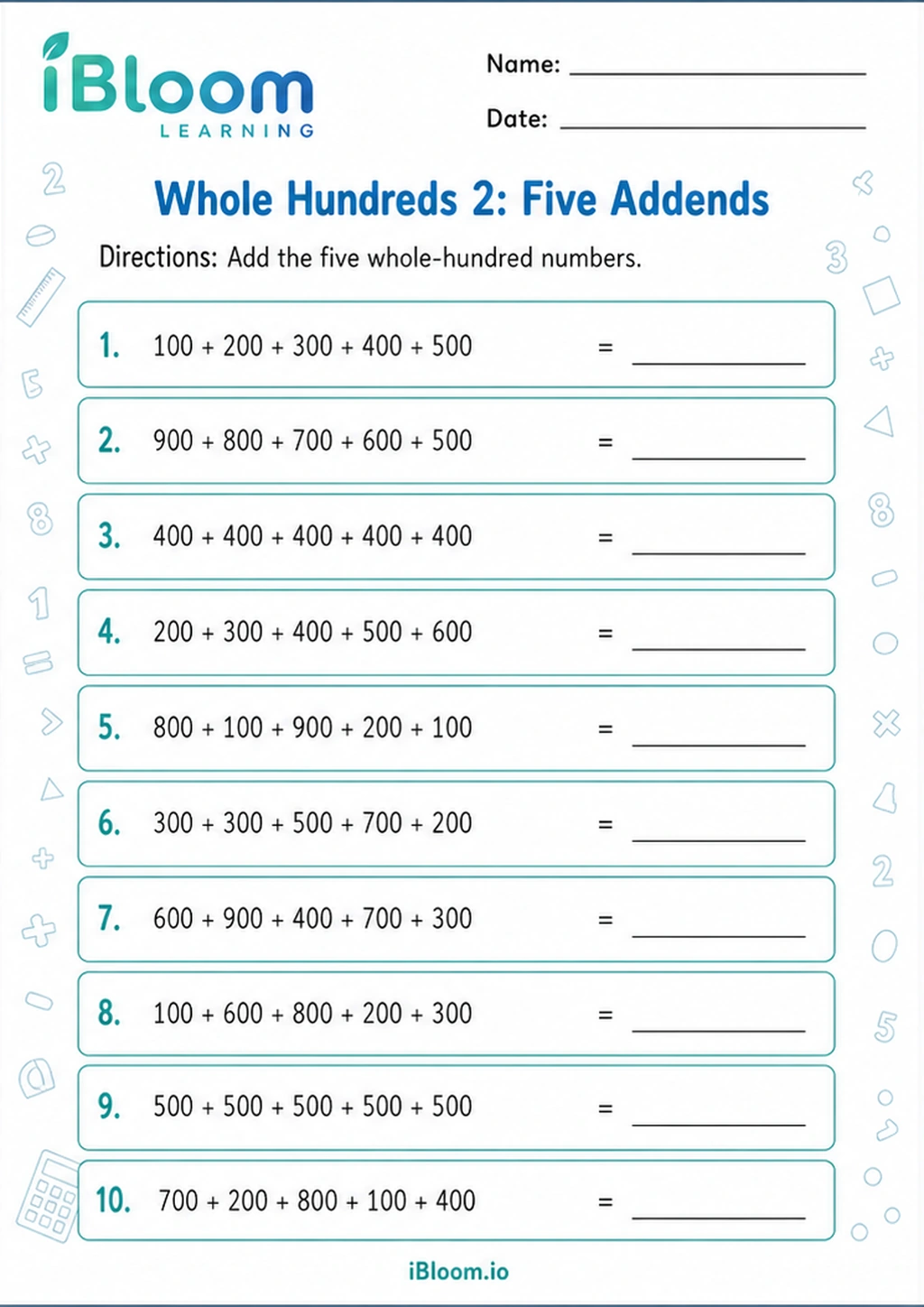 Whole Hundreds 2: Five AddendsClass 5 printable practice for Adding Multiple Whole Hundreds.Class 5Free PDF preview
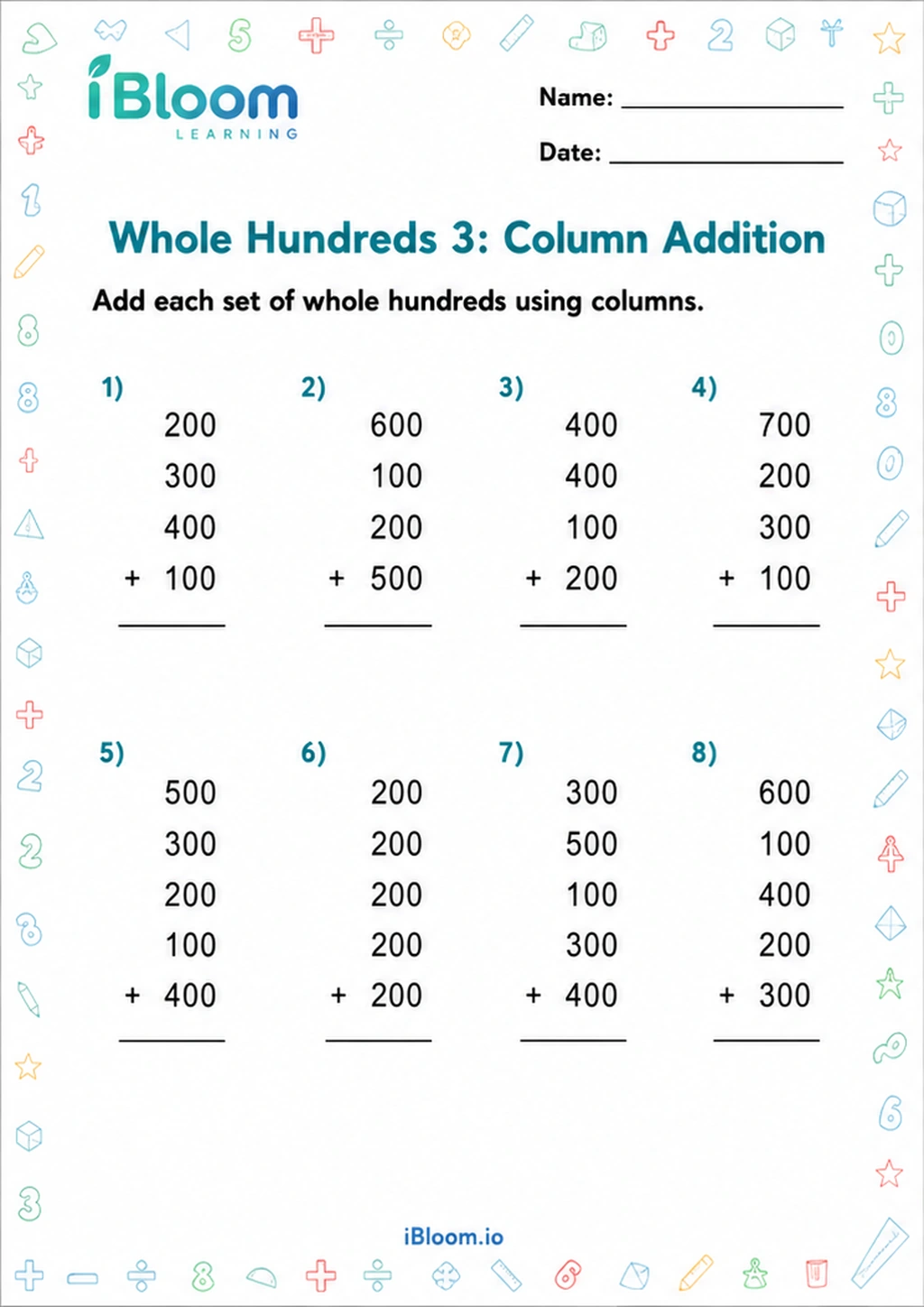 Whole Hundreds 3: Column AdditionClass 5 printable practice for Adding Multiple Whole Hundreds.Class 5Free PDF preview
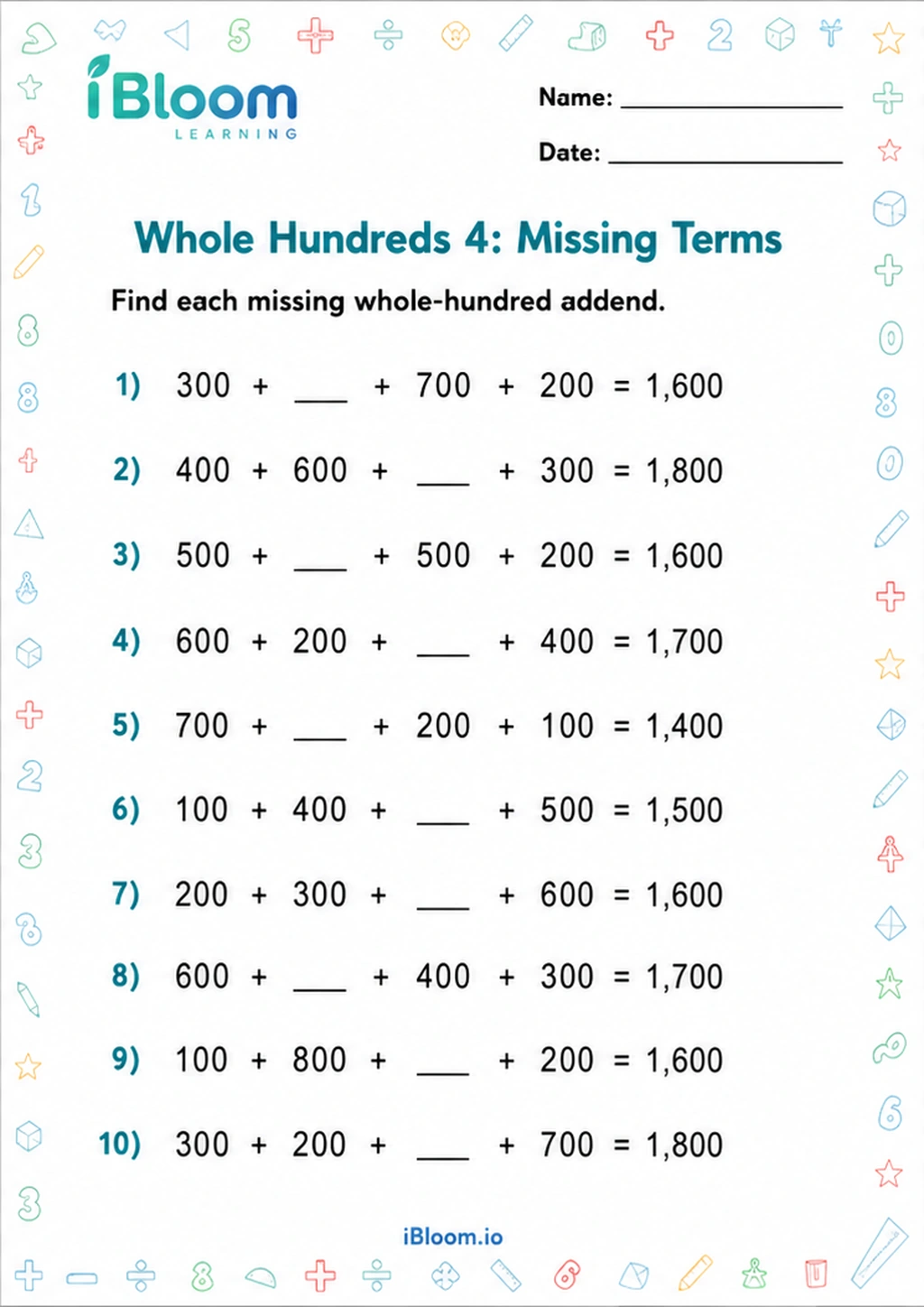 Whole Hundreds 4: Missing TermsClass 5 printable practice for Adding Multiple Whole Hundreds.Class 5Free PDF preview
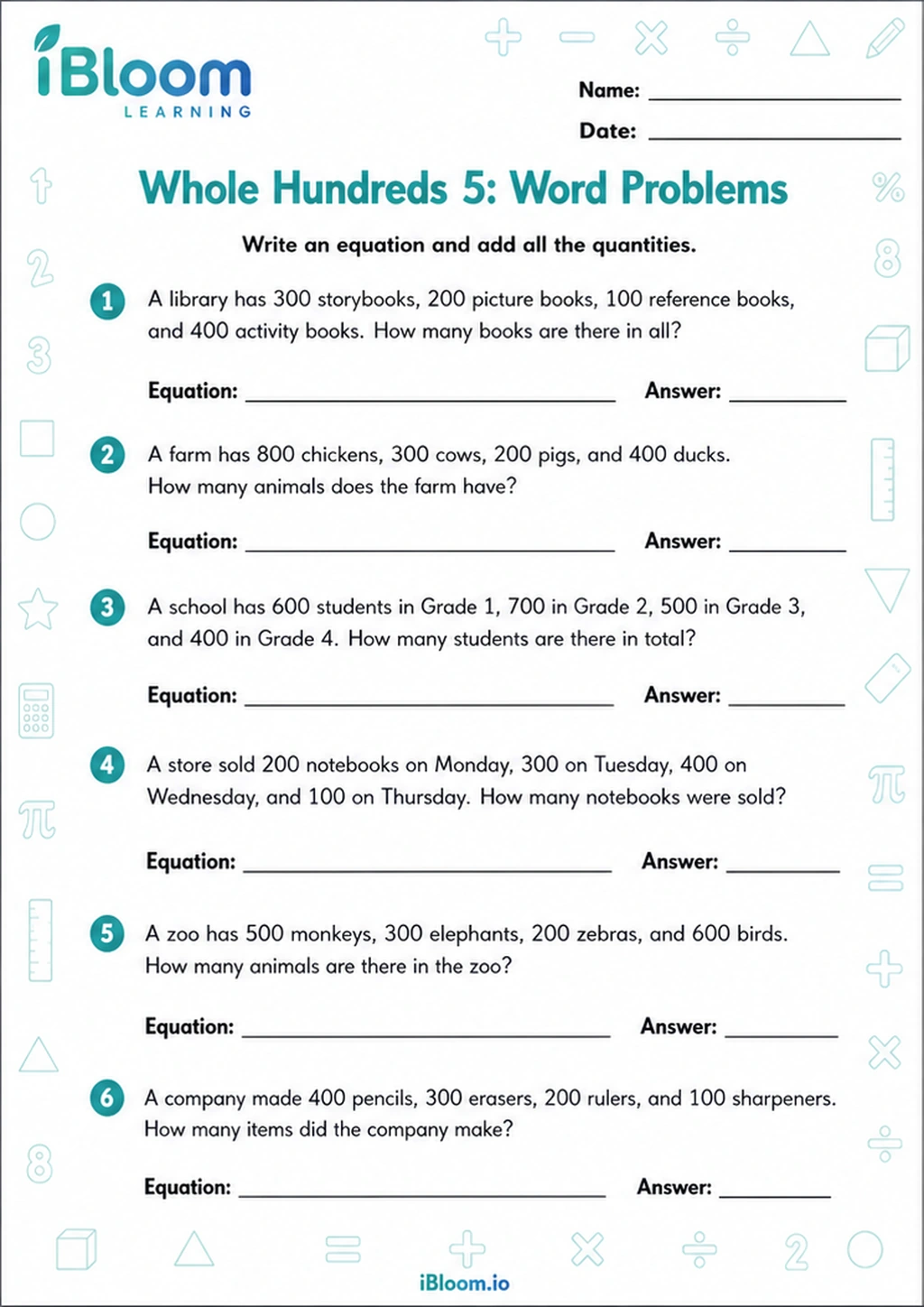 Whole Hundreds 5: Word ProblemsClass 5 printable practice for Adding Multiple Whole Hundreds.Class 5Free PDF preview
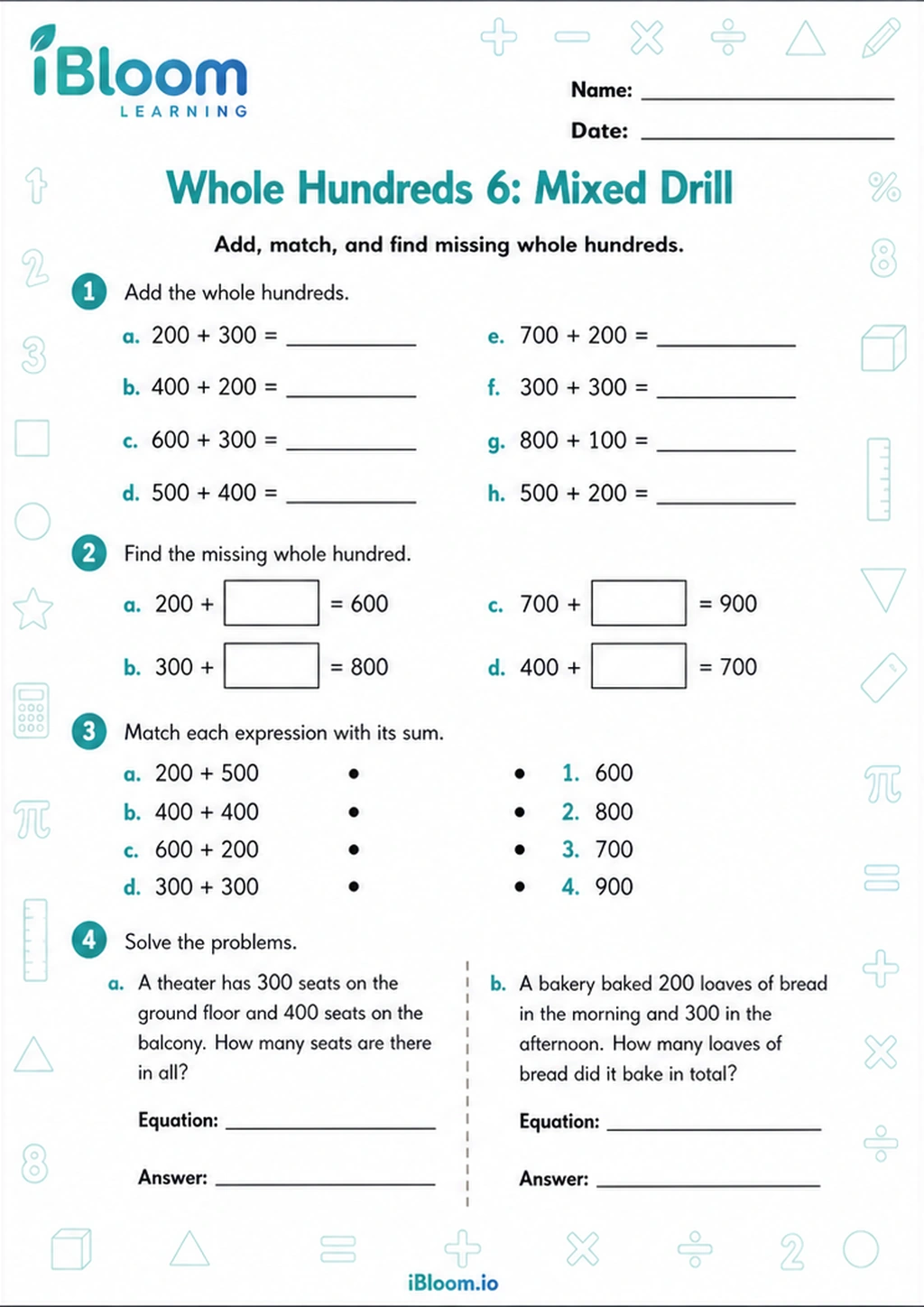 Whole Hundreds 6: Mixed DrillClass 5 printable practice for Adding Multiple Whole Hundreds.Class 5Free PDF preview
Practice that builds confidence
What this skill builds
These printable maths drills help children practise adding three or more whole-hundred numbers, such as 200 + 500 + 100. Instead of counting by ones, children use place value to combine hundreds and write the sum confidently.
The activities include horizontal and vertical addition formats, varied numbers of addends, and plenty of repeated practice. They are useful for building speed, accuracy, and comfort with larger numbers in the Mathematics > Math Drills > Addition sequence.
Adding whole hundreds with multiple terms strengthens a child’s understanding that 100, 200, 300 and similar numbers can be treated as groups of hundreds. For example, 400 + 200 + 300 becomes 4 hundreds + 2 hundreds + 3 hundreds, which is 9 hundreds, or 900. This supports mental maths, place value fluency, and later work with larger addition.

How the practice progresses
The worksheets focus on sums made from whole-hundred addends. Children may see questions written across the page, like 300 + 100 + 500, or stacked vertically. Some sets use three addends, while others may include more terms, encouraging children to keep track of the running total. Because the ones and tens places are zero, children can concentrate on combining the hundreds accurately.
Parent routine at home
Use a short, steady routine: ask your child to read the full number sentence aloud, circle the hundreds digits, add those digits, and then attach two zeros to the answer. For 200 + 600 + 100, they say “2 + 6 + 1 = 9, so the sum is 900.” After every few questions, ask them to explain one answer in words, not just write the number.

Classroom uses for teachers
Teachers can use these pages as warm-up drills, revision sheets, maths centre tasks, or quick checks after a lesson on place value addition. They also work well for pair practice: one learner solves while the other checks the hundreds count. The format makes it easy to spot whether a child understands the concept or is relying on slow counting.

Common errors to watch for
Some children add only the first two addends and forget the remaining terms. Others write 9 instead of 900 after adding the hundreds digits, or add extra zeros. In vertical problems, misalignment can also cause confusion. Encourage children to mark each addend once it has been included and to check that the final answer is still a whole hundred.
Free printable PDF download
Use this adding whole hundreds multiple terms worksheet page to preview the activity, print it, or download it as a PDF for quick practice. It works well for homework, homeschool lessons, tutoring, morning work, revision, and classroom centers.
Answers and answer key support
After the child completes the worksheet independently, parents and teachers can use the answer support or answer key information to check the work, review mistakes, and choose the next practice step.
Why iBloom worksheets help
These iBloom worksheets give focused practice without mixing in unrelated addition skills too early. The repeated whole-hundred structure helps children notice patterns, use vocabulary such as addend and sum, and build confidence before moving to mixed hundreds, tens, and ones. A child-friendly strategy is: “Add the hundreds first, then give the answer its two zeros.”
Helpful answers
Frequently asked questions
What does adding whole hundreds with multiple terms mean?
It means adding three or more numbers that are exact hundreds, such as 100, 300, 600, or 900. Children combine the hundreds and write the final sum as a whole-hundred number.
How should my child solve 400 + 200 + 100?
They can add the hundreds digits first: 4 + 2 + 1 = 7. Then they write the number as 700 because the addends are whole hundreds.
Why do these worksheets use numbers ending in two zeros?
Numbers ending in two zeros let children focus on place value. They learn that 300 means 3 hundreds, so addition becomes a matter of combining groups of hundreds.
What mistakes are common in this topic?
Children may forget one of the addends, write only the hundreds digit as the answer, or add too many zeros. Marking each term after adding it can help prevent these errors.
Can these worksheets be used for mental maths practice?
Yes. Since the tens and ones places are zero, children can practise adding the hundreds mentally and then writing the full sum.
Is this adding whole hundreds multiple terms worksheet free?
Yes. You can preview it for free and use the printable worksheet for home or classroom practice.
Can I download this adding whole hundreds multiple terms worksheet as a PDF?
Yes. Use the worksheet download option to save a printable PDF, or print the worksheet directly from the page.
Does this adding whole hundreds multiple terms worksheet include answers or an answer key?
When the activity has fixed answers, iBloom includes answer support so parents and teachers can check the completed worksheet.