Free printable practice
Counting Practice Activities
Printable preschool and kindergarten counting worksheets for number recognition, counting objects, ten frames, missing numbers, and early skip counting.
Explore Counting
Free printable worksheet PDFs
Preview every available page, then download the free worksheet PDF for home, homeschool, tutoring, or classroom practice.
Preview the exact activity before downloading it.
Practice that builds confidence
Building counting from real quantities
These counting practice activities help preschool and kindergarten children build early number sense through hands-on printable tasks. Children count objects, match quantities to numerals, trace small numbers, compare 1 more and 1 less, and notice what comes before, after, or between numbers.
The collection includes count-and-color pages, count-and-cross-out activities, ten frames, number lines, missing numbers, counting to 5 and 10, counting to 100, counting backward, tens and ones, and skip counting by 2s and 10s. The worksheets move from concrete pictures to written numbers so children can connect what they see, say, and write.
Young learners first need to understand that each object gets one number word and that the last number tells how many. These worksheets support that idea with groups of objects to count, match, draw, color, or cross out. Pages such as counting to 5, counting to 10 objects, and count-match to ten keep quantities small enough for children to check carefully.

Moving from numbers to sequences
Once children can count groups, they begin working with the order of numbers. Missing number, before and after, between, number recognition, and count backward pages help children hear and see the sequence. Counting to 100 and before/after 100 activities extend the same skill to larger numbers, while number line practice gives a visual path for counting forward and back.
Ten frames, tens, ones, and skip counting
Ten frames help children see numbers as full and partial groups of ten instead of only as separate items. Tens and ones pages introduce the idea that larger numbers can be built from groups. Skip counting by 2s and 10s gives children early practice with patterns they will use later for addition, place value, and multiplication readiness.
A simple parent routine
Choose one worksheet that fits your child’s current range, such as counting to 5, counting to 10, or numbers to 100. Ask your child to touch each object while saying the number aloud, then circle or write the matching numeral. After the page, make a quick real-life connection: count crayons, steps, snacks, or toy cars. If your child loses track, have them line up the items or mark each one after counting.

Classroom uses for teachers
Teachers can use these pages for morning work, math centers, small-group practice, early finisher bins, or quick checks after a counting lesson. Count-and-color and count-and-cross-out pages work well for independent practice, while ten frames and number lines are useful for teacher-led questioning: “How do you know?” “What comes next?” “What is one less?”

Free printable PDF download
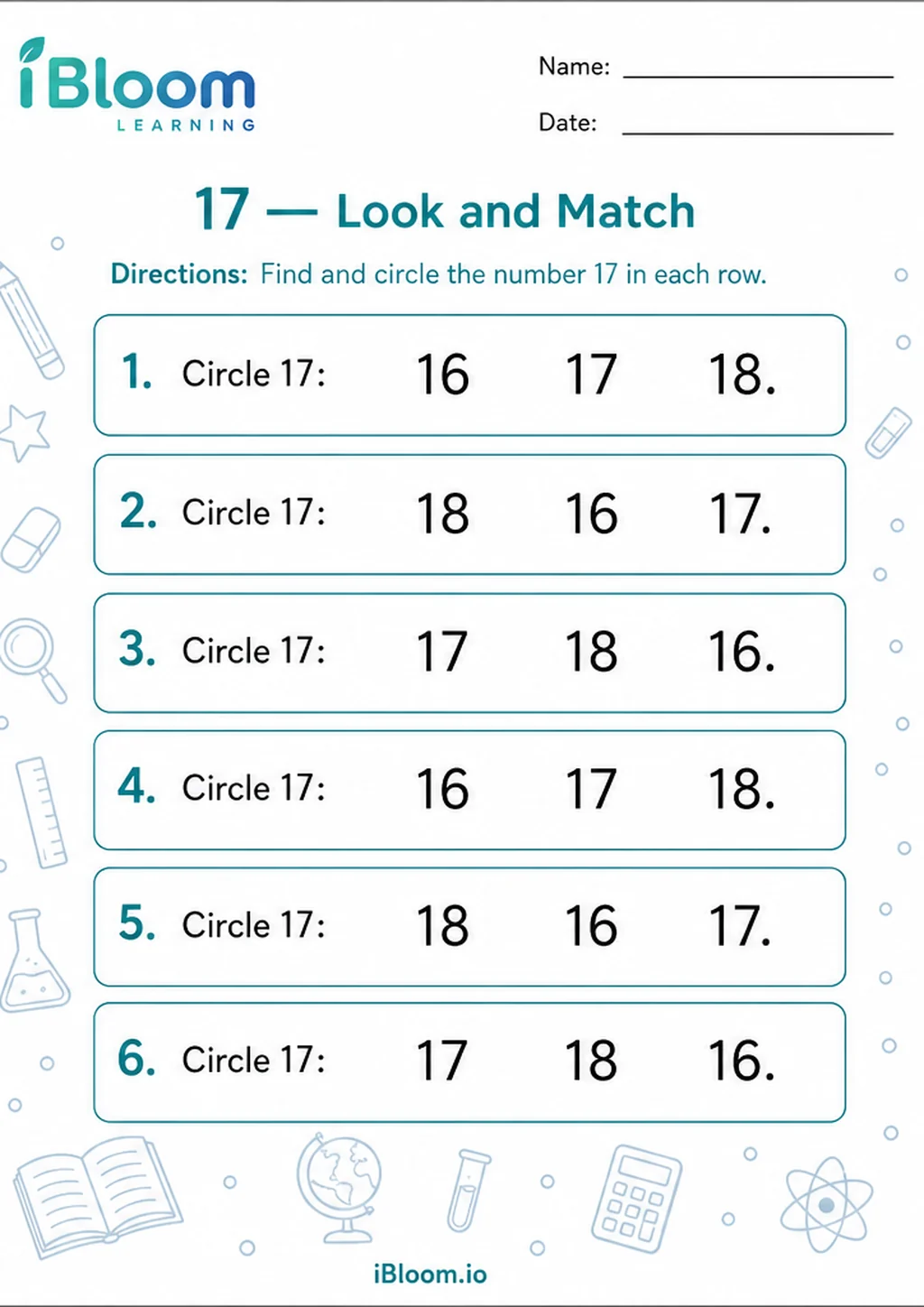
Use this counting worksheets for preschool and kindergarten page to preview the activity, print it, or download it as a PDF for quick practice. It works well for homework, homeschool lessons, tutoring, morning work, revision, and classroom centers.
Answers and answer key support
After the child completes the worksheet independently, parents and teachers can use the answer support or answer key information to check the work, review mistakes, and choose the next practice step.
Why iBloom worksheets help
The activities are focused by skill, so children can practise one counting idea without unnecessary distractions. A child-friendly strategy is: touch, say, mark, check. Touch each item, say the number, mark it by coloring or crossing out, then check that the final number matches the written answer. Watch for common errors such as skipping objects, counting one object twice, reversing numerals, or reciting numbers correctly without matching them to the objects.
Helpful answers
Frequently asked questions
What counting skills do these worksheets cover?
They cover counting objects, matching quantities to numbers, number recognition, missing numbers, before and after, between numbers, ten frames, number lines, counting backward, tens and ones, and skip counting by 2s and 10s.
Are these worksheets better for preschool or kindergarten?
Both can use them. Preschool children can start with counting to 5, tracing, and matching small groups, while kindergarten children can work on counting to 10, counting to 100, number lines, ten frames, and 1 more or 1 less.
How can I help my child stop skipping objects while counting?
Encourage your child to touch or mark each object as they say a number word. Count slowly from left to right or top to bottom, then check by counting the marked items again.
Why are ten frames included in counting practice?
Ten frames help children see numbers in relation to 10. This supports quick recognition of small quantities and prepares children for place value, addition, and comparing numbers.
When should a child try counting to 100 worksheets?
A child is ready when they can count smaller ranges with confidence and understand that numbers follow a stable order. Start with short sections of the 100 sequence before using full counting-to-100 pages.
Is this counting worksheets for preschool and kindergarten free?
Yes. You can preview it for free and use the printable worksheet for home or classroom practice.
Can I download this counting worksheets for preschool and kindergarten as a PDF?
Yes. Use the worksheet download option to save a printable PDF, or print the worksheet directly from the page.
Does this counting worksheets for preschool and kindergarten include answers or an answer key?
When the activity has fixed answers, iBloom includes answer support so parents and teachers can check the completed worksheet.