Free printable practice
Number Recognition Practice Activities
Printable preschool and kindergarten number recognition worksheets for identifying, reading, matching, and writing numbers 1 through 20.
Explore Number Recognition
Free printable worksheet PDFs
Preview every available page, then download the free worksheet PDF for home, homeschool, tutoring, or classroom practice.
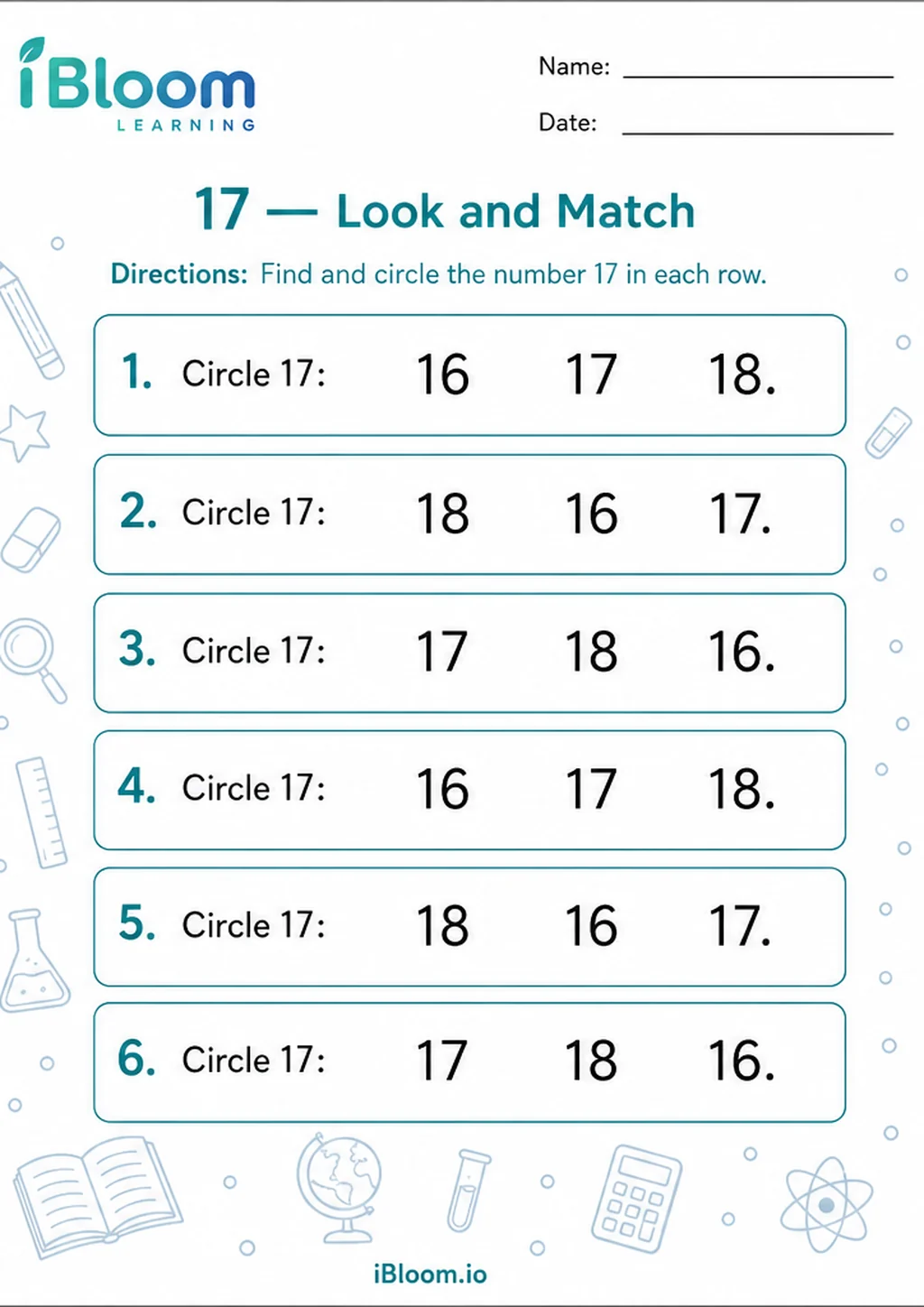
Preview the exact activity before downloading it.
Practice that builds confidence
Building recognition from 1 to 20
These preschool and kindergarten counting worksheets help children recognize the written numerals 1 through 20. Learners practise looking closely at number shapes, naming each numeral, and connecting the symbol to counting words they hear and say.
The printable activities include number-focused practice for 1, 2, 3, and onward through 20, with tasks such as finding a target number, matching numerals, tracing, circling, and choosing the correct number from a small group.
Number recognition is the bridge between oral counting and written maths. In this Preschool and Kindergarten > Counting > Number Recognition collection, children meet each numeral as its own visual symbol, from familiar early numbers like 1, 2, and 3 to teen numbers such as 13, 16, 18, and 20. The focus is not speed; it is accurate noticing, naming, and remembering.

What children practise on the page
The worksheets use repeated, clear encounters with one number or a small set of numbers. Children may identify 7 among other numerals, match 14 to another 14, trace 5, or circle 19 when it appears in a row. This helps them learn that a number keeps its identity even when its size, position, or surrounding numbers change.
A simple routine for parents
Choose one number page at a time. First, point to the numeral and say its name together: “This is 12.” Next, ask your child to trace it in the air, then find it on the worksheet. After the page, look for the same number in daily life—on a calendar, door, clock, book page, or package. Keep the routine playful and stop before guessing turns into frustration.

Classroom uses for teachers
Teachers can use these printables for morning tubs, small-group counting support, independent practice, or math centers. A page on 6 can reinforce a number introduced during calendar time, while pages for 11 through 20 can support children who can count aloud but still confuse teen numerals. The single-number topics also make it easy to choose targeted review.

Common errors to watch for
Some children reverse numerals such as 2, 3, 5, or 7, or mix up visually similar teen numbers like 12 and 17. Others can chant “one to twenty” but cannot point to a requested numeral. Encourage slow looking: straight lines, curves, and the order of digits matter. For 10 through 20, remind children to look at both digits, not just the first one.
Free printable PDF download
Use this number recognition worksheets preschool kindergarten page to preview the activity, print it, or download it as a PDF for quick practice. It works well for homework, homeschool lessons, tutoring, morning work, revision, and classroom centers.
Answers and answer key support
After the child completes the worksheet independently, parents and teachers can use the answer support or answer key information to check the work, review mistakes, and choose the next practice step.
Why iBloom worksheets help
The collection breaks number recognition into focused, printable steps instead of crowding too many demands onto one page. Children get repeated exposure to each numeral, and adults can select exactly the number that needs practice. A child-friendly strategy is “say it, trace it, find it”: say the number name, trace its shape with a finger, then find the matching numeral on the page.
Helpful answers
Frequently asked questions
What numbers are included in this number recognition collection?
The collection covers individual practice for numbers 1 through 20, including early numerals like 1, 2, and 3 as well as teen numbers such as 13, 17, 18, 19, and 20.
How is number recognition different from counting objects?
Number recognition means a child can identify the written numeral, such as seeing 8 and saying “eight.” Counting objects means matching number words to a set of items. Both skills support each other, but they are not the same.
My child can count to 20 but cannot recognize all the numbers. Is that normal?
Yes. Many preschool and kindergarten children learn the counting sequence before they can identify every written numeral. Focused practice with one number at a time helps connect the spoken word to the printed symbol.
Which numbers are commonly confused by young learners?
Children often reverse or mix up 2, 3, 5, and 7. Teen numbers can also be confusing because 12, 13, 17, and 19 all require children to notice both digits carefully.
How can I use these worksheets without making practice feel repetitive?
Use a short routine: say the number, trace it with a finger, complete part of the worksheet, then find the same number somewhere in the room. Changing the setting keeps the recognition practice meaningful.
Is this number recognition worksheets preschool kindergarten free?
Yes. You can preview it for free and use the printable worksheet for home or classroom practice.
Can I download this number recognition worksheets preschool kindergarten as a PDF?
Yes. Use the worksheet download option to save a printable PDF, or print the worksheet directly from the page.
Does this number recognition worksheets preschool kindergarten include answers or an answer key?
When the activity has fixed answers, iBloom includes answer support so parents and teachers can check the completed worksheet.