



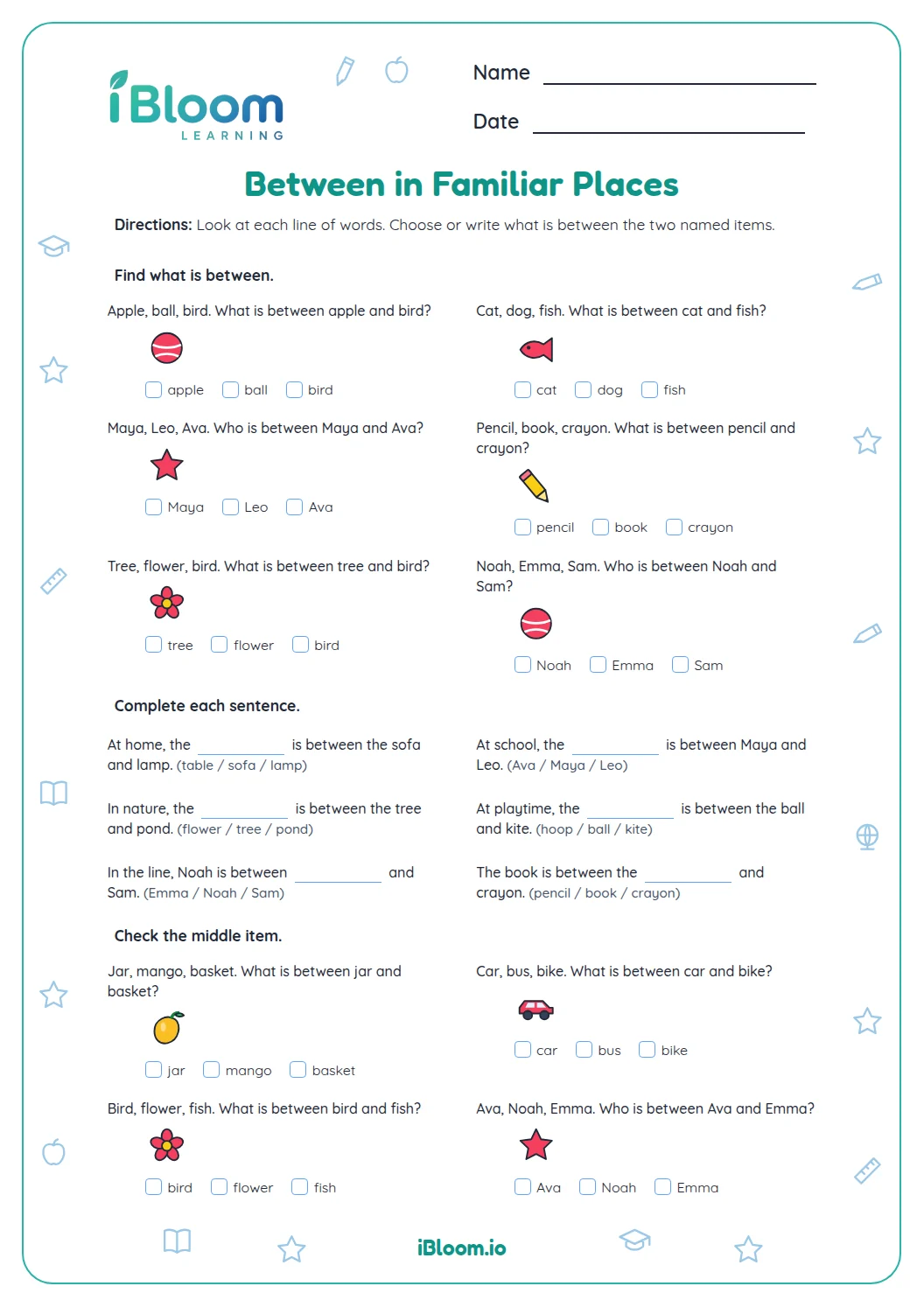
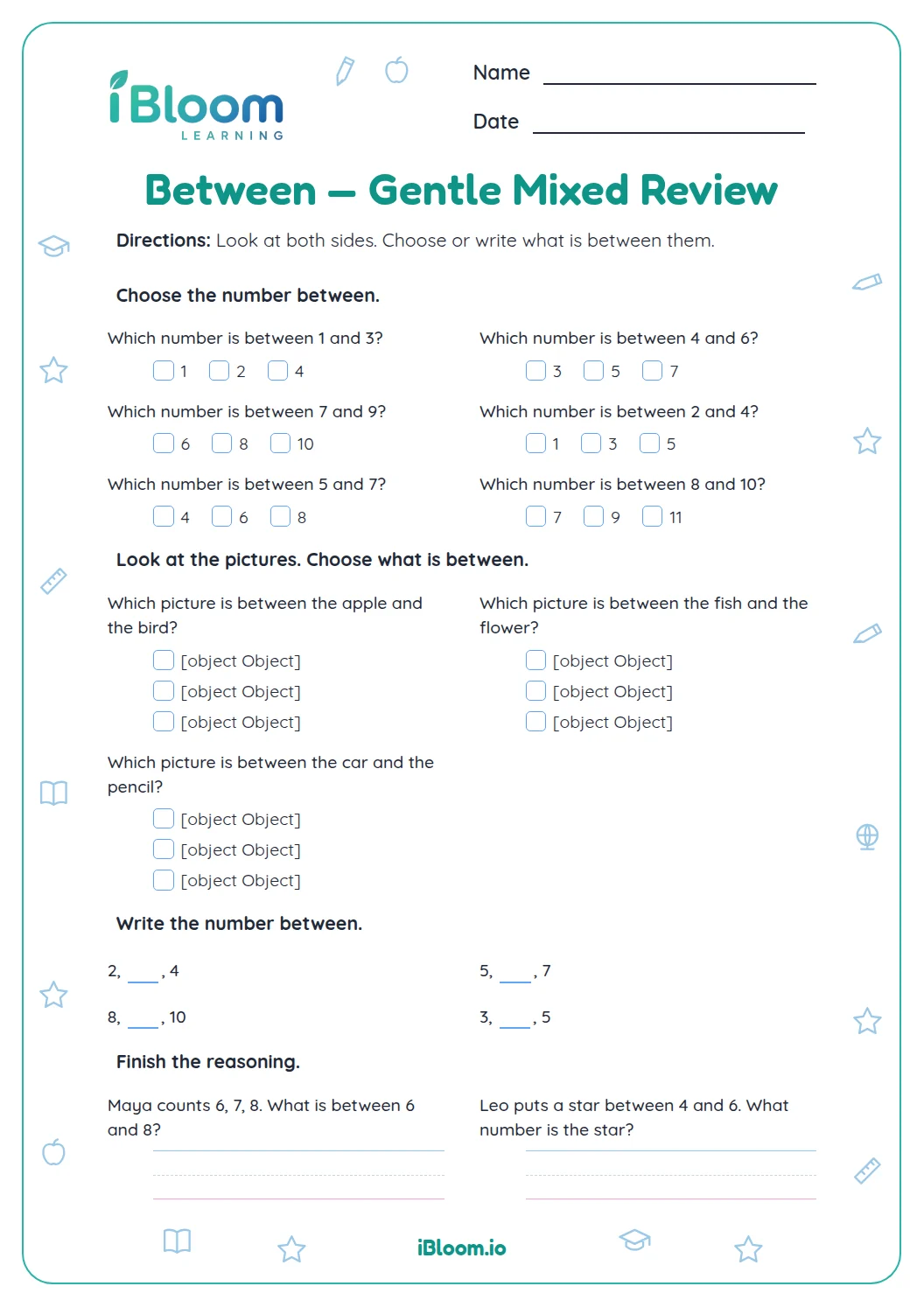
About this worksheet
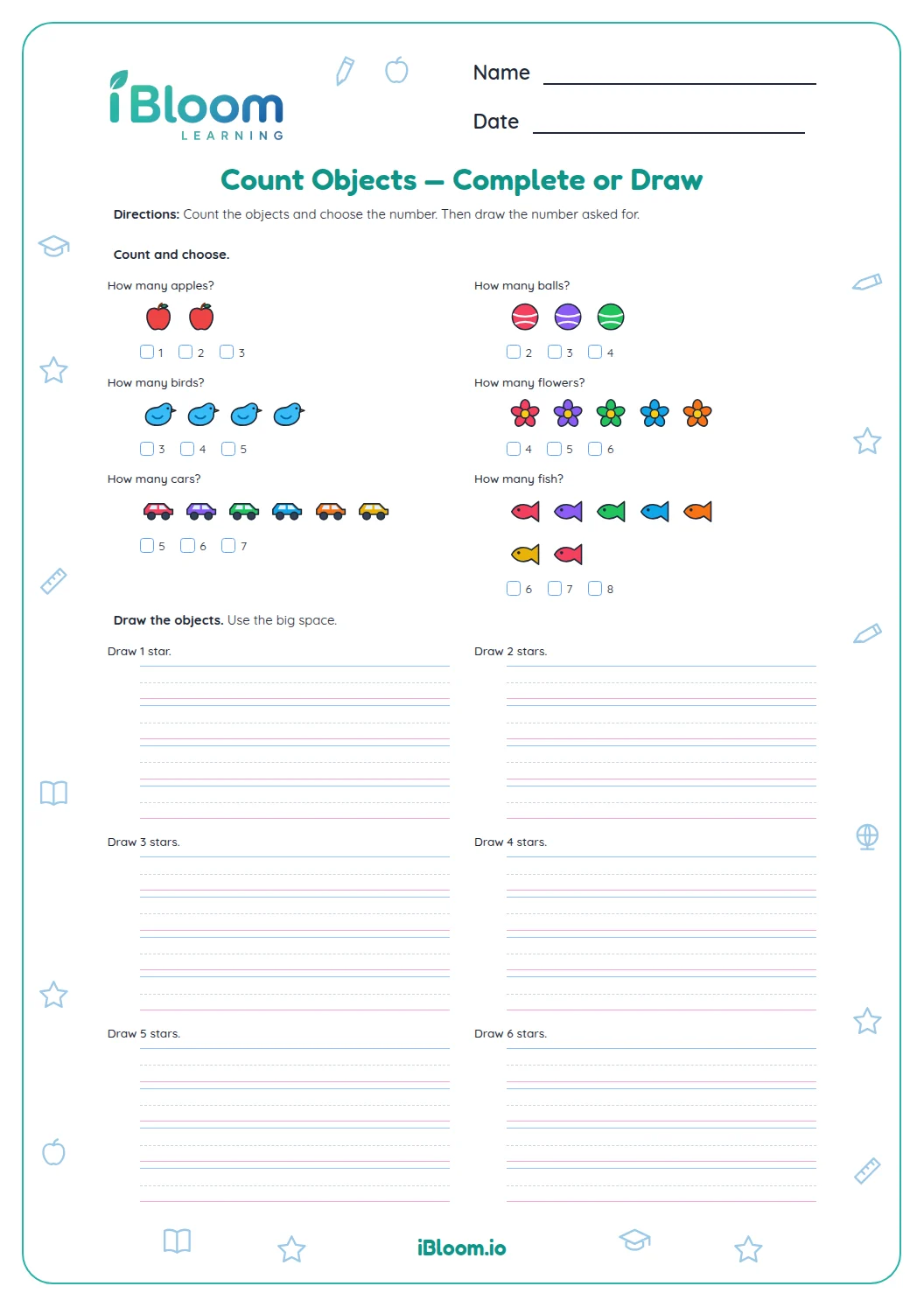
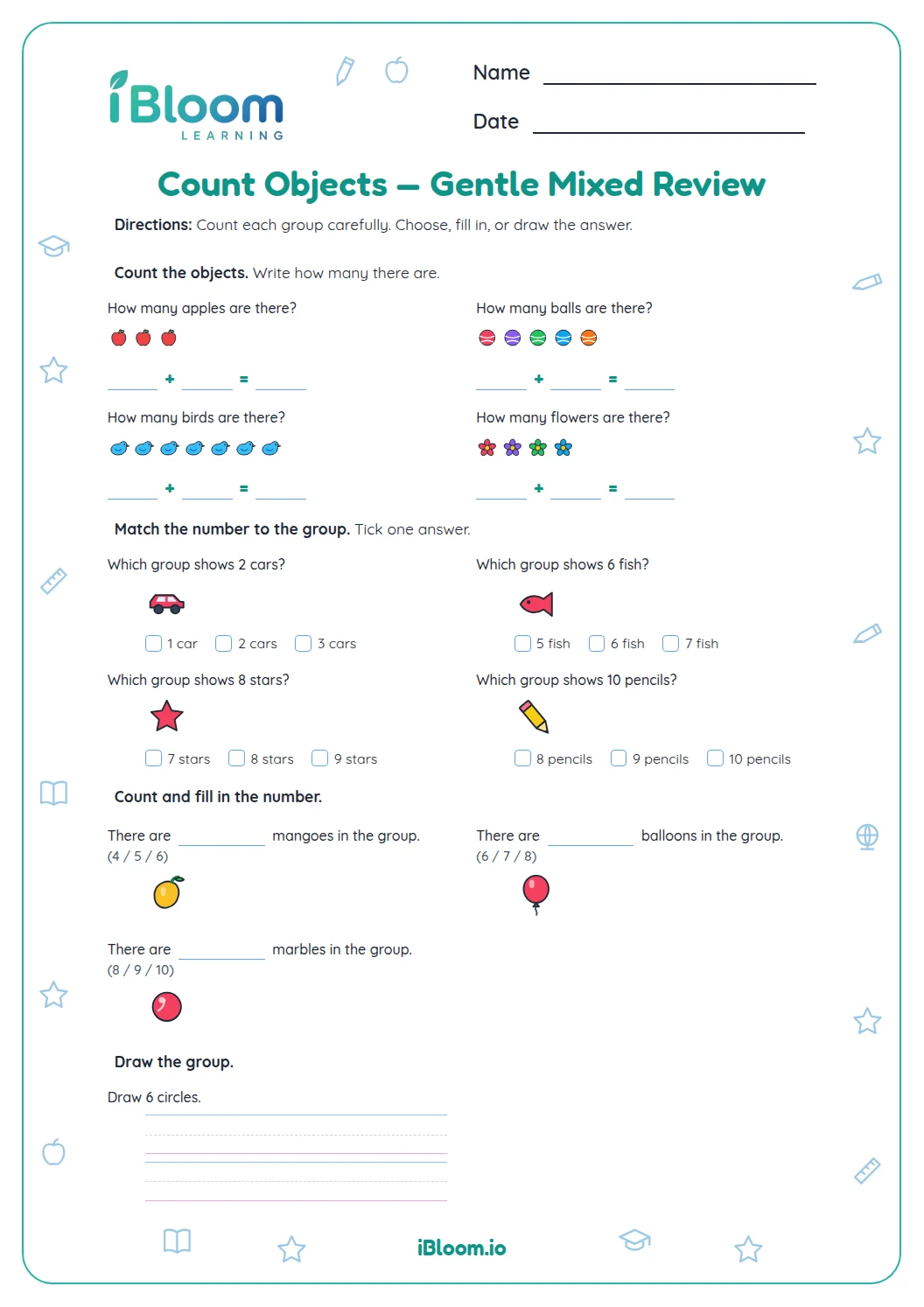
This picture-based printable gives Preschool–Kindergarten learners practice counting objects and matching each group to a number. Children count familiar items such as balls, birds, flowers, pencils, cars, fish, apples, balloons, and cookies. There are 14 questions across three pages, including picture choices and familiar-context counts, plus a separate three-page answer key. The questions practice the “how many?” counting skill in Common Core K.CC.B.5.
Aligned to K.CC.B.5
How can learners work through counting pictured objects in familiar contexts?
This picture-based printable gives Preschool–Kindergarten learners practice counting objects and matching each group to a number. Children count familiar items such as balls, birds, flowers, pencils, cars, fish, apples, balloons, and cookies. There are 14 questions across three pages, including picture choices and familiar-context counts, plus a separate three-page answer key. The questions practice the “how many?” counting skill in Common Core K.CC.B.5.
For example, How many balls are there? [pictured group of two balls] The result is 2.
- 1How many balls are there? [pictured group of two balls]
- 22
What is included in this counting pictured objects in familiar contexts sheet?
The worksheet has 14 questions arranged in short parts. The separate answer key provides an answer for each item.
- Count and choose
How can an adult support practice?
Children count pictured objects and connect each group to its number. The pictures include everyday items in short groups, and some questions place objects in familiar contexts such as a bowl or pond. Yes. The worksheet uses picture clues for every question, including the familiar-context items. Children can use the pictured objects as the things they count rather than relying on words alone.
How to use this worksheet
- 1Name the kind of object in the group.
- 2Touch or point to one object at a time.
- 3Say one counting number for each object.
- 4Choose or write the number after counting all the objects.
- 5Count once more to check that no object was skipped or counted twice.
Common mistakes and quick fixes
The mistake
Counting one object more than once.
The fix
Move a finger from object to object as each number is said.
The mistake
Skipping an object in a row.
The fix
Start at one end and count across the group in order.
The mistake
Choosing a number before counting the whole group.
The fix
Touch every object once, then select or write the total.
Common Core alignment
This worksheet practices K.CC.B.5 through count pictured objects accurately and connect each group to its number.
Count pictured objects and tell how many.
On this sheet: Questions ask learners to count pictured objects accurately and connect each group to its number.
Show the official wordingHide the official wording
Count to answer “how many?” questions about as many as 20 things arranged in a line, a rectangular array, or a circle, or as many as 10 things in a scattered configuration; given a number from 1-20, count out that many objects.
What to practice next
Make more practice
Questions parents and teachers ask
What will children practice on this counting page?
Children count pictured objects and connect each group to its number. The pictures include everyday items in short groups, and some questions place objects in familiar contexts such as a bowl or pond. Pictures include balls, birds, flowers, pencils, stars, cars, fish, and apples.
How should a child count the pictures?
Have the child point to each object while saying one number in order. After the last object, ask how many there are. This connects the final count word with the total number of objects. Encourage the child to say one number for each separate picture.
Are pictures included throughout the sheet?
Yes. The worksheet uses picture clues for every question, including the familiar-context items. Children can use the pictured objects as the things they count rather than relying on words alone. Context prompts name familiar objects, while the pictures show the counted group.
What is the answer key for?
The separate answer key shows the matching count for each pictured group. For a missed answer, recount the objects together and point to each picture once before checking the number. For written questions, the key gives the total as a numeral.
How long does the activity take?
About 10 minutes is a useful estimate for 14 short counting questions. A young learner may do a few at a time, with an adult nearby to help point to the pictures and keep a one-to-one count. The pictures are arranged in small groups that are easy to point through.