


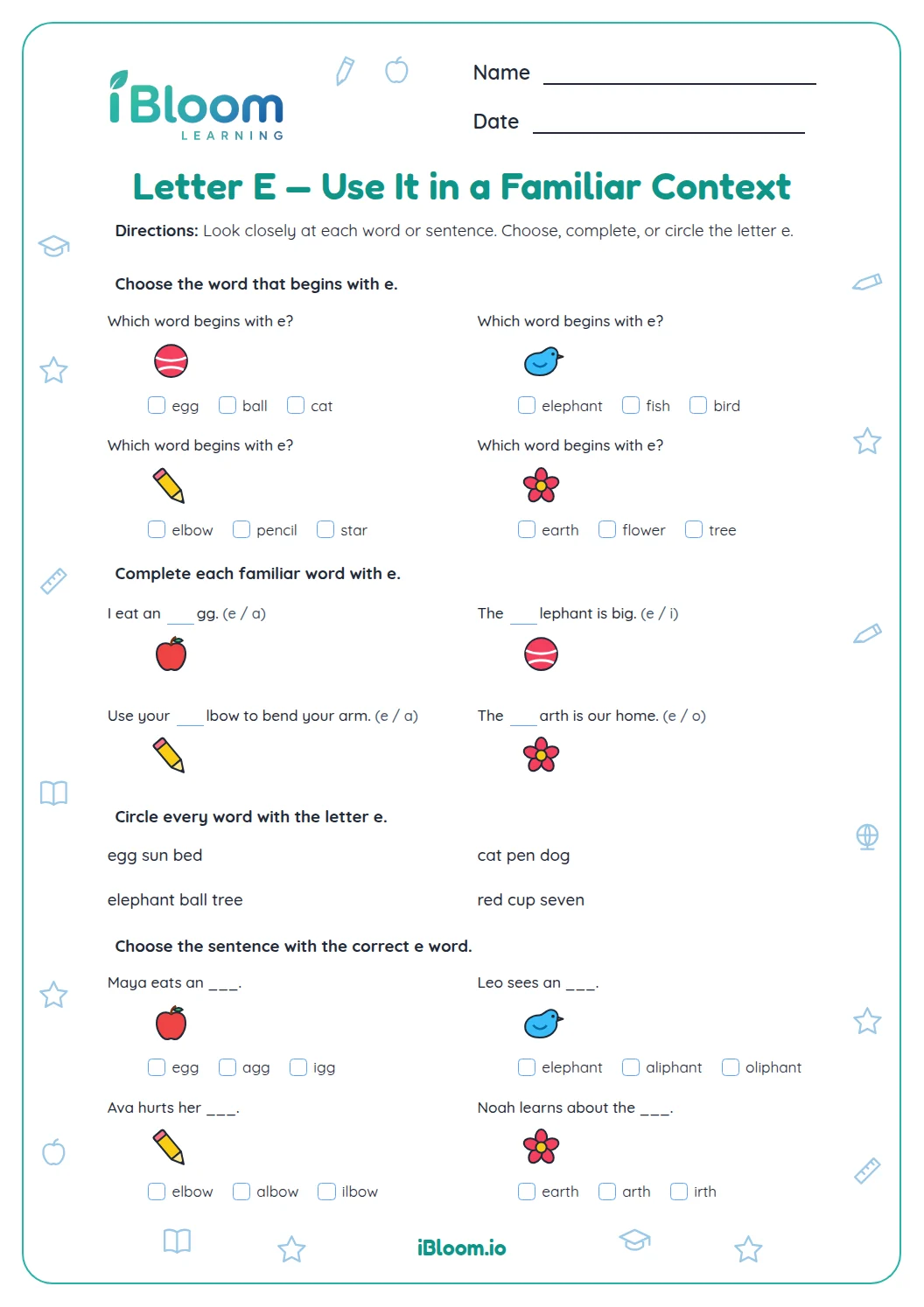


About this worksheet
This printable builds familiarity with uppercase E and lowercase e through tracing, picture clues, beginning-sound choices, and a simple drawing prompt. Children see familiar E words such as egg, elephant, and envelope, then use the initial sound to complete a word.
Aligned to RF.K.3.b and RF.K.1.d
How can children learn the letter E?
Children can look at the letter, say its name, trace its shape, and connect it to familiar words. Egg, elephant, and envelope begin with E. Speaking each word aloud helps children hear the starting sound.
What is on the worksheet?
Part A traces uppercase and lowercase E. Part B identifies E in letter rows and familiar words. Part C matches picture clues and beginning sounds, completes two E words, and draws an E word.
Using the letter page
- 1Say the letter name before tracing E and e.
- 2Name each pictured object aloud.
- 3Listen for /ĕ/ at the start of egg and elephant.
- 4Draw one familiar object whose name begins with E.
Common slips
The mistake
Confusing the letter name E with its sound in egg.
The fix
Say the letter name, then say the short e sound at the start of egg.
The mistake
Choosing a word because it contains e later.
The fix
Stretch the first sound and listen to the very beginning.
Curriculum alignment
This worksheet practices the skill named in its title.
Associate long and short vowel sounds with common spellings.
On this sheet: Students connect the letter E with its short vowel sound in familiar beginning words.
Show the official wordingHide the official wording
Associate the long and short sounds with the common spellings (graphemes) for the five major vowels.
Recognize and name all upper- and lowercase letters of the alphabet.
On this sheet: Tracing and identifying uppercase and lowercase E supports letter recognition.
Show the official wordingHide the official wording
Recognize and name all upper- and lowercase letters of the alphabet.
What to practice next
Make more practice
Further reading
Questions parents and teachers ask
What sound does E make in egg?
Egg begins with the short e sound. Say the word slowly and listen to the first sound. Children can then compare it with a word that begins with a different sound, such as sun or cat. An adult can say each word aloud while the child points to its first letter.
Why are uppercase and lowercase letters included?
Uppercase E and lowercase e are two printed forms of the same alphabet letter. The tracing items let children practice both forms and see them together. Adults can point out the forms in a book or on a sign after the activity.
Which picture words are used?
The sheet uses egg, elephant, and envelope as picture clues. Each begins with the letter E. Children can name each picture before choosing its first letter, which connects the printed letter to the sound at the start of the word.
What can a child draw for the last activity?
A child can draw any familiar object whose spoken name begins with E, such as an egg, elephant, or envelope. The prompt asks for one drawing, and the key gives examples rather than requiring a single exact picture.
Can a child complete this with help?
Yes. An adult can name each picture and invite the child to say the first sound before choosing a letter. The tracing lines and picture clues support shared practice, and the drawing prompt accepts any recognizable object whose name starts with E.