




About this worksheet
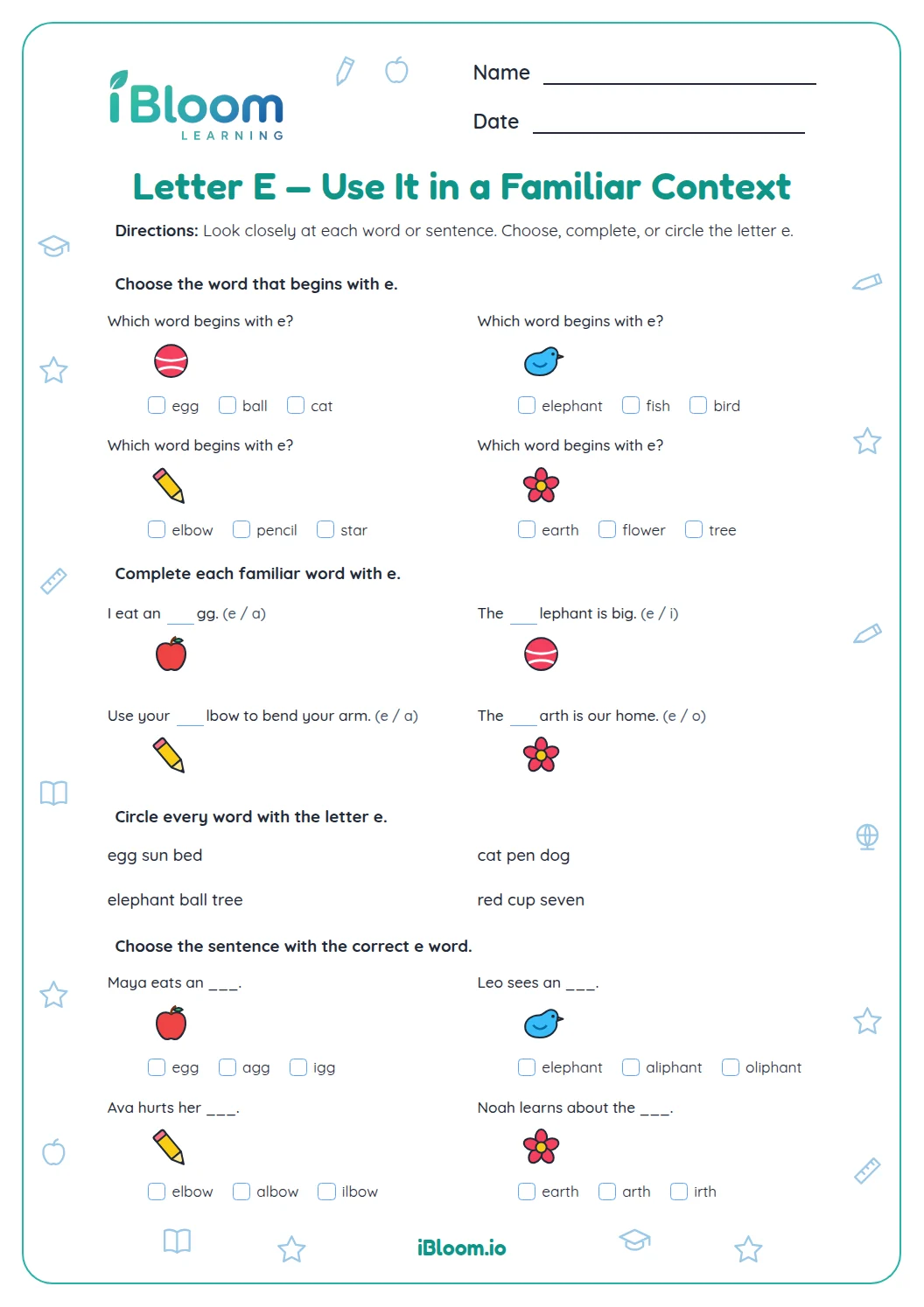
This Preschool and Kindergarten worksheet reviews the letter E in five short ways. Children trace uppercase and lowercase forms and familiar words, choose picture names beginning with E, circle e in printed words, complete letter pairs or words, and recognize matching letter forms. The 20 questions keep the page focused on one letter, with an answer key for checking.
Aligned to L.K.1.a
How can tracing help children notice E?
Trace uppercase E, lowercase e, and short E words. Say each aloud to connect the letter shape with familiar print.
How can a picture name point to E?
Say each pictured word before choosing. Egg, elephant, and elbow begin with the letter E; check the first letter you hear and see.
What does the mixed review include?
There are 20 questions in five parts: tracing, picture-name choices, circling e in words, completing letter pairs or words, and matching uppercase and lowercase forms.
How to use this worksheet
- 1Trace each E form and word from left to right.
- 2Say each picture name before choosing.
- 3Read each short word and circle every e.
- 4Write lowercase e in each letter pair or word blank.
- 5Match uppercase E with lowercase e in the final section.
Common mistakes and quick fixes
The mistake
Choosing a picture without naming it.
The fix
Say the picture name and listen for its first letter sound.
The mistake
Confusing uppercase E with lowercase e.
The fix
Compare the tall lined form with the smaller rounded form.
The mistake
Missing e inside a word.
The fix
Read each word slowly and scan every letter.
Curriculum alignment
This practice builds the named skill through short, grade-appropriate examples.
Print uppercase and lowercase letters through focused E tracing.
On this sheet: Print uppercase and lowercase letters through focused E tracing.
Show the official wordingHide the official wording
Print many upper- and lowercase letters.
What to practice next
Make more practice
Further reading
Questions parents and teachers ask
How many items are included?
There are 20 questions in five parts: four tracing prompts, four picture-name choices, four word-circling rows, four letter or word completion prompts, and four form-recognition choices. The answer key lists the expected choices and letters for checking. Read the prompt aloud and check the marked responses together.
Which picture names begin with E?
The picture choices include egg, elephant, envelope, and eggplant. Children can name each picture and look for E at the start of the word. The other choices give a contrasting picture name for comparison. Read the prompts together and check answers with the printed key.
What words do children circle?
The word rows include short familiar words such as egg, bed, tree, pen, red, and hen. Children circle every complete word in a row that contains the letter e, scanning from left to right. Read the prompts together and check answers with the printed key.
Does the page include handwriting?
Yes. Children trace uppercase E, lowercase e, and short words, then write lowercase e in completion prompts. The final section also asks them to recognize matching uppercase and lowercase forms. An adult can check each response with the answer key.
How can an adult support this practice?
Say each picture name with the child and point to its first letter. For the word rows, read each word aloud and have the child scan from left to right for e. Then compare the uppercase and lowercase forms in the final section.