




About this worksheet
This printable Letter P review gives preschool and kindergarten learners several ways to meet the letter: trace uppercase and lowercase forms, compare P with other letters, and listen for /p/ in familiar picture names. The picture choices keep the sound practice concrete, while a final open response invites the child to name another P word. The activities align with CCSS RF.K.3.a, recognizing and naming uppercase and lowercase letters.
Aligned to RF.K.3.a
How can a child practice writing P?
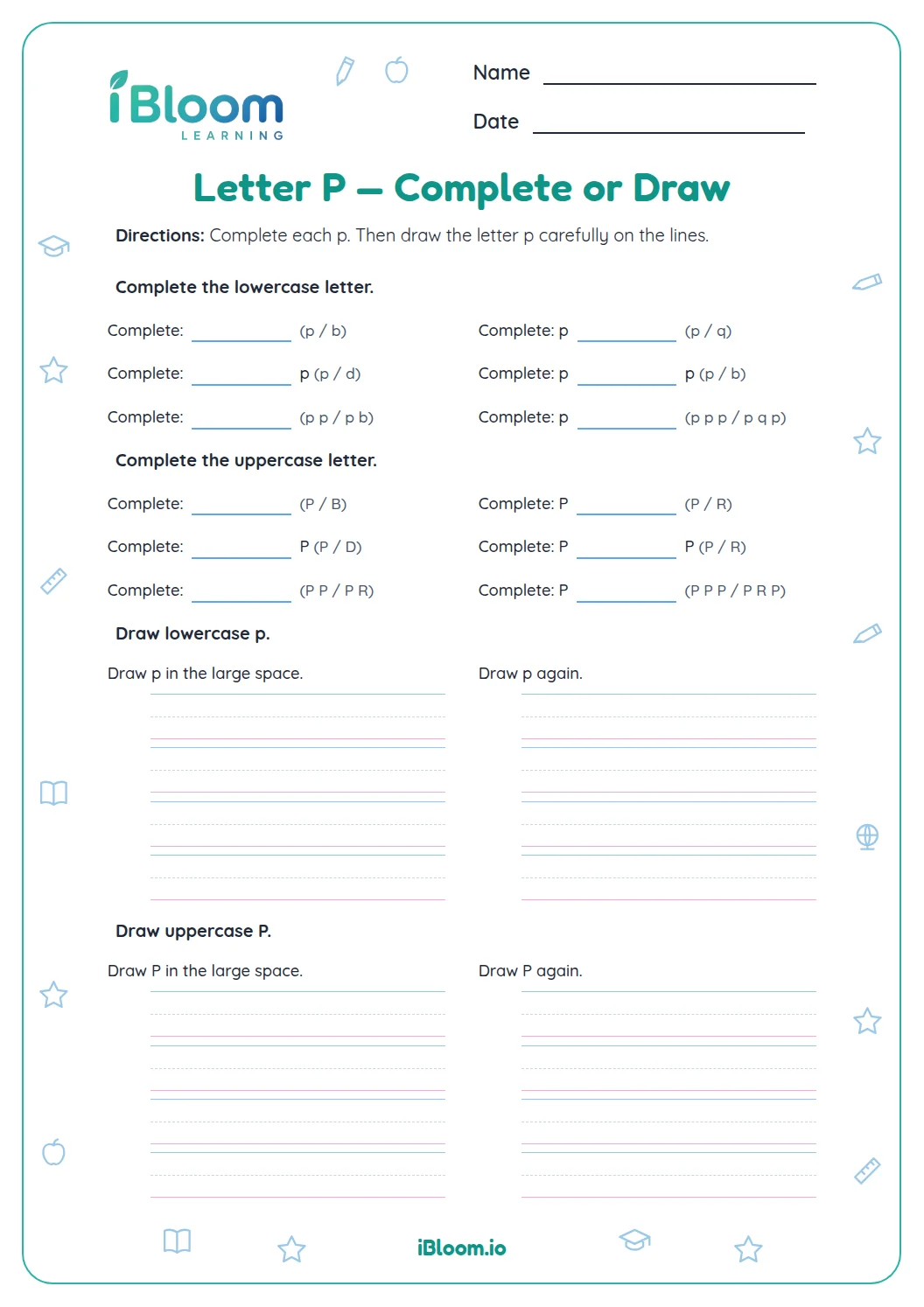
Trace the tall uppercase P and the lowercase p. Say the letter name while tracing, then notice how both forms share a straight line and a rounded part.
- 1Trace Pp from left to right.
- 2Say “P” as you trace, then name a word such as pear.
How do you hear /p/ at the start of a word?
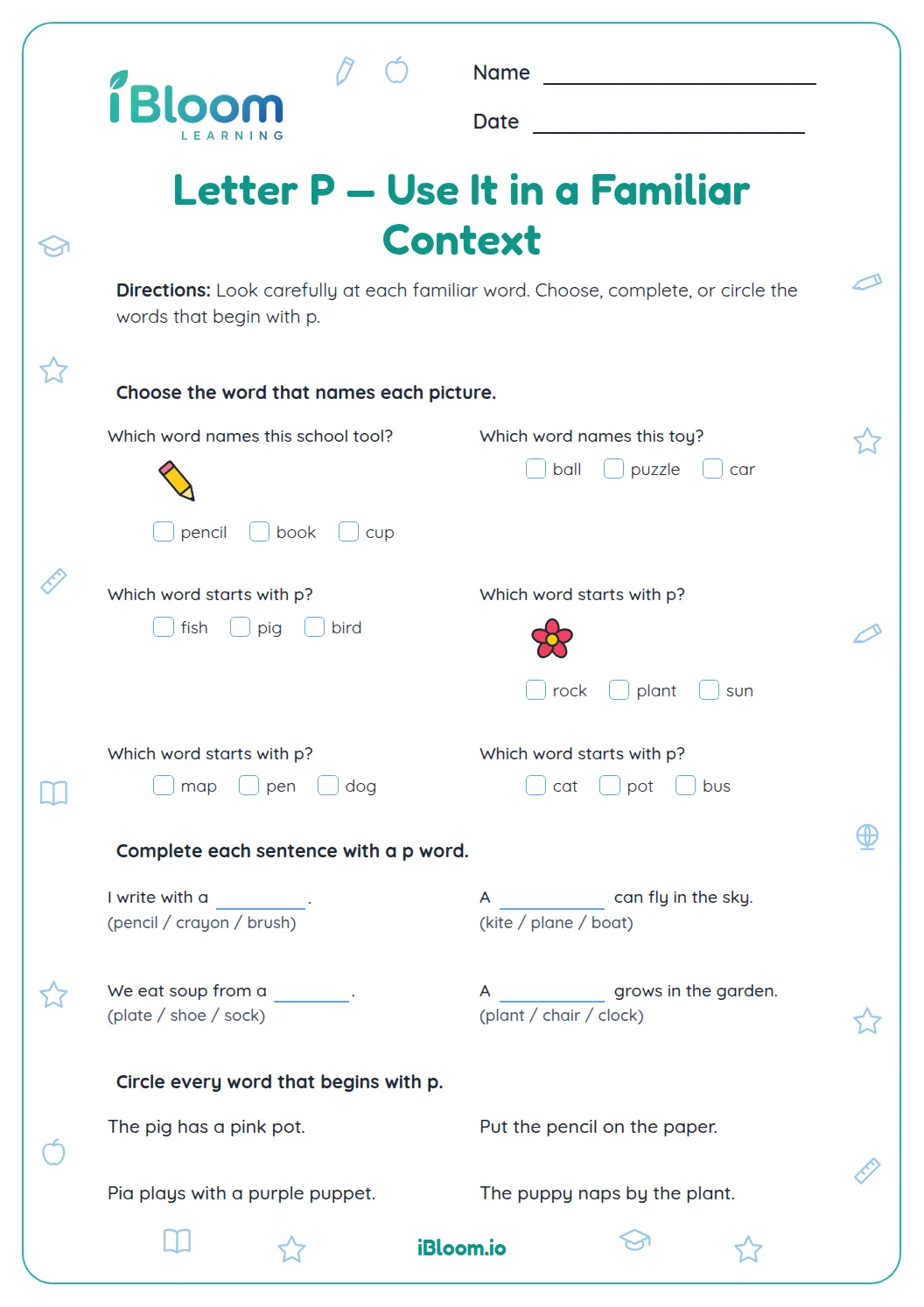
Say the picture name and listen to its first sound. Pig, pencil, pear, pizza, and pan begin with /p/; sun and cat begin with other sounds.
How can you tell uppercase P from lowercase p?
Look for the capital P with its bowl at the top. The lowercase p has a long line that drops below the writing line.
How to use this worksheet
- 1Point to uppercase P and name it.
- 2Trace uppercase P slowly from top to bottom, then around the curve.
- 3Trace lowercase p and notice its long downstroke.
- 4Say each picture name before choosing its first sound.
- 5Invite the child to think of another P word and say it aloud.
Common mistakes and quick fixes
The mistake
Naming a picture by a different word than the common label.
The fix
Say the intended picture name aloud first: “pear,” “pig,” or “pencil.”
The mistake
Confusing letter name P with its sound /p/.
The fix
Say “the letter is P; its first sound in pig is /p/.”
The mistake
Reversing lowercase p and q.
The fix
Check which side the round part sits on: lowercase p has the stem on the left.
Recognize and name uppercase and lowercase P.
On this sheet: Picture choices ask learners to connect P with its primary consonant sound, and tracing practices letter recognition.
Show the official wordingHide the official wording
Demonstrate basic knowledge of one-to-one letter-sound correspondences by producing the primary sound or many of the most frequent sounds for each consonant.
What to practice next
Make more practice
Further reading
Questions parents and teachers ask
Which picture words use P?
The page includes pig, pencil, pear, pizza, and peach as picture names that begin with /p/. Children say each name and listen to its first sound before choosing. Other pictured names provide a comparison. The other pictured names provide a comparison so children can listen for the first sound.
How should my child say the sound?
Say the short consonant sound /p/, as at the beginning of pig, without adding an extra vowel sound. Then connect the sound to the printed uppercase or lowercase letter. Practice saying the letter name and its sound separately.
What is the difference between uppercase and lowercase P?
Uppercase P has a tall line and a rounded part at the top. Lowercase p has a long downstroke below the writing line, with its round part near the top. Tracing both forms helps children notice the difference.
How can we practice after the page?
Look around for familiar objects whose names begin with /p/. Say each name aloud and listen for the first sound, then find or write the letter P. The page’s picture choices can serve as a model for this quick game.
Which P pictures appear on the worksheet?
Children identify pictured words such as pig, pencil, pear, and pizza by their beginning /p/ sound. They also distinguish pictures whose names begin with another sound, using each picture and its word together. The picture options include clear examples of /p/ words alongside familiar distractors such as cat and sun.
Does the page practice both forms of P?
Yes. The sheet includes uppercase and lowercase P tracing and recognition, plus picture choices for the /p/ sound. The answer key shows the letter responses and correct picture choices. Children can say each letter name and sound as they trace, then check picture choices with the key.