





About this worksheet
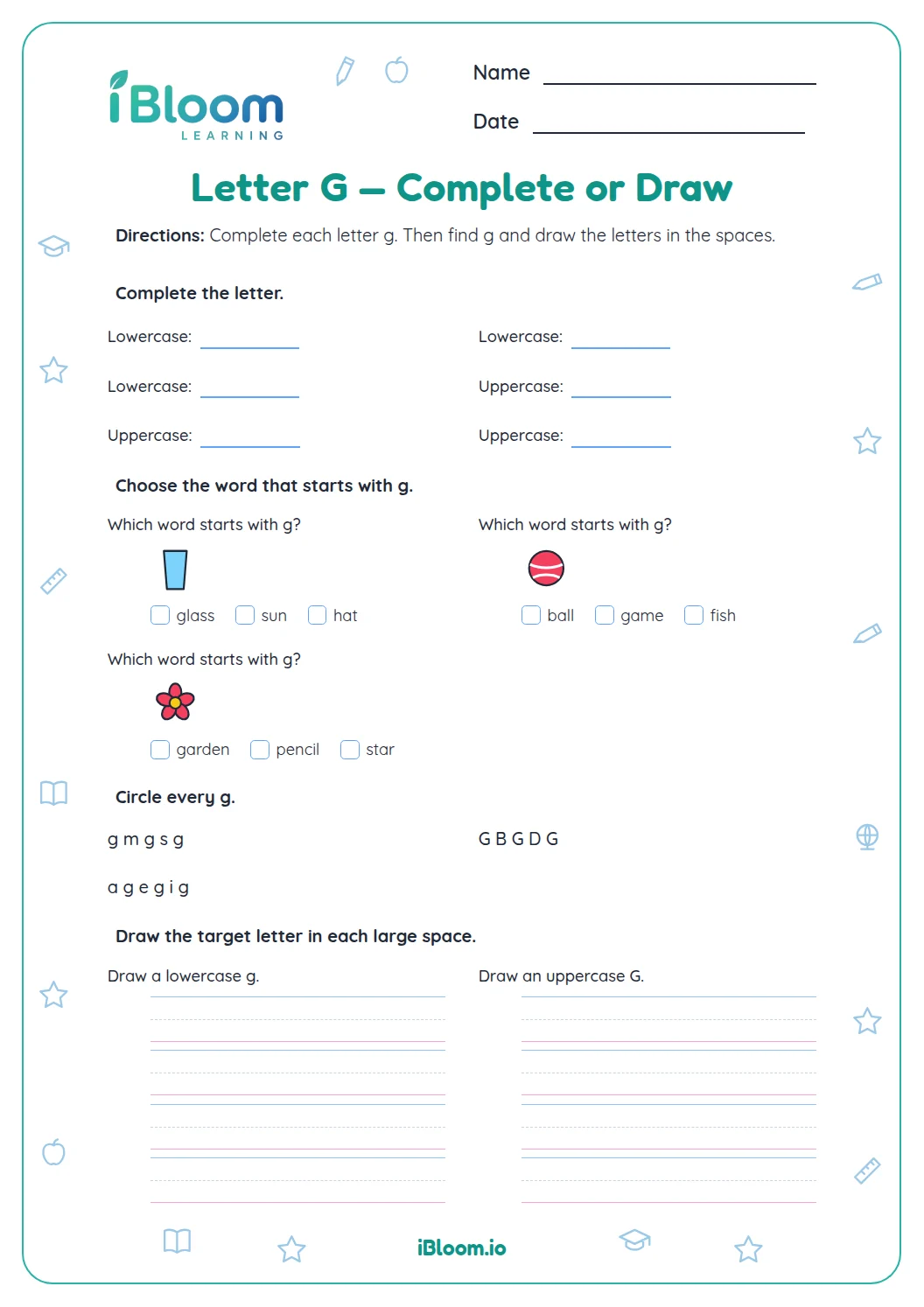
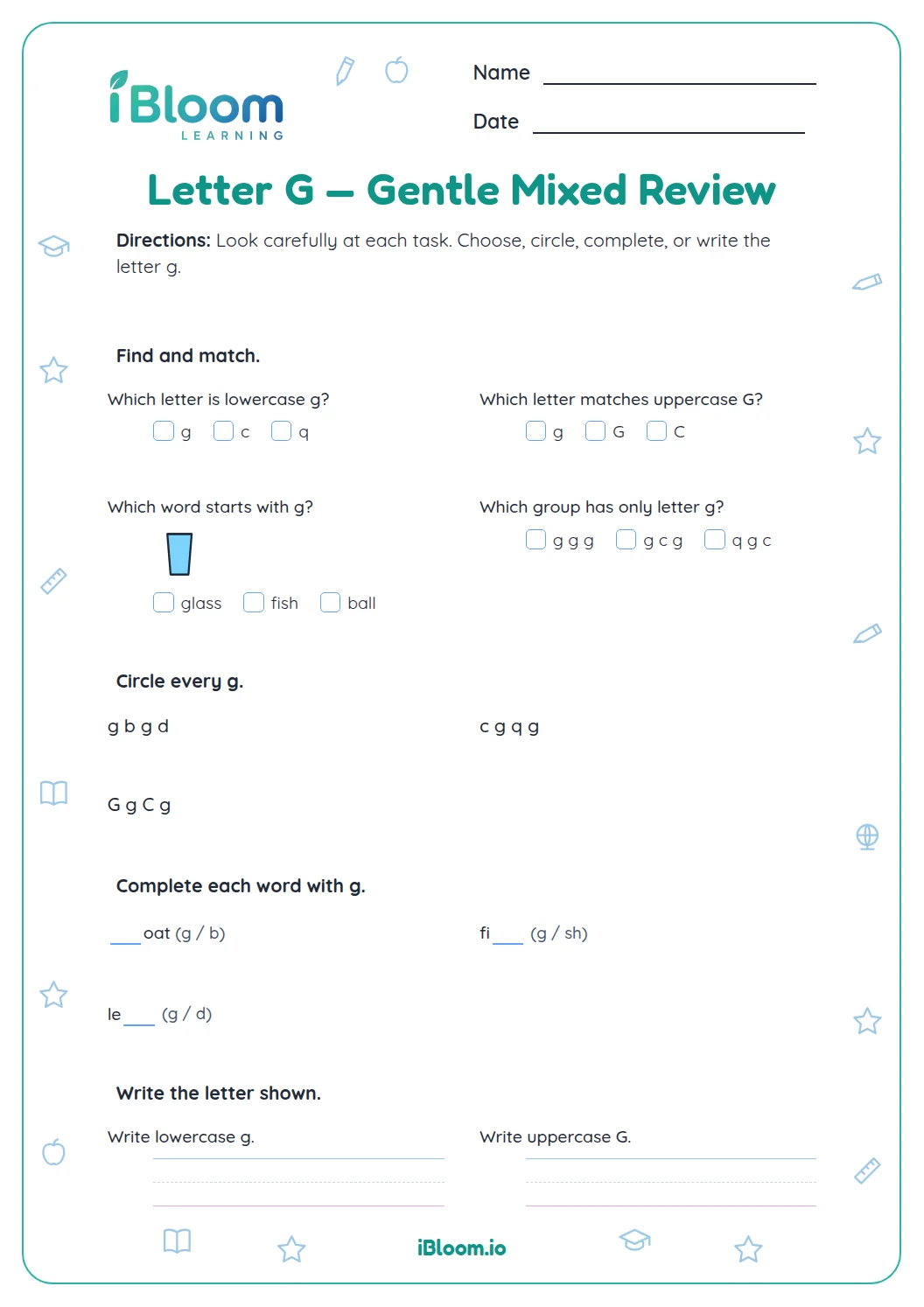
This Kindergarten Letter G worksheet connects letter formation with the /g/ sound in familiar words. Children trace uppercase G, lowercase g, and Gg, then name pictures such as goat, grapes, guitar, and gift. The last word rows give short reading practice with G at the beginning. A separate answer key identifies the picture choices and tracing models. The page practices Common Core L.K.1.a for letter forms and RF.K.3.a for the consonant sound in familiar words.
Aligned to L.K.1.a and RF.K.3.a
How does the sheet practice letter G?
Part A begins with uppercase G, lowercase g, and the pair Gg. Part B uses pictures to connect familiar names with the beginning sound. Part C asks children to spot the letter in short word rows.
How can a child hear the first sound?
Say every picture name aloud, then listen to its first sound. Keep the whole word in mind and compare the opening sound with G.
What is one example from the G page?
Say “girl” aloud and listen to its first sound. It begins with /g/, so choose the girl picture.
- 1Say “girl” slowly and listen for /g/ at the start.
- 2Choose the girl picture.
What can an adult check in the answer key?
The key identifies each picture choice and repeats the tracing forms. For the short word rows, it shows which word or words begin with G. The final drawing key gives a model when that activity is included.
How to use this worksheet
- 1Say the letter name G.
- 2Trace uppercase G and lowercase g slowly.
- 3Name each picture from left to right.
- 4Listen for /g/ at the beginning of the word.
- 5Circle the printed words that begin with G.
Common slips and quick fixes
The mistake
Choosing a picture because the word contains the letter later.
The fix
Say the word slowly and listen to its first sound for G.
The mistake
Mixing uppercase G with lowercase g.
The fix
Compare the two trace models, then practice them as a pair.
The mistake
Rushing through a curved letter shape.
The fix
Start at the model’s top and follow its curve with one steady motion.
Common Core alignment
The worksheet connects letter forms with familiar beginning sounds for G.
Trace and print uppercase and lowercase G.
On this sheet: The tracing rows practice uppercase and lowercase G.
Show the official wordingHide the official wording
Print many upper- and lowercase letters.
Connect G with its consonant sound in familiar words.
On this sheet: Picture and word choices connect G with the /g/ sound.
Show the official wordingHide the official wording
Demonstrate basic knowledge of one-to-one letter-sound correspondences by producing the primary sound or many of the most frequent sounds for each consonant.
What to practice next
Make more practice
Further reading
Questions parents and teachers ask
Which G words are pictured on this worksheet?
The choices include goat, grapes, guitar, gift, girl, giraffe, and globe. Say each name aloud and notice the /g/ sound at the beginning. The final short rows use written G words, and the garden theme keeps the picture set cohesive.
What sound does G make in these words?
In words such as goat, gift, and garden, G represents the consonant sound /g/. Children can say the word slowly and focus on its first sound before selecting a picture. These familiar examples keep the sound connected to the letter.
How does the worksheet practice both forms of G?
The first part shows uppercase G, lowercase g, and the pair Gg for tracing. Children can compare the tall capital with the lowercase form and then name both as the same letter before moving to picture words. These differences make both picture names useful examples.
How should children use the picture choices?
Invite the child to name all three pictures in each row. Then listen for /g/ at the start of each name and select the one that begins with that sound. The answer key identifies the intended picture. Take a short break if the hand gets tired.
What does the answer key show?
The separate key lists the selected picture for each choice and the letters used for tracing. For each tracing item, look for a recognizable G or g that follows the printed guide rather than judging speed or neatness. Use the model as a guide for the next attempt.