




About this worksheet
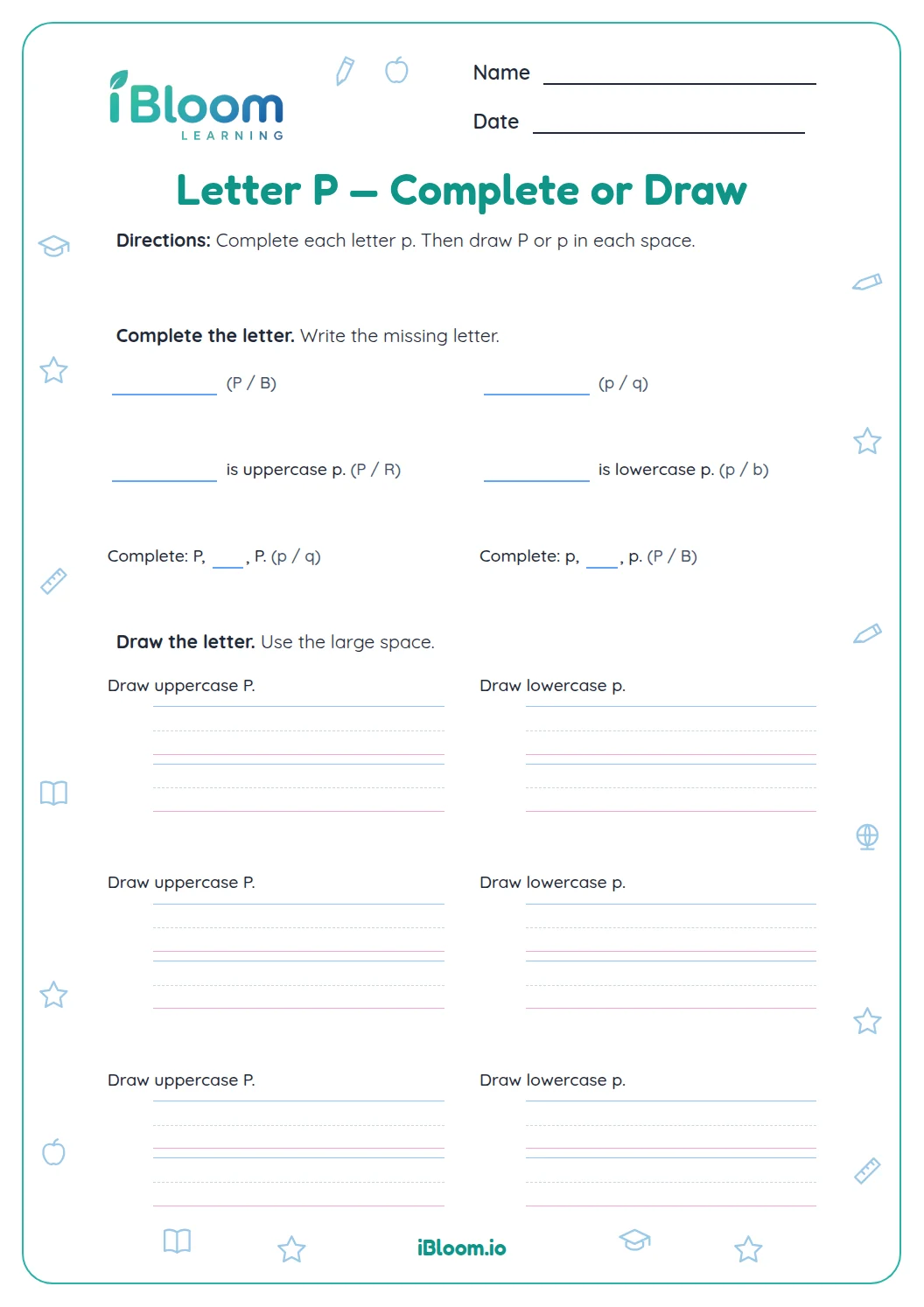
This free two-page Letter P worksheet is for preschool and kindergarten learners. Children trace uppercase P and lowercase p, choose pictures and words that begin with /p/, and recognize the letter among familiar forms. The picture choices keep the sound practice concrete, while the separate answer key helps an adult check each item. Letter printing and sound correspondence connect to CCSS L.K.1.a and RF.K.3.a.
Aligned to L.K.1.a and RF.K.3.a
How should children trace P and p?
Begin with the large uppercase P, then trace lowercase p. Say the letter name while following its shape. The two forms look different, but both represent the letter P.
Keep the first practice calm and brief. An adult can model the starting point and direction, then let the child try each trace before moving to picture and word review.
- 1Trace uppercase P.
- 2Name the letter: P
How can pictures help identify the /p/ sound?
Say each picture name slowly and listen to its first sound. Pig begins with /p/; cat and bus begin with different sounds. The picture choices let children connect a familiar object name to the sound they hear.
Listen for the sound at the beginning, rather than searching for the letter shape in the middle or end of a word.
How do children recognize P and p?
Look at the letter’s shape and compare it with nearby choices. Uppercase P has a straight line with a rounded part at the top. Lowercase p has a tall line and a rounded part near the bottom.
Later questions mix letter recognition with easy spoken words such as pan, pet, and pop. This gives children a gentle review of the letter form and its primary sound.
What does the two-page review include?
The 14 questions are grouped into three parts: tracing, picture-sound choices, and P/p recognition in letters and words. Point to each picture and say its name aloud before choosing.
The separate answer key identifies the intended picture, letter, or word. For tracing activities, the key notes the letter to practice; it is not a handwriting score.
A short routine for Letter P practice
- 1Say the letter name P before tracing its uppercase form.
- 2Trace lowercase p and compare its shape with uppercase P.
- 3Name each picture aloud and listen for /p/ at the beginning.
- 4Find uppercase P or lowercase p among the letter choices.
- 5Read a short word with an adult and identify its first sound.
- 6Use the answer key together after the child has tried each activity.
Letter P mix-ups to notice
The mistake
Choosing a word because it has p at the end, such as cap.
The fix
Say the word slowly and listen specifically to its first sound.
The mistake
Mixing up lowercase p and lowercase b.
The fix
Notice which side the rounded part is on: p has its stem on the right of the bowl.
The mistake
Naming the letter from memory without checking its shape.
The fix
Compare the form in the choice with the uppercase P or lowercase p being asked for.
Common Core alignment
Tracing and sound choices connect letter forms with how children say their primary sound.
Print the uppercase and lowercase forms of the letter P.
On this sheet: The sheet includes tracing uppercase P and lowercase p.
Show the official wordingHide the official wording
Print many upper- and lowercase letters.
Connect the letter P with its primary /p/ sound.
On this sheet: Picture and word choices ask children to identify words beginning with /p/.
Show the official wordingHide the official wording
Demonstrate basic knowledge of one-to-one letter-sound correspondences by producing the primary sound or many of the most frequent sounds for each consonant.
What to practice next
Make more practice
Further reading
Questions parents and teachers ask
What letters does the worksheet ask children to trace?
The first tracing activities focus on uppercase P and lowercase p. Children can say the letter name as they follow each form. These short tracing items begin the review before the sheet moves to picture sounds and letter recognition. The adult may point out the starting point before the child begins.
Which pictures begin with the /p/ sound?
The picture choices include familiar names such as pig and pencil. Say each picture name aloud and listen to its first sound. A picture is the right choice when its name begins with /p/, as in pig. Picture names can be said aloud before children choose an answer.
What age group is this worksheet for?
The worksheet is designed for preschool and kindergarten practice with one letter at a time. An adult can guide picture naming and tracing, while children choose letters and words they recognize. The answer key makes it easy to review together.
How many activities are on the printable?
There are 14 questions in three parts across two worksheet pages: letter tracing, picture-sound choices, and P/p recognition. A separate two-page key lists the intended letters, picture answers, and words. The tracing questions come first, followed by picture and word activities.
Does the answer key grade handwriting?
No numeric handwriting score is needed for these trace items. The key names uppercase P or lowercase p as the target form. An adult can encourage the child to follow the letter shape and try the trace independently. The key identifies the target letter or response for each activity.
What does /p/ mean?
The slash notation /p/ represents the sound heard at the beginning of words such as pig, pan, and pet. The picture and word choices ask children to connect that spoken sound with the letter P. Keep the focus on the first sound when saying a word.