






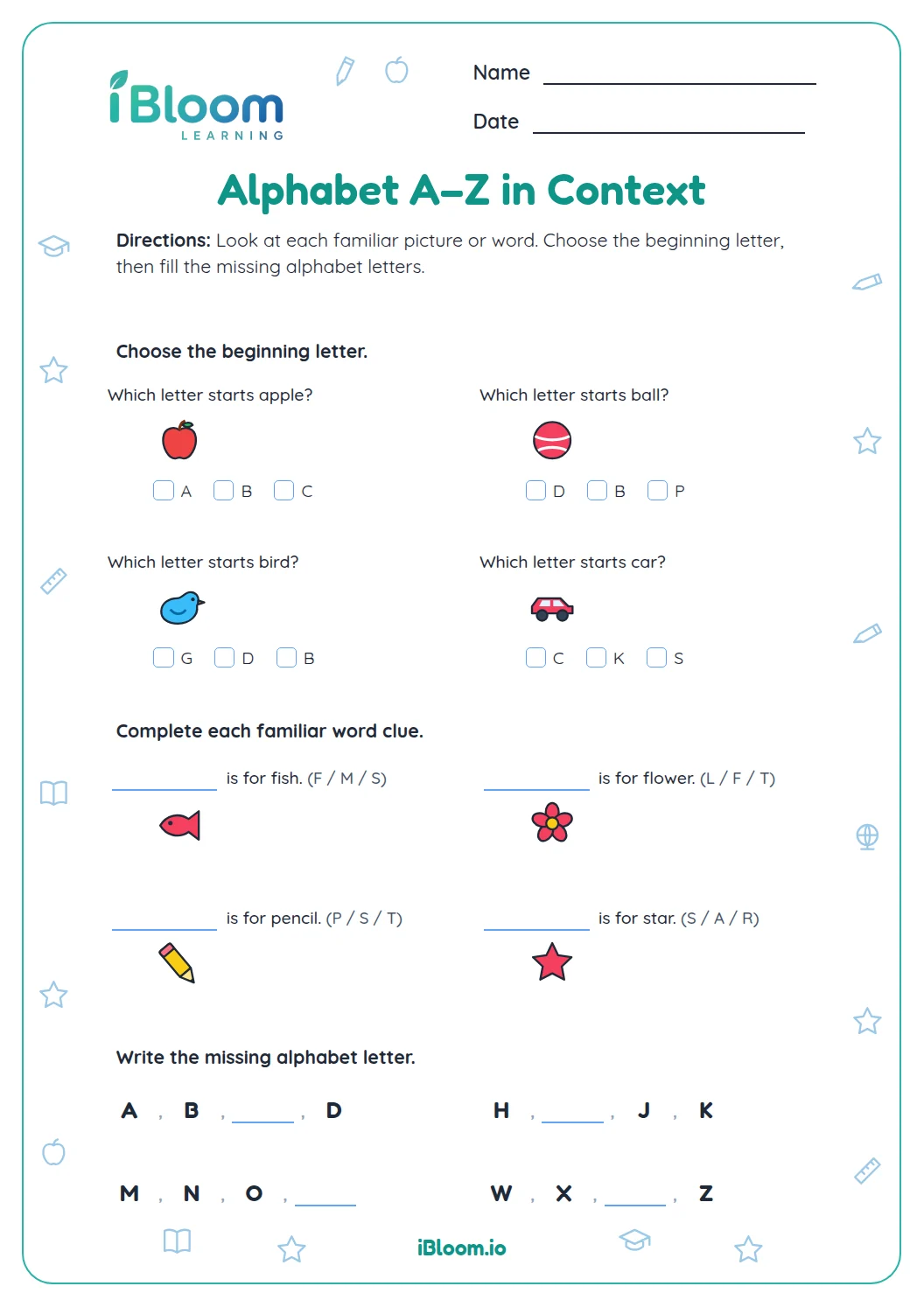

About this worksheet
This printable gives preschool and kindergarten learners a gentle mixed review of letter Y. Children use yo-yo picture clues, find y in short word rows, complete three familiar words, and trace uppercase and lowercase forms. A separate answer key supports checking the selections, missing letters, and tracing models.
Aligned to RF.K.1.d
How is uppercase Y different from lowercase y?
Uppercase Y has two arms that meet and continue down as one stem. Lowercase y has a short fork at the top and a tail that drops below the writing line. The tracing rows let children practice both forms.
- 1Trace Yy.
- 2Make the uppercase Y arms meet at the stem.
- 3Let lowercase y finish with a tail below the line.
Why trace letters before words?
The yo-yo picture gives a familiar starting sound. Word rows and missing letters then ask children to notice y at the beginning, middle, or end of a word.
What is included?
There are 15 questions in four activity groups: picture choices, finding y in words, completing words, and tracing. The three-page answer key shows the expected selections and letters.
How can I use this page?
- 1Name the letter Y and look at its two forms.
- 2Choose pictures whose names begin with the y sound.
- 3Scan each short word row and circle a word with y.
- 4Add y to complete each familiar word.
- 5Trace uppercase Y and lowercase y slowly.
Common mix-ups and helpful fixes
The mistake
Make lowercase y stop at the writing line.
The fix
Follow the model’s tail below the line.
The mistake
Start uppercase Y with one straight stroke.
The fix
Trace the two upper arms first, then continue down the stem.
The mistake
Rush through the short word as one shape.
The fix
Say each letter name while tracing the familiar Y word.
Common Core alignment
This worksheet practices recognizing and naming both forms of a letter.
Recognize and name uppercase and lowercase letters.
On this sheet: Children identify uppercase and lowercase Y and practice forming both.
Show the official wordingHide the official wording
Recognize and name all upper- and lowercase letters of the alphabet.
What to practice next
Make more practice
Further reading
Questions parents and teachers ask
Does this worksheet practice both forms of Y?
Yes. The tracing rows include uppercase Y, lowercase y, and the combined form Yy, followed by the word yo-yo. The picture and word activities also give children opportunities to notice y in familiar print. The answer key repeats each model for checking.
What is the difference between Y and y?
Uppercase Y has two upper arms that meet and continue down as a stem. Lowercase y has a forked top and a tail that drops below the writing line. The worksheet includes separate models and a combined Yy row for children to trace.
Is the answer key useful for tracing?
The answer key repeats the tracing models and shows the expected picture choices, circled words, and missing letters. An adult can check the choice and word activities after the learner finishes, then compare the tracing rows with the printed models.
What does RF.K.1.d mean?
The Kindergarten standard asks children to recognize and name uppercase and lowercase letters throughout the alphabet. This page focuses practice on both forms of Y in tracing, words, and picture choices. This sheet gives letter-specific practice. The examples use familiar print.
How long should a tracing session take?
About 15 minutes is a starting estimate for the picture, word, and tracing activities. A young learner can complete one group at a time and take a hand break before tracing. Follow the child’s pace and stop when careful letter formation becomes tiring.