


About this worksheet
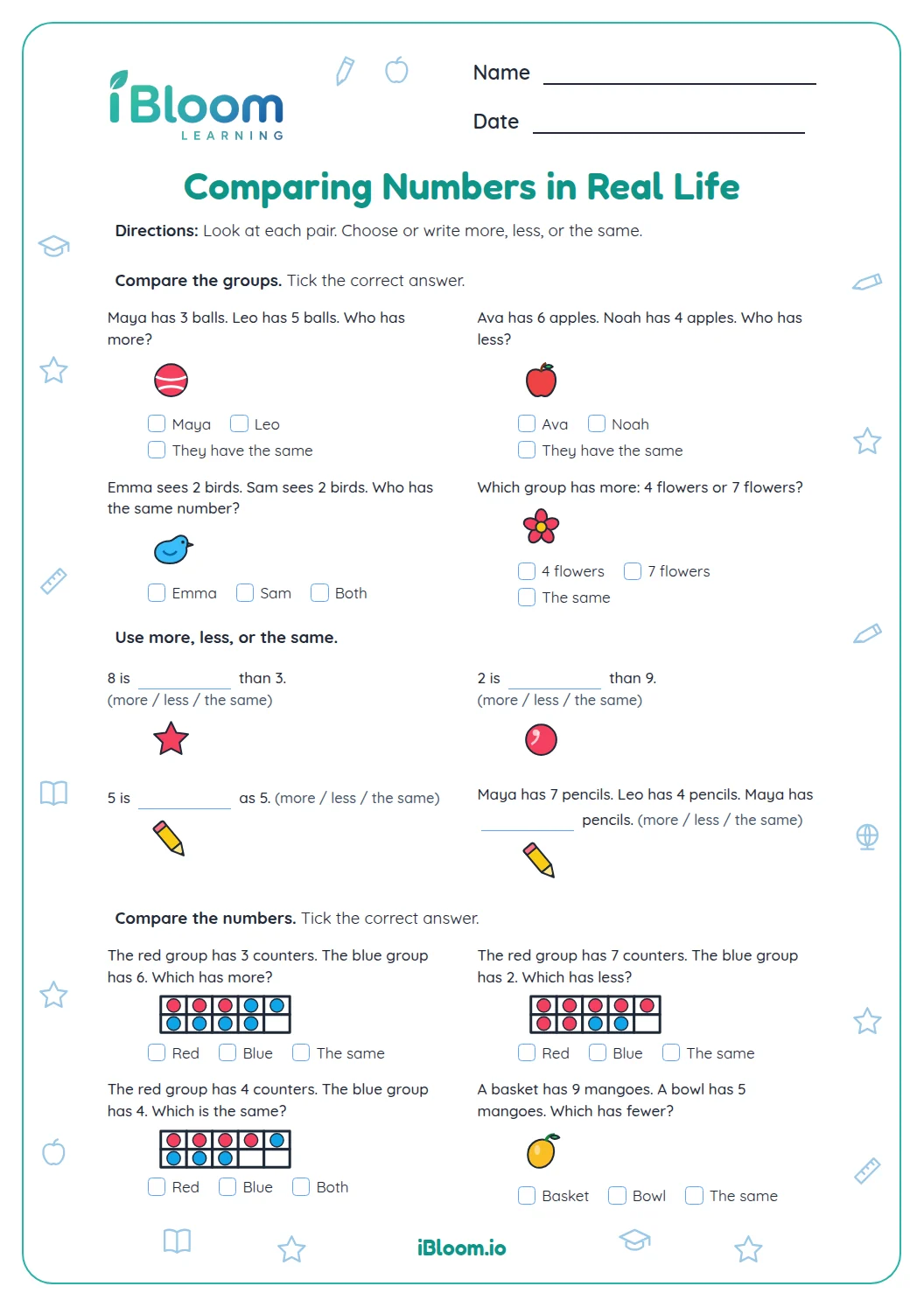
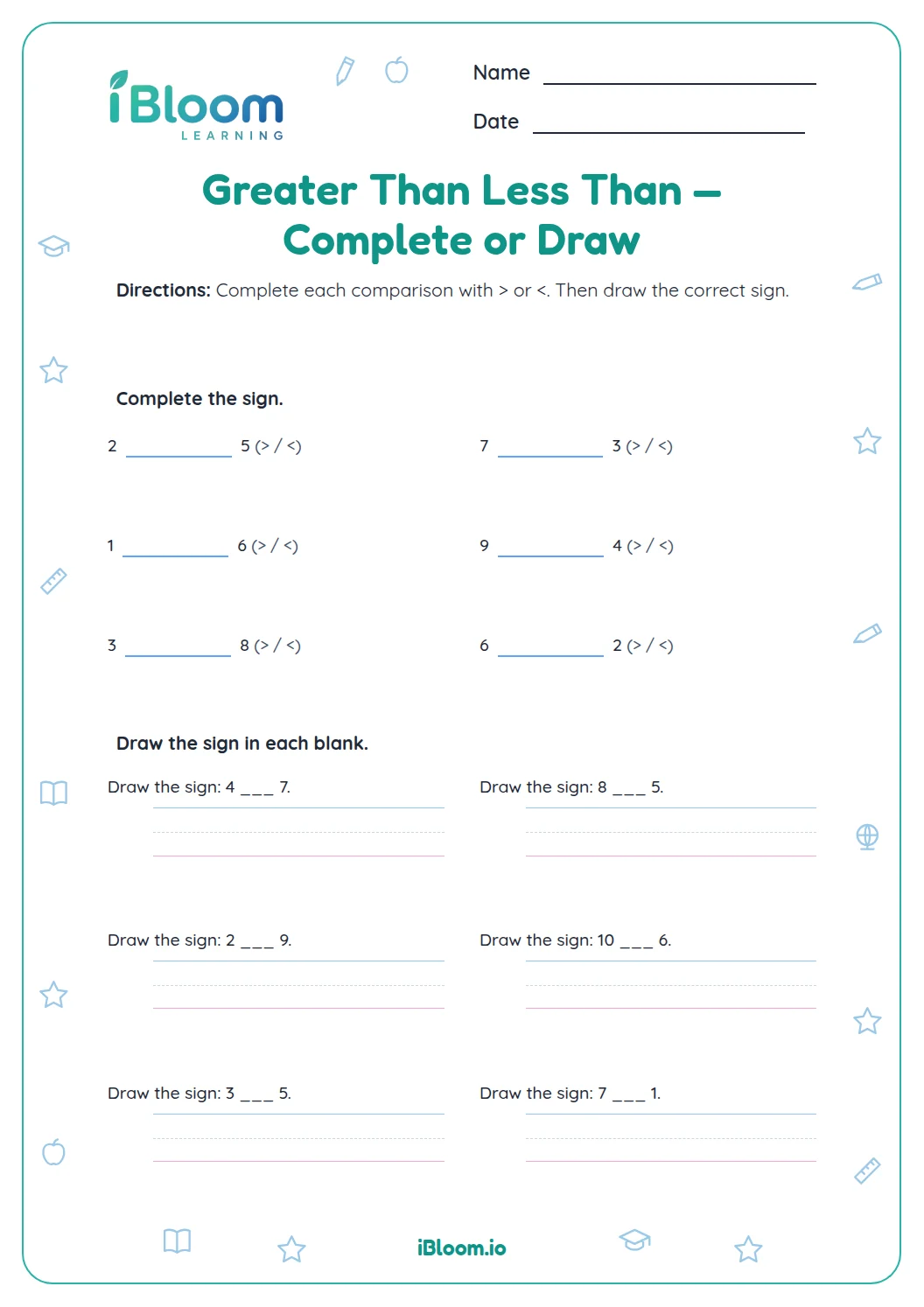
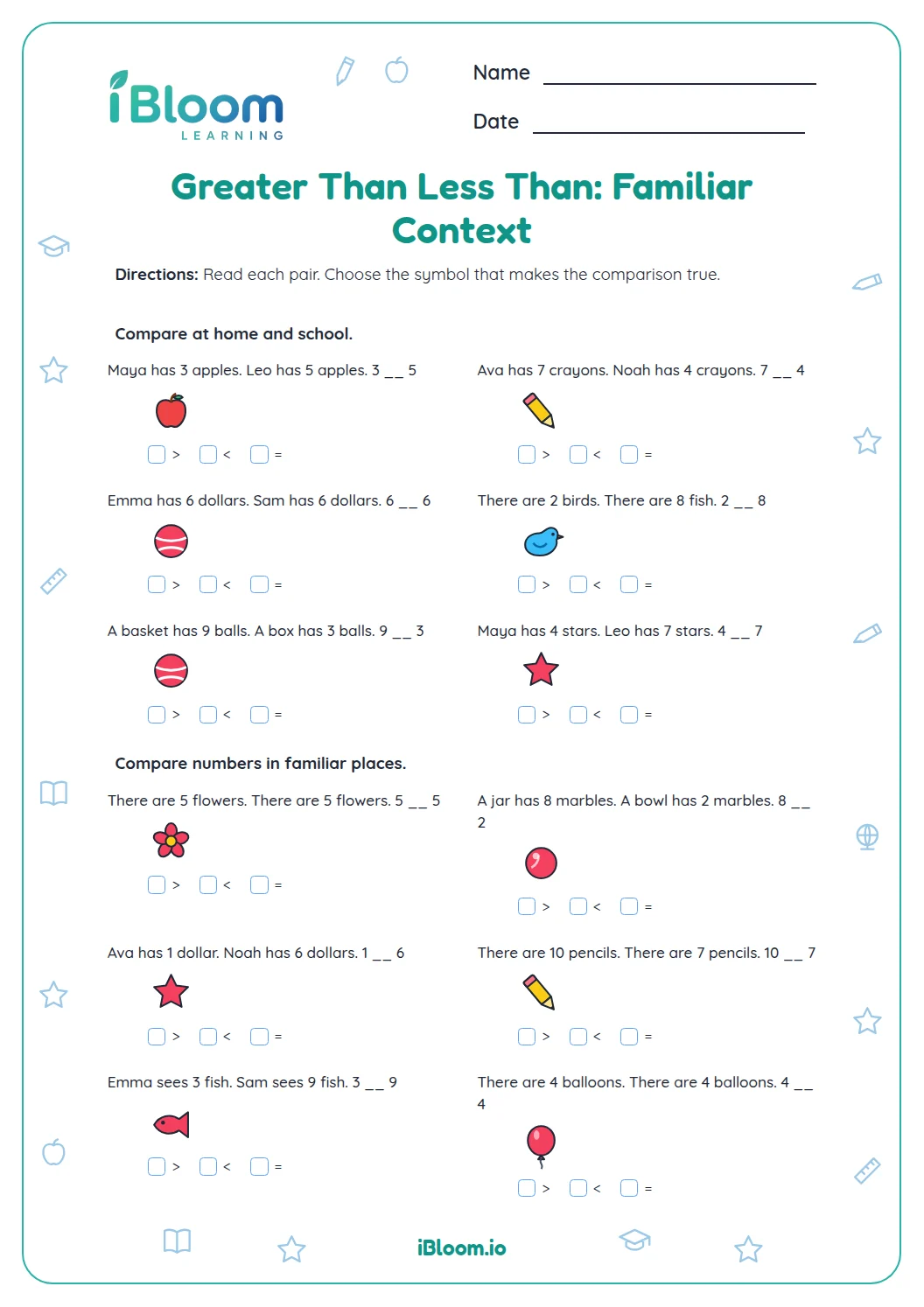
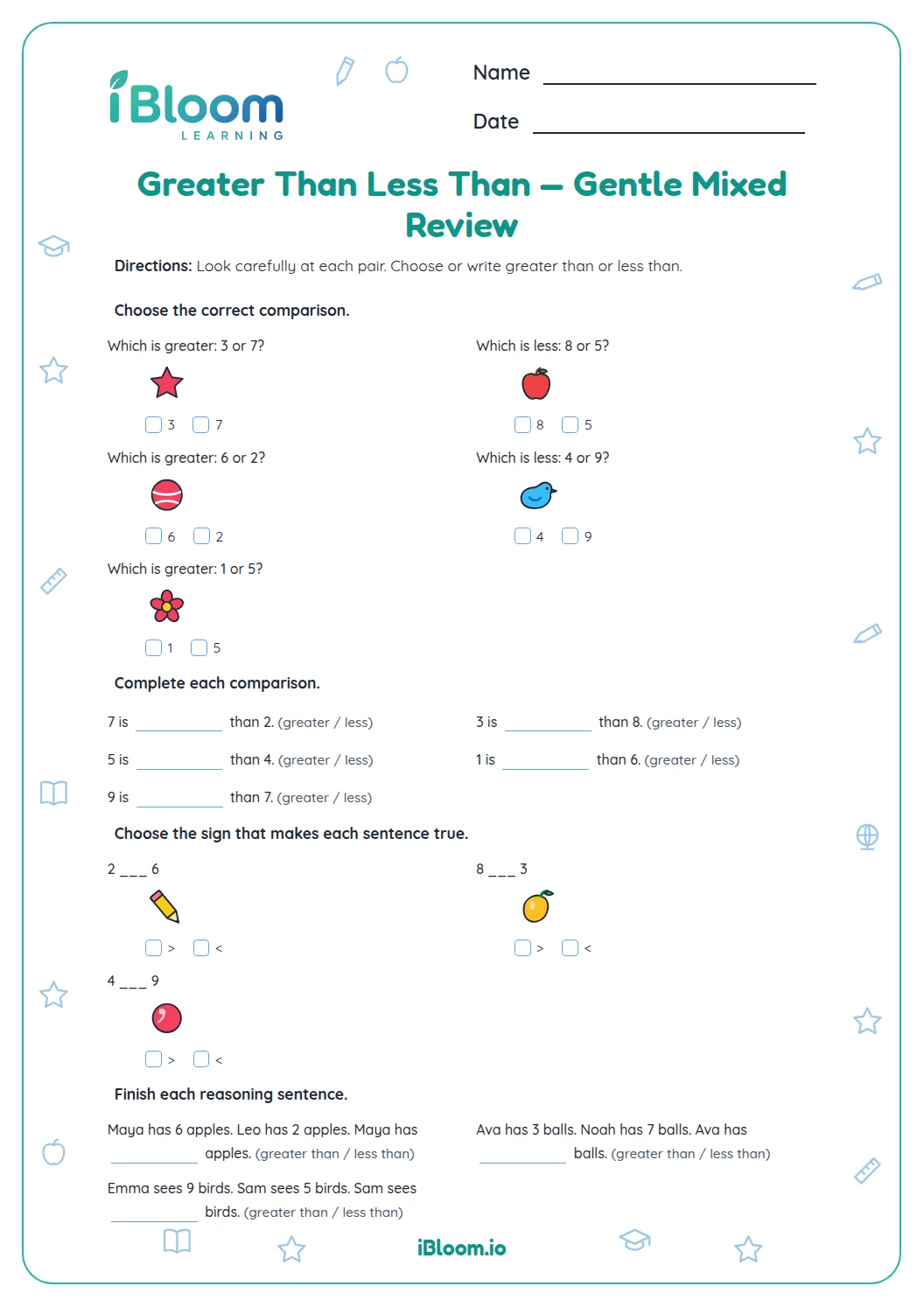
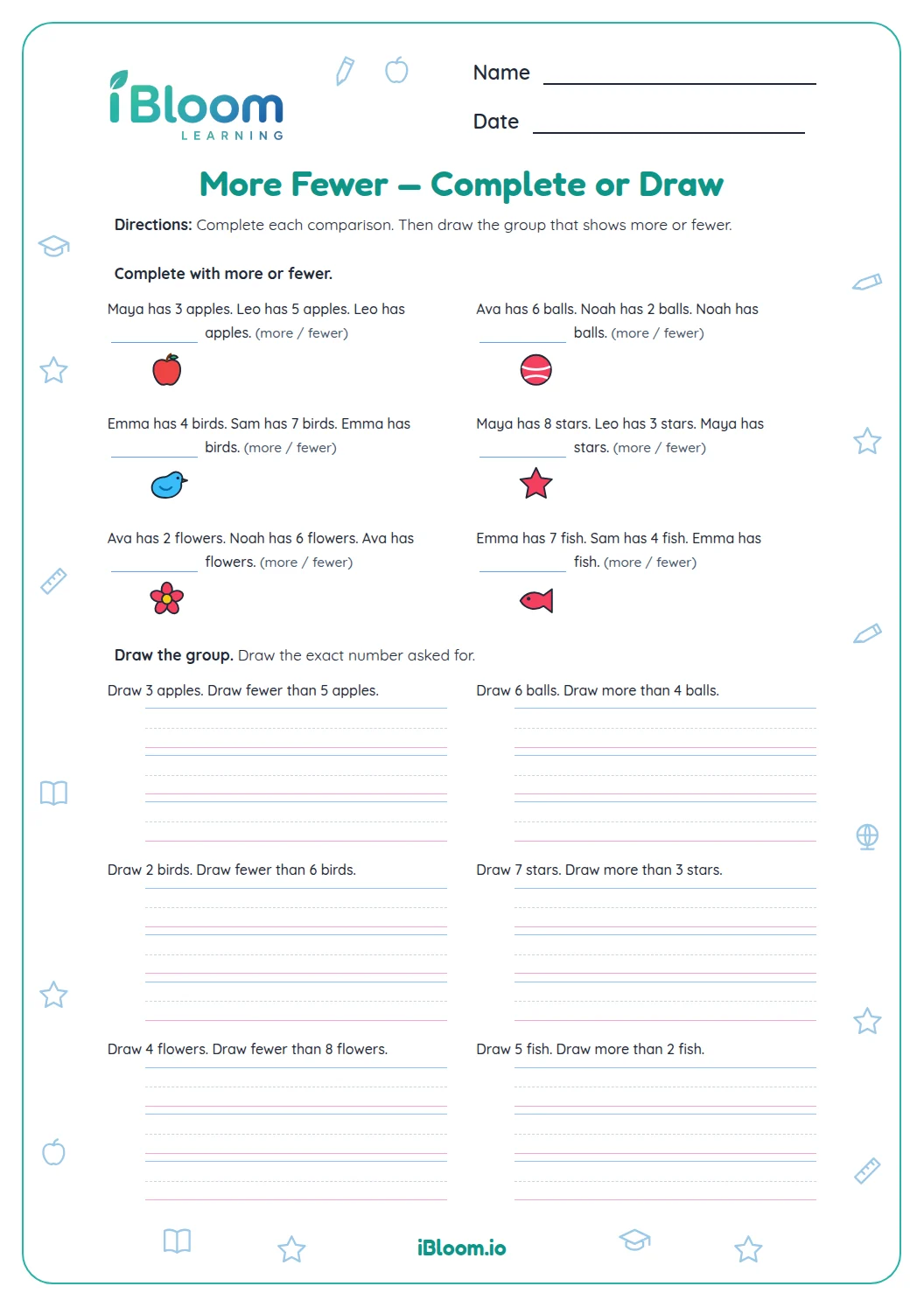
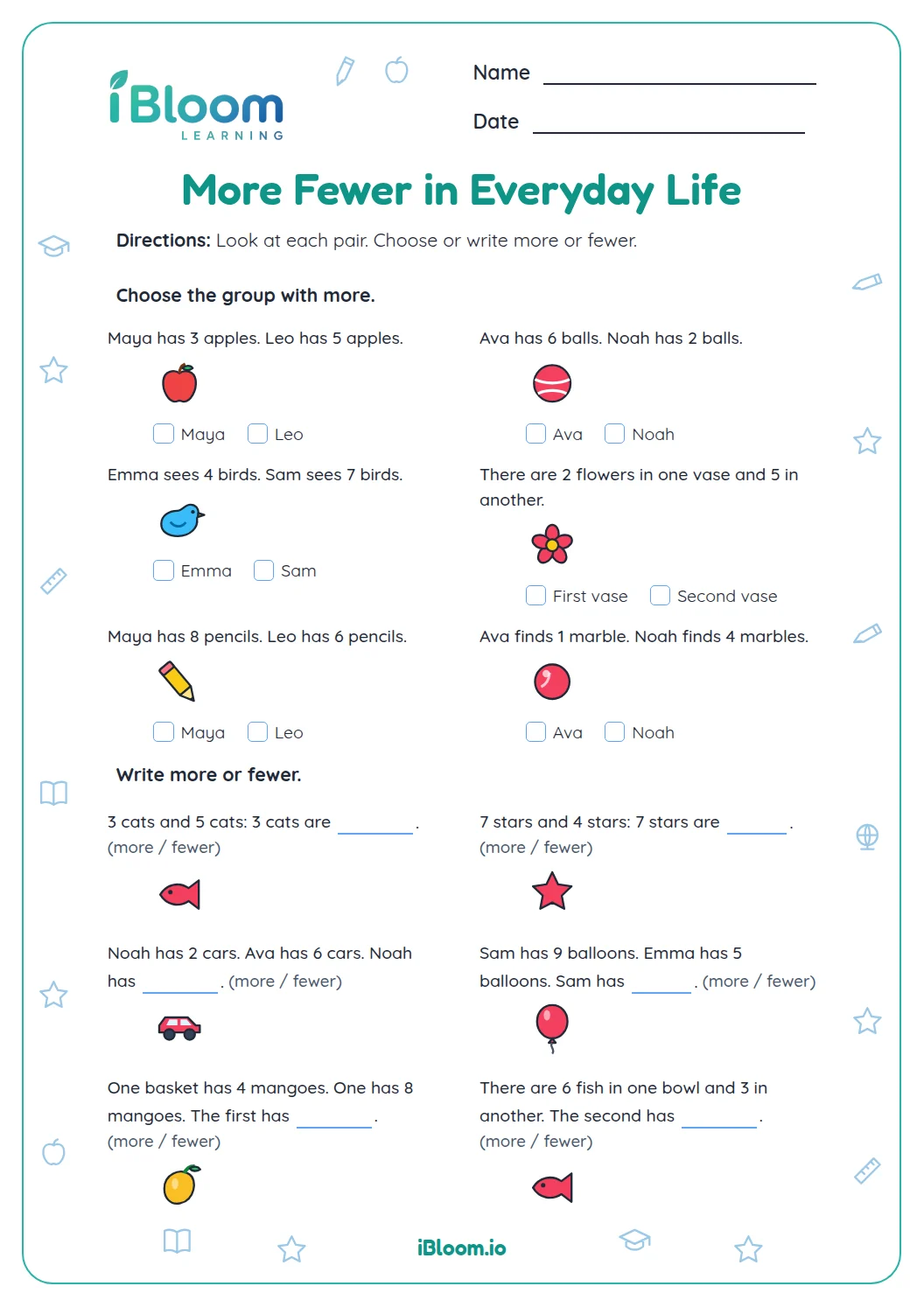
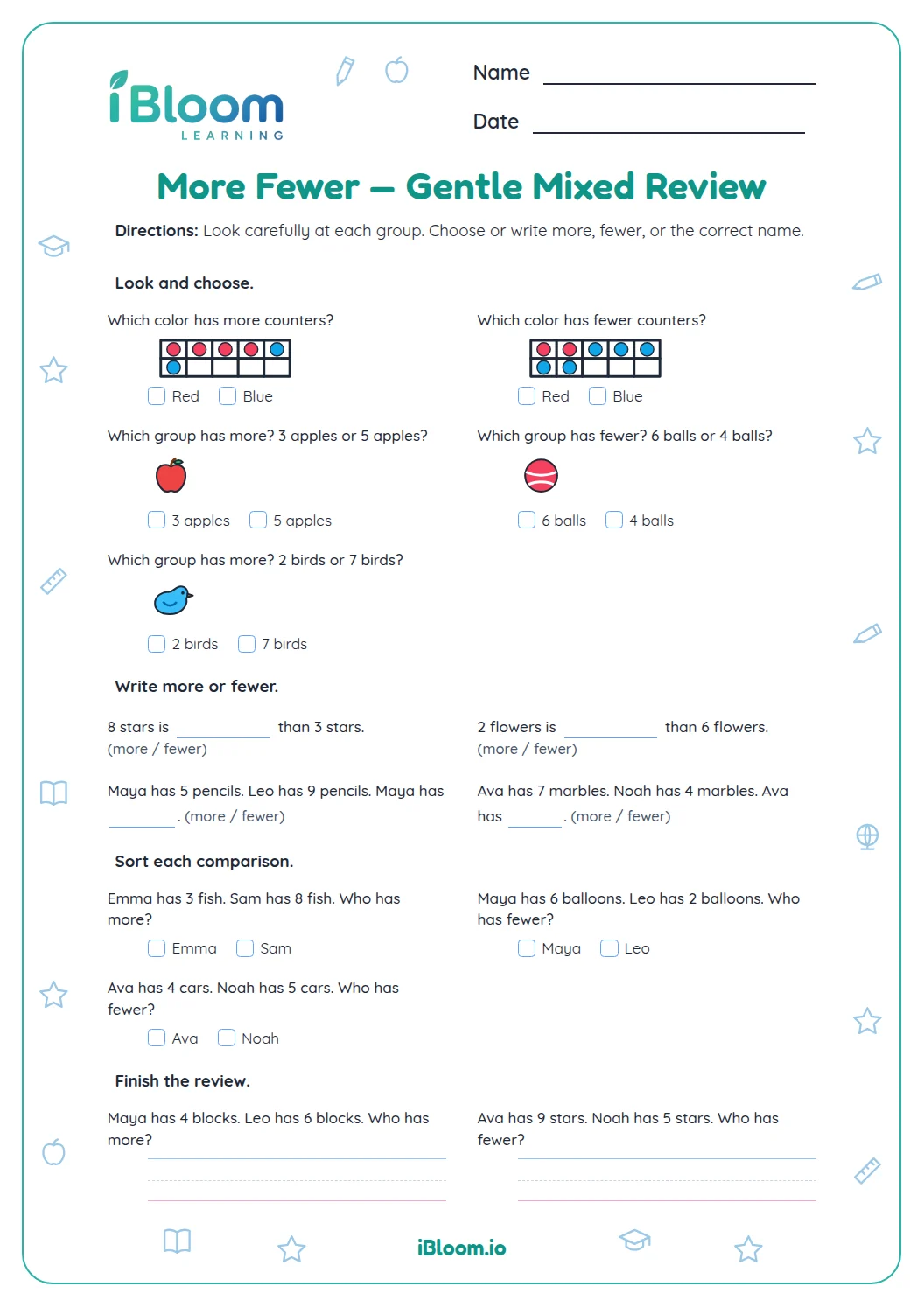
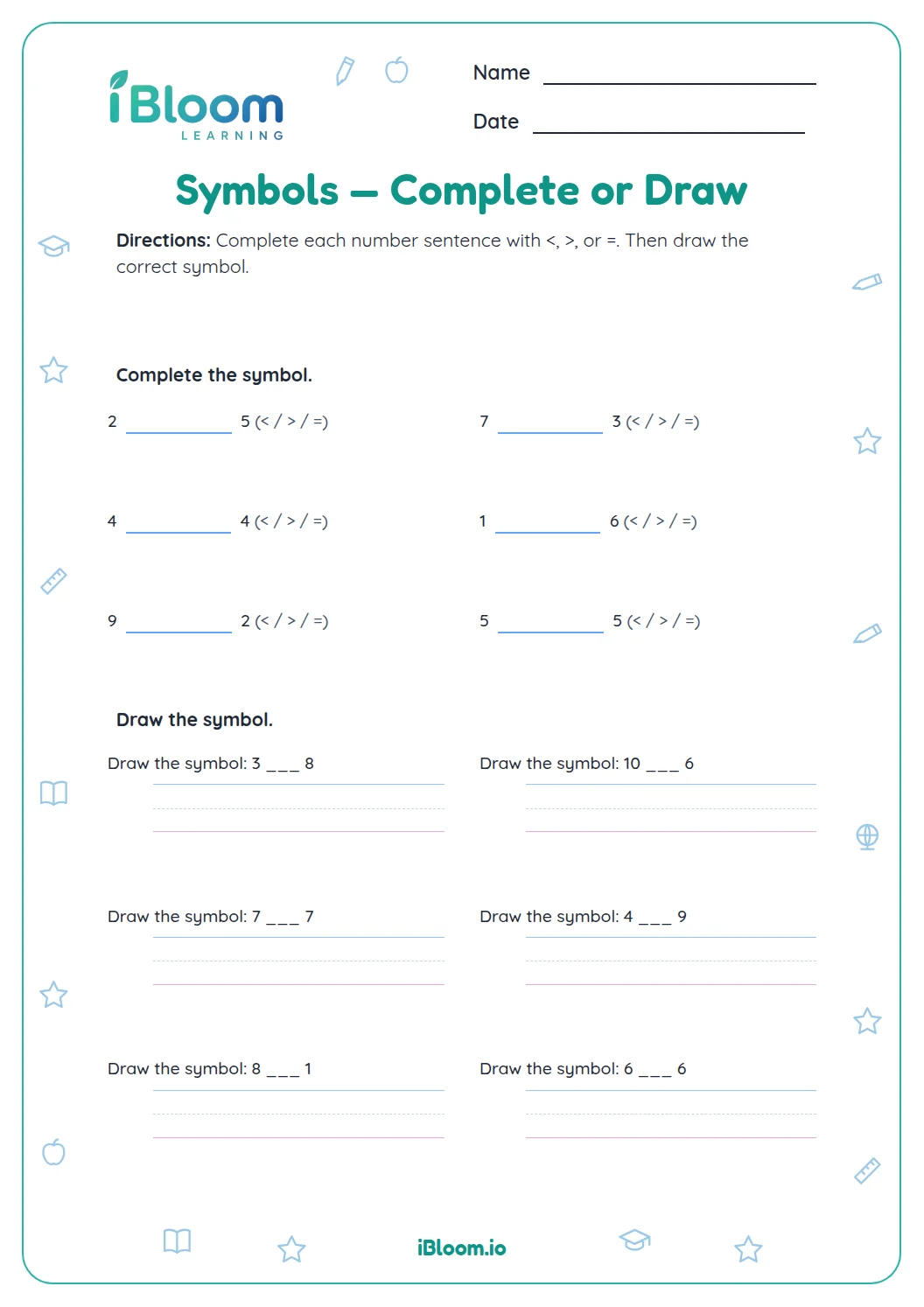
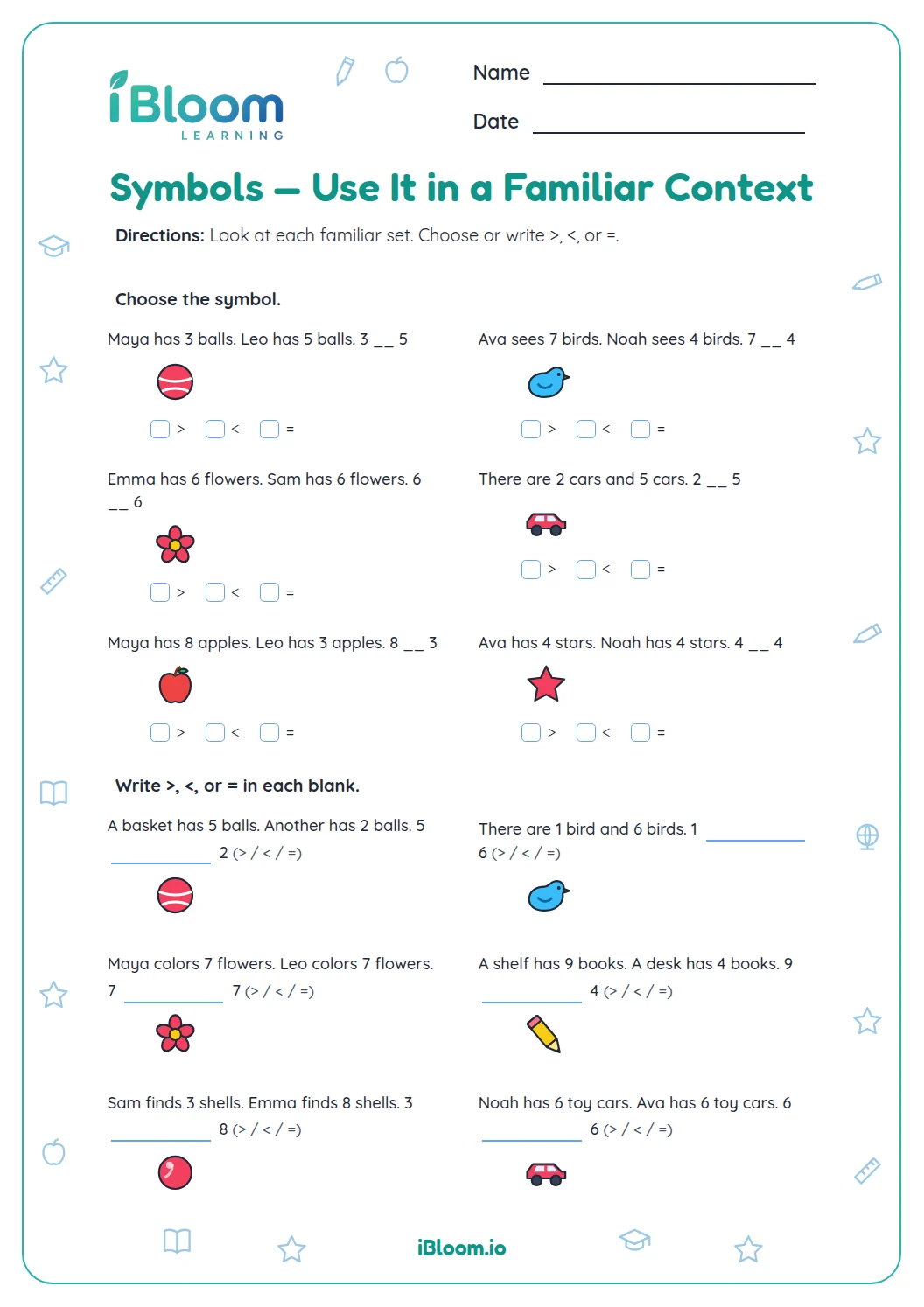
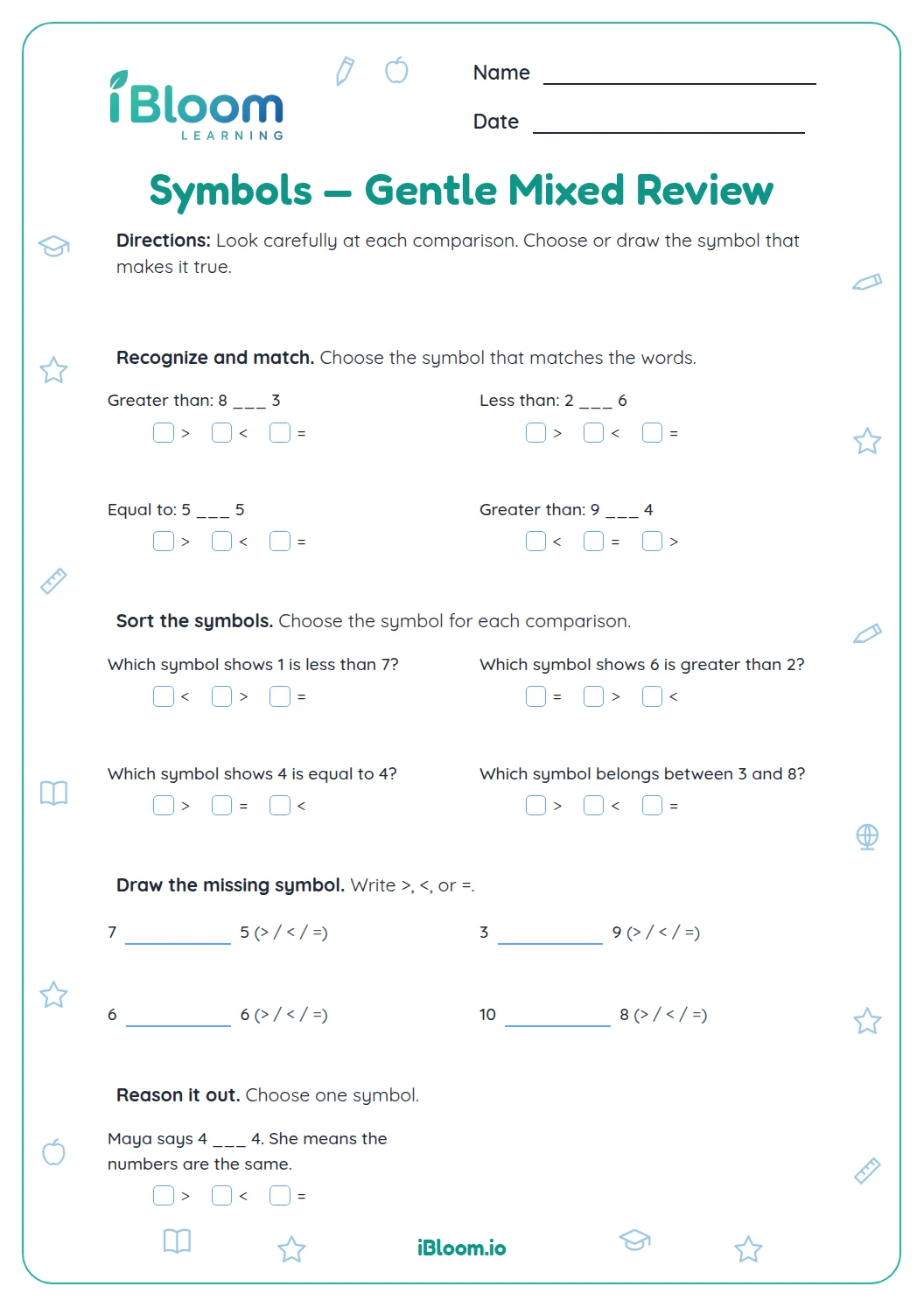
This free printable Kindergarten worksheet gives children 15 chances to compare quantities and numerals. Four questions use countable picture groups, followed by greater-than, less-than, equal-to, and comparison-sign practice. It aligns with CCSS K.CC.B.5 and K.CC.C.6, and includes a separate answer key. The items move from counting small groups to deciding which numeral or group is greater, lesser, or the same.
Aligned to K.CC.B.5 and K.CC.C.6
How can counting help compare groups?
Count each pictured object once, then compare the totals. A group with more objects has the greater number. Questions 1–4 use familiar pictures to practice one-to-one counting.
- 1Count 1, 2, 3, 4, 5, 6, 7 apples.
- 2There are 7 apples.
What do <, =, and > mean?
The open side points toward the greater number. The two short sides meet at the lesser number. An equals sign means both sides have the same amount.
- For 2 ___ 5, choose <.
- For 6 ___ 6, choose =.
What skills appear in the mixed review?
The last part asks children to compare familiar quantities such as toy cars, kites, birds, and nests. Children can count or match the two groups before choosing.
How to use this worksheet
- 1Count each pictured object once, touching or pointing as you say each number.
- 2Compare the final counts: ask which number is greater or less.
- 3Read the whole comparison before picking a sign.
- 4For < and >, point the open side toward the greater number.
- 5Check each response with the answer key and recount missed groups.
Common mistakes and quick fixes
The mistake
Skipping an object or counting one twice.
The fix
Touch one picture at a time and move across the row.
The mistake
Choosing the larger-looking digit instead of comparing its value.
The fix
Say both number names and decide which comes later in the count.
The mistake
Turning < and > around.
The fix
Remember that the open mouth faces the greater number.
Common Core alignment
This worksheet practices counting and comparing small quantities.
Count objects and compare quantities up to 20.
On this sheet: The four picture counts ask children to count groups of 5–9 objects.
Show the official wordingHide the official wording
Count to answer "how many?" questions about as many as 20 things arranged in a line, a rectangular array, or a circle, or as many as 10 things in a scattered configuration; given a number from 1-20, count out that many objects.
Compare two groups and name the greater, lesser or equal group.
On this sheet: The remaining items compare numeral pairs and quantities.
Show the official wordingHide the official wording
Identify whether the number of objects in one group is greater than, less than, or equal to the number of objects in another group, e.g., by using matching and counting strategies.
What to practice next
Make more practice
Further reading
Questions parents and teachers ask
What does this Kindergarten worksheet practice?
Count slowly from left to right, touching each picture once as you say each number. For the seven apples in question 1, point to each apple and stop when every one has been counted. Then match the total to the choice.
How many questions are included?
The sheet has 15 questions: four picture counts, four numeral comparisons, four comparison-sign choices, and three quantity comparisons. Children move from counting pictured sets to comparing written numbers and groups. Each question has one clear answer, and a separate key is included.
How should my child compare two groups?
Have your child count each group once, then compare the totals. Matching one object from each group is another way to see whether one group has more, fewer, or the same number. When comparing 4 and 7, say both number names and identify which comes later in the counting sequence. That number is greater; the other is less.
How do children remember the comparison signs?
For less than, the pointed end faces the smaller number; for greater than, the open side faces the larger number. An equals sign shows that both amounts are the same. For example, 2 < 5 and 6 = 6.
Is an answer key included?
Yes. A separate answer key gives the correct numeral or comparison sign for every item, so an adult can check the page after the child finishes. The answer key lists the count for each picture group and the correct response for every comparison. Ask the child to recount missed picture questions before correcting them.