


About this worksheet
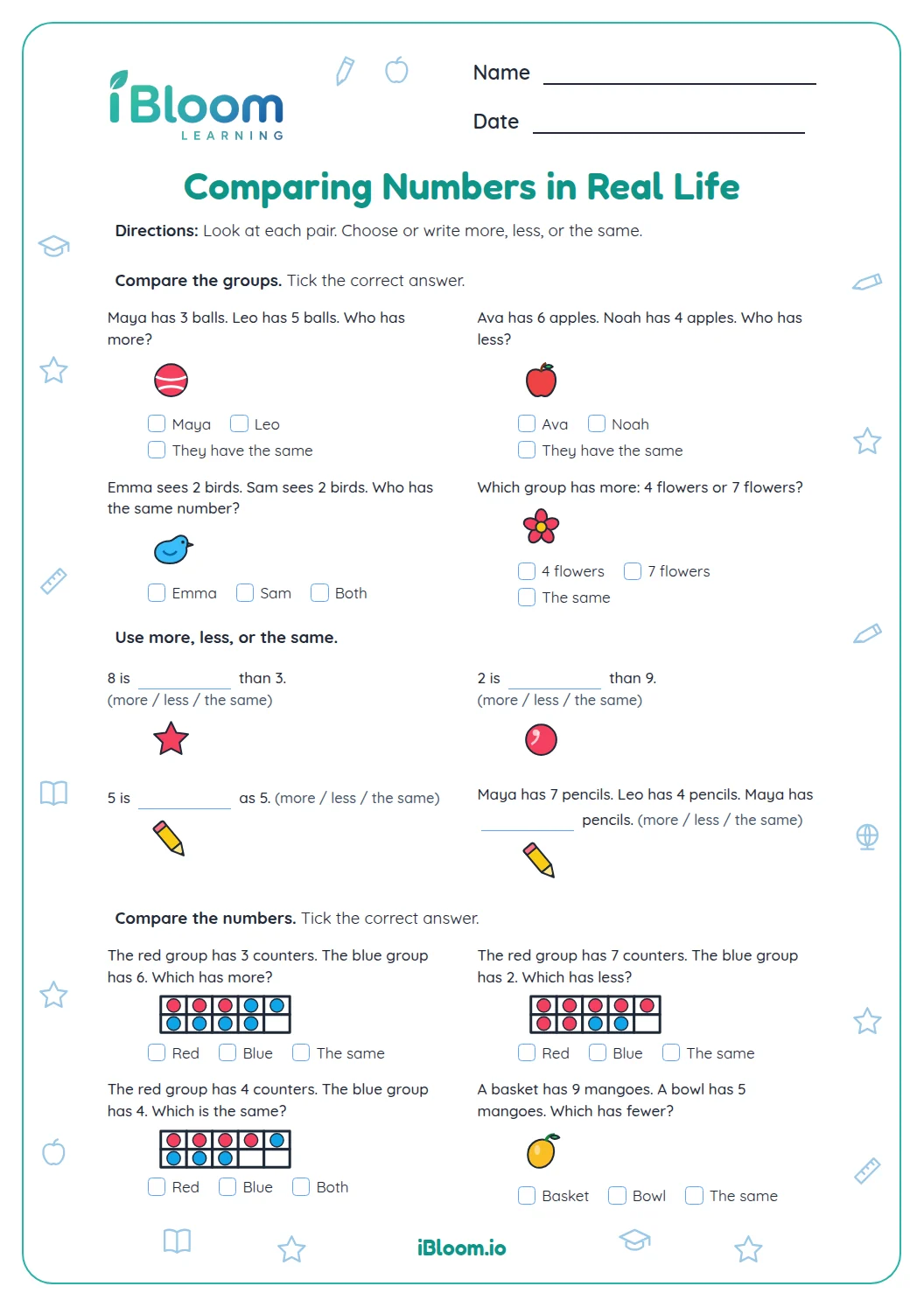
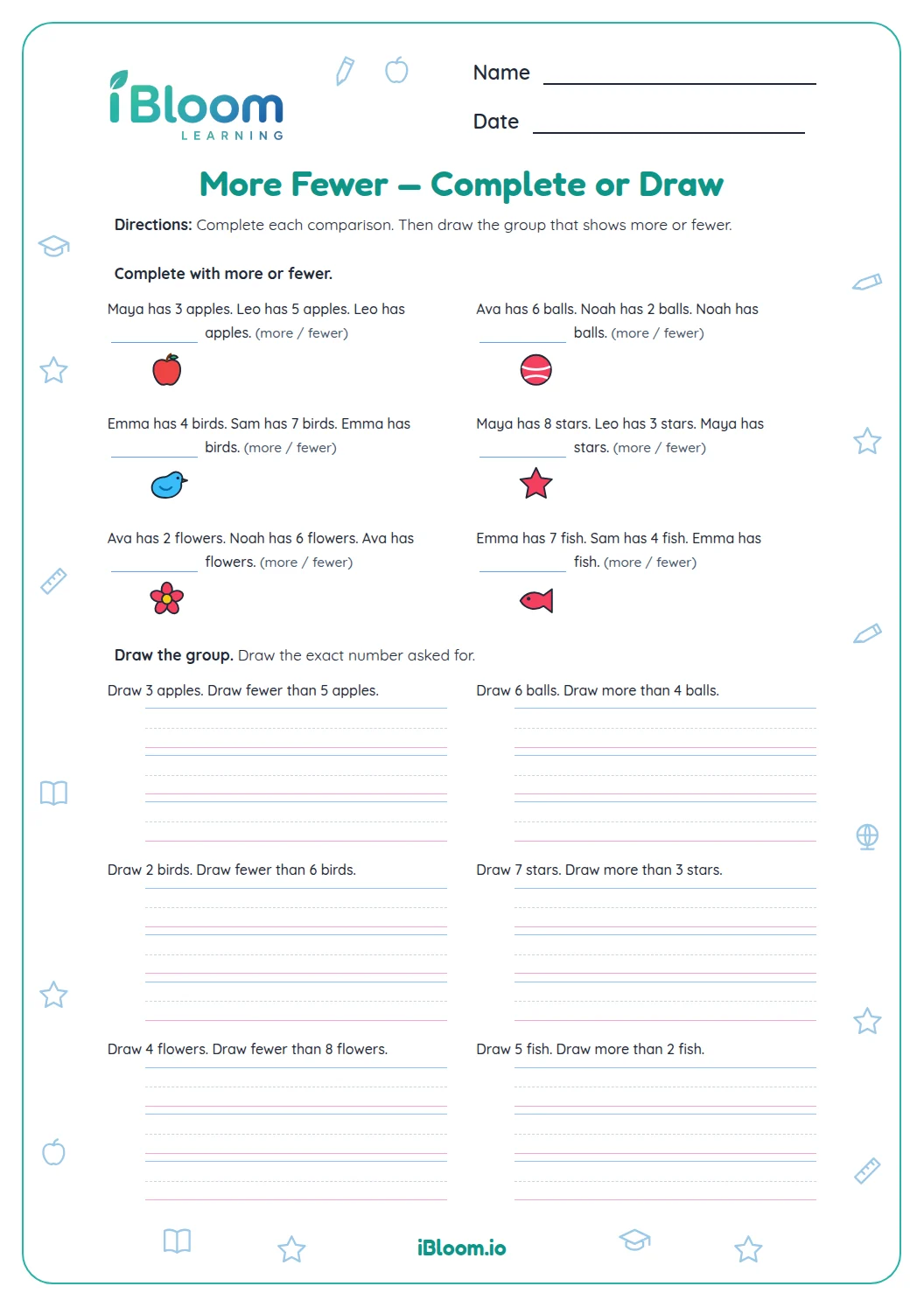
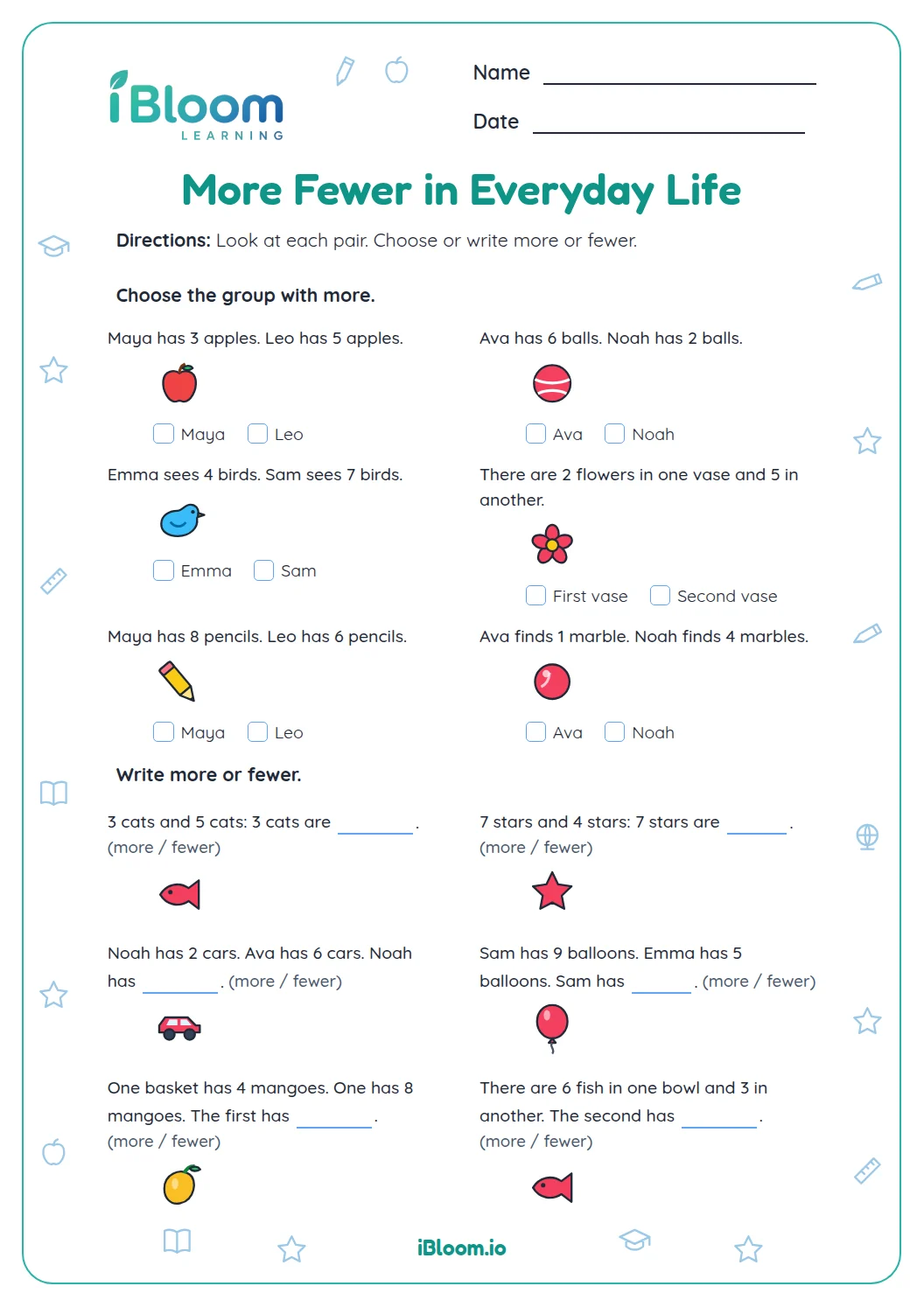
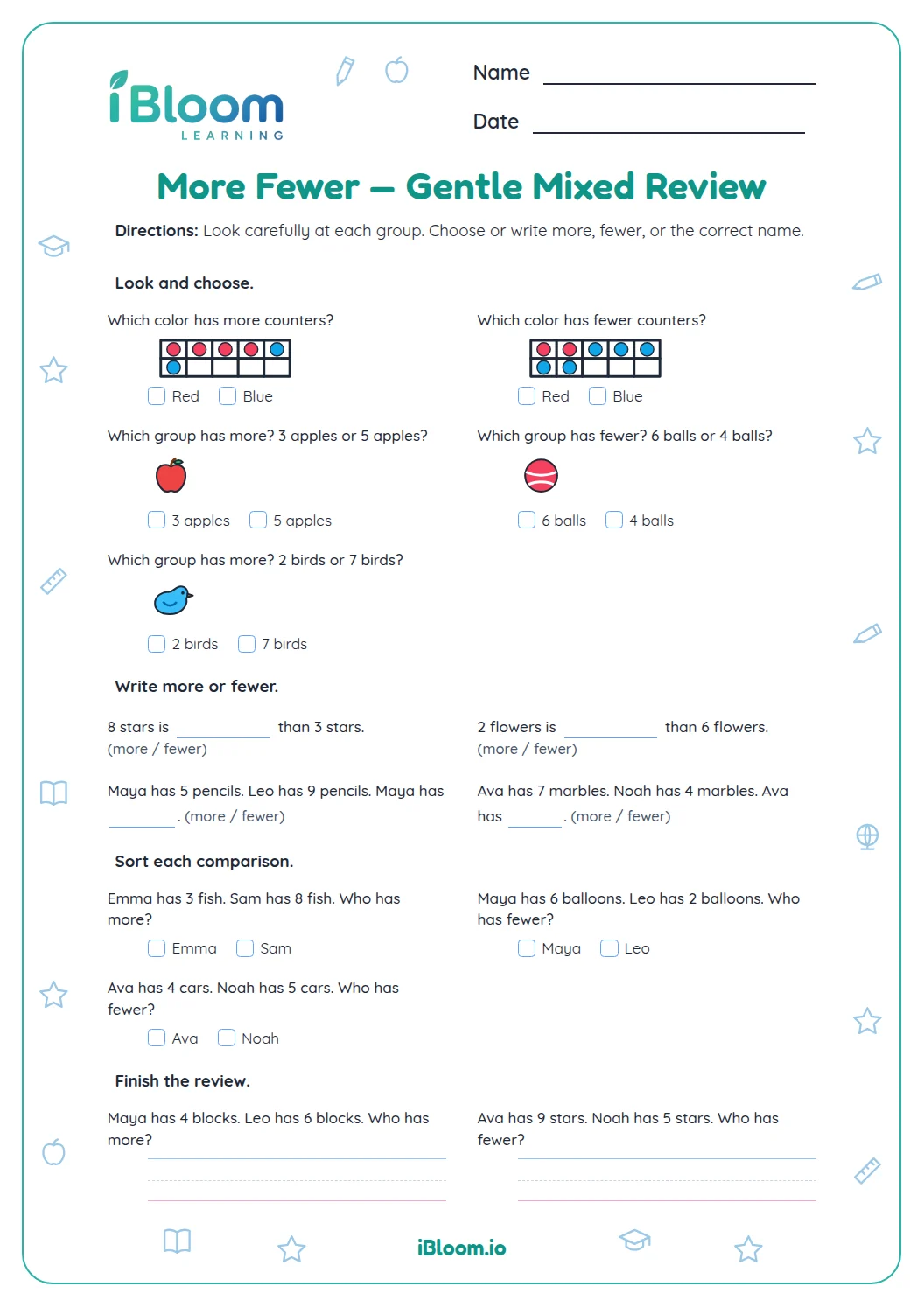
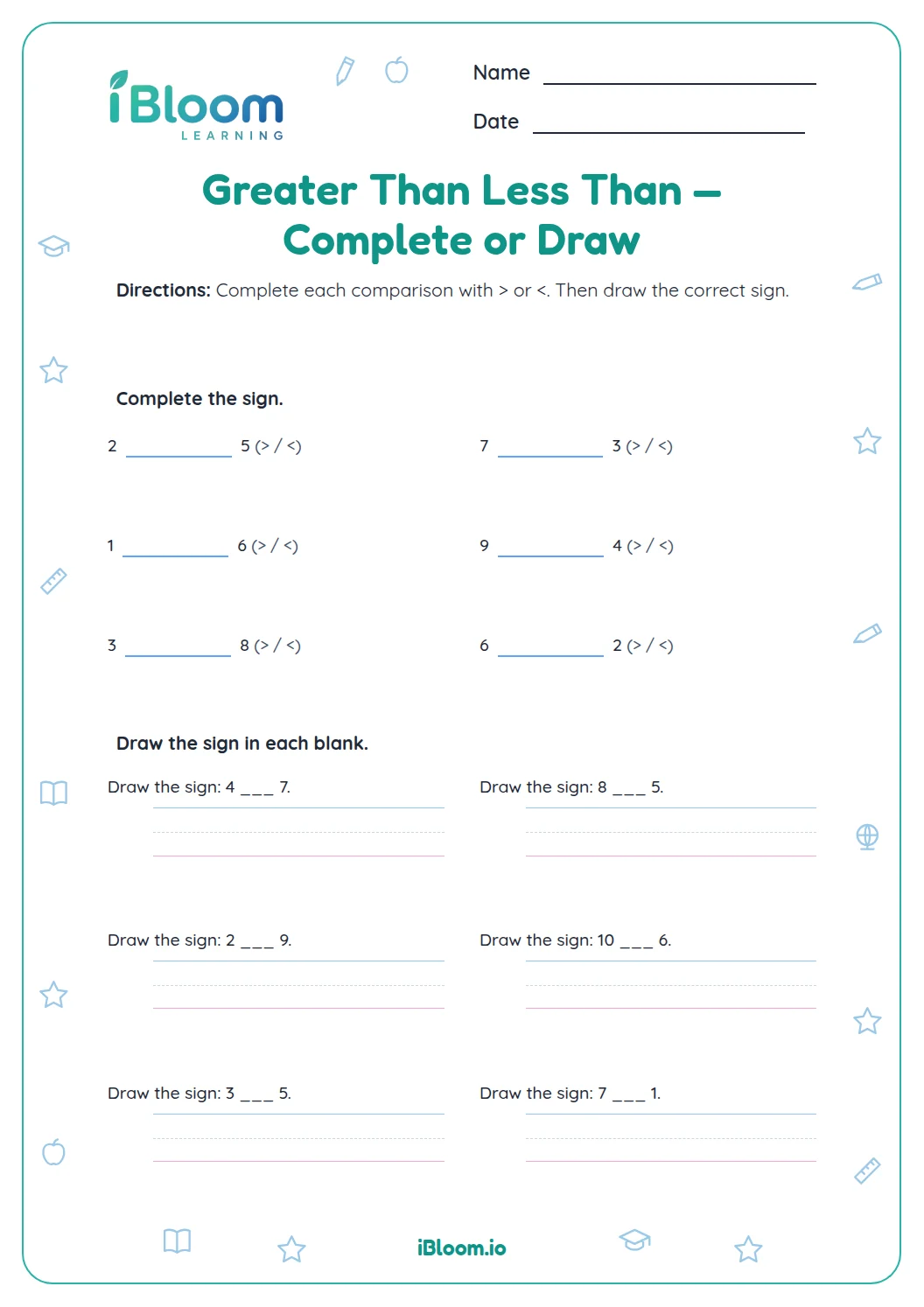
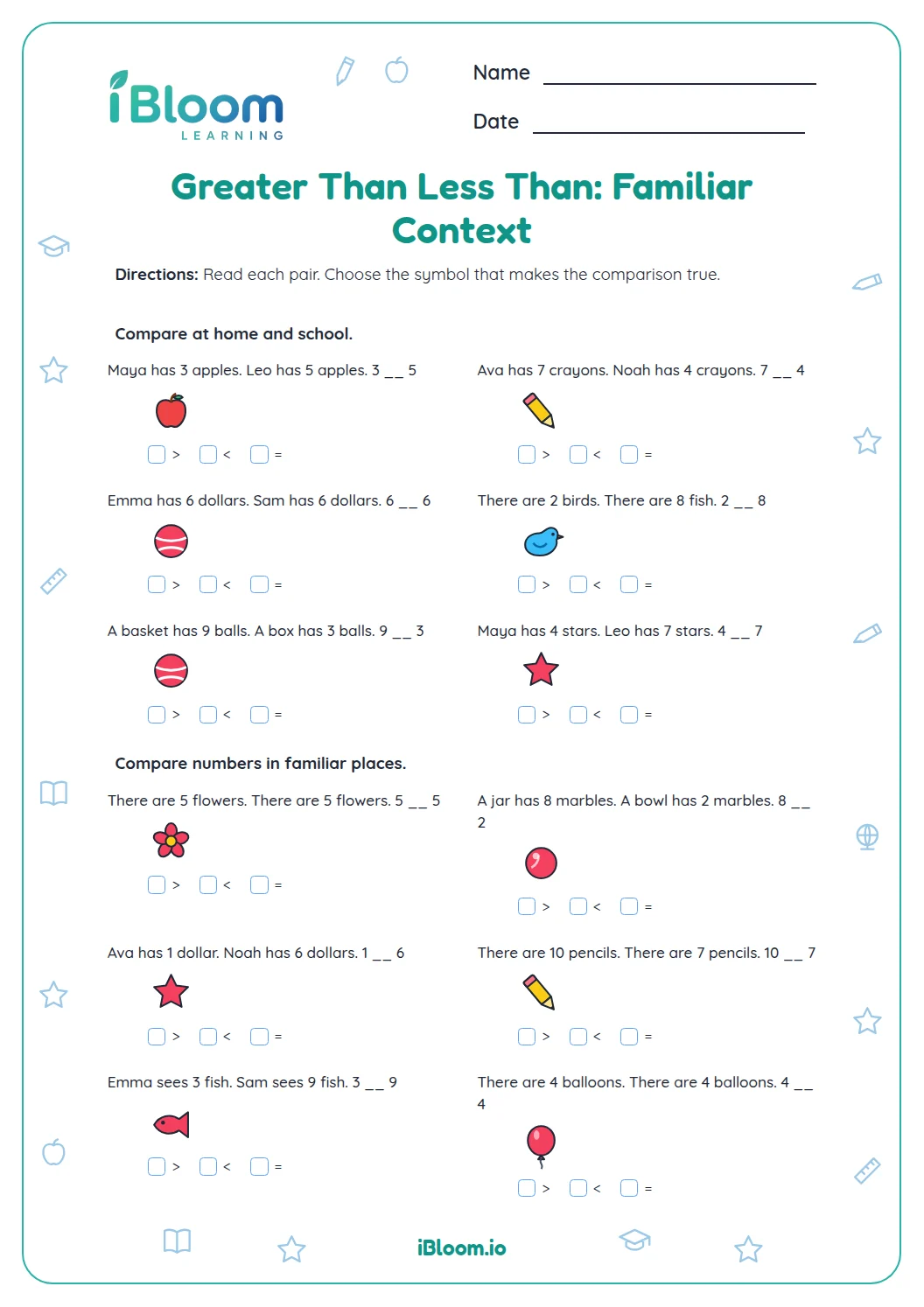
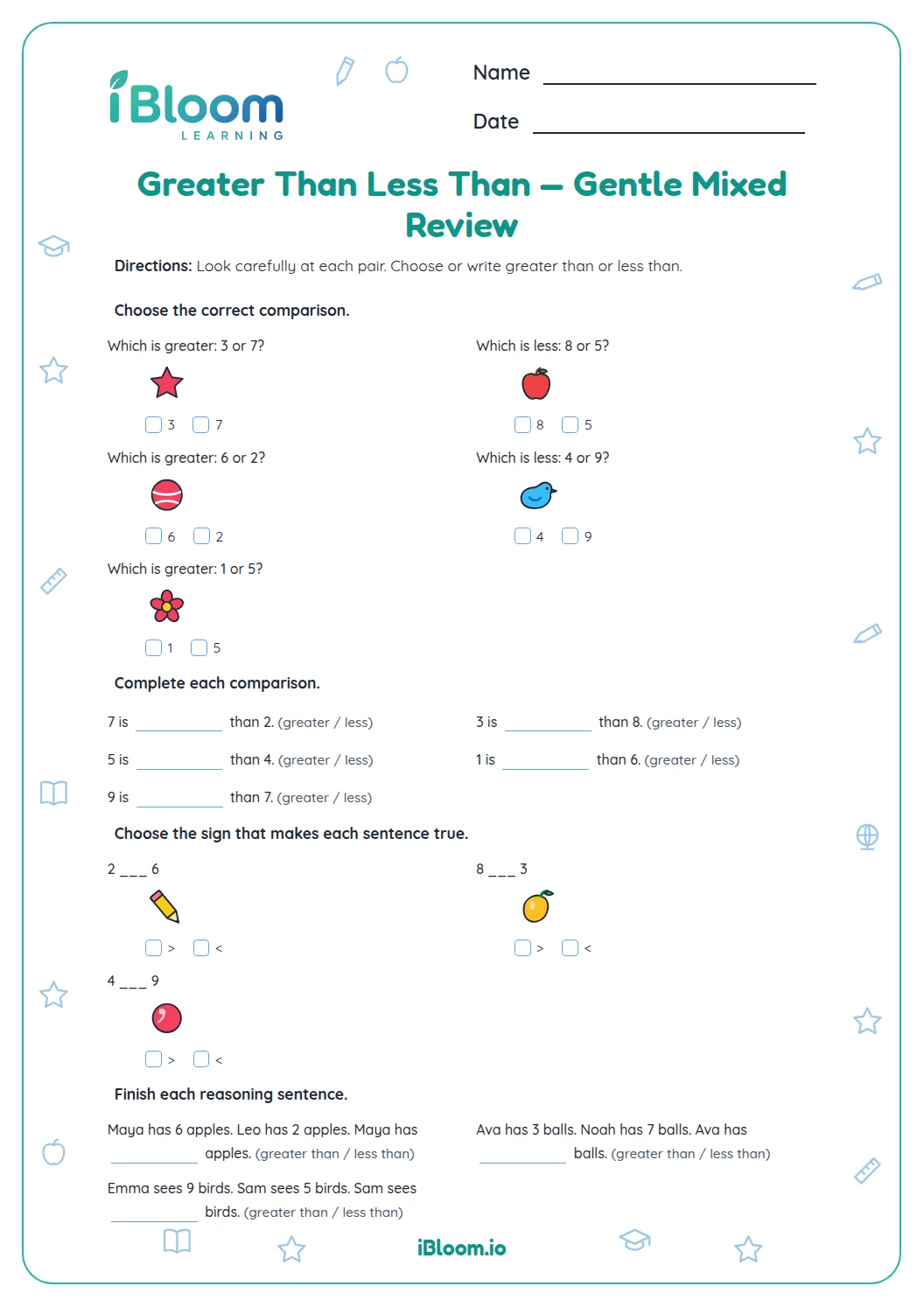
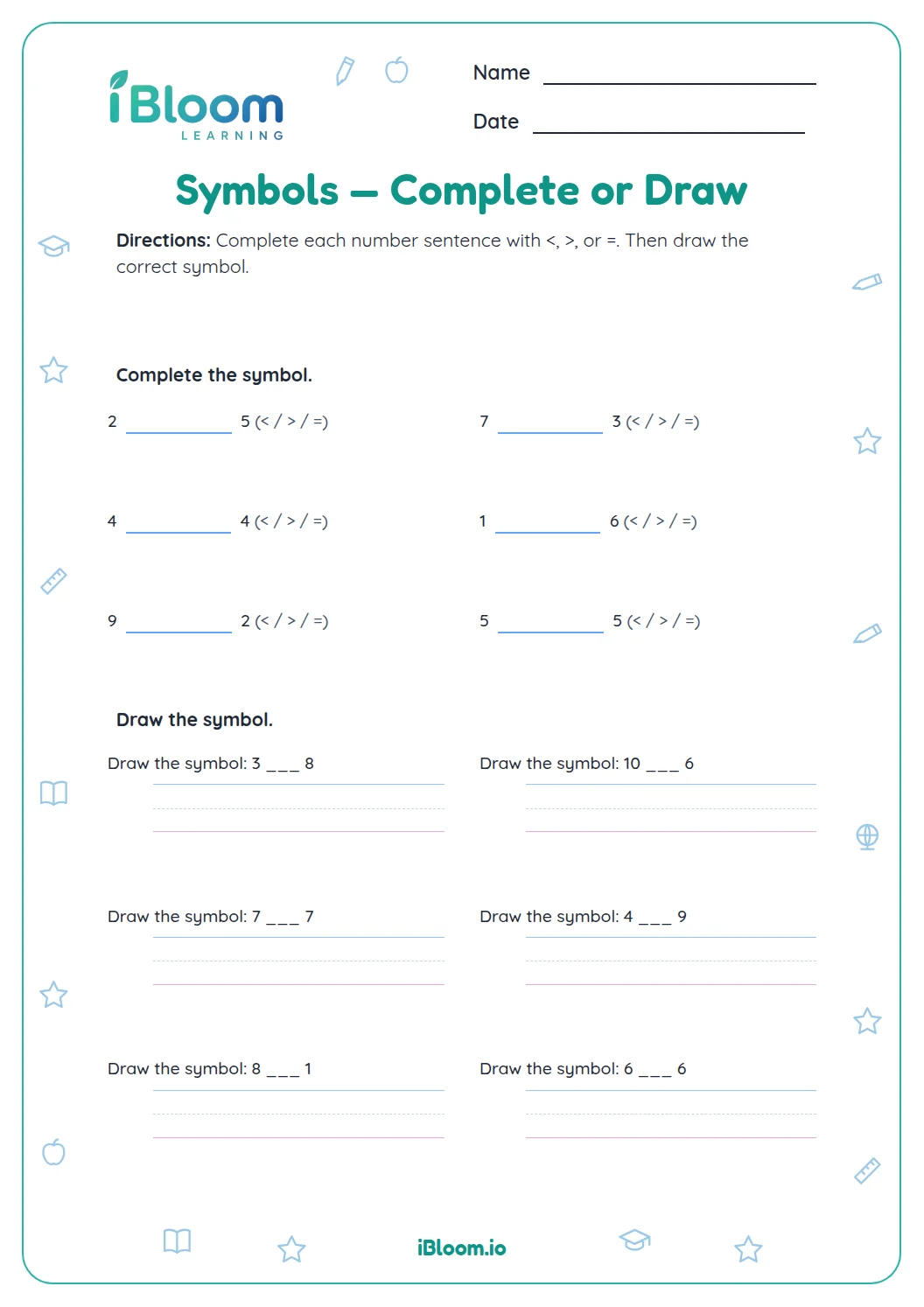
This free printable worksheet helps Pre-K and Kindergarten children compare two numbers from 1 to 10 using the words more than, less than and the same as. Part A gives six sentences, like "7 is ___ 4," and children color the bubble that completes it. Part B asks which of two numbers is more or less. In Part C they draw dots to make a group that is more than, fewer than or equal to a number. It practices Common Core K.CC.C.7, comparing written numerals, with drawing as a hands-on bridge. The answer key is a separate two-page file.
Aligned to K.CC.C.7
What does it mean to compare numbers in Kindergarten?
Comparing means deciding whether one number is more than, less than or the same as another. Young children usually know this about groups of things long before they can read numerals: they notice who has more crackers. The step on this sheet is carrying that idea over to written numbers from 1 to 10.
Children often get stuck with the words rather than the idea. More than, less than and the same as are three short phrases they need to hear and say many times. Reading each sentence aloud and tapping out the count helps the words stick.
How can a child tell which number is more?
The simplest rule is to count up. The number you say later is more, and the number you say earlier is less. For a child who is not sure, drawing a dot for each number and matching the dots one to one, pairing a dot from each group, shows what is left over.
Part C of this sheet builds that habit. Children draw their own dots, then compare what they drew with the number in the question, so every answer can be checked by counting.
- 17 is ___ 4.
- 2Count up: 1, 2, 3, 4 ... 5, 6, 7. We say 7 after 4.
- 3So 7 comes later, and 7 is more than 4.
- 4Check with dots: draw 7 dots and 4 dots. Pair them up. 3 dots have no partner.
- 5Answer: more than
What is on this worksheet?
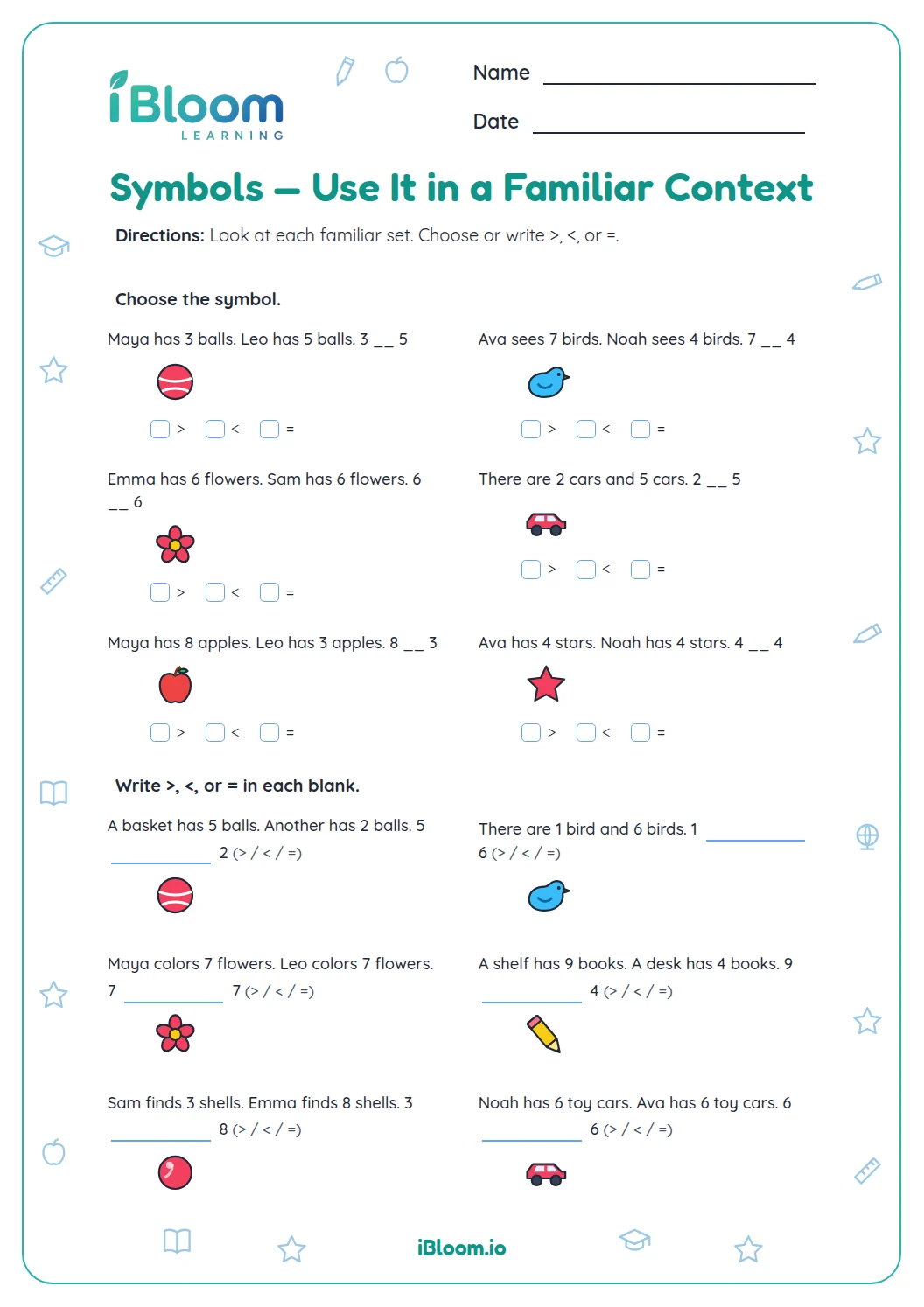
Part A has six sentences with a blank: 3 is ___ 5, 7 is ___ 4, 6 is ___ 6, 2 is ___ 8, 9 is ___ 3 and 5 is ___ 5. Each has three bubbles (more than, less than, the same as), and two of the pairs are equal, so children learn that the same as is a real answer, not a trick.
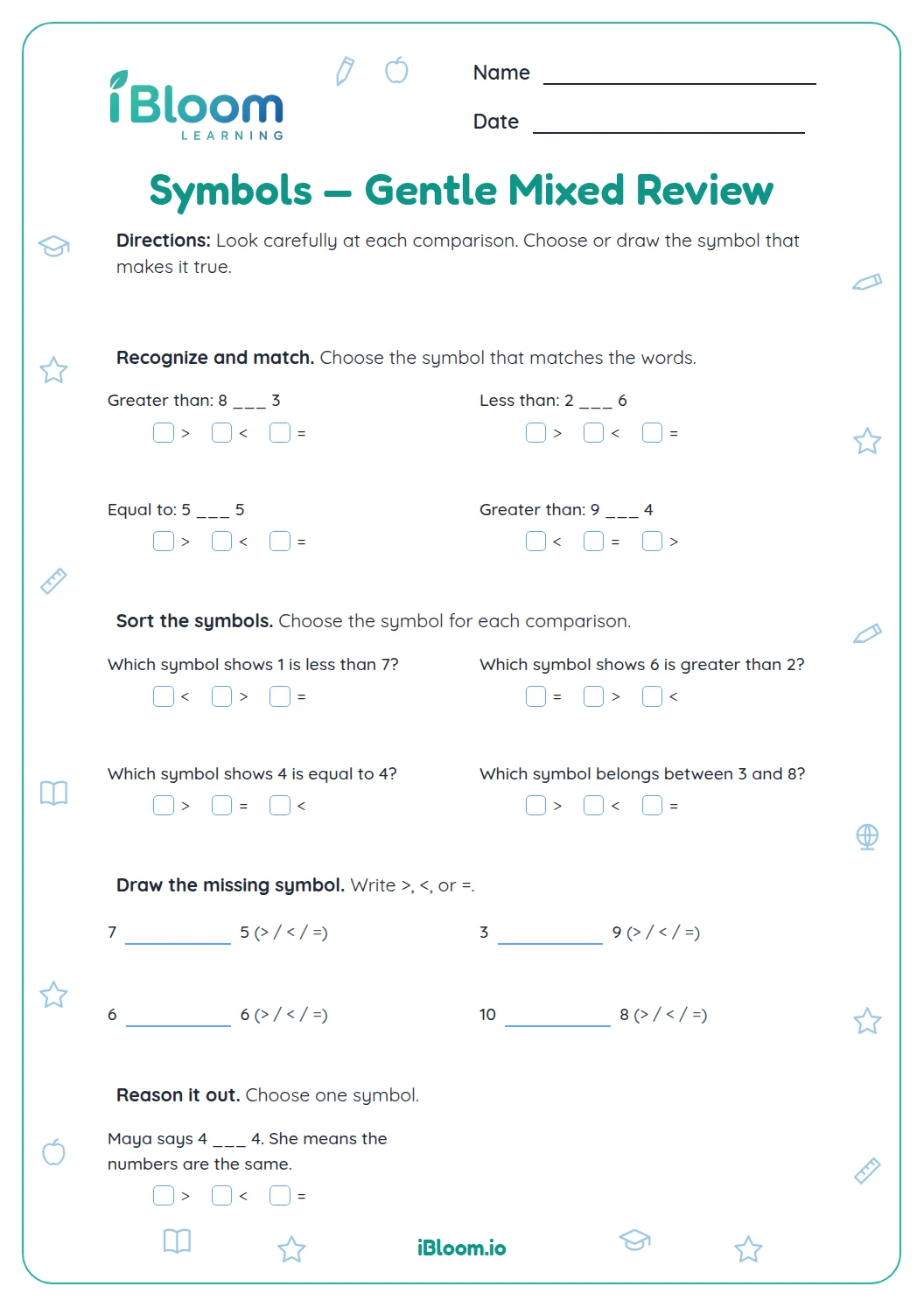
Part B asks "Which number is more?" or "Which number is less?" for pairs such as 4 and 9, 6 and 2, 10 and 7, and 1 and 5. Part C asks children to draw more dots than 2, fewer dots than 6, and the same number of dots as 4, with an open space for each drawing.
- Part A: 6 sentences, color more than, less than or the same as
- Part B: 4 questions, color the number that is more or less
- Part C: 3 drawing tasks, with space to draw dots
- Numbers used: 1 to 10
How can adults help a child who is just starting?
Read each question aloud and let your child point and say the numbers. For Part C, an adult can write the target number lightly beside each drawing space. Children who are still learning to count past 5 can start with the smaller numbers and come back to 9 and 10 later.
Be ready for answers that differ from the key in Part C. There is more than one right drawing for "more than 2" or "fewer than 6," and children should check their own count against the number in the question.
How to use this worksheet at home or in class
- 1Warm up with two small piles of objects. Ask, "Which pile has more? Which has less? Are they the same?"
- 2Read question 1 together. Say "3 is ___ 5" and count up from 3 to find out which is bigger.
- 3Let your child color the bubble for each sentence in Part A, saying the sentence aloud with the answer.
- 4In Part B, ask your child to count up to each number and notice which one is said later.
- 5In Part C, count each group of drawn dots together and match it to the number in the question.
- 6Check with the answer key. If an answer is wrong, draw both groups and match the dots one to one.
Common mistakes and quick fixes
The mistake
Choosing the bigger numeral by how it looks, or always picking the first number, rather than counting. For example, saying 2 is more than 8 because 2 comes first.
The fix
Count up from 1 and ask which number is said later. Then draw 2 dots and 8 dots, and match them one to one.
The mistake
Skipping the same as option when two numbers are equal, as in 6 is ___ 6.
The fix
Draw 6 dots twice and pair them up. When nothing is left over, the groups are the same as each other.
The mistake
Drawing the wrong number of dots in Part C, for example exactly 2 dots for "more dots than 2."
The fix
Have your child draw the number in the question first, then add a dot or more for "more," or stop short for "fewer." Count the drawing aloud and compare.
Common Core alignment
Most US states use the Common Core math standards or a close state version, so this sheet fits Kindergarten counting and comparing in most classrooms.
Say whether one number from 1 to 10 is more than, less than or the same as another.
On this sheet: Parts A and B compare two written numerals from 1 to 10; Part C ties each number to a drawn group.
Show the official wordingHide the official wording
Compare two numbers between 1 and 10 presented as written numerals.
What to practice next
Make more practice
Further reading
Questions parents and teachers ask
What does the same as mean on a comparing numbers worksheet?
It means the two numbers are equal. On this sheet, 6 is the same as 6 and 5 is the same as 5. Young children often think one number must always be more, so seeing two equal pairs helps them learn that same is a real answer.
How do I know whether my child should draw 3 dots or 8 dots for more than 2?
Any number of dots greater than 2 is correct, from 3 to 10 if you keep to numbers within 10. There is no single right drawing. Ask your child to count the dots aloud and tell you why the number is more than 2.
What if my preschooler is not ready for numbers up to 10?
Start with the smaller pairs, such as 3 and 5 or 6 and 6, and keep dots nearby for matching. Read each sentence aloud and let your child point. Leave the larger numbers like 9 and 10 for another day, or return to them once counting is steady.
Which questions does the answer key cover?
The answer key shows all 13 answers. For the first two drawing tasks it gives one sample, because many drawings are correct, and it notes the range of right answers. The same-as-4 task has just one answer: exactly four dots. Check your child's drawing by counting the dots together.
Why not teach the greater-than and less-than symbols now?
Many children mix up the symbols, so it is better to secure the ideas of more, less and the same first. Words and drawn dots give them meaning before the symbols are added. When your child answers these comparisons easily, move on to the Symbols sheet.
How long does this worksheet take?
Most children finish in about 15 minutes. Parts A and B go quickly, while the drawing in Part C takes longest, since each child draws and counts their own dots. Break it into two sittings for younger children, doing Parts A and B first.