





About this worksheet
This printable introduces one through pictures, numeral choices, number sequences, a drawing prompt, and numeral tracing. Adults can read directions aloud while children point, choose, count, or write. The answer key gives a check for each of the 15 prompts.
Aligned to K.CC.A.3
How does a child connect one to a group?
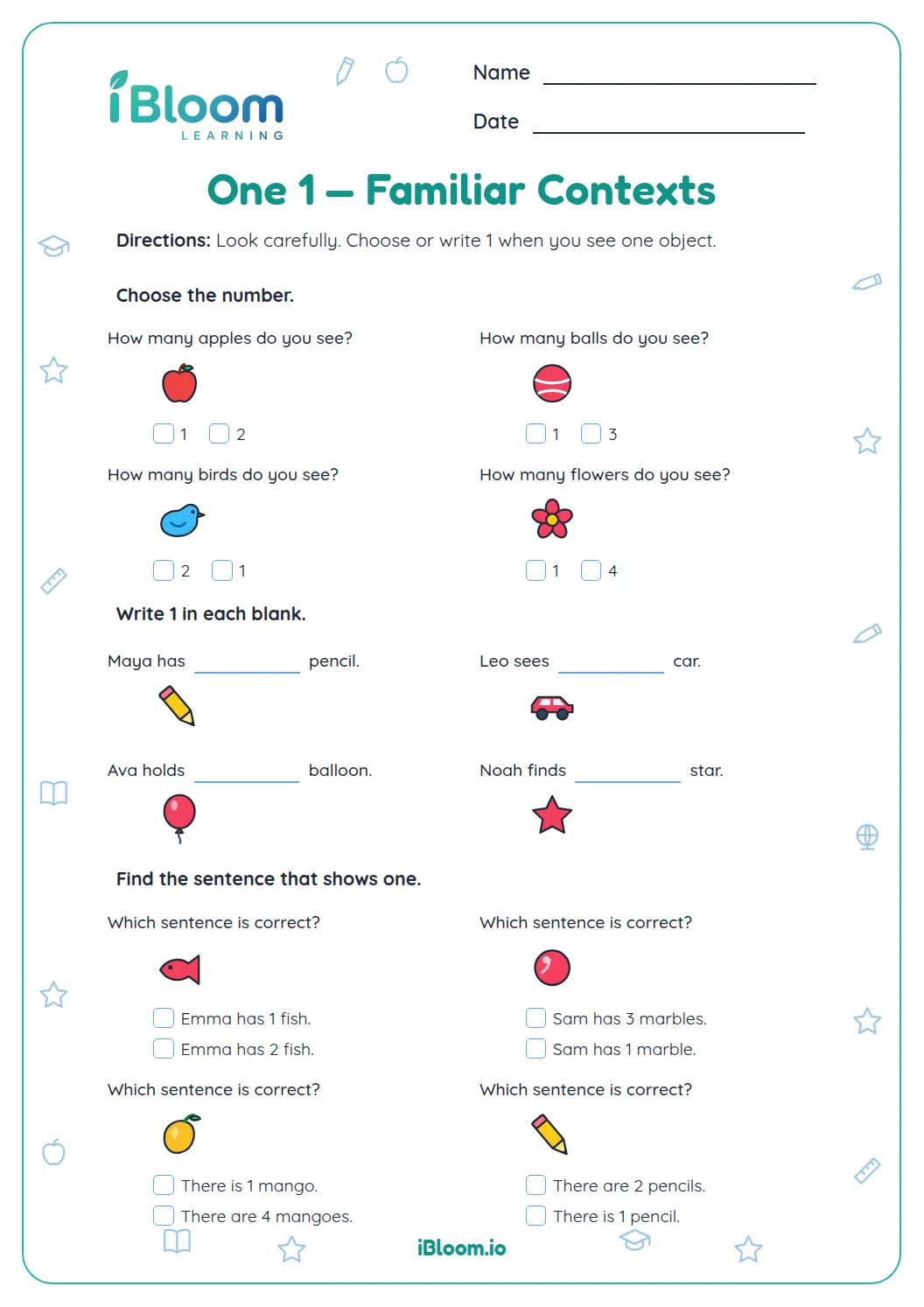
Count each pictured group and choose its total. Some groups contain one object; others contain two or three, so each question needs a fresh count.
How does the page revisit one?
Picture choices, number words, numerals, and short sequences give several compact ways to recognize one and its neighbors.
How to use the worksheet
- 1Read each short prompt aloud and let the child point to a choice.
- 2Touch each pictured object once while counting.
- 3Say “one” and connect it to the numeral 1.
- 4For the drawing item, check that the box has exactly one dot.
- 5Trace the numeral from the top down, then review the answer key together.
Common mistakes and quick checks
The mistake
Choosing a group with more than one object
The fix
Touch and count each item; stop when the total is one.
The mistake
Mixing up the numeral 1 and the word one
The fix
Say the number aloud, then match its spoken name to the printed symbol.
The mistake
Adding extra dots to the drawing
The fix
Count the marks in the box and leave exactly one.
Curriculum alignment
This worksheet practices K.CC.A.3.
Write and recognize the numeral 1 for a group of one object.
On this sheet:
Show the official wordingHide the official wording
Write numbers from 0 to 20. Represent a number of objects with a written numeral 0-20 (with 0 representing a count of no objects).
What to practice next
Make more practice
Further reading
Questions parents and teachers ask
What number ideas does this page practice?
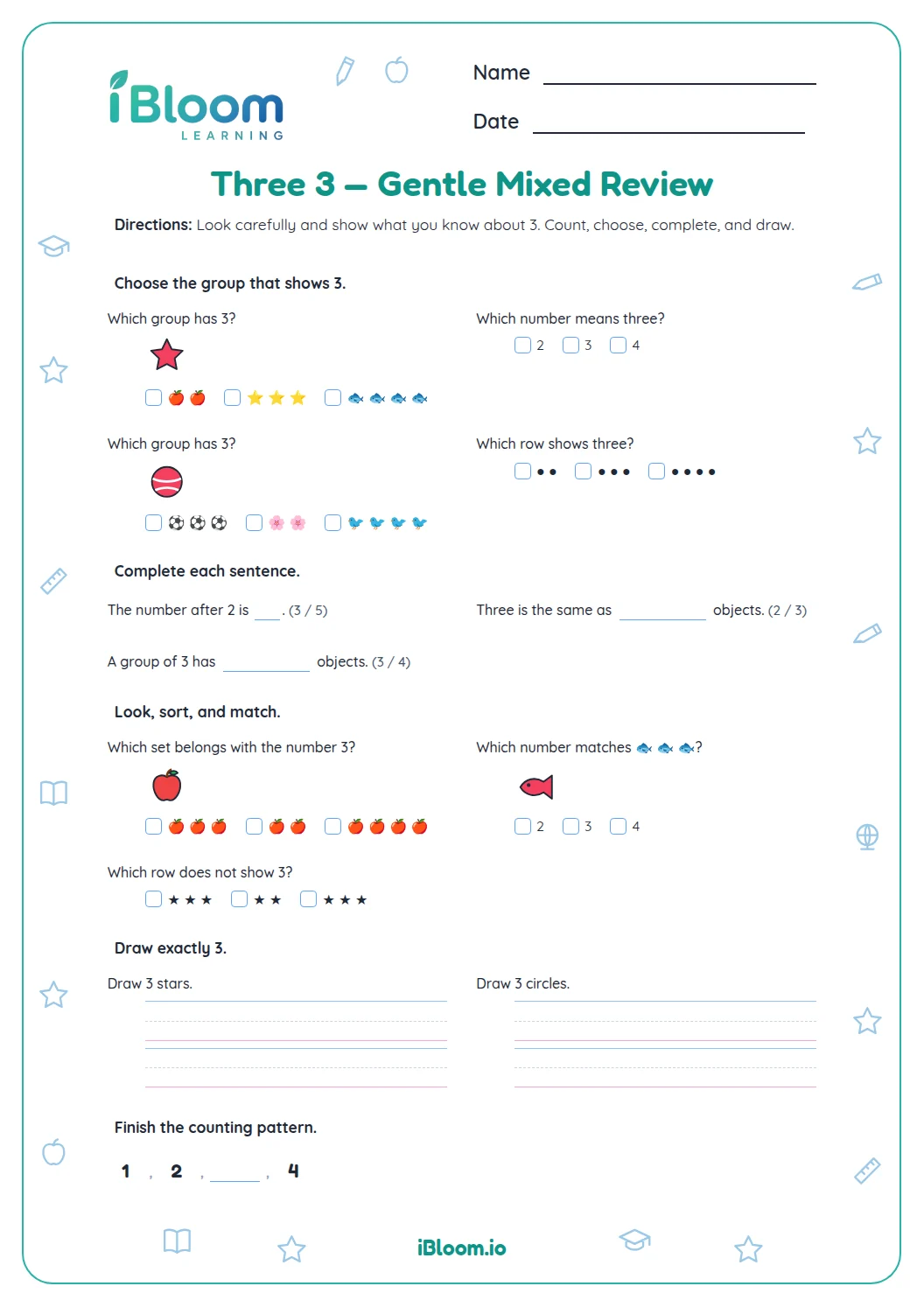
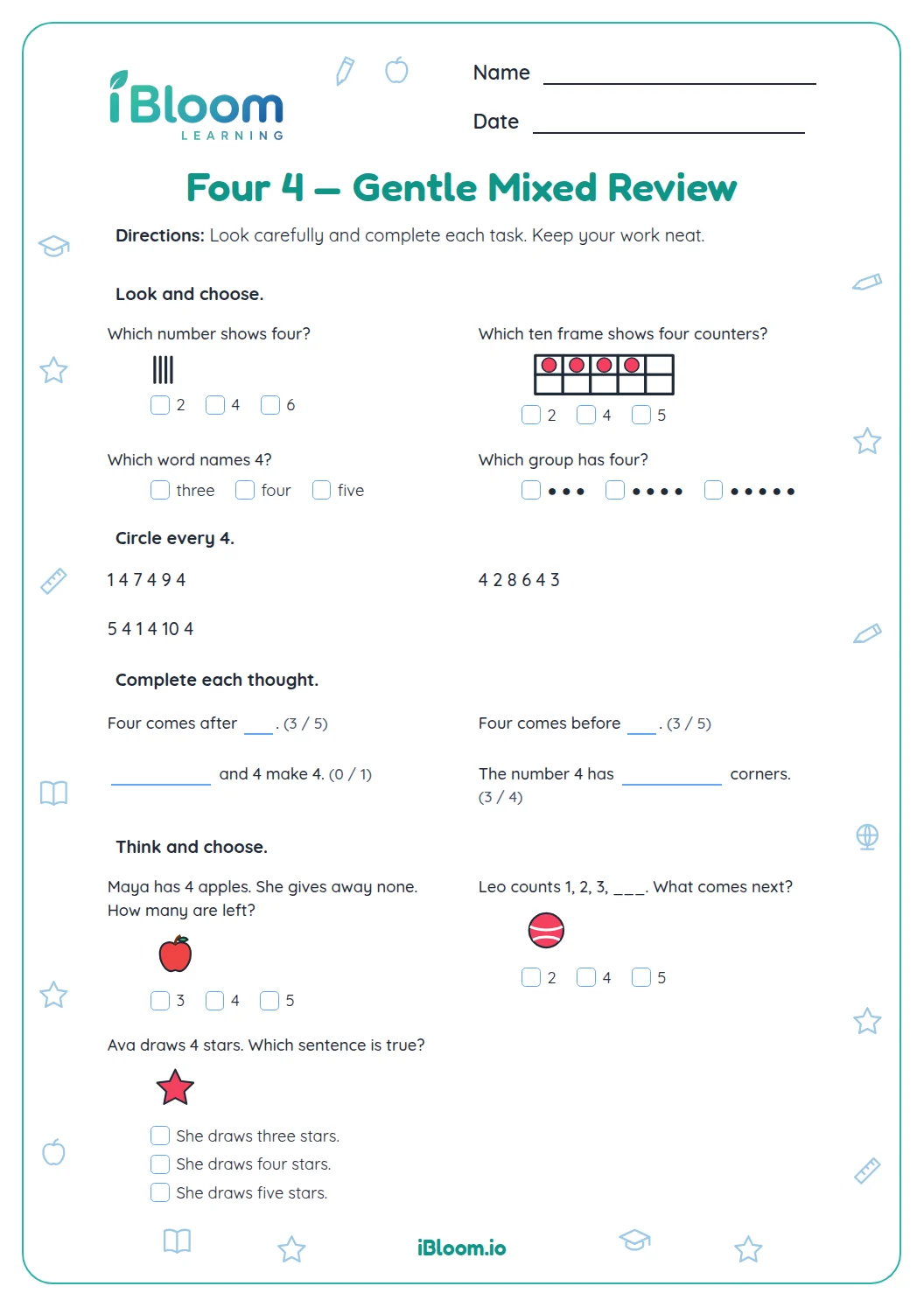
Children count groups with one, two, or three objects, identify the numeral and word one, and complete short number sequences. Picture groups use birds, apples, stars, balls, fish, and flowers, so children practice counting different familiar objects. Several questions ask learners to choose the written numeral or number word that matches one. An adult can read each prompt aloud.
Can I read the questions aloud?
Yes. The prompts are short, and an adult can read them while the child points to pictures or answer choices. This lets a beginning learner take part without needing to read every word on the page. Invite the child to say the number while pointing to the answer.
What should I do if my child counts a picture incorrectly?
Touch each object once and count slowly together. Then ask how many objects there are altogether. When the group contains one object, connect that count to the spoken word “one” and the numeral 1. Invite the child to say the number while pointing to the answer.
Why are there picture choices?
Pictures make the idea of one concrete. The child can compare groups and count familiar objects before answering with a numeral or word. The page keeps picture-based tasks alongside numeral practice. Invite the child to say the number while pointing to the answer.
What does the answer key show for drawing and tracing?
The key treats the drawing as correct when it contains one dot. For tracing, the expected response is the numeral 1. A child’s traced shape can vary as long as it is recognizable as the numeral. Invite the child to say the number while pointing to the answer.