


About this worksheet
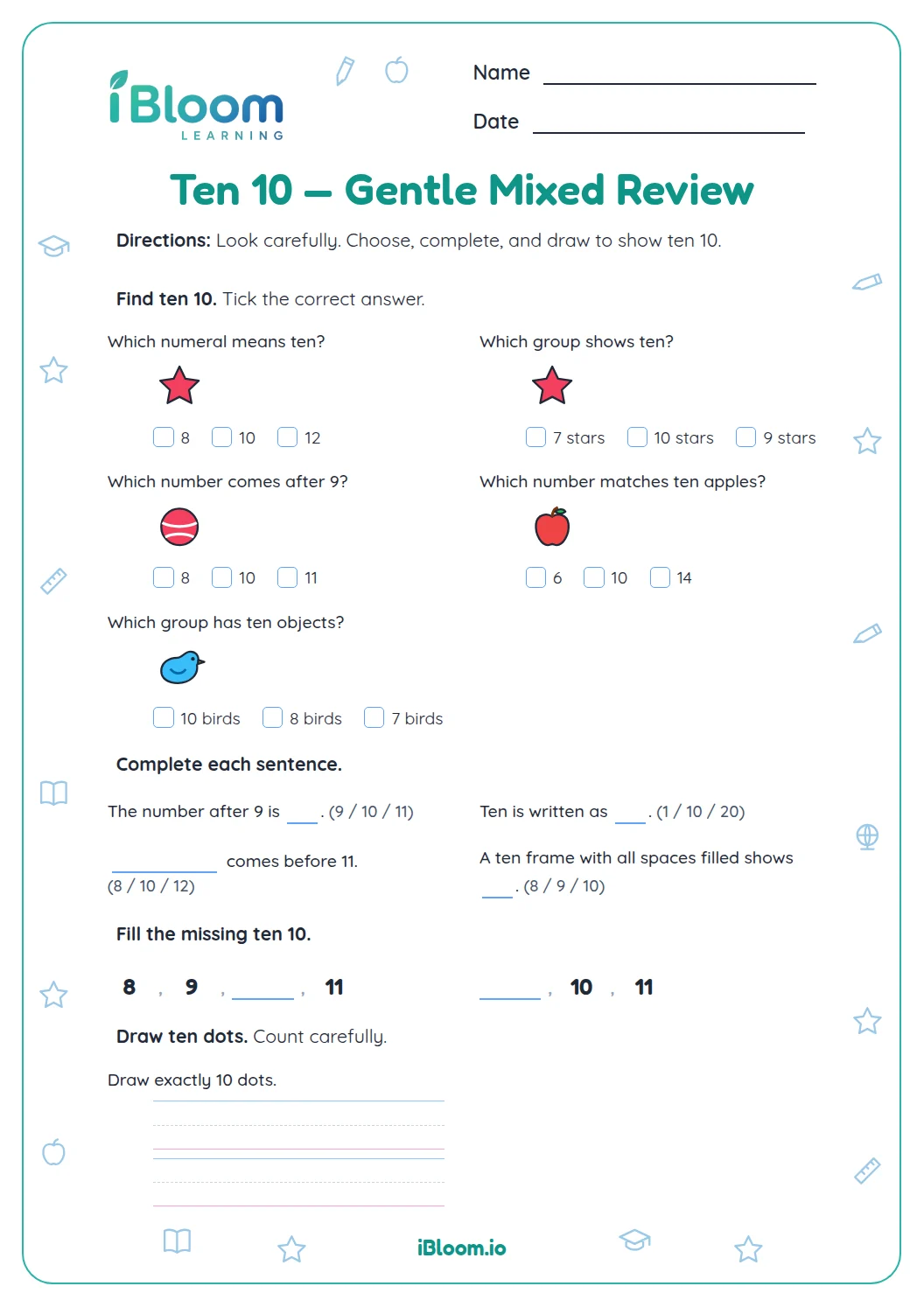
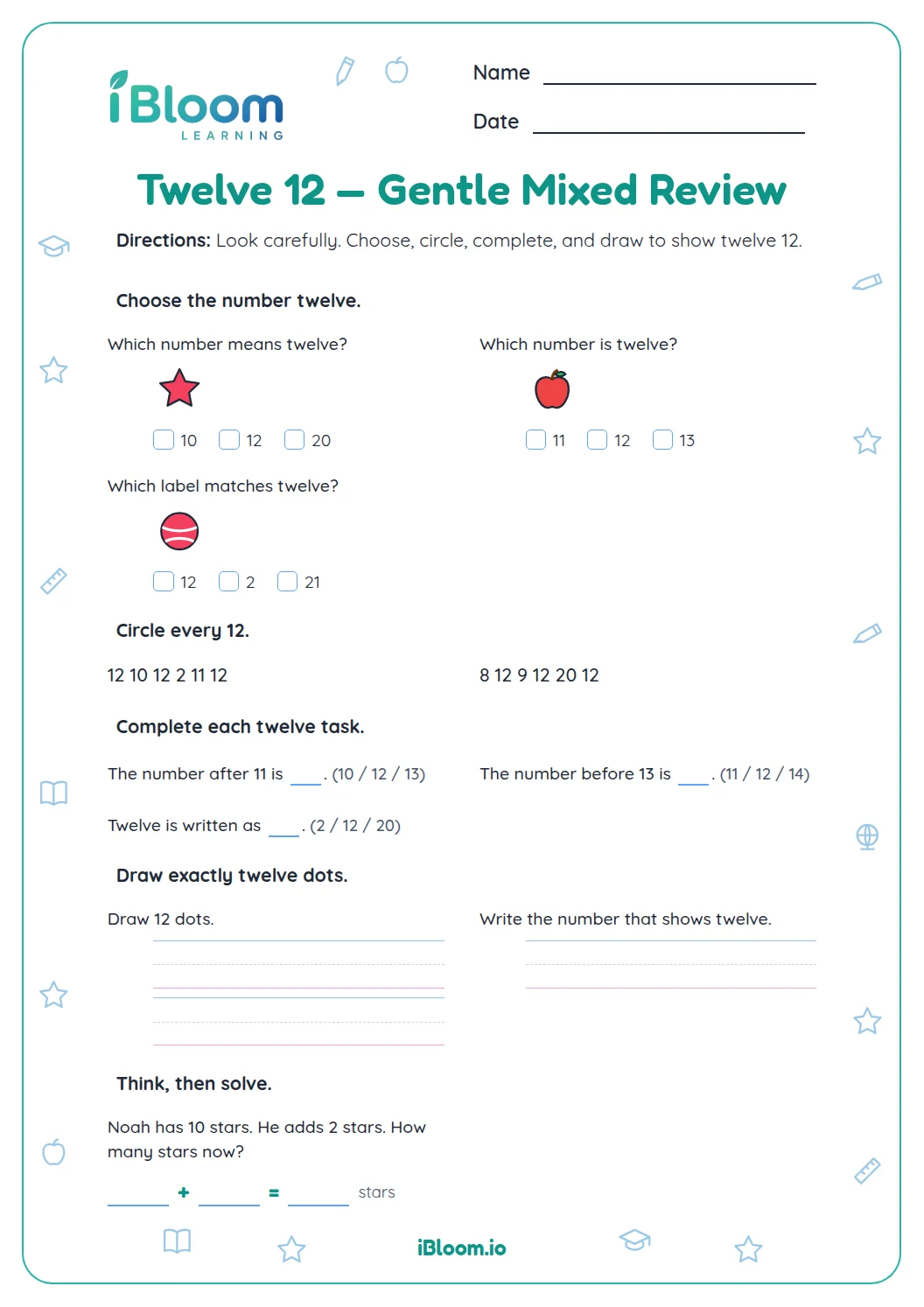
This preschool and kindergarten sheet keeps the original focus on completing ten and drawing a group of ten. Children trace the numeral, fill in counting and make-ten items, recognize 10, count pictured objects and draw ten dots. The separate key lists number answers and describes the drawing.
Aligned to K.CC.A.3
What is on this number 10 worksheet?
The sheet begins with tracing and completing number facts about ten. Children then recognize 10 among similar numerals and count pictured apples, stars and balloons. A drawing prompt returns to the original sheet’s request to draw a set of ten.
Point to each pictured object once while counting. For the drawing tasks, draw exactly ten of the named object in each box.
- Trace the numeral 10
- Complete counting and make-ten items
- Recognize 10 and count pictured objects
- Draw a group of ten dots
How can a child form the number 10?
Say “one, zero” while looking at the model. The 1 is a straight stroke; the 0 is a closed oval. Trace each digit, then try writing both together without lifting the pencil between digits.
When counting objects, touch or point to one item for each number word. Stop after ten and match the set to the numeral 10.
How can children check a group of ten?
Point to one object for each number word, starting at one and stopping at ten. A second count can catch a skipped dot or an object counted twice.
For q5, the count goes 8, 9, 10, 11, so the missing number is 10.
- 18, 9, ___, 11
- 2Count forward one number at a time: the missing number is 10.
Practice together
- 1Name 10 and trace the dotted numeral with a finger before using a pencil.
- 2Complete each number sentence by counting in order.
- 3Point to each apple, star or balloon once as you count.
- 4Draw ten of the named object in each box, then count again.
- 5Use the separate key to check number answers and the drawing count.
Common number 10 mix-ups
The mistake
Writing 01 instead of 10.
The fix
Say the digits in order: one, then zero. The 1 goes first.
The mistake
Skipping an object or counting one object twice.
The fix
Point to each object once as you say each number.
The mistake
Making an open oval for zero.
The fix
Close the oval so the zero is a complete loop.
Common Core alignment
Children connect the written numeral 10 with a group of ten objects.
Write 10 and use the numeral to represent a group of ten objects.
On this sheet: Children trace 10, select it to represent ten apples and draw ten dots.
Show the official wordingHide the official wording
Write numbers from 0 to 20. Represent a number of objects with a written numeral 0–20 (with 0 representing a count of no objects).
What to practice next
Make more practice
Further reading
Questions parents and teachers ask
Is this worksheet for preschool or kindergarten?
It is labeled for both Preschool and Kindergarten and uses short counting and tracing, numeral-recognition and picture tasks. Adults can read the directions aloud and let children point to each object as they count before writing or saying an answer.
Does the sheet include pictures to count?
Yes. Children count a group of ten apples, eight stars and nine balloons. The groups show clearly how the numeral relates to a quantity. Point to one object at a time and say one number word for each object carefully.
What does the tracing activity practice?
The tracing row gives children a model for forming the two digits in 10. They can trace the 1 and closed 0 slowly, then try writing the numeral on the line while saying “one, zero.” This connects the spoken number with its written form.
Is an answer key included?
Yes. The answer key lists the number answers and describes the drawing prompt. Children draw exactly ten dots in the box. Any clear arrangement is acceptable as long as it contains ten objects. An adult can help the child point to each dot while counting.
How should an adult help with the drawing prompt?
Invite the child to draw ten dots, then point to each one while counting aloud. If the child skips or counts one twice, start again and move a finger from dot to dot. The key accepts any clear arrangement with exactly ten dots.