






About this worksheet
Children trace the numeral 3, then count familiar picture groups and write each quantity. The varied groups help children connect the written numeral with counting.
Aligned to K.CC.A.3
How does tracing help children write 3?
Begin at the top of the numeral and make two rounded curves. The three trace lines give children a repeated model before the page asks them to write or choose 3.
For question 4, touch each apple once while saying 1, 2, 3, then write 3 in the blank.
- 1Touch each apple once: 1, 2, 3.
- 2There are three apples.
- 3Write 3 in the blank.
How do the pictures connect to the numeral 3?
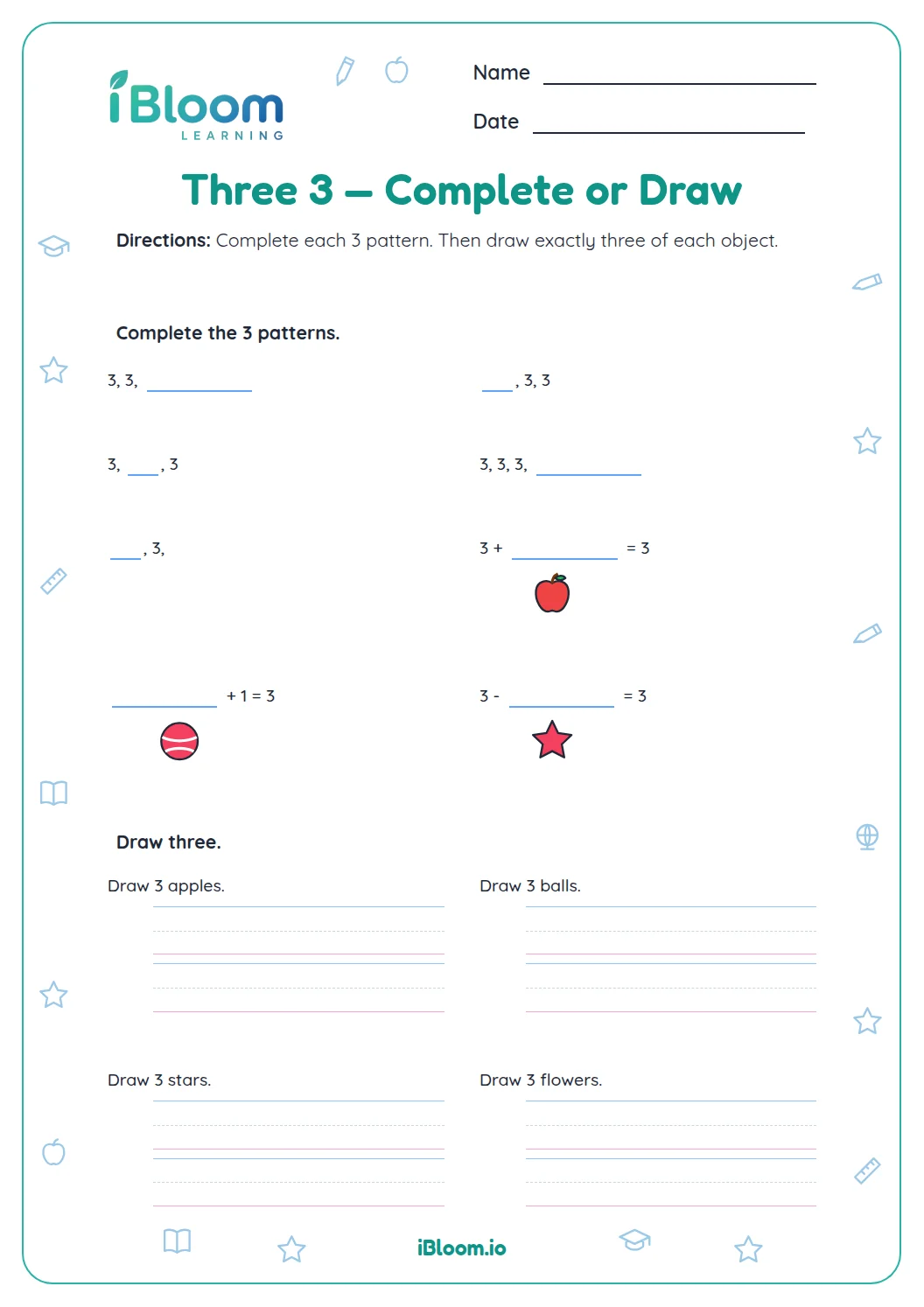
Questions 4–7 show groups of apples, birds, balls, and stars to count. Questions 8–14 use flowers, fish, apples, balloons, pencils, and stars in short counting contexts; children write 3 in each blank.
How can a child check a group of three?
A group of three can be counted one object at a time. The answer key shows 3 for each picture group and counting question, so an adult can check the child’s count and numeral together.
How to use this worksheet
- 1Start each 3 at the top of the trace model.
- 2Say “three” while tracing the curves.
- 3Point to each object once as you count.
- 4Write or choose 3 for a group of three.
- 5Use the last two questions to continue the count after 2.
Common mistakes and quick fixes
The mistake
Starting the numeral at the bottom.
The fix
Begin at the top and curve around in two rounded turns.
The mistake
Counting one picture twice.
The fix
Touch each object once as you say each number.
The mistake
Choosing 2 or 4 for a group of three.
The fix
Count the pictures again, then match the total to 3.
Common Core alignment
The activity connects numeral formation with counting groups of objects.
Write 3 to represent a counted group of three objects.
On this sheet: Write 3 to represent a counted group of three objects.
Show the official wordingHide the official wording
Write numbers from 0 to 20. Represent a number of objects with a written numeral 0-20 (with 0 representing a count of no objects).
What to practice next
Make more practice
Further reading
Questions parents and teachers ask
How can a child practice writing the number 3?
Begin at the top of the trace model and make two rounded curves. This page offers three trace lines, followed by blanks that ask children to write 3 after counting familiar picture groups. An adult can model the motion once, then let the child try each line.
Why are there pictures on the worksheet?
The pictures make each group countable. A child can touch each apple or bird once, say the count words, and then write or choose 3. The page uses apples, birds, balls, stars, flowers, fish, balloons, and pencils to connect a quantity with its numeral.
What is the answer to the flower question?
The flower group has three flowers, so the matching numeral is 3. Count each picture once, then look for 3 among the choices. The same count-and-match step works for the flowers, fish, and other picture groups on these two pages.
Does the worksheet include number order?
Yes. The final questions ask which numeral comes after 2 and what number completes the count 1, 2, ___. In both cases, the next number is 3. These items connect writing the numeral with saying the number sequence aloud. Say the count aloud.
How many activities are on the worksheet?
There are 14 activities across two worksheet pages: three tracing lines, four picture-counting blanks, and seven short responses connecting pictured groups or the counting sequence with 3. The separate answer key lists the expected numeral for each activity.