




About this worksheet
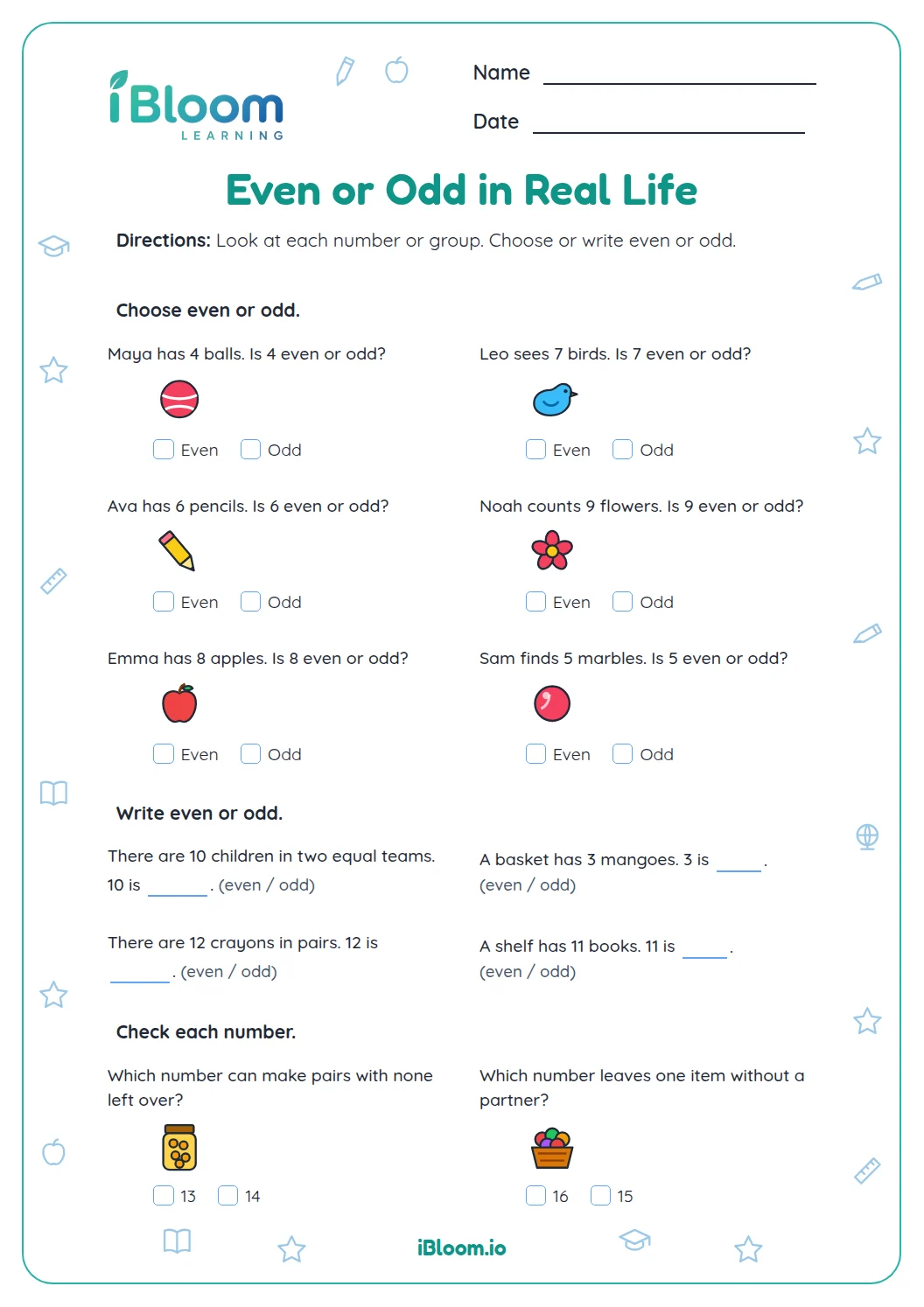
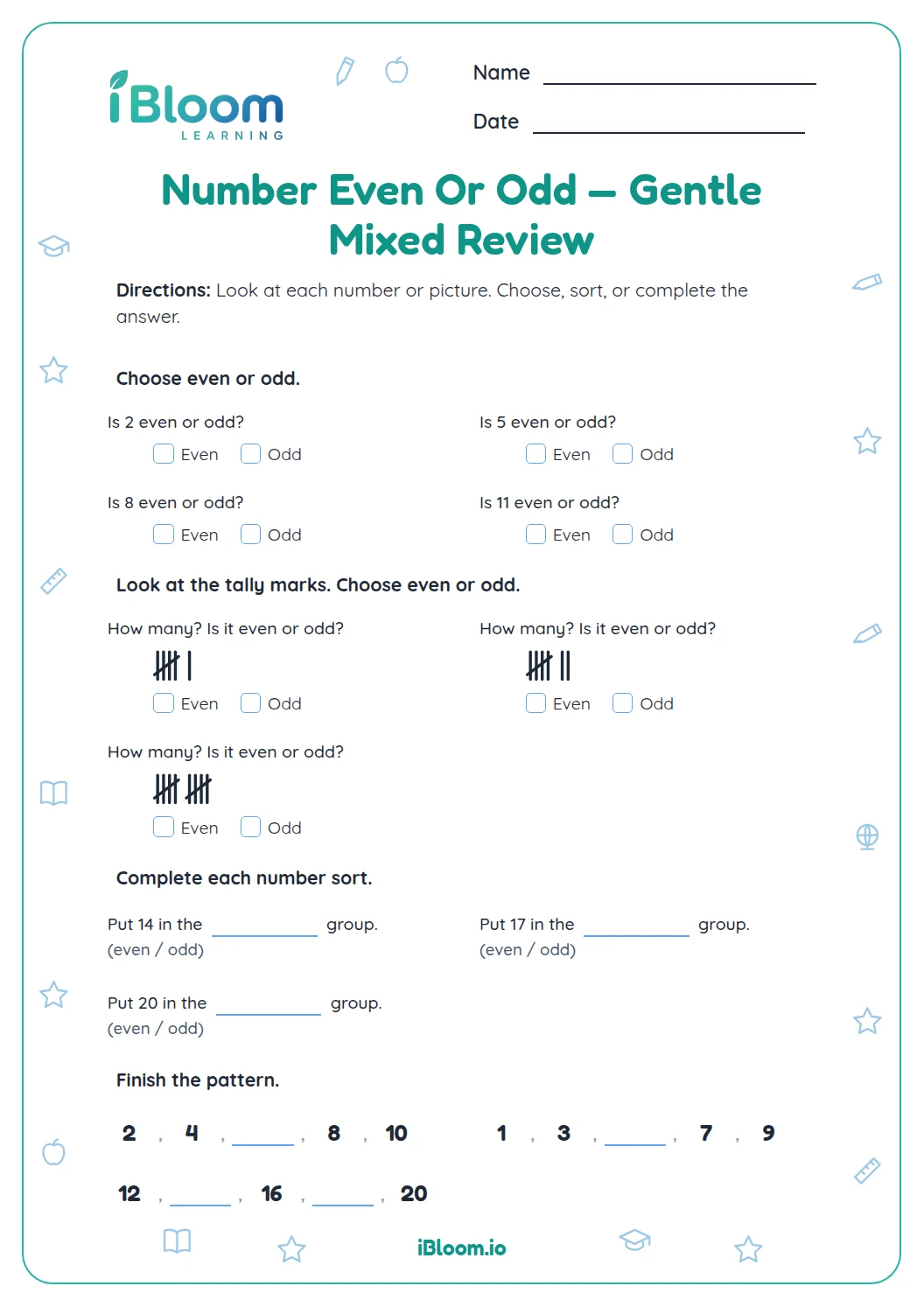
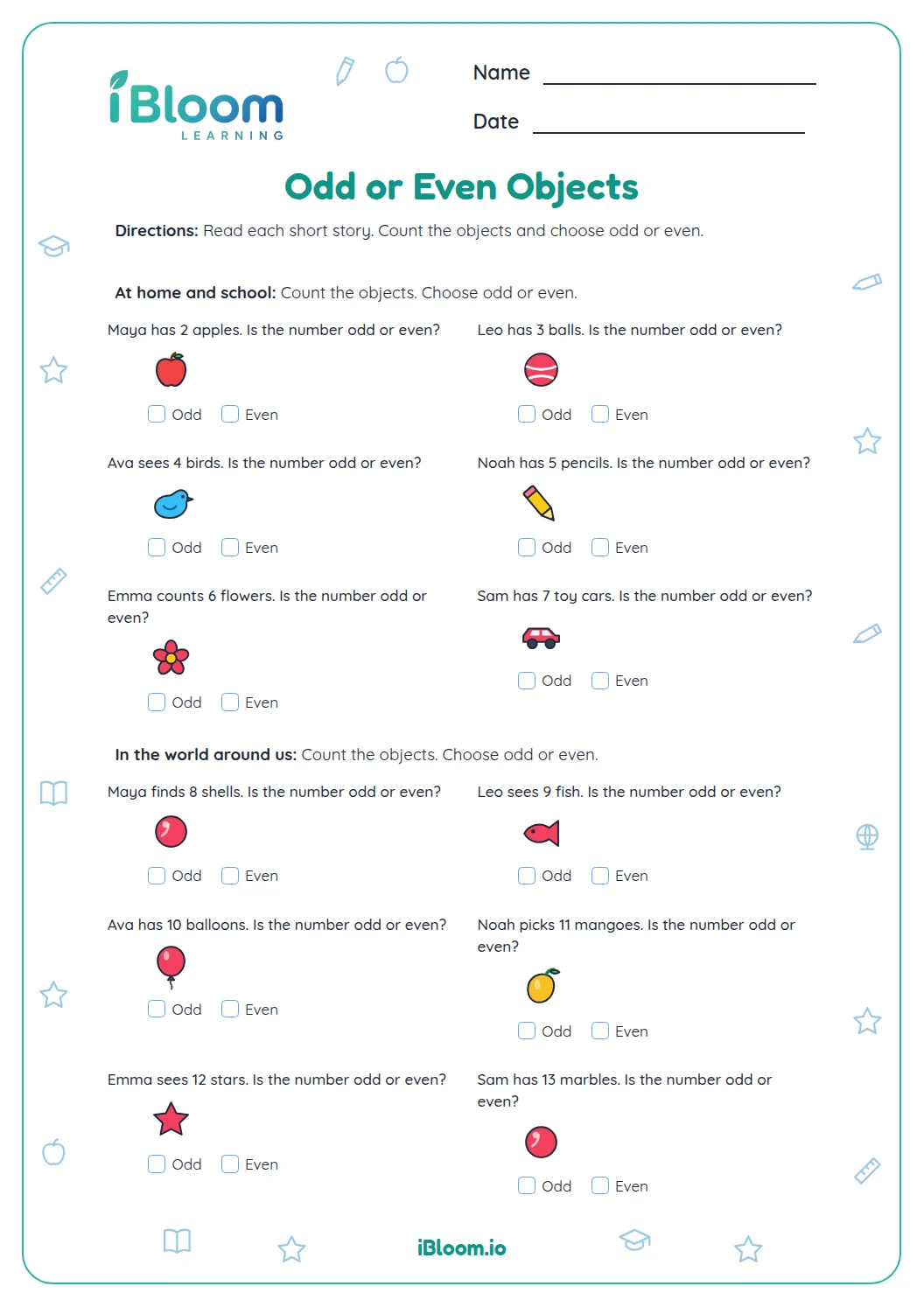
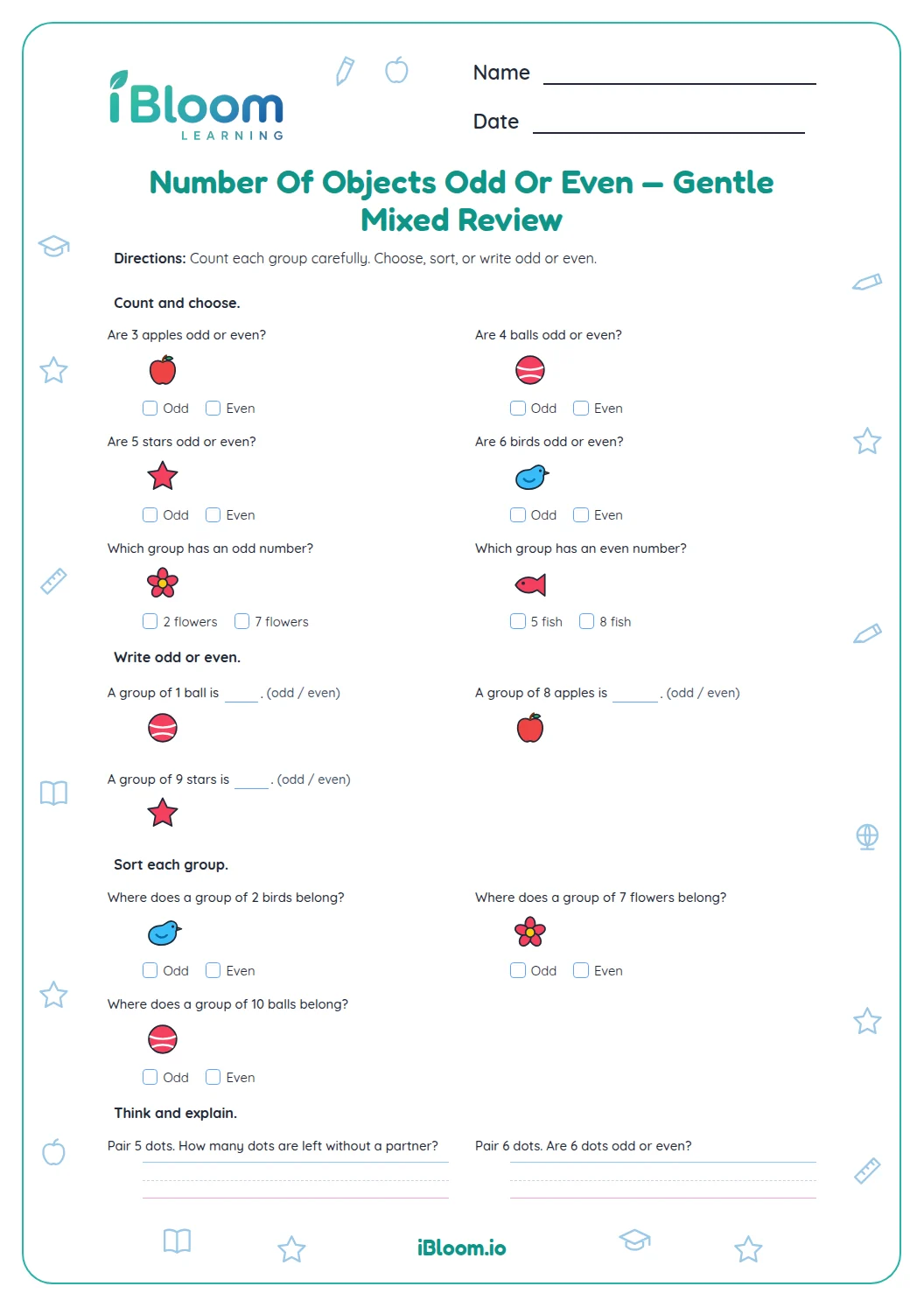
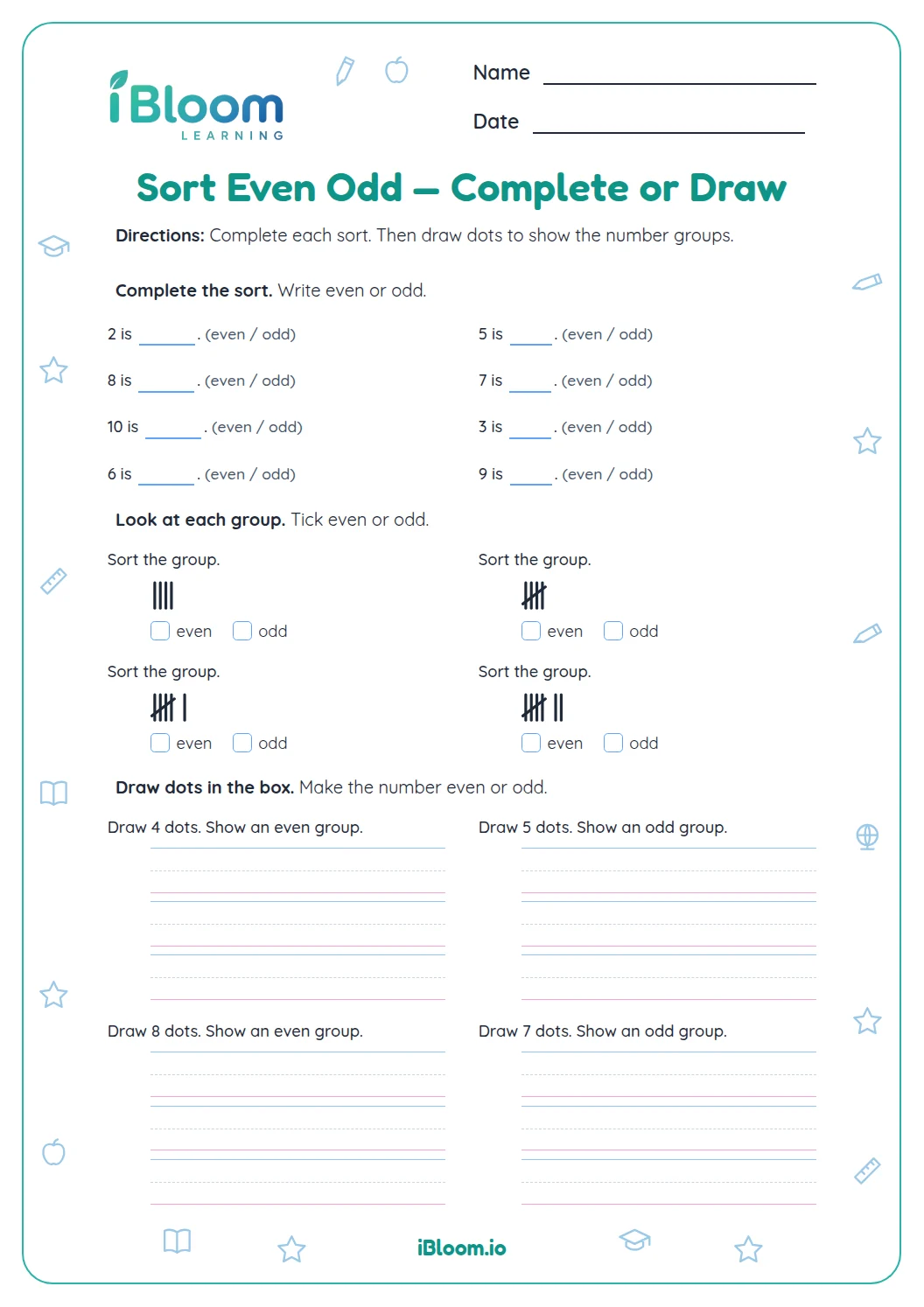
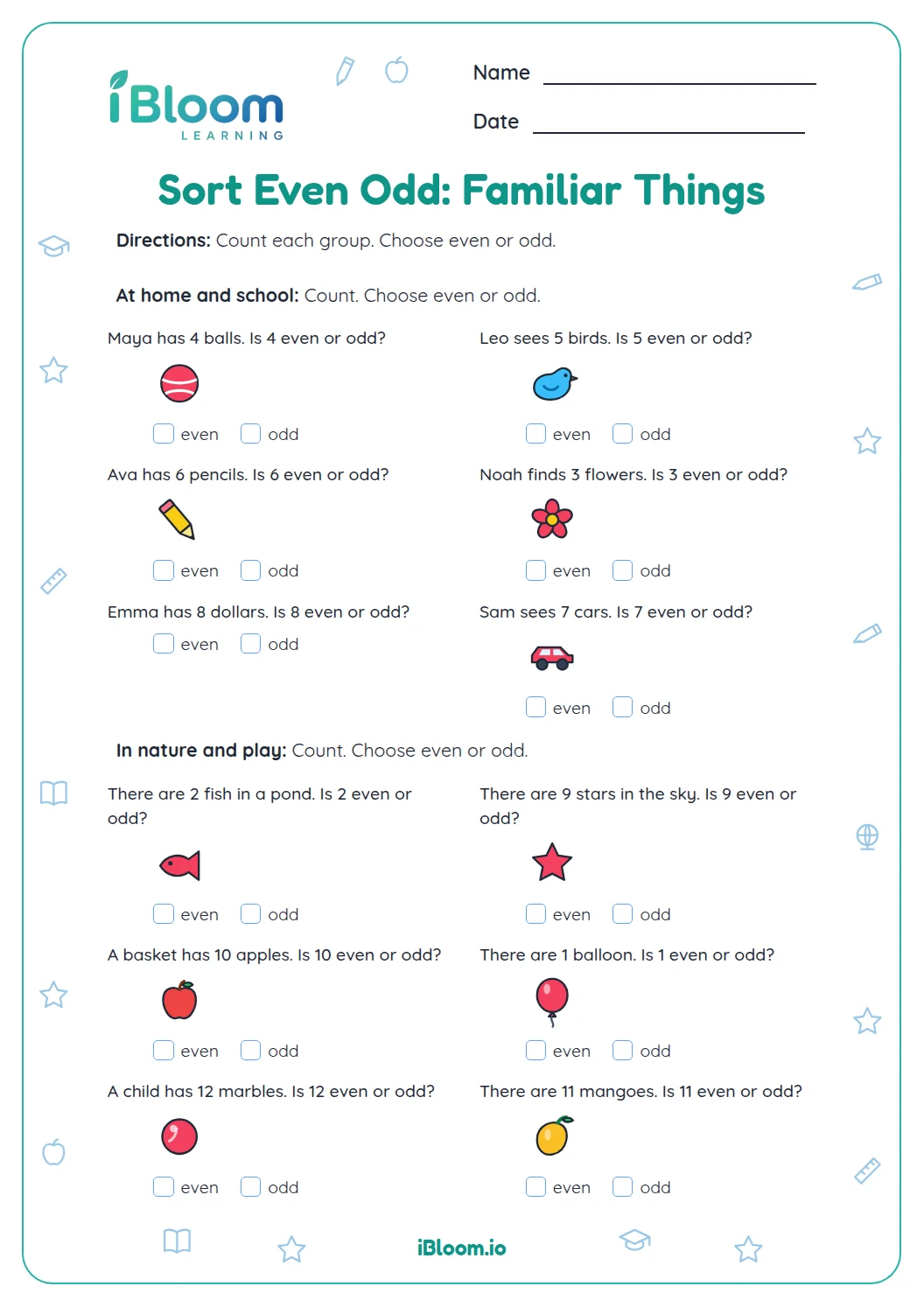
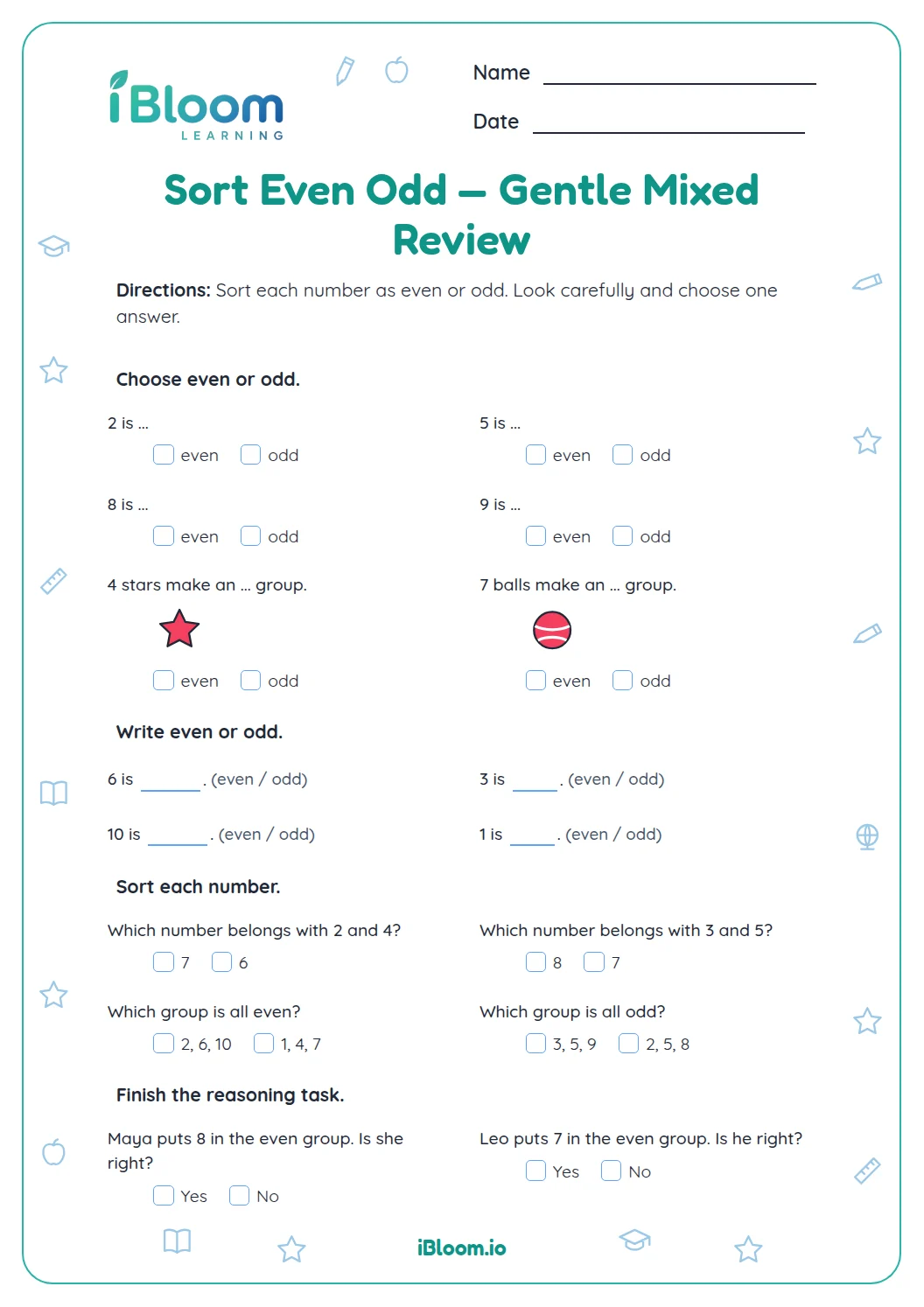
This free printable worksheet helps young learners decide whether a group has an even or odd number of objects. Six illustrated groups make pairing visible; six numerals and two skip-counting patterns extend the practice. The last two prompts use pictured groups for a final pairing check. A separate key checks all 16 answers.
Aligned to 2.OA.C.3
What kinds of even and odd practice are included?
The sheet starts with groups of pictured objects. Children decide whether each group can be split into pairs, then classify numerals from 2 to 19. Two patterns practice counting by twos, and the final pictured groups provide one more pairing check.
For example, eight objects make four pairs, so the group is even. With nine, four pairs leave one object without a partner.
- Six pictured groups
- Six numbers and two patterns
- Two pictured pairing checks
How do pairs show that a number is even?
Make pairs without skipping or reusing an object. No leftover means even; one leftover means odd. For a numeral, counting by twos can confirm the pairing result.
How can families check the answers?
Use the separate key after the child has tried all 16 questions. For a missed item, draw the number of dots and pair them again.
How to use this worksheet
- 1Pair the pictured objects before choosing even or odd.
- 2Say each numeral and classify it.
- 3Fill both patterns by counting by twos.
- 4Count pairs or leftovers in the final pictured groups.
- 5Check with the answer key.
Common mistakes and quick fixes
The mistake
Pairing one object twice.
The fix
Touch each object once as you make pairs.
The mistake
Calling a group even when one object is left.
The fix
Count the pairs and look for a leftover.
The mistake
Skipping a number in a counting-by-two pattern.
The fix
Say the sequence aloud before filling the blank.
Common Core alignment
This worksheet practices the following mathematical ideas.
Pair objects or count by twos to decide whether a set is odd or even.
On this sheet: Children classify pictured groups and numbers, then make and pair dots.
Show the official wordingHide the official wording
Determine whether a group of objects (up to 20) has an odd or even number of members, e.g., by pairing objects or counting them by 2s; write an equation to express an even number as a sum of two equal addends.
What to practice next
Make more practice
Further reading
Questions parents and teachers ask
What is an even number?
An even number of objects can be arranged into pairs with none left over. On this worksheet, children test that idea with six pictured groups and later with numerals. Counting by twos is another way to check, but pairing makes the meaning easy to see.
What is an odd number?
An odd number leaves one object without a partner after the rest are paired. For example, five objects make two pairs and one leftover. Children use pictured groups, numerals, and a final pictured group to practice recognizing the same idea in different forms.
How many questions are on the printable?
There are 16 questions in four parts: six pictured groups, six numerals, two number patterns, and two pictured pairing checks. The groups and numbers stay within 20. A separate answer key gives the classification or a sample description of the dot pairs.
Does the worksheet include pictures?
Yes. The first six items show countable objects so young learners can pair them instead of relying on number words alone. The final two items show pictured groups and ask children to count pairs or leftovers. A pencil is all that is needed to complete the page.
What does the answer key show?
The key identifies each pictured group and numeral as even or odd, supplies the missing pattern numbers, and identifies the pairs or leftover in the final pictured groups. For a missed answer, return to the picture and pair each object once.
What should I say when my child is unsure?
Ask the child to touch each object once while making pairs. If every object gets a partner, the group is even; if one object remains, it is odd. For a printed numeral, the child can pair pictured objects or count aloud by twos to verify the result.