



About this worksheet
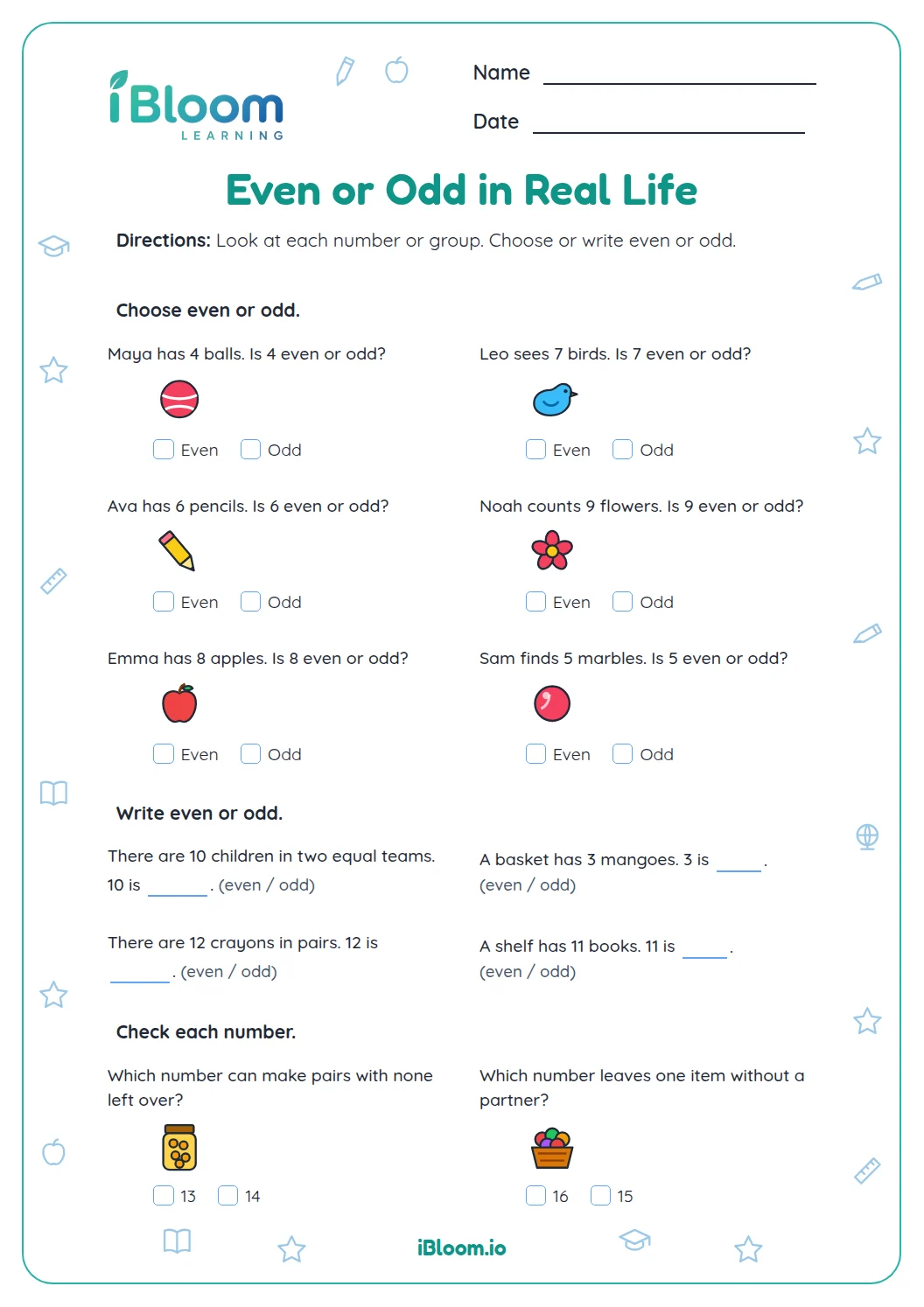
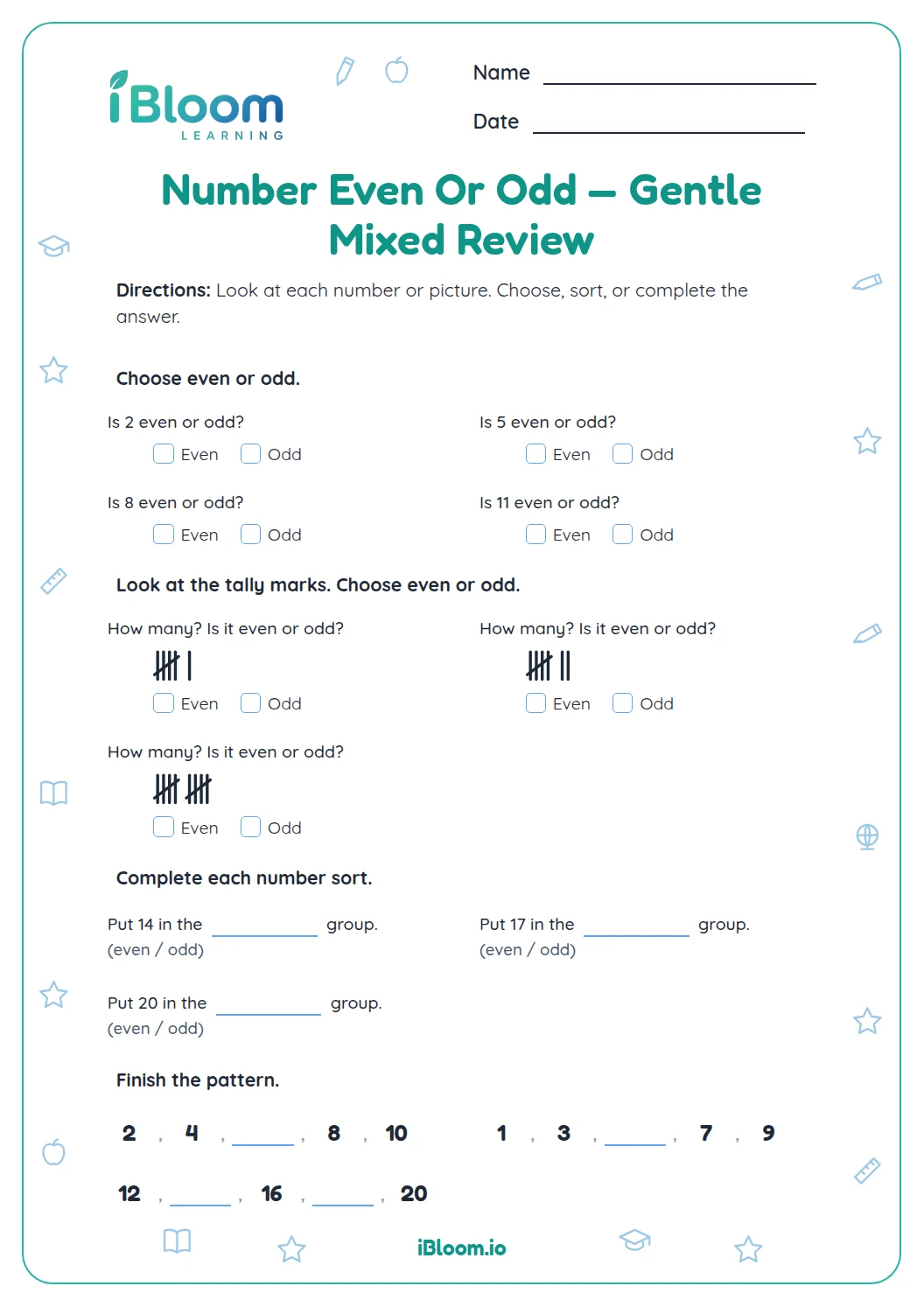
This free printable worksheet introduces odd and even numbers through pairing. In Part A, children count a group of pictures, such as 3 apples or 7 birds, and decide whether the number is odd or even by thinking about pairs. In Part B they finish sentences like “5 cookies make 2 pairs and 1 is left. So 5 is ___,” and in Part C they draw 7 dots and 6 dots and circle the pairs. It practices counting out groups (Common Core K.CC.B.5) and the pairing idea in 2.OA.C.3, deciding odd or even by putting objects in pairs. A grown-up reads the questions aloud. The answer key is separate.
Aligned to 2.OA.C.3 and K.CC.B.5
What are odd and even numbers, in words a young child can use?
A number is even if you can split the objects into pairs with none left over. A number is odd if one object has no partner. Four shoes make two pairs, so 4 is even. Five shoes make two pairs and one lonely shoe, so 5 is odd.
Young children do not need rules about the last digit. They need to see, with real objects, pictures or drawn dots, that the pairs either match up or leave one out.
How does this worksheet teach it?
Part A shows a group of pictures, such as 3 apples or 9 stars, and asks whether the number is odd or even. Children count the group, then pair the pictures up, two at a time, to see whether one is left over.
Part B puts the idea into words: each sentence says how many pairs the group makes and whether one is left, and the child writes odd or even. In Part C children draw their own dots and circle the pairs, which shows whether they can use the idea without pictures to help.
- 19 pencils make 4 pairs and 1 is left. So 9 is ___.
- 2Touch each pencil and count: 9
- 3Circle two at a time: 2, 4, 6, 8
- 44 pairs use 8 pencils, so 1 pencil has no partner
- 5Answer: odd
What is on this worksheet?
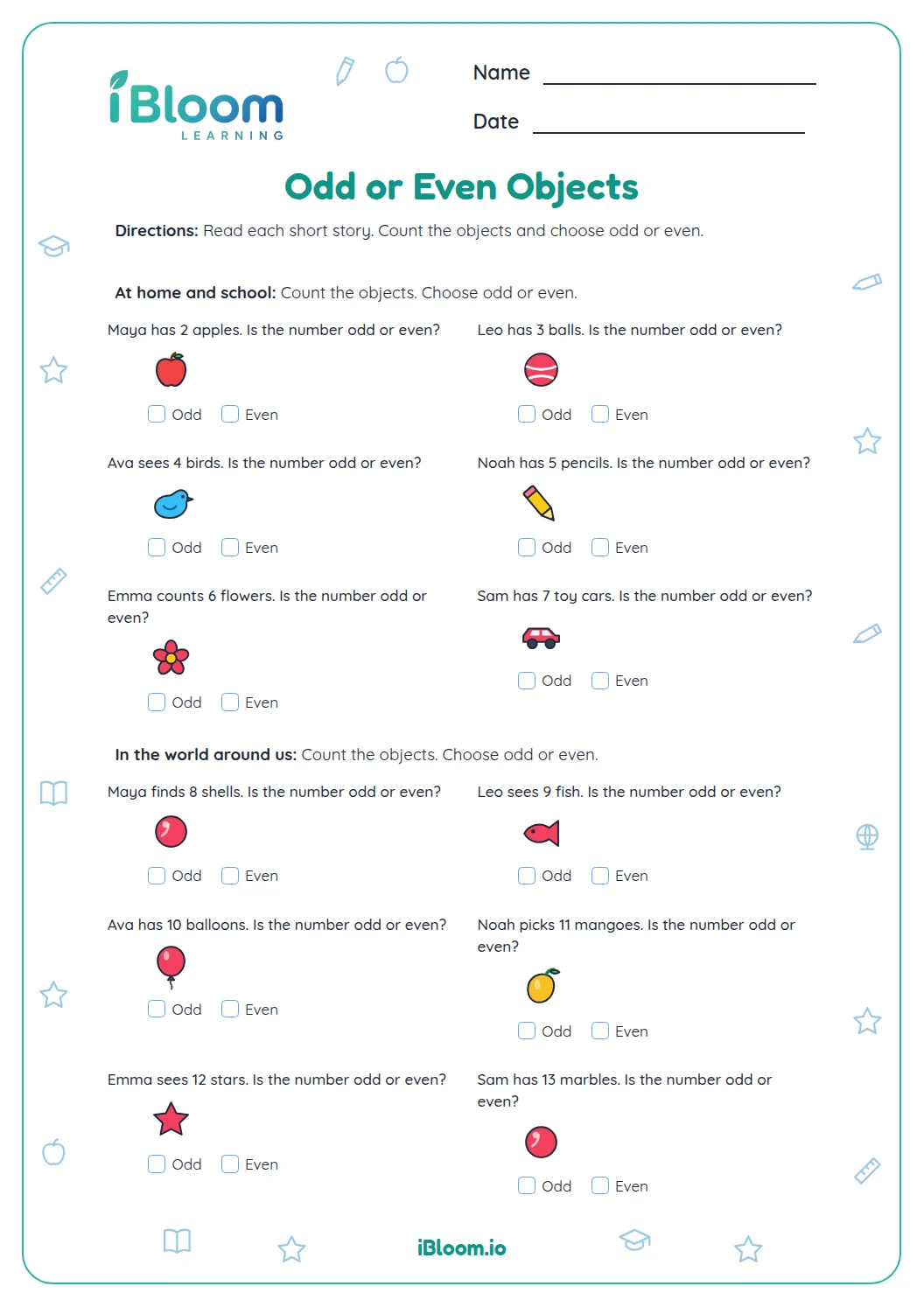
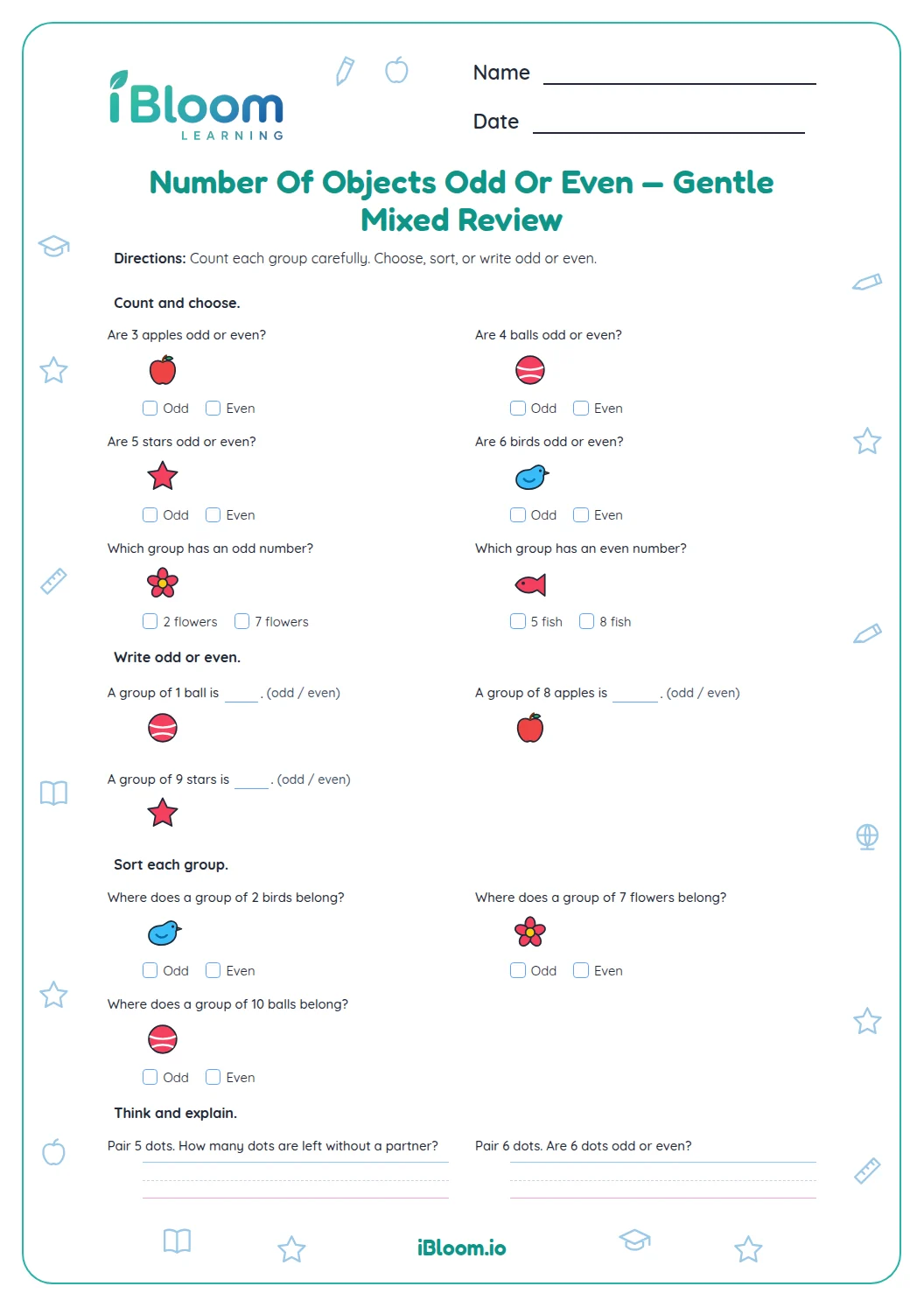
Part A has six groups of pictures: 3 apples, 6 balls, 4 flowers, 7 birds, 9 stars and 10 fish. Three are odd and three are even, and they do not simply take turns, so a child cannot answer by following a pattern. Part B has three sentences about 5 cookies, 8 balloons and 9 pencils, each drawn above its sentence.
Part C gives two lined spaces. Children make 7 dots and 6 dots, circle the pairs and say whether the number is odd or even. A grown-up can check the circles.
- Part A: 6 groups to count, mark odd or even
- Part B: 3 sentences to finish with odd or even
- Part C: 2 draw-it questions for 7 dots and 6 dots
How do young children learn odd and even?
Young children decide odd or even by putting objects in pairs, the method named in 2.OA.C.3. Along the way they use the skills underneath it: counting out a group, matching one to one, and seeing a group split into pairs.
This sheet is low-pressure practice. Children who draw seven dots and circle the pairs can see for themselves that one dot is left over, so 7 is odd.
How to use this worksheet at home or in class
- 1Warm up with real objects: lay out 6 buttons, make pairs together, and ask whether any are left over. Then try 7.
- 2Read each Part A question aloud and let your child touch and count the pictures, then move buttons or fingers into pairs before choosing.
- 3For a group that wraps onto a second row, show how the extra picture in the first row pairs with one below it.
- 4Read the Part B sentences aloud and let your child say odd or even before writing it, or write it for them.
- 5In Part C, let your child draw the dots anywhere on the lines, then circle pairs with a crayon.
- 6Check with the answer key, and praise the pairing, not only the right answer.
Common mistakes and quick fixes
The mistake
Pairing the pictures only inside each row. The 6 balls are drawn as a row of 5 and 1 more, so a child pairing row by row sees one left in each row and says odd.
The fix
Pair across the rows: the extra ball in the top row partners with the ball below it. Moving real counters into twos makes this clear.
The mistake
Miscounting a group that wraps to a second row, such as the 9 stars, by skipping one or counting one twice.
The fix
Have your child touch each picture once and say the number, or cross each one off with a pencil as it is counted.
The mistake
Knowing that one is left over but marking Even, because the two words are new and easy to swap.
The fix
Give each word a meaning to hold on to: even means everyone has a partner, odd means one is left alone. Say it each time before marking.
Common Core alignment
Most US states use the Common Core standards or a close state version, so this sheet fits counting and early number work in most early learning classrooms.
Tell whether a group is odd or even by putting the objects in pairs.
On this sheet: The pairing method in all three parts is the one this standard describes: children put objects in pairs and see whether one is left over.
Show the official wordingHide the official wording
Determine whether a group of objects (up to 20) has an odd or even number of members, e.g., by pairing objects or counting them by 2s; write an equation to express an even number as a sum of two equal addends.
Count groups of up to 10 pictures, and count out 7 and 6 dots.
On this sheet: Parts A and B ask children to count groups of up to 10 pictures, and Part C asks them to count out 7 and 6 dots.
Show the official wordingHide the official wording
Count to answer “how many?” questions about as many as 20 things arranged in a line, a rectangular array, or a circle, or as many as 10 things in a scattered configuration; given a number from 1-20, count out that many objects.
What to practice next
Make more practice
Further reading
Questions parents and teachers ask
How can preschoolers practice odd and even?
As a pairing game. Preschoolers can match objects two by two and notice when one is left over, which tells them whether the group is odd or even. Socks, blocks or snacks work well before the sheet. Keep it playful and short for younger children, and stop if counting itself still feels hard.
What are the answers to Part A?
3 apples is odd, 6 balls is even, 4 flowers is even, 7 birds is odd, 9 stars is odd, and 10 fish is even. Each odd group leaves one picture without a partner, and each even group leaves none. The answer key shows every question, including Parts B and C.
Do children need real objects as well as the pictures?
Pictures help, and real objects help most. Use buttons, blocks or crackers on the table so your child can move things into pairs while you read each question. The groups on the page are drawn in rows of five, so children can also touch and cross off each picture as they count.
What if my child can't write the words odd and even?
A grown-up can write them while the child says the answer aloud. In Part A, children only mark a bubble, and in Part C they mostly draw. Only Part B asks for a written word, and your child can copy it from the Part A choices or just tell you the answer.
How do I check the draw-it questions?
Look for the right number of dots and for circles around pairs. Seven dots should show three circled pairs and one dot outside any circle, and six dots should show three circled pairs with none left out. Any clear drawing that shows the pairs is fine, even if the dots are uneven.
How long does it take, and is there an answer key?
Most children finish in about 10 minutes with a grown-up reading each question. Yes, a separate two-page answer key gives all eleven answers, including a sample for each drawing in Part C. You can also do one part per sitting and spread the sheet across a few days.