






About this worksheet
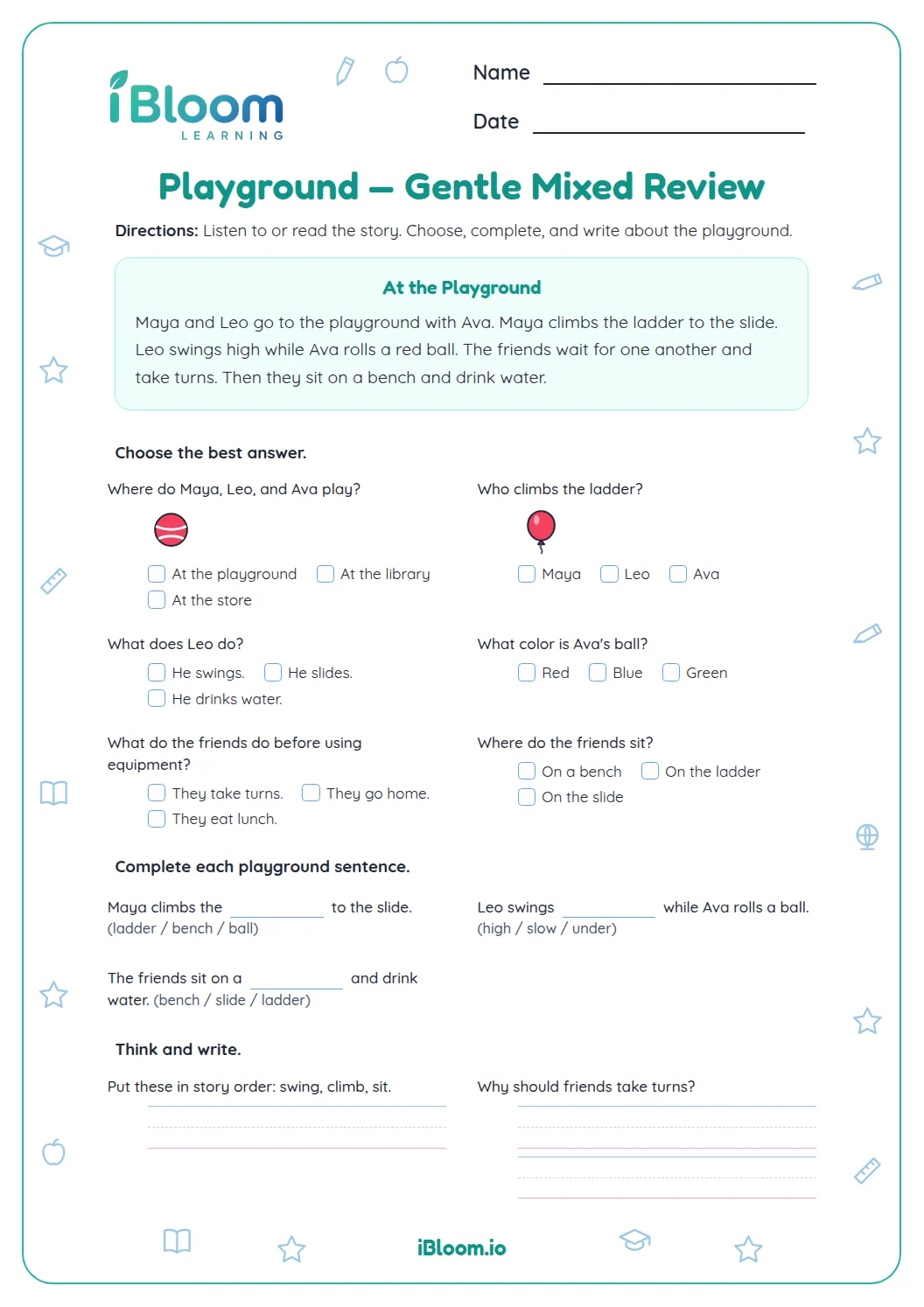
This printable reading comprehension page is for preschool and kindergarten learners. Children read or listen to a short story about Maya finding her red boat, answer questions about story details, and apply familiar clues about toys and places. Picture-supported choices and a separate answer key make the activity easy to discuss together.
Aligned to RL.K.1
Which story details should children notice?
Maya looks in the toy box, remembers playing by the pond, and finds her red boat beside a lily pad. She brings it to shore and puts it on a high shelf.
- 1Question: What floated beside the boat?
- 2Look back at the pond sentence.
- 3Answer: A lily pad.
How do familiar clues help?
A child can use what they know about everyday places. A boat belongs near water, and a toy may be put in a toy box or on a shelf. The context questions ask children to connect those ideas to a simple situation.
What is on the worksheet?
The passage comes first, followed by five questions about its details and nine questions that use familiar places, actions, and vocabulary. Picture clues support several choices.
How to use this worksheet at home or in class
- 1Read or listen to the passage once all the way through.
- 2Retell what Maya did to find the boat.
- 3For story questions, look for the matching detail.
- 4For familiar clues, think about what you know about the place or object.
- 5Check answers with the key and reread any uncertain line.
Common mistakes and quick fixes
The mistake
Choosing an answer that sounds possible but is not in the story.
The fix
For detail questions, return to the sentence that tells what Maya did.
The mistake
Mixing up the pond and the shelf.
The fix
Retell the order: find the boat near the pond, then put it on the shelf.
The mistake
Ignoring the clue in a familiar-place question.
The fix
Use the object or place named in the question to think of a sensible location.
This Common Core standard describes the story questions on this worksheet.
Ask and answer questions about important details in a story.
On this sheet: Children answer detail questions and use clues to connect the story to familiar places.
Show the official wordingHide the official wording
With prompting and support, ask and answer questions about key details in a text.
What to practice next
Make more practice
Further reading
Questions parents and teachers ask
Should an adult read the story aloud?
Either approach works for this early reader page. An adult can read the short passage aloud and pause to talk about what happened, or a beginning reader can try it independently. The answer choices and pictures support children as they answer details and apply clues.
What does “use it in a familiar context” mean here?
Children connect a story clue to places and situations they know, such as looking in a toy box or noticing that a boat belongs near water. The later questions ask them to use those familiar clues, then return to details from Maya’s story.
Where does Maya find her boat?
Maya remembers playing near the pond and finds the red boat floating beside a lily pad. She reaches from the shore and brings it back. Questions about the setting and actions help children follow how she solves the problem in the passage.
What should a child do if they miss a question?
Return to the sentence that gives the clue. For example, the passage says Maya puts the boat on a high shelf so it will stay safe. Looking back at that detail helps children distinguish the answer from other plausible places.
Does this worksheet have an answer key?
Yes. The separate key lists the correct choice for every question. It covers both details stated in the story and simple familiar-context clues, so an adult can discuss why the selected answer fits and reread the passage when a child wants to check a detail.
How long does the activity take?
Allow about 15 minutes to read the story and answer the questions. Younger children may benefit from an adult reading aloud and discussing the picture clues. The page is designed for preschool and kindergarten learners, so the passage can be shared or read independently.