





About this worksheet
This gentle mixed review is for preschool and kindergarten learners practicing short sentences. Children trace three familiar phrases, then answer eleven questions about what simple sentences say. The answer key gives a quick check for each choice and phrase. The short reading tasks connect to Common Core RL.K.1.
Aligned to RL.K.1
What does tracing add to sentence practice?
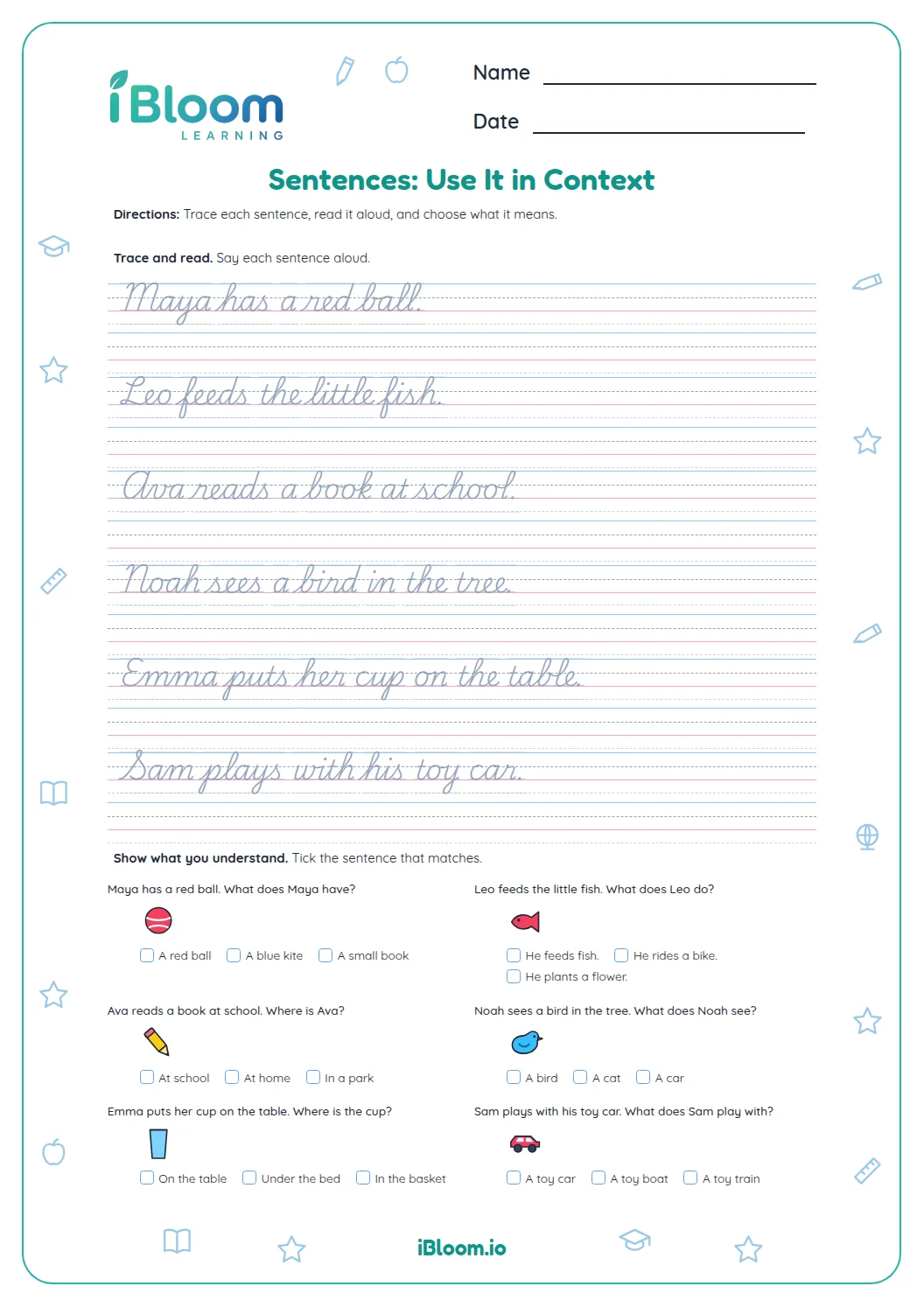
Part A has four complete sentences to trace and read aloud. Learners then answer questions about the sentence details and complete four sentences with a missing word. The page uses familiar names, objects, colors, and actions.
- Part A: trace and read four sentences
- Part B: answer six questions about sentence details
- Part C: complete four sentences with a missing word
How does a sentence show an action?
Part B asks children to read a short question and choose the sentence that names the subject’s action. Familiar animals and actions keep attention on the words.
- 1What does the cat do?
- 2Choose “cat naps,” which names the cat and its action.
How can a child check a sentence answer?
Invite the learner to say the chosen sentence aloud and point to the word that names the action. Repeating the subject and action helps connect the words in a short sentence.
How to use this worksheet at home or in class
- 1Trace each complete sentence, then read it aloud together.
- 2For Part B, reread the sentence before choosing an answer.
- 3For Part C, use the sentence meaning to choose the missing word.
- 4Invite the child to point to a word or phrase that supports each answer.
- 5Review the completed page with the answer key.
Common mistakes and quick fixes
The mistake
Choosing a sentence with the right animal but a different action.
The fix
Check both the subject and the action words.
The mistake
Rushing through a phrase without reading it.
The fix
Trace once, then say the phrase aloud.
The mistake
Choosing an action that belongs to a different animal.
The fix
Say the subject and action together, such as “the cat naps,” before marking the answer.
Common Core alignment
This page practices the listed Common Core skill through the questions and responses on the sheet.
Answer a simple question about what a short sentence says.
On this sheet: Part B asks learners to choose the action named in a short sentence.
Show the official wordingHide the official wording
With prompting and support, ask and answer questions about key details in a text.
What to practice next
Make more practice
Further reading
Questions parents and teachers ask
What does this preschool and kindergarten worksheet practice?
Children trace and read four complete sentences, answer six questions about sentence details, and complete four sentences with a missing word. The key shows the trace text and correct choices or words. An adult can read prompts aloud while the child points, reads, traces, or writes.
Which sentences do children trace?
The tracing lines are “Maya has a red ball,” “Leo sees a big bird,” “Ava can hop,” and “Noah has a blue kite.” Each is a complete, short sentence. Children can trace the words, read them aloud, and look back at them for later questions.
What kinds of reading questions are on the page?
Six questions ask what Maya has, what Leo sees, what Ava can do, the color of Noah’s kite, and which sentences tell about a bird or Noah’s kite. Children choose from short sentence choices. Four more prompts ask them to complete a sentence with a missing word.
Can I read the sentences and choices aloud?
Yes. Reading aloud lets a child focus on connecting the sentence with its meaning while still seeing the words. Invite the child to point to the matching detail, say the answer, or try reading independently. Keep the sentence visible so the child can compare its words with the choices.
How should I use the answer key?
Check the tracing sentences, selected choices, and missing words after the child finishes a section. If an answer differs, reread the sentence together and compare both choices or possible words. The goal is to connect a short written sentence with what it says and use that meaning to answer.
How many pages should I print?
Print all three worksheet pages and keep the separate three-page answer key for checking. The tracing sentences are together in Part A, with the reading choices and sentence completions on later pages. You can complete one part at a time and check it before continuing.