




About this worksheet
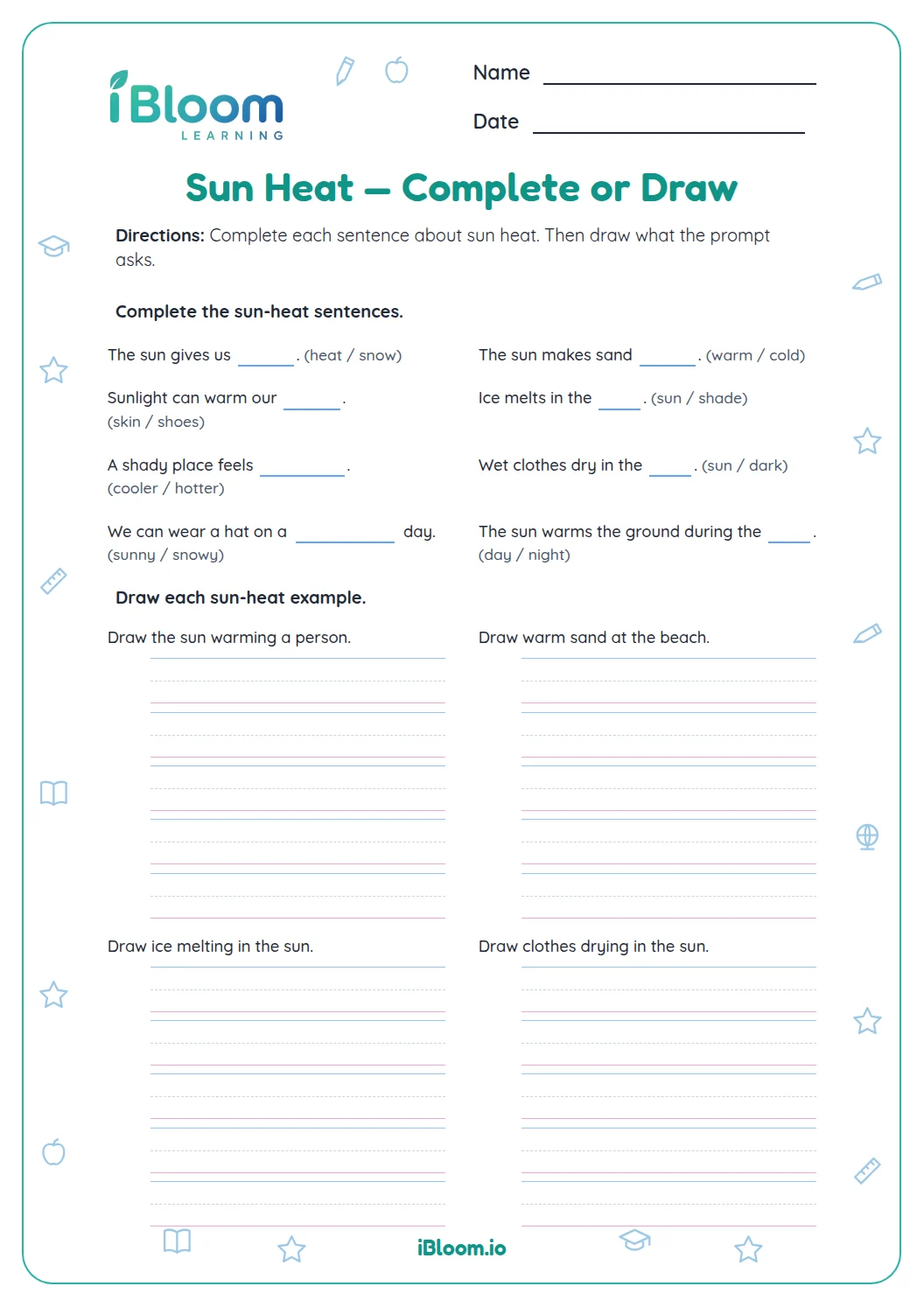
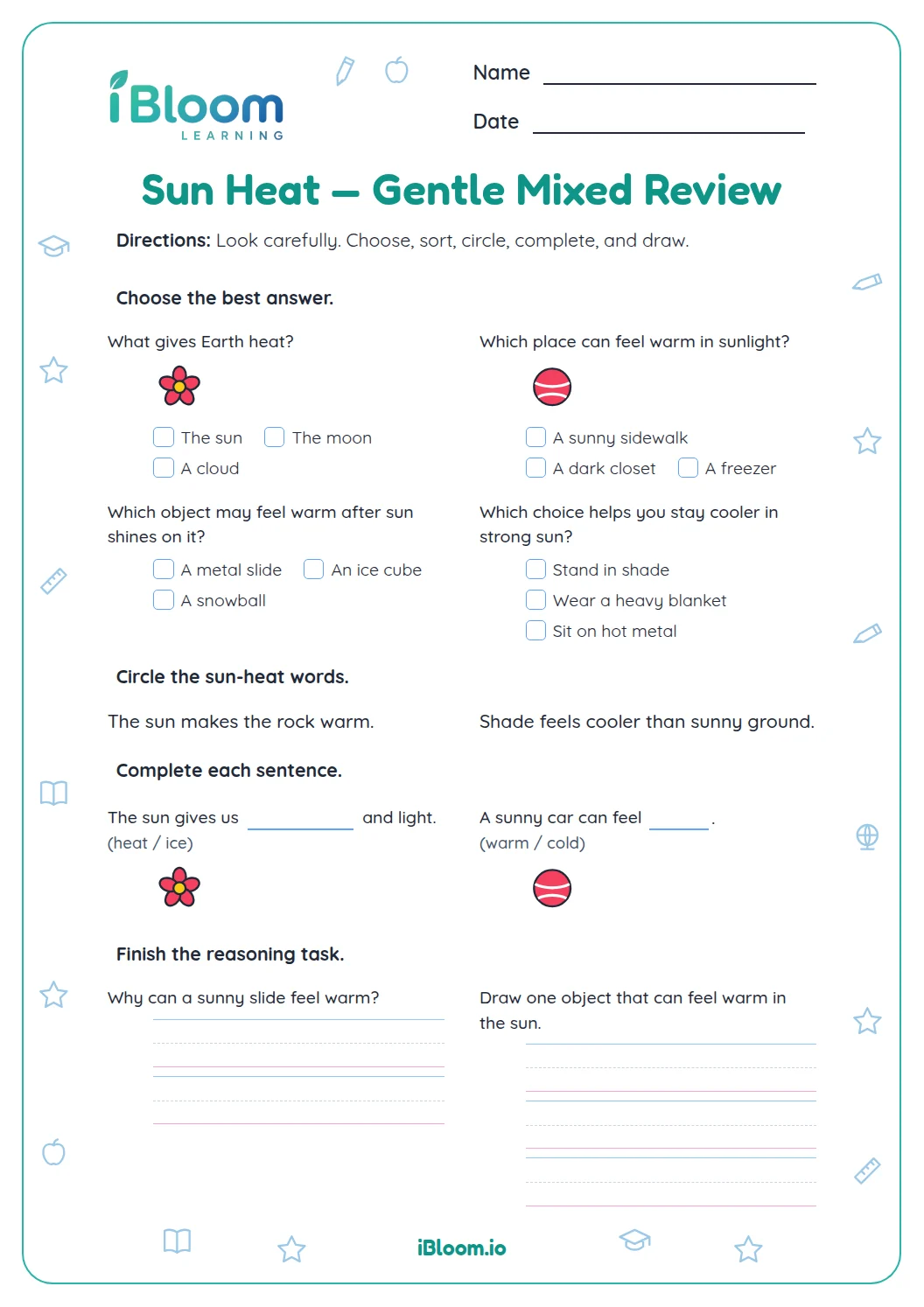
This free printable science worksheet helps Preschool–Kindergarten children notice how sunlight warms familiar places and objects. Across 16 questions, children use picture-supported choices about sunny ground, shade, water, and drying clothes, then draw a sunny and shady scene. The answer key includes the choices and sample drawing details. The activity practices making observations about sunlight’s effect on Earth’s surface (K-PS3-1).
Aligned to K-PS3-1
What changes when sunlight reaches a place?
Sunlit ground can become warmer than nearby shaded ground. The worksheet uses everyday examples—sand, a rock, water, a playground, and a shirt—to help children notice where sunlight reaches.
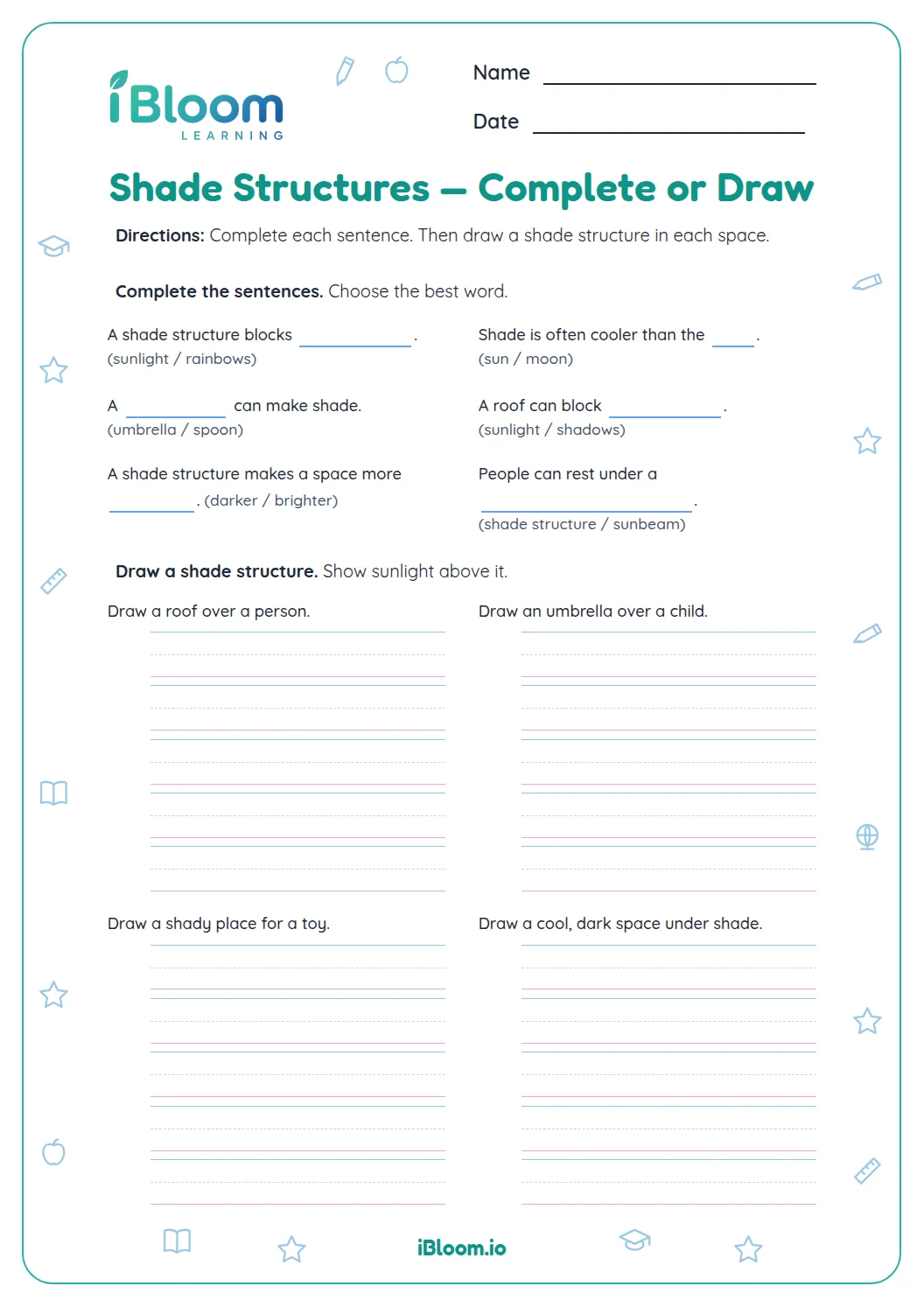
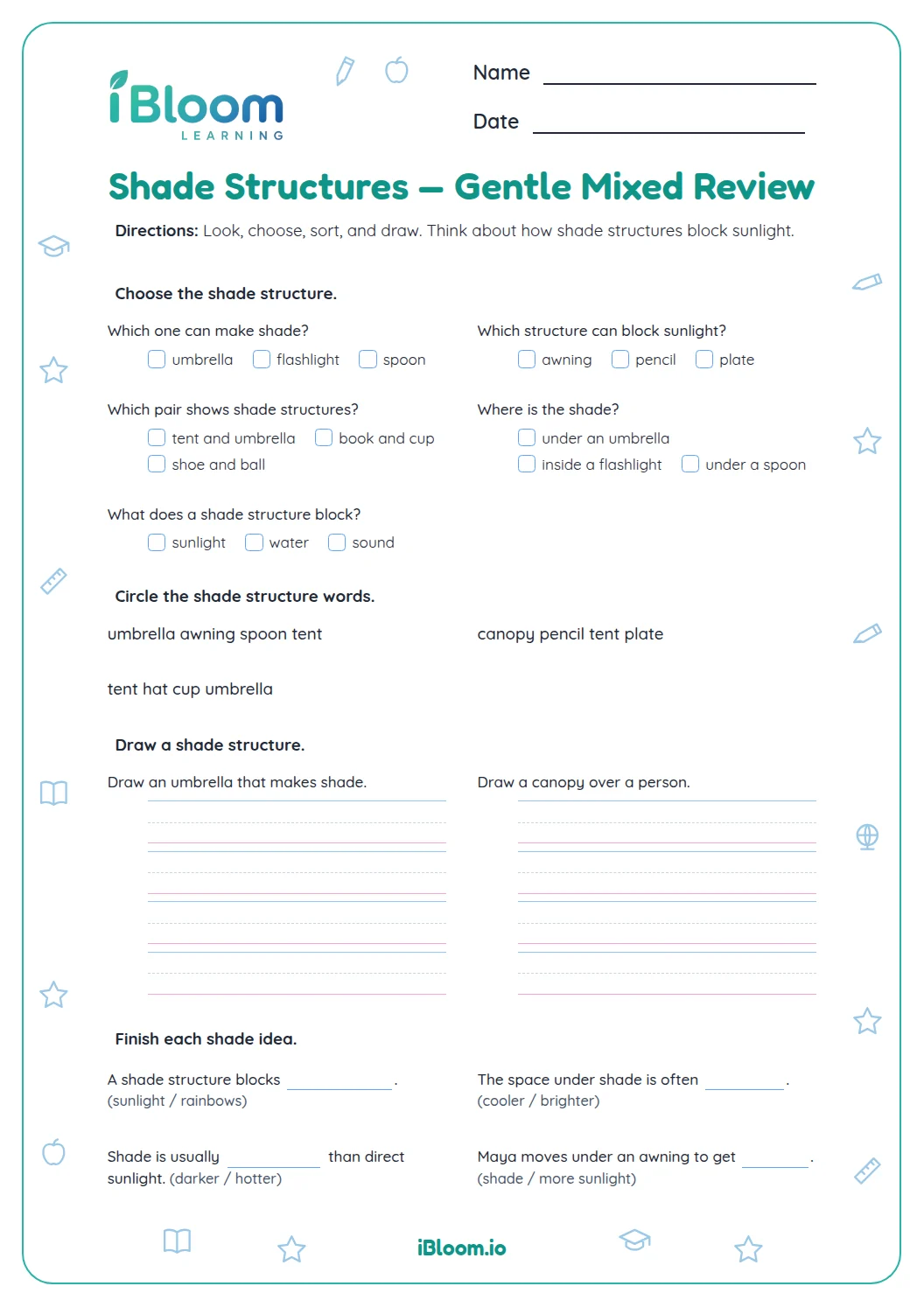
Parts A and B use picture choices and short completions. Part C checks understanding with more comparisons, and Part D gives two drawing prompts about sun and shade.
- 1A tree blocks some direct sunlight.
- 2Ground under the tree is shady.
- 3Open ground can receive more direct sunlight.
How do the picture choices build observation?
Children compare places or objects and choose what sunlight may warm or help dry. The answer choices keep each situation familiar, while the pictures give a visual clue to discuss.
For the drawing prompts, look for a sun, an open area receiving light, and a nearby shaded area.
How can we talk about sunny and shady places?
Invite the child to point out what blocks the light and compare the two places. Use “warmer” as a relative observation; the worksheet does not ask children to measure temperature.
How to use this worksheet
- 1Look at the picture clue and have an adult read the situation.
- 2Point to the place that receives direct sunlight.
- 3Choose the answer that fits the sunny or shady clue.
- 4For the last part, draw both an open sunny area and a shaded area.
- 5Use the key to talk through choices and drawings.
Common mistakes and quick fixes
The mistake
Calling a place sunny because it is outdoors.
The fix
Check whether anything blocks direct sunlight.
The mistake
Thinking shade means no warmth at all.
The fix
Compare the sunny and shady places as warmer or cooler.
The mistake
Drawing a sun without showing where its light reaches.
The fix
Add open ground and a nearby shaded spot, such as under a tree.
Curriculum alignment
Children compare familiar sunny and shady places and observe sunlight’s effect on Earth’s surface.
Children observe how sunlight warms familiar ground and other surfaces.
On this sheet: Children compare familiar surfaces in sunlight and shade and represent their observations.
Show the official wordingHide the official wording
Make observations to determine the effect of sunlight on Earth’s surface.
What to practice next
Make more practice
Further reading
Questions parents and teachers ask
What does the worksheet teach about sunlight?
Children observe that sunlight can warm Earth’s surface and compare places that receive direct sun with places in shade. Picture questions use familiar examples such as ground, water, a playground, and clothing. The final drawings ask children to show a sunny and a shady place.
What should the child draw in the last part?
A clear response shows the sun, an open patch of ground receiving sunlight, and a nearby shaded patch. A tree can show what blocks the light. The two prompts invite related scenes, so children can add details or make a second version.
Do children need a thermometer?
No thermometer is needed for these picture comparisons. Children use familiar observations about which place may feel warmer or cooler after sunshine. An adult can ask what blocks the light and point out that the worksheet focuses on noticing sunlight’s effect.
How many questions are on the sheet?
There are 16 questions across four parts, including picture-supported choices and two drawing prompts. The printable includes a separate answer key with selected answers and examples of details that could appear in the drawings. Children can compare their scenes with the sample details while explaining where the sunlight reaches.
How can we extend the activity outdoors?
With an adult, compare a safe sunny surface and a nearby shaded one. Notice which feels warmer without touching anything hot, then identify what makes the shade. This short observation connects the worksheet’s pictures to a familiar place.
Which science standard does it practice?
The worksheet practices kindergarten performance expectation K-PS3-1: making observations to determine the effect of sunlight on Earth’s surface. Children compare sunny and shady places and represent them in drawings. The standard statement and official source are listed in the curriculum section.