
About this worksheet
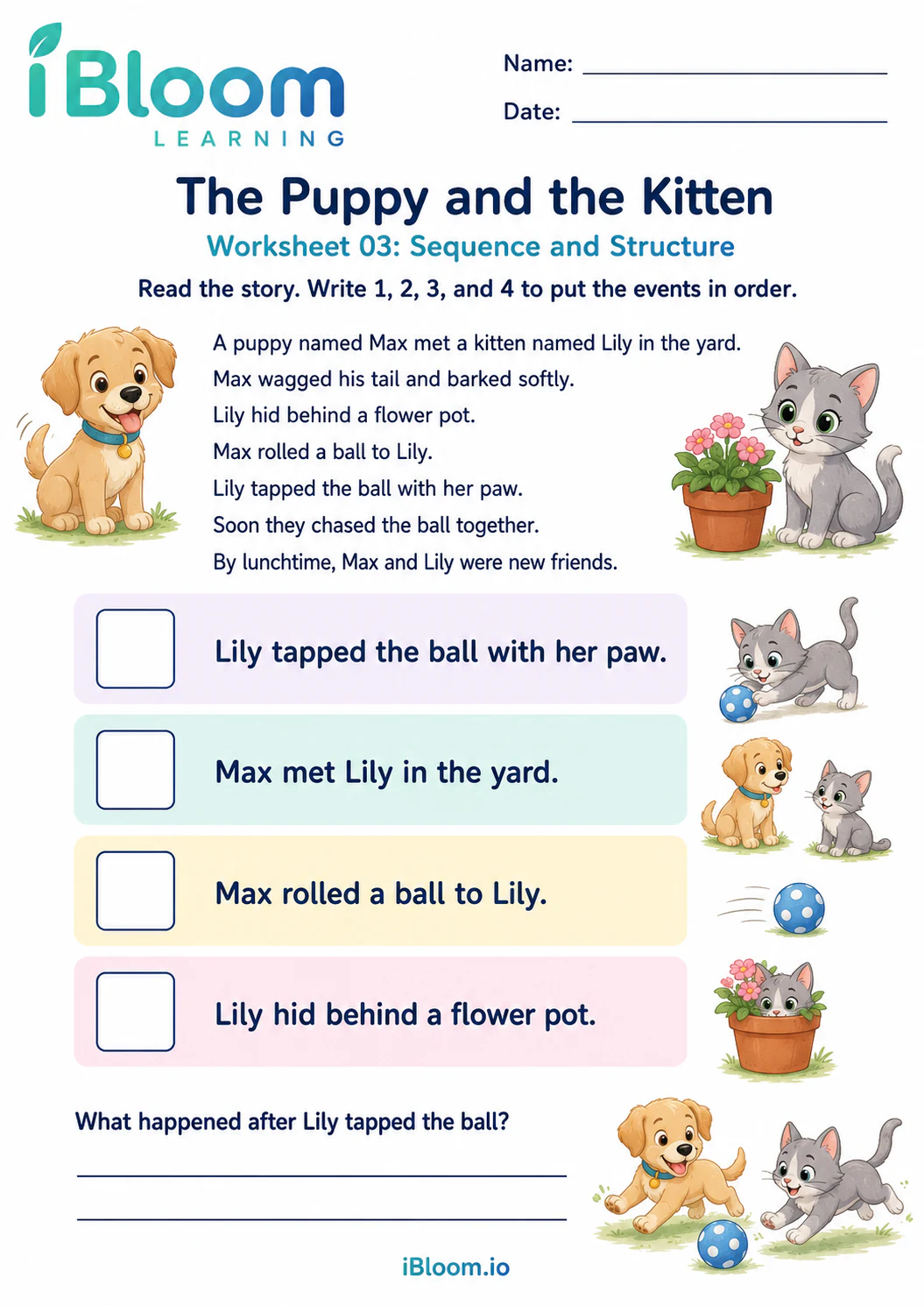
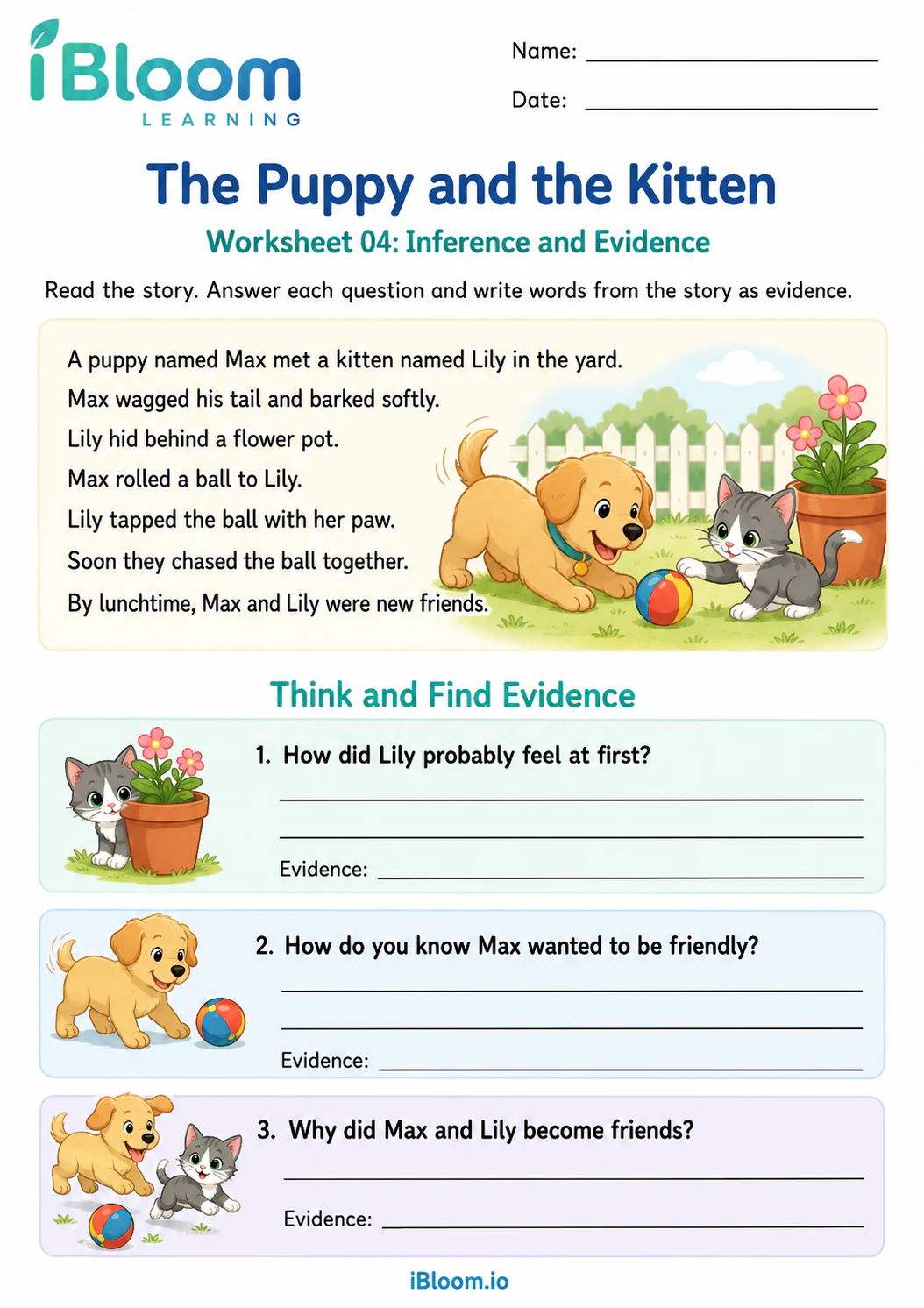
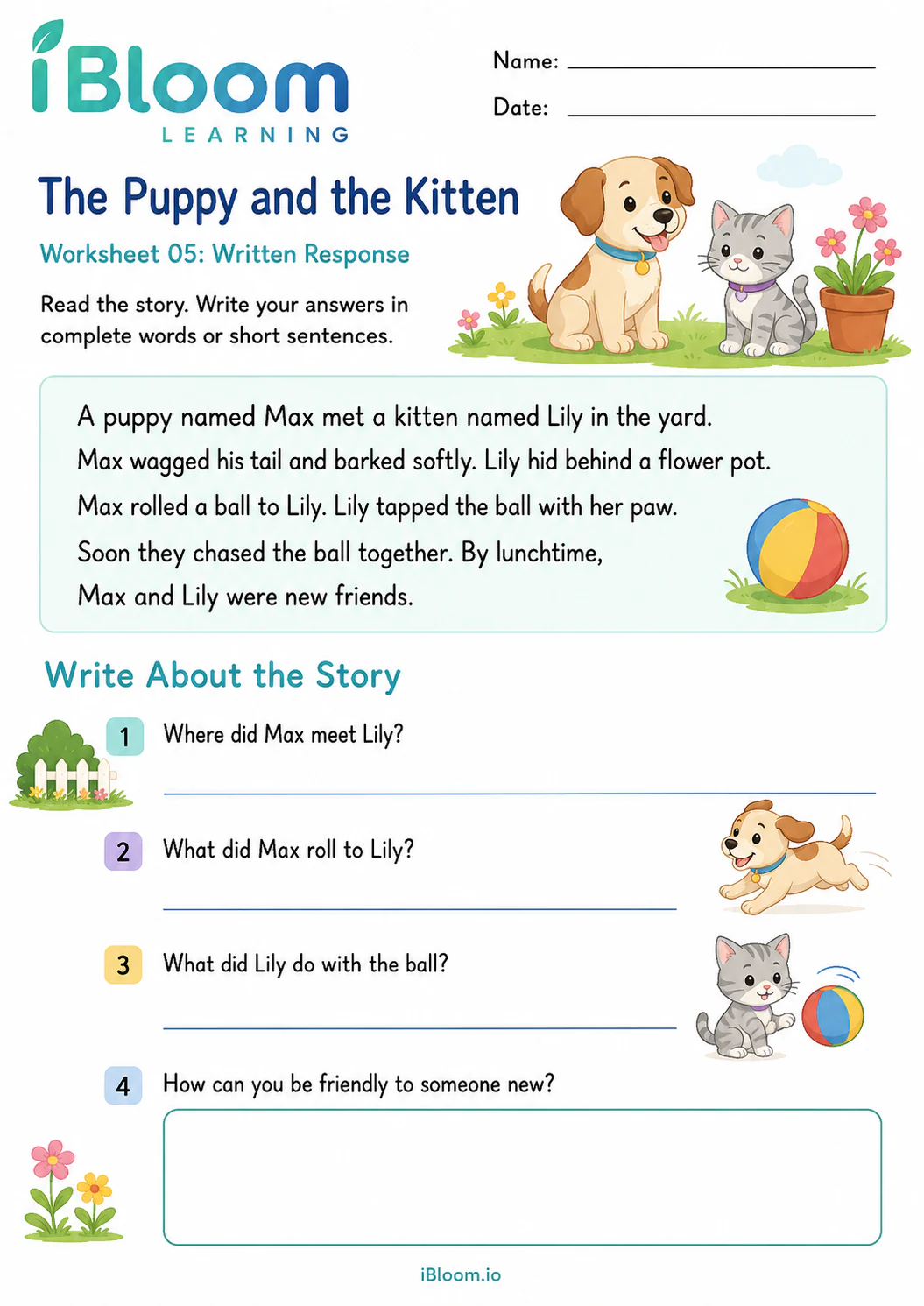
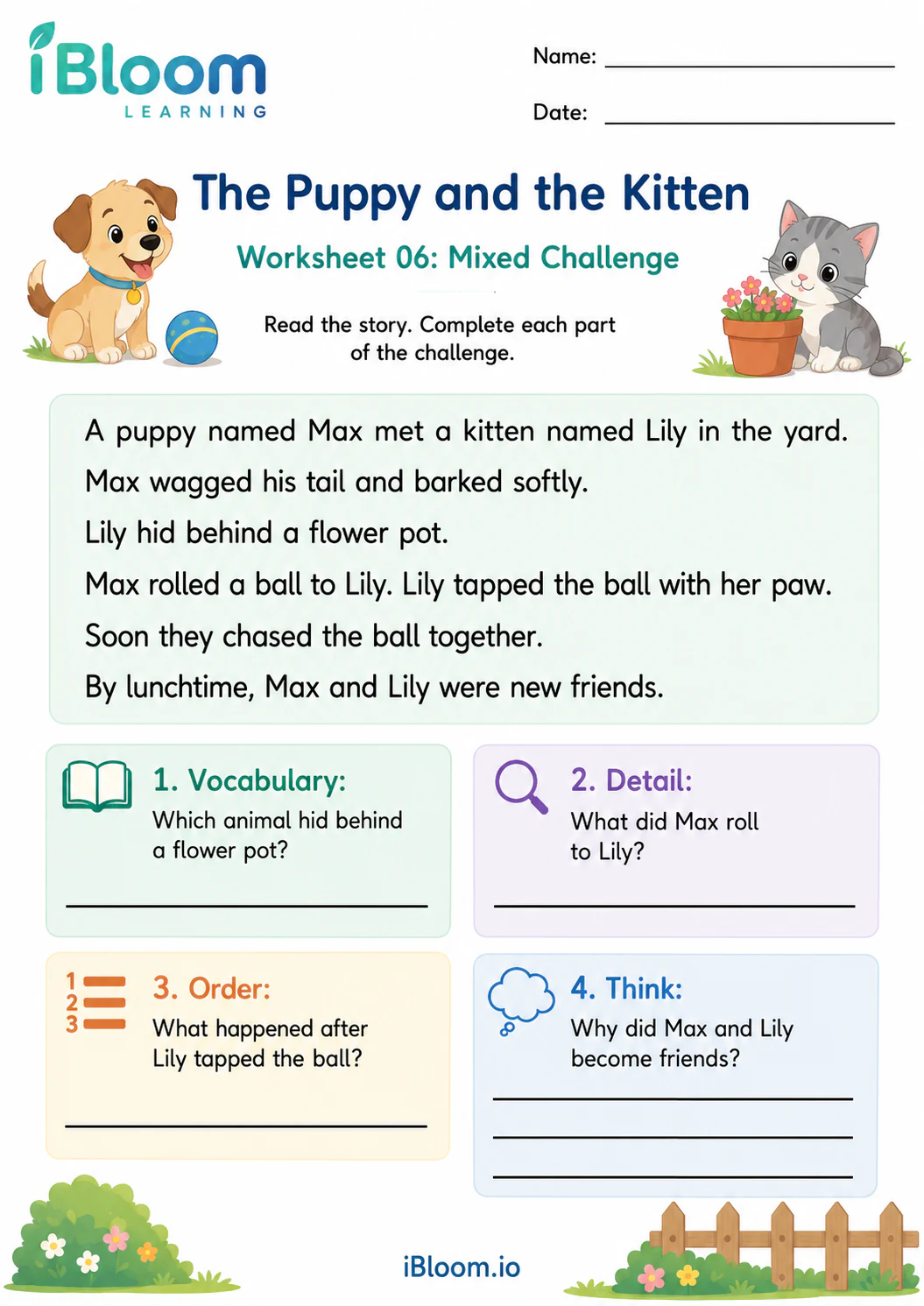
This Grade 1 printable pairs the short story “The Puppy and the Kitten” with 16 questions about Max and Lily. Learners find story details, explain a character’s action, consider word meaning, and retell events. The questions practice Common Core RL.1.1 by asking readers to answer from details in the text. A separate key gives direct answers and sample responses.
Aligned to RL.1.1
Which details tell how Max and Lily became friends?
Part B asks who met in the yard and where they met. Parts C and D ask readers to explain Max’s greeting and find what Lily did after Max rolled the ball. Each answer comes from a sentence in the story.
How do story words help readers picture the action?
Part E asks about softly, paw, and the time Max and Lily became friends. Use the words around an unfamiliar word to check its meaning.
- 1Question: What did Lily do with her paw?
- 2Find the sentence: “Lily tapped the ball with her paw.”
- 3The sentence gives the action directly.
- 4Answer: tapped the ball.
How can a reader retell the story clearly?
For question 16, put the important events in order: Max meets Lily, rolls her the ball, and they chase it together. A retell can be brief as long as it keeps the key events in sequence.
How to use this worksheet
- 1Read “The Puppy and the Kitten” once to follow the whole story.
- 2For Parts B–D, reread the sentence that contains the answer.
- 3For Part E, use nearby words to explain a word or detail.
- 4For Part F, say the answer aloud before writing it.
- 5Use the answer key to check facts and compare open-ended answers with the samples.
Common reading slips and quick fixes
The mistake
Mixing up who hid behind the flower pot.
The fix
Reread the sentence that begins “Lily hid” and name Lily.
The mistake
Answering where the ball rolled with where Max and Lily met.
The fix
Find the sentence about the ball after Lily tapped it; it rolled by a small tree.
The mistake
Retelling only the ending.
The fix
Include the meeting, the ball, and the animals playing together.
Common Core alignment
Ask and answer questions about key details in a story.
On this sheet: Most items ask readers to recall and explain story details.
Show the official wordingHide the official wording
Ask and answer questions about key details in a text.
What to practice next
Make more practice
Further reading
Questions parents and teachers ask
What happens in “The Puppy and the Kitten”?
Max meets Lily in the yard. Lily hides behind a flower pot, then Max rolls her a red ball. Lily taps it, and the two chase it together. By lunchtime they are friends. The questions ask readers to return to those events for details and explanations.
What reading skills does this worksheet practice?
Readers answer questions about characters, setting, and events; explain a word from the story; and retell what happened. Several prompts ask for a short written response. Invite the learner to point to the sentence that supports an answer before writing it.
Can an adult read the story aloud?
Yes. An adult can read the passage aloud while the child follows along, then let the child answer from the story. Rereading a sentence together can help a beginning reader locate a detail without supplying the answer. The story can be read more than once.
What does “tapped” mean in the story?
Here, tapped means touched lightly. The next words say Lily used her paw on the ball, which helps the reader picture a gentle touch. Question 13 asks learners to use the story’s action to explain the word. Invite the learner to act out a light tap.
Is an answer key included?
Yes. The separate key gives answers for the story-detail questions and sample responses for questions that can be answered in more than one reasonable way. Compare a written response with the story and the sample, rather than expecting every child’s wording to match exactly.