


About this worksheet
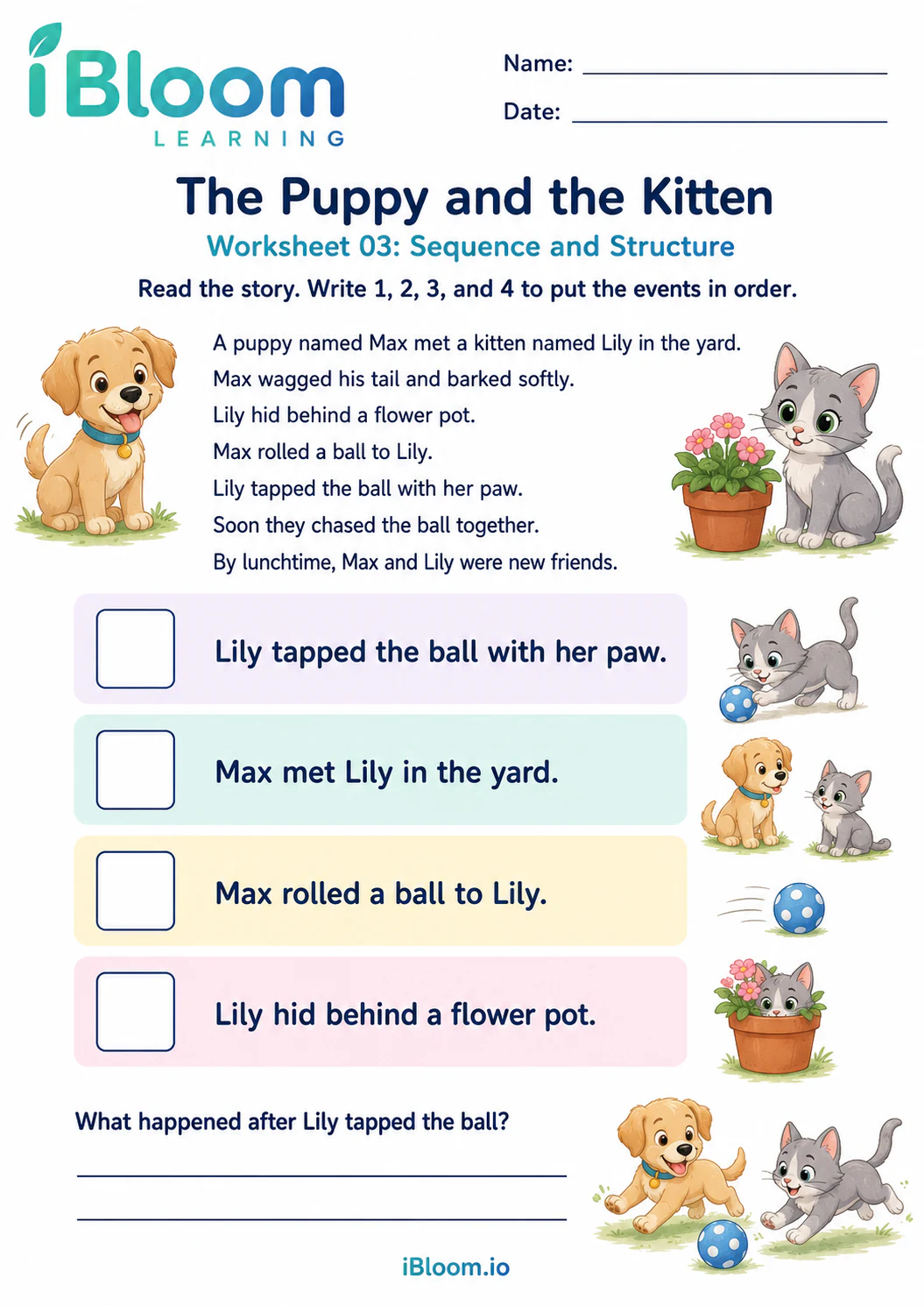
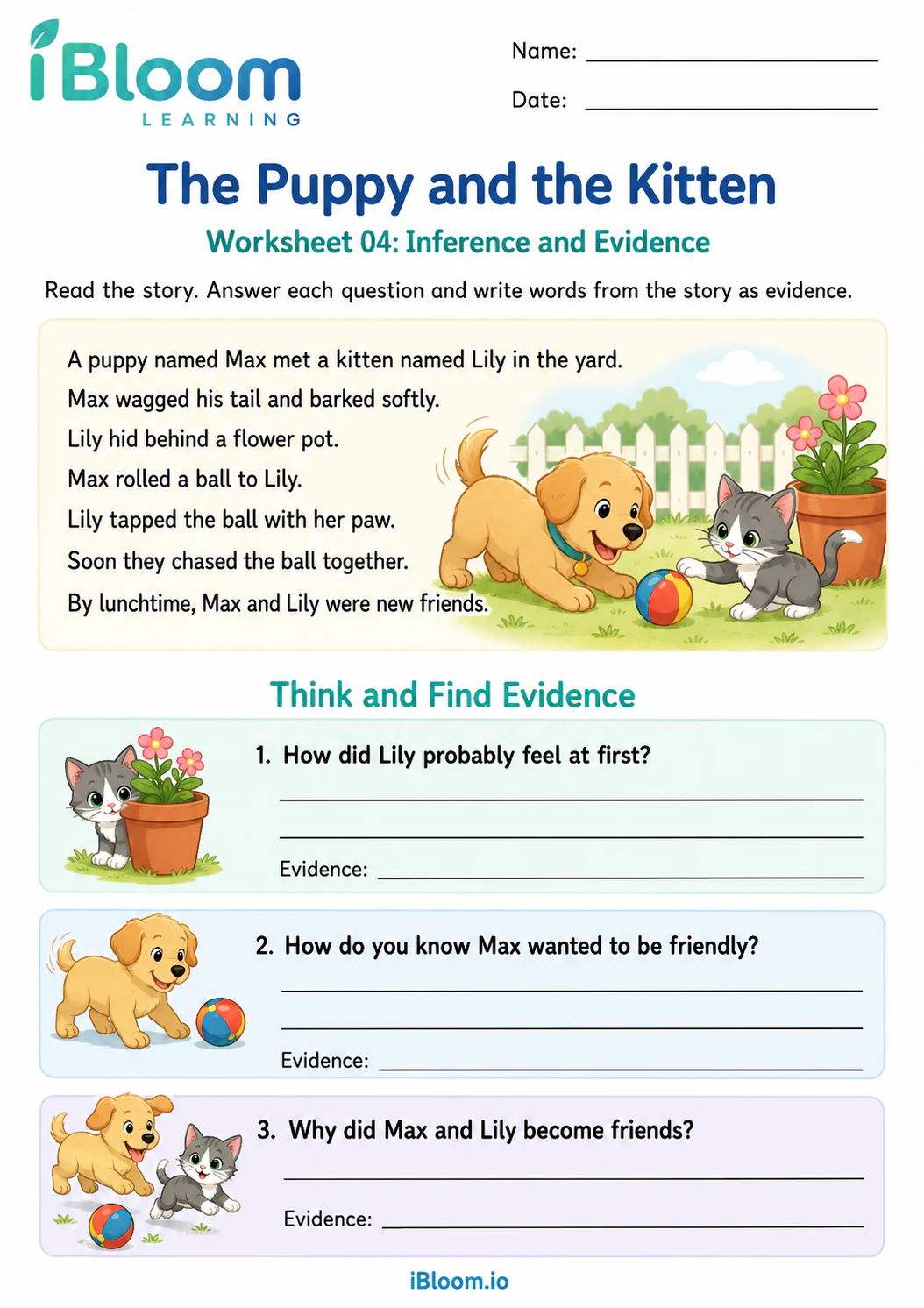
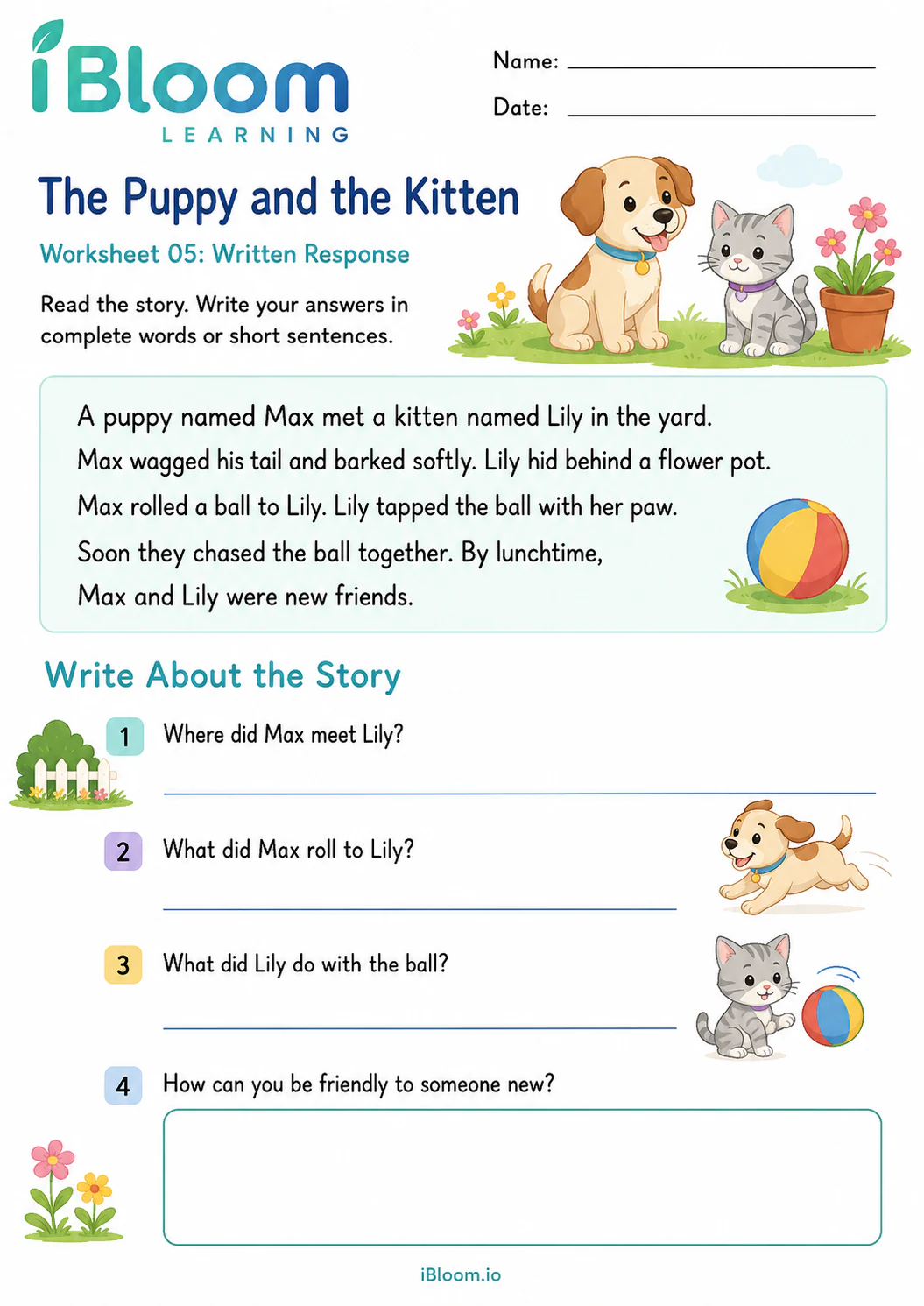
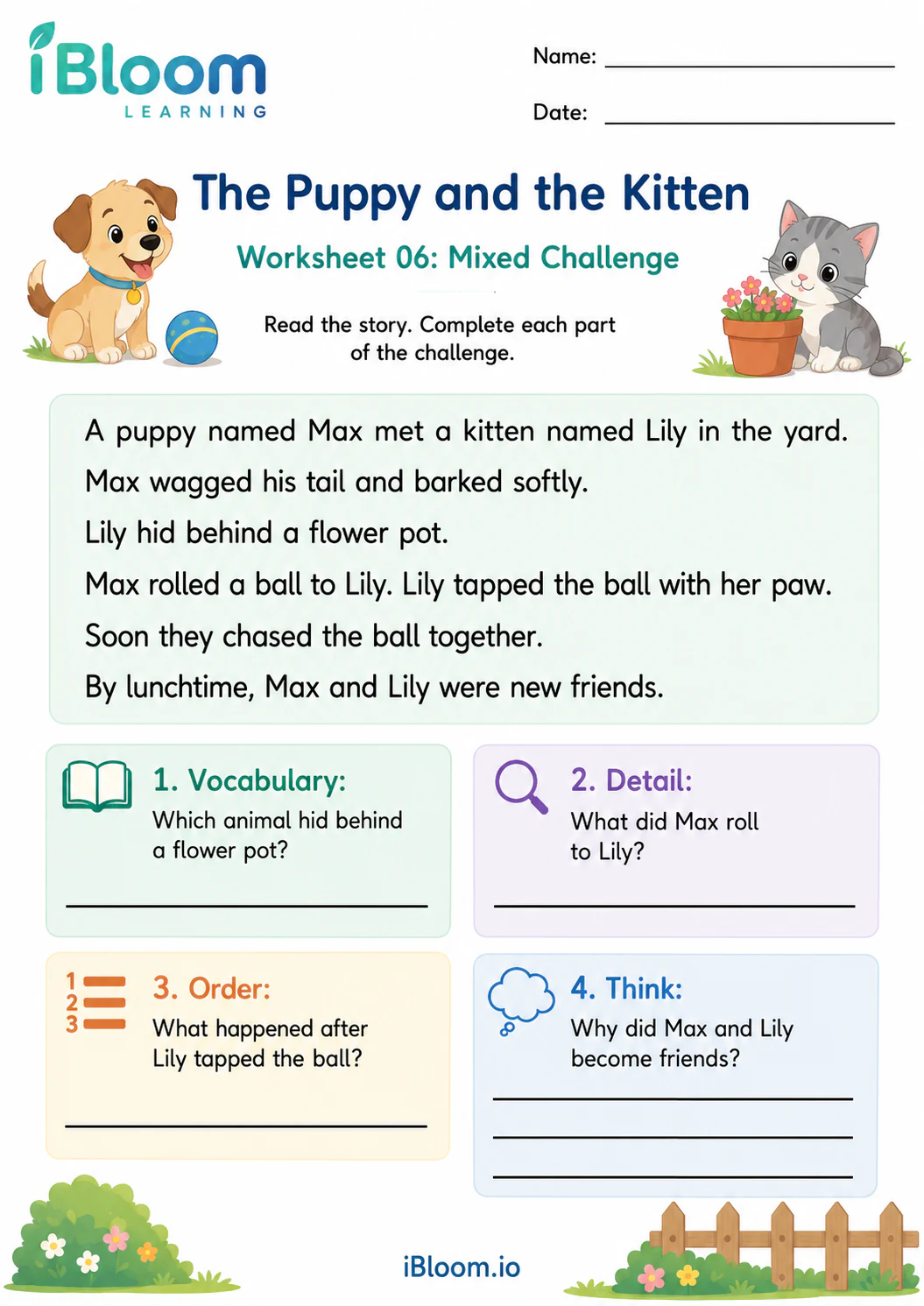
This Grade 1 printable pairs an original 61-word puppy-and-kitten story with questions about its main idea and supporting details. Max meets Lily in the yard; after he rolls a ball to her, she joins the play and they become friends. Children choose what the story is mostly about, locate events, and explain how the characters’ actions support that idea. The answer key includes sample responses for open questions.
Aligned to RL.1.2 and RL.1.1
What is the main idea of a story?
The main idea tells what the whole story is mostly about. In “Max and Lily,” a puppy and kitten meet in the yard, begin to play with a ball, and become friends by lunchtime. That change matters more than any one small event.
How do details support the big idea?
Details name actions in the story: Max barks softly, Lily hides behind a flower pot, and Max rolls her a ball. Lily taps it, then the two pets chase it together. Readers use these events to explain how the characters become friends.
How should children answer?
Parts B and C ask children to choose an idea or locate a short detail. Part D invites a retell or explanation. Children may use their own words as long as the answer is accurate and supported by the passage.
How to use this worksheet
- 1Read the story once to learn who Max and Lily are and what happens in the yard.
- 2Choose the answer that covers the whole story in Part B.
- 3Look back at the passage to find a detail for Part C.
- 4Use one or more events to support the written responses in Part D.
- 5Check the key; accept a different response when it matches the passage.
Common mistakes and quick fixes
The mistake
Choosing one event, such as hiding by the flower pot, as the main idea.
The fix
Ask whether the choice tells what the whole story is mostly about or only one moment.
The mistake
Changing a detail when answering from memory.
The fix
Look back at the passage and point to the sentence that supports the answer.
The mistake
Retelling events without connecting them to the characters becoming friends.
The fix
Add how Max’s ball and Lily’s response help the two pets begin to play together.
Curriculum alignment
Retell a story with key details and identify its central message or lesson.
On this sheet: Children identify the story’s main idea and use details to retell how the pets become friends.
Show the official wordingHide the official wording
Retell stories, including key details, and demonstrate understanding of their central message or lesson.
Ask and answer questions about key details in a text.
On this sheet: Children answer questions about events and details stated in the passage.
Show the official wordingHide the official wording
Ask and answer questions about key details in a text.
What to practice next
Make more practice
Further reading
Questions parents and teachers ask
What is the main idea of “Max and Lily”?
Max and Lily are a puppy and kitten who meet in the yard and become friends after playing with a ball. That overall change is the story’s big idea. The questions also ask children to find smaller events that show how the pets begin to play together.
What details show that Max and Lily become friends?
Max rolls a ball to Lily, she taps it with her paw, and soon they chase it together. By lunchtime they are new friends. Those events help readers understand the change from Lily hiding behind the flower pot to joining Max in play.
Can an adult read the story aloud?
Yes. An adult can read the passage and choices aloud while the child listens for meaning and finds details. That keeps the focus on main idea and text evidence, especially for a first grader who is still building fluency with printed words.
Do written answers need to match the key word for word?
No. The key gives sample answers rather than a script to copy. A child can use their own words, point to a different supporting detail, or describe an event in a new way as long as the response is accurate and supported by Max and Lily’s story.
How many questions are included?
There are 16 questions in four parts after the passage: main-idea choices, detail questions, and written responses. The answer key gives sample wording for open questions. Children may phrase an answer differently when the passage supports it, and can point to the sentence that helped them.