


About this worksheet
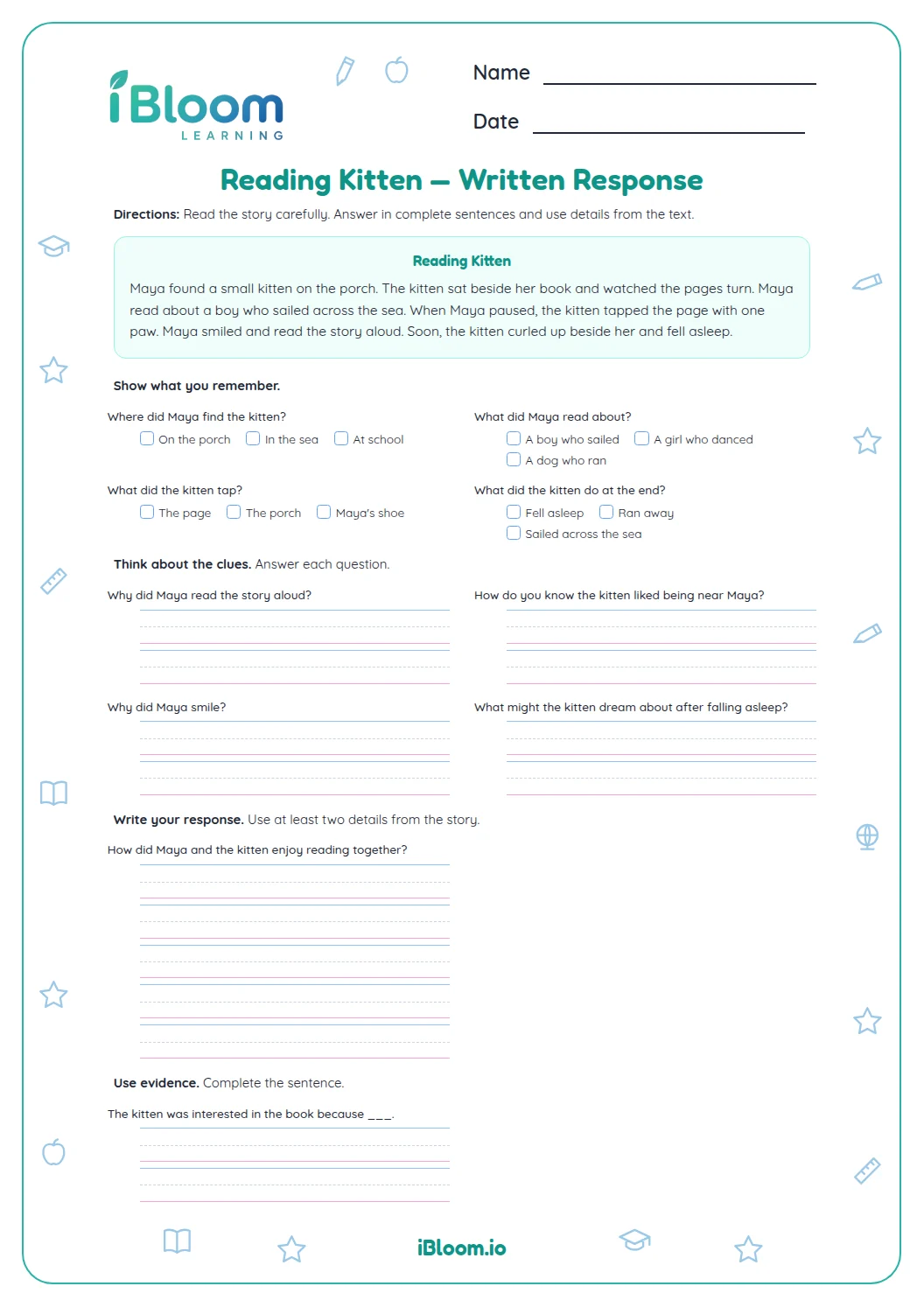
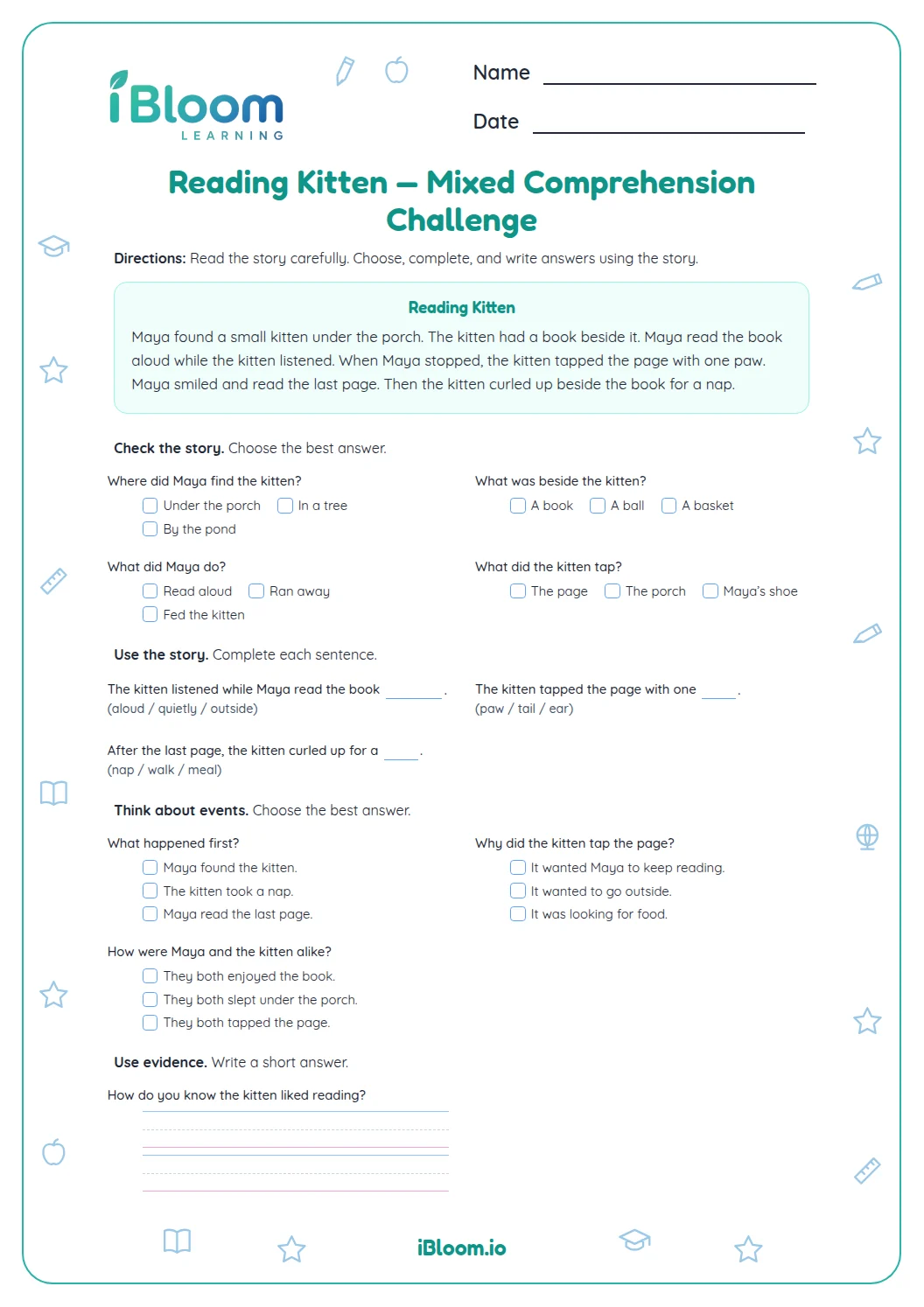
This free Grade 1 reading worksheet uses a short original story about Mia helping a lost kitten. Children answer 14 questions about the main idea, story details, and how details support an idea. Several responses ask children to write a brief answer in their own words. It practices Common Core RL.1.2 by asking readers to retell a story with key details and understand its central message. A separate answer key gives sample responses for open questions.
Aligned to RL.1.2
What is the main idea of this story?
The main idea tells what the whole story is mostly about. It is broader than one event. Mia finds a kitten, asks her dad for help, gives it water, and makes a bed while they wait. Together, those details show that the story is about Mia helping a lost kitten.
Which details help explain the main idea?
Details tell what happened and help readers explain an idea. On this sheet, children find where the kitten was, what Mia did, and how the story ends. Questions in Part B invite a short written answer, so children can connect a detail to the events around it.
- 1Idea: Mia cares for the kitten.
- 2Look for an action that shows care.
- 3Mia made a warm bed from a box and a towel.
- 4That detail supports the idea.
How is the worksheet organized?
The passage comes first. Part B asks multiple-choice questions about the main idea and specific events. Part C asks four short written questions about sequence, purpose, and evidence from the story. The key accepts the listed sample answers and other accurate details.
How to use this worksheet
- 1Read the title and ask what a story about a kitten might include.
- 2Read the story aloud once, or let your child read it independently.
- 3For Part B, point back to the exact sentence that supports each choice.
- 4For Part C, help your child answer in a complete thought and include a story detail.
- 5Compare answers with the key; discuss any response that uses a different accurate detail.
Common mistakes and quick fixes
The mistake
Choosing one event as the main idea.
The fix
Ask whether that detail explains the whole story or only one moment.
The mistake
Answering from memory without checking the passage.
The fix
Reread the sentence around the event and use its exact information.
The mistake
Giving a detail without answering why it matters.
The fix
Connect the detail to Mia helping the kitten or to how the kitten gets home.
Common Core alignment
This Grade 1 story practice focuses on a story’s central message and the details that support it.
Retell a story with key details and show understanding of its lesson.
On this sheet: Children identify the story’s main idea and use details to explain Mia’s actions and the ending.
Show the official wordingHide the official wording
Retell stories, including key details, and demonstrate understanding of their central message or lesson.
What to practice next
Make more practice
Further reading
Questions parents and teachers ask
What is the main idea of the Reading Kitten story?
The story is mostly about Mia helping a lost kitten. She asks her dad for help, gets water, makes a warm bed, and helps the kitten return home. These details all connect to the same main idea instead of describing unrelated events.
What details should a child use to answer the questions?
Children should use details stated in the passage, such as where Mia found the kitten, what she put in a dish, or how she made a bed. For written questions, a short answer is enough when it accurately explains the event or reason.
How many questions are on this worksheet?
There are 14 questions: 10 multiple-choice items and 4 short written responses. The passage is printed before the questions, and the answer key provides the correct choices and sample responses for questions with more than one acceptable wording. Use the story to verify each response.
Can an adult read the passage aloud?
Yes. Reading the passage aloud can help a child focus on understanding the story and using details. After listening, the child can point to a sentence that supports an answer, then choose or write the response independently. This keeps the work focused on meaning rather than decoding every word.
What does the answer key include?
The key lists all 14 answers. It includes exact multiple-choice answers and sample responses for the written questions; a child’s wording can differ as long as it matches a real detail or reasonable inference from the passage. Read the matching passage sentence together when checking.