

About this worksheet
This Grade 1 printable pairs an original 90-word story about Mia, Ben and Leo with 16 comprehension questions. Children find stated details, interpret a word in context, order events and point to story evidence. It practices CCSS RI.1.1 by asking and answering questions about key details. The worksheet and answer key each span three pages.
Aligned to RI.1.1
Which details can a reader find?
Part B asks children to return to the story for people, place, objects and actions. For instance, the children set up their puzzle table in the library.
- 1Question 1: Who helped Mia and Ben? → Leo
How do story clues help answer questions?
Part C asks why an event happened and what a word means in context. The bell rang before the puzzle was done, which explains why the children packed the pieces.
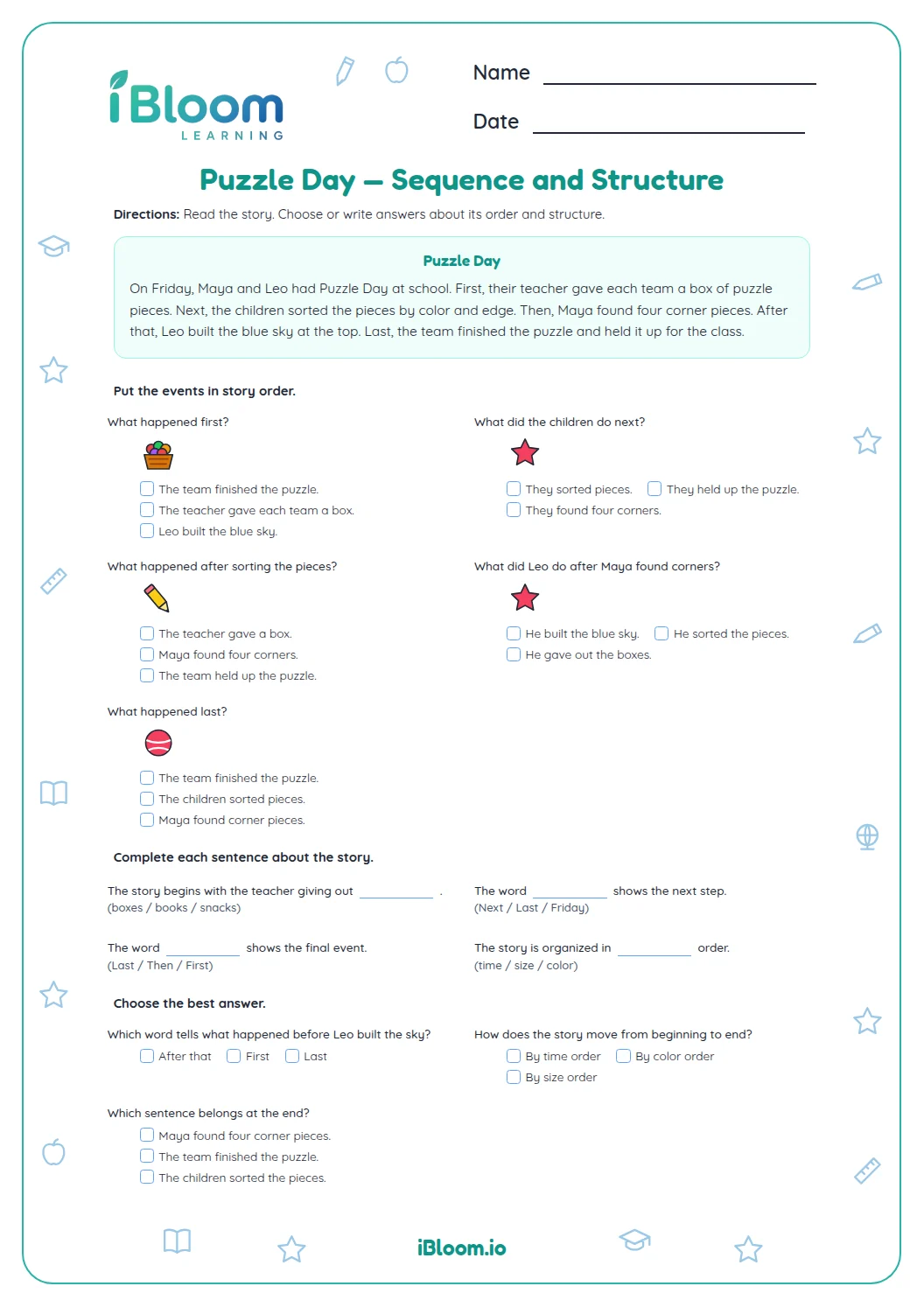
- 1Question 7: What happened before the children made the sign? → The bell rang.
How can children explain an answer with evidence?
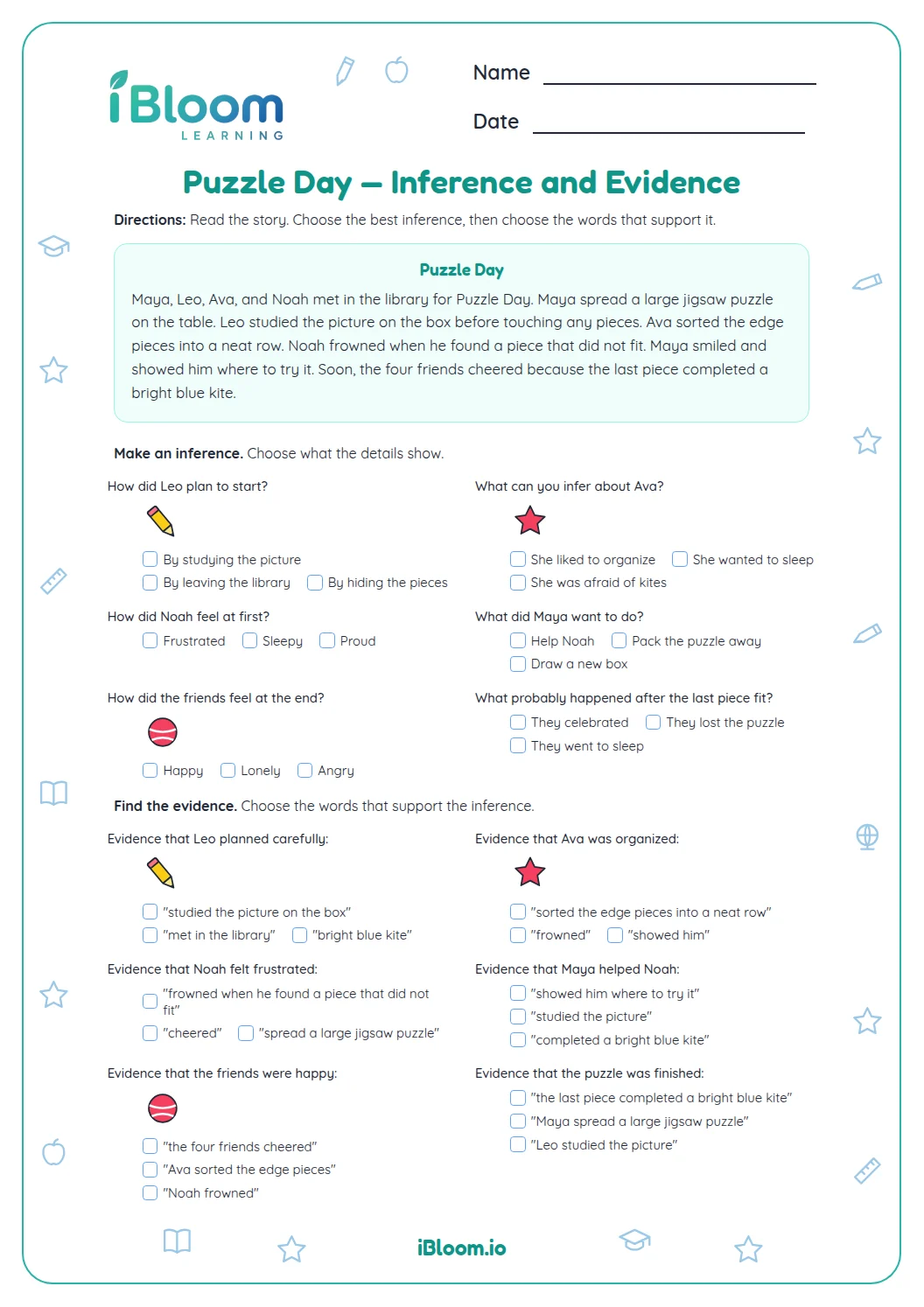
Part D asks children to connect answers to details in the story. For example, Mia’s words, “We can finish it together,” show that the friends plan to keep working as a team.
How to use this worksheet
- 1Read the story once to learn who is helping and what they are doing.
- 2Reread the paragraph named by a question before answering.
- 3For sequence questions, tell which event happened first or next.
- 4Use the story's own words for names and details.
- 5For the last response, give a possible feeling and connect it to Mia's words.
Common slips and helpful fixes
The mistake
Mixing up who found the bird piece.
The fix
Look back for the sentence naming Leo; Mia sorted edge pieces.
The mistake
Saying the puzzle was completed.
The fix
Check the ending: the children plan to finish tomorrow.
The mistake
Giving a prediction with no clue.
The fix
Connect the feeling to Mia saying they can finish together.
Common Core alignment
This worksheet practices the listed Common Core skill through its questions.
Ask and answer questions about key details in a text.
On this sheet: Ask and answer questions about key details in a text.
Show the official wordingHide the official wording
Ask and answer questions about key details in a text.
What to practice next
Make more practice
Further reading
Questions parents and teachers ask
How long is the Puzzle Day story?
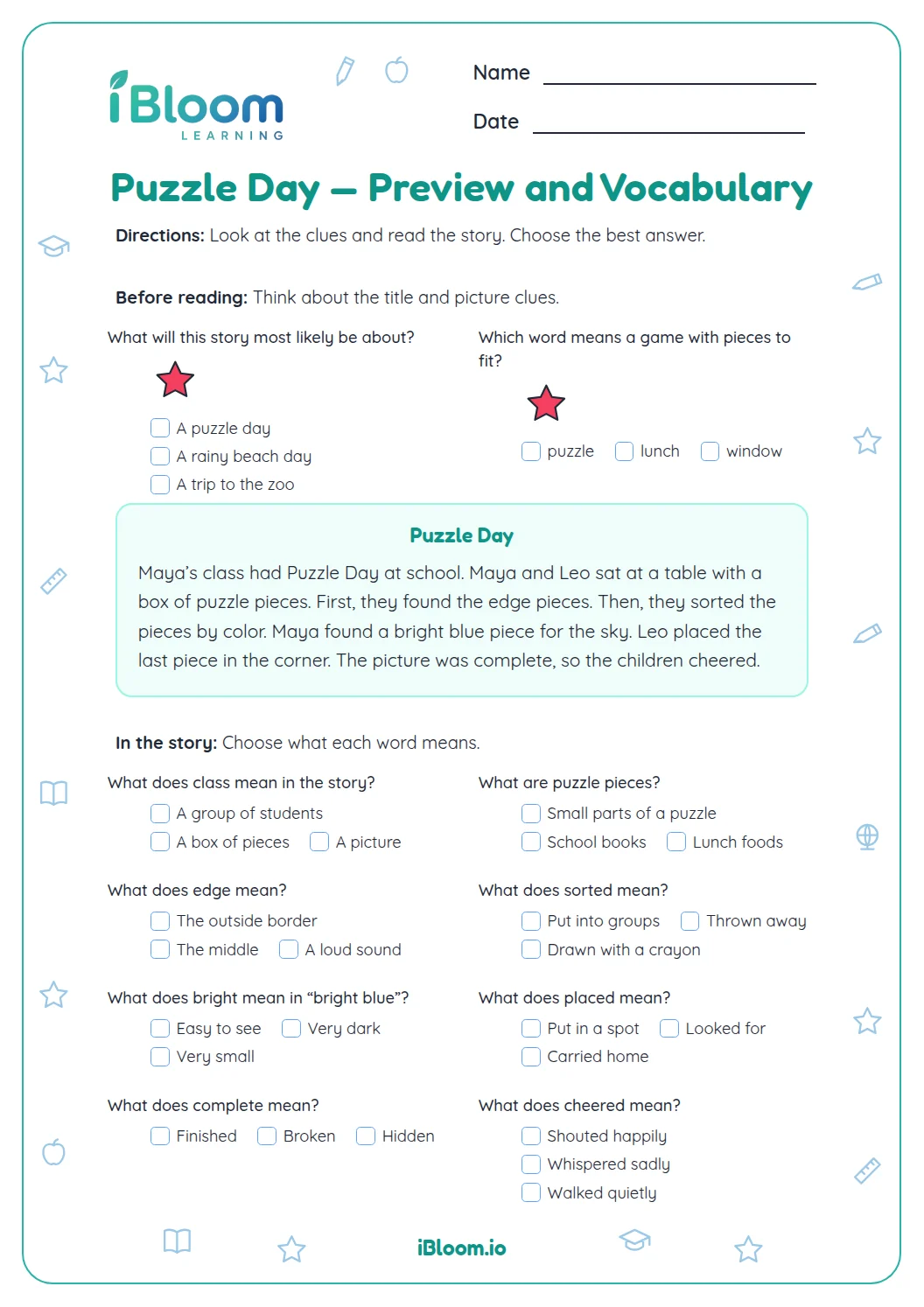
The story has two short paragraphs about three friends building a barn puzzle. It gives enough details to answer questions about the setting, puzzle pieces and what the children do when the bell rings. The 16 questions move from finding stated facts to explaining a clue.
What kinds of questions are included?
Children answer questions about story details, sequence, a word in context, a reason, the main idea and a prediction. The final questions ask the reader to use more than one sentence from the story, while the early questions can be answered with one clear detail.
Should a child reread the story?
Yes. Rereading is useful when a question asks who did an action or what happened next. Children can point to the sentence that supports an answer, then write it in their own words or borrow the story’s exact detail. Reading a sentence again can help children place the events in order before writing.
What clue supports the last answer?
Mia says, “We can finish it together.” Those words support the answer that the friends want to keep working as a team. Children can quote that sentence or explain its meaning in their own words. The key gives a model response, and equivalent wording is fine.
How can I use the answer key?
Let the child finish a section before checking the matching answers. Some questions accept a phrase rather than a full sentence, and question 16 has a sample response because feelings can be stated in different reasonable ways. Compare the response with the story and accept wording that keeps the same meaning.