





About this worksheet
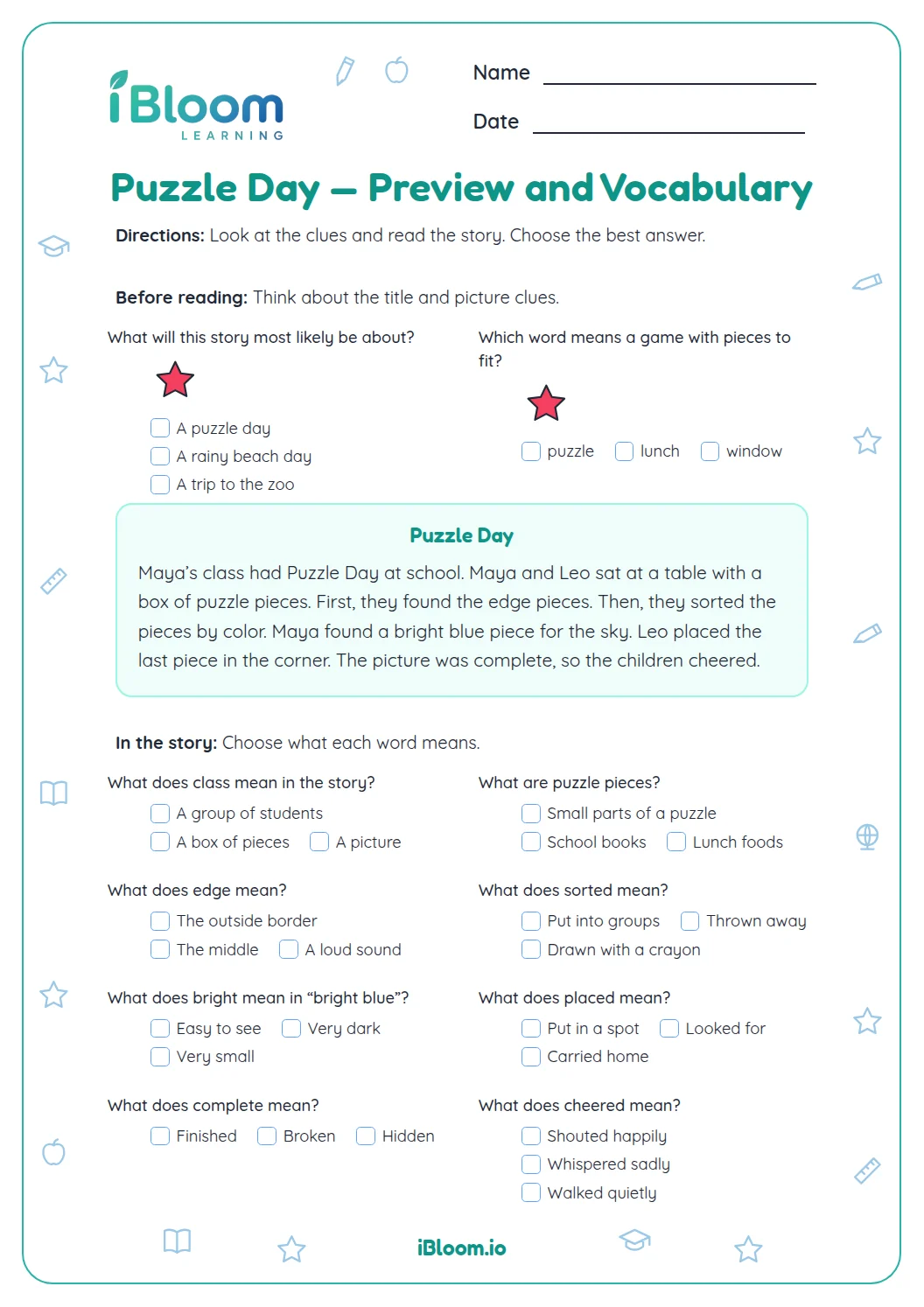
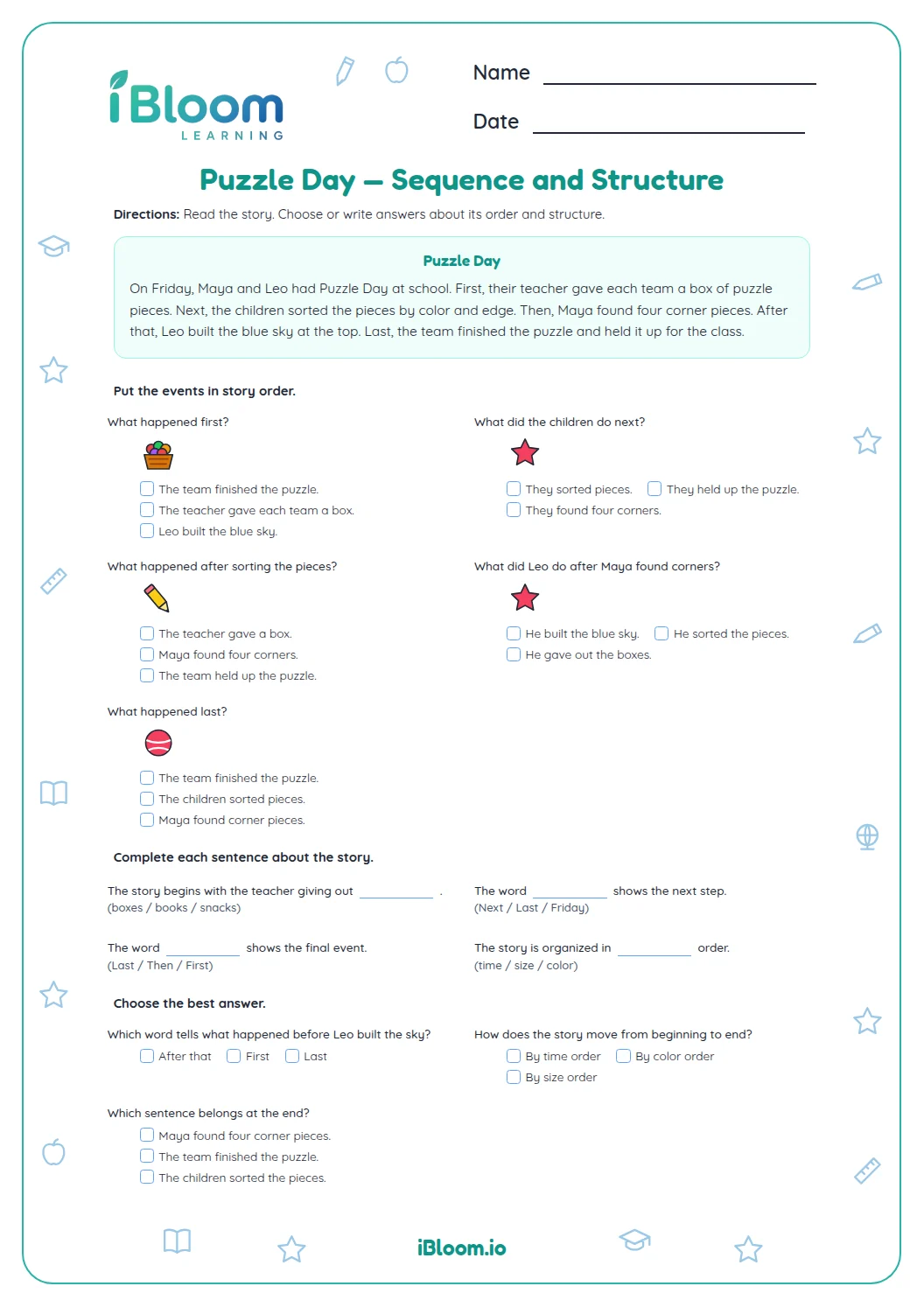
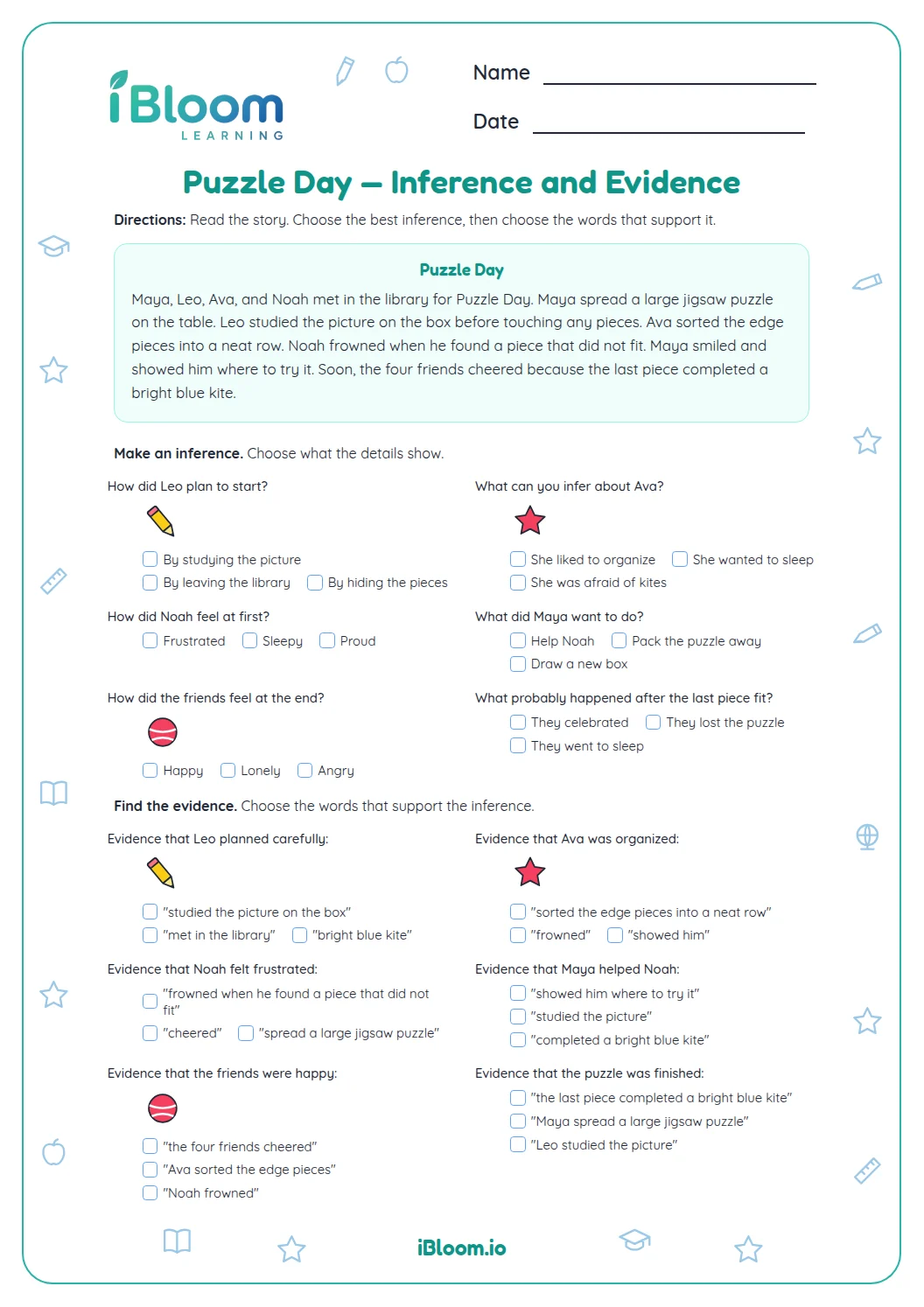
This free printable worksheet helps Grade 1 readers practice finding the main idea and key details of a short story. Children read Puzzle Day, a 70-word story about Maya, Leo and a jigsaw puzzle on each table at school. Then they pick the main idea and the best title, answer four detail questions (two with picture choices) and write two short answers from the story. It supports Common Core RL.1.1 and RL.1.2, asking and answering questions about key details and retelling stories. An answer key is included.
Aligned to RL.1.1 and RL.1.2
What is on this Puzzle Day worksheet?
A short original story, then three parts. The story is about Maya and Leo, who work on a jigsaw puzzle at school. In Part B, children choose the main idea and the best name for the story. In Part C, they answer four questions about details, two of which use pictures instead of words. In Part D, they write a short answer to two more detail questions.
Every answer can be found by looking back at the story, so children can check themselves by pointing to the words.
- The story: 70 words in two short paragraphs
- Part B: main idea and best title (questions 1 and 2)
- Part C: details, including two picture choices (questions 3 to 6)
- Part D: short written answers (questions 7 and 8)
What is the difference between the main idea and a detail?
The main idea is the big idea that most of the story is about. A detail is one small fact inside the story. In Puzzle Day, “Maya found the corner pieces first” is a detail, and so is “Leo looked for pieces with blue sky.” Put all the details together and you get the main idea: a class worked on a puzzle together.
A helpful question for a young reader is, “If I told a friend this story in one sentence, what would I say?” The answer is usually the main idea.
- 1What is the story mostly about? → A class doing a puzzle together
- 2Why not “A class painting a park”? → The park is only on the finished puzzle
- 3Best name? → Puzzle Day at School
How can a child find a detail in a story?
Look back. Every detail question names something that is in the story, so a child can point a finger to the words, then answer. “Who found the corner pieces first?” sends the reader back to the third sentence, where Maya is named.
The picture choices in questions 3 and 4 let children answer without reading three more phrases. They still need to find the detail in the story before choosing: the puzzle on each table, and the red kite in the finished picture.
What should a child write in Part D?
Only a few words are needed. For “What did the children share?” the answer is their pieces. For “What did the finished puzzle show?” the answer is a bright park. A child who writes “the pieces” or “a park” has found the right detail too, so check the meaning, not the exact words.
How to use this worksheet at home or in class
- 1Read the story aloud together once, then let your child read it again alone.
- 2Ask the one-sentence question: what is this story mostly about? Let your child say it before looking at question 1.
- 3Have your child answer questions 1 and 2, then talk about which choices were only small parts of the story.
- 4For Part C, ask your child to point to the sentence that has each answer.
- 5Let your child write Part D in their own words, and read the answers back together.
- 6Check with the key and try another children’s story worksheet.
Common mistakes and quick fixes
The mistake
Choosing “A class painting a park” for question 1 because the park is the last thing in the story.
The fix
Ask whether the whole story is about painting. It is about a puzzle. The park is what the puzzle showed at the end.
The mistake
Picking the balloon or rainbow for question 4 because they are nice sky pictures.
The fix
Go back to the second paragraph and find the sentence that says what was in the sky. It says a red kite.
The mistake
Choosing Leo for question 5 because his name comes in the very next sentence.
The fix
Find the sentence about the corner pieces. Maya found them first, and Leo looked for something else.
Common Core alignment
Grade 1 readers answer questions about key details and retell stories. This worksheet asks both about one short story.
Answer questions about key details, such as who found the corner pieces.
On this sheet: Questions 3 to 8 ask about key details of Puzzle Day, using pictures, choices and short written answers.
Show the official wordingHide the official wording
Ask and answer questions about key details in a text.
Retell what the story is about, using the key details.
On this sheet: Questions 1 and 2 ask what the whole story is mostly about and which name fits it.
Show the official wordingHide the official wording
Retell stories, including key details, and demonstrate understanding of their central message or lesson.
What to practice next
Make more practice
Further reading
Questions parents and teachers ask
What is the main idea of Puzzle Day?
The main idea is that a class works on a puzzle together. Maya and Leo each find a different kind of piece, the children share, and the puzzle shows a park when it is done. Question 1 asks for this idea, and question 2 asks for the best name, Puzzle Day at School.
How is a main idea different from a detail?
A main idea covers the whole story, while a detail is one small fact. Maya finding the corner pieces is a detail, because it happens in one sentence. The main idea is what all the details add up to. Part B asks about the main idea, and Parts C and D ask about details.
Is this story the right length for Grade 1?
Puzzle Day is about 70 words in two short paragraphs, with short sentences and familiar words such as table, sky and park. If your child is still building reading stamina, read it aloud together first, then let them read it again alone before answering the questions.
Why do two questions use pictures?
Questions 3 and 4 use picture choices so a young reader can show what they remember without reading three more phrases. The pictures do not give the answer away: the child still has to recall the detail, a puzzle on each table or a kite in the sky, and pick the matching picture.
What if my child writes a different answer in Part D?
Accept any answer that names the right detail. “Their pieces,” “the pieces” and “puzzle pieces” all answer question 7, and “a park” or “a bright park” answers question 8. If a child’s spelling is imperfect, focus on whether the answer comes from the story. Writing practice can happen separately.
What should we read after Puzzle Day?
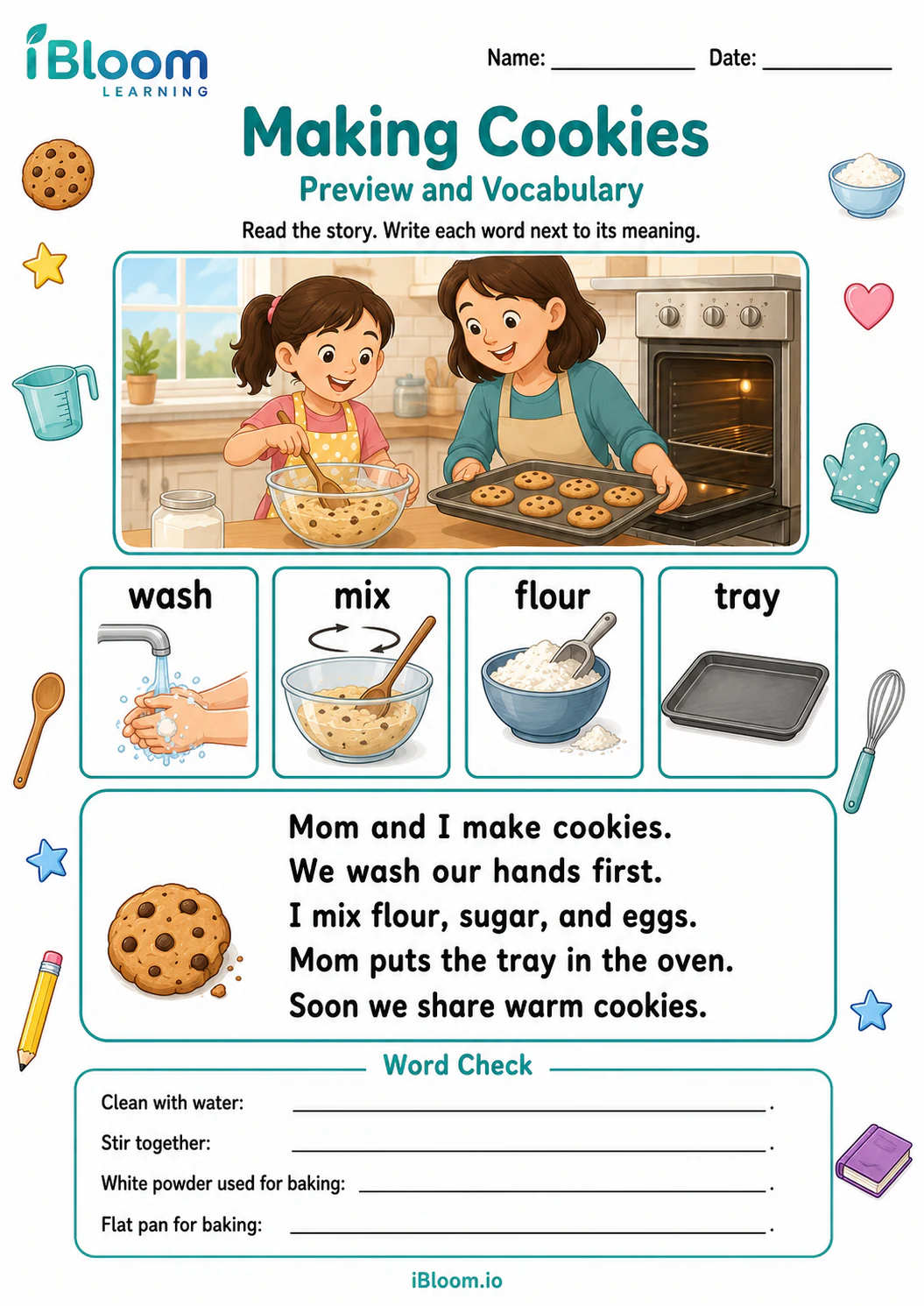
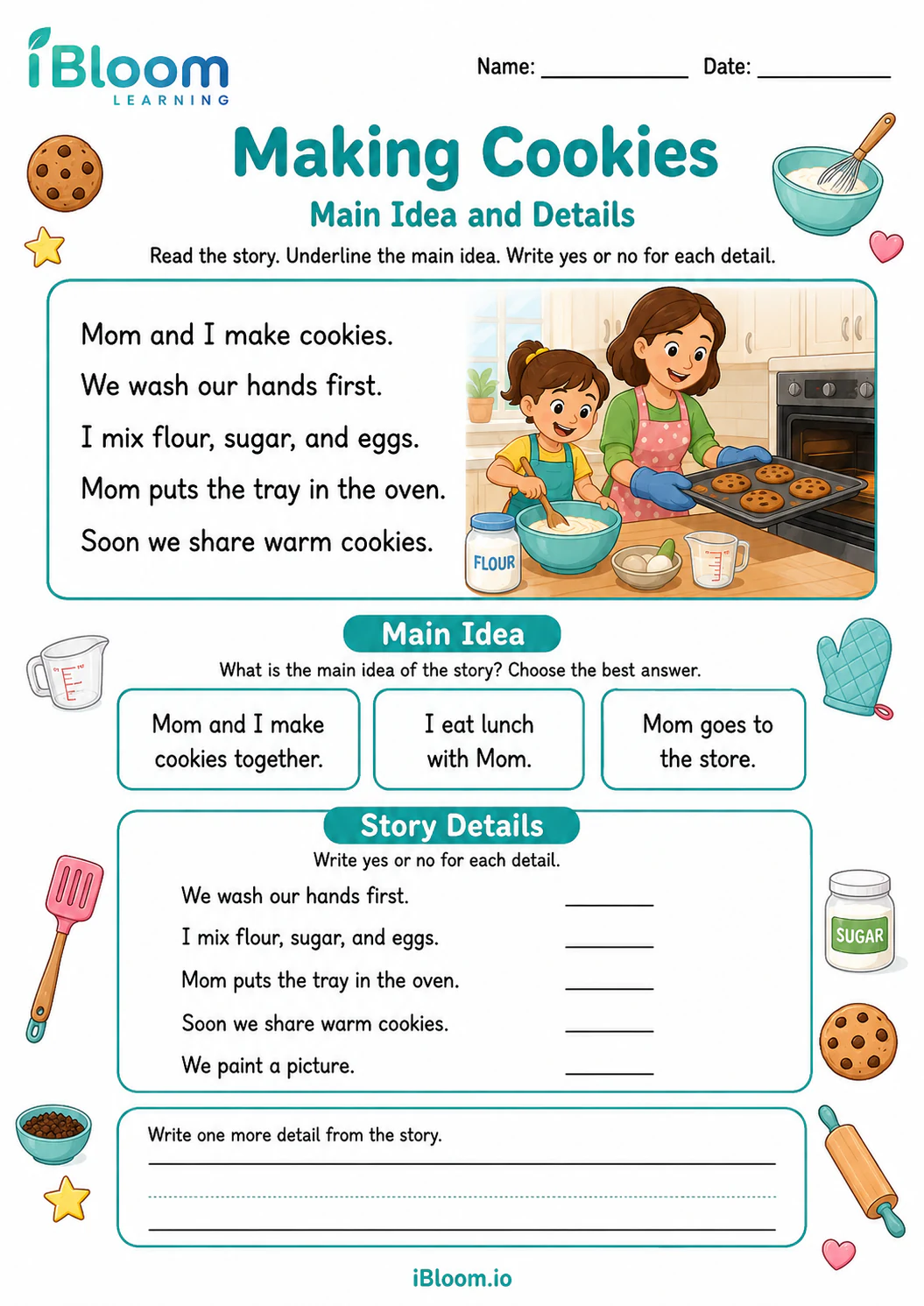
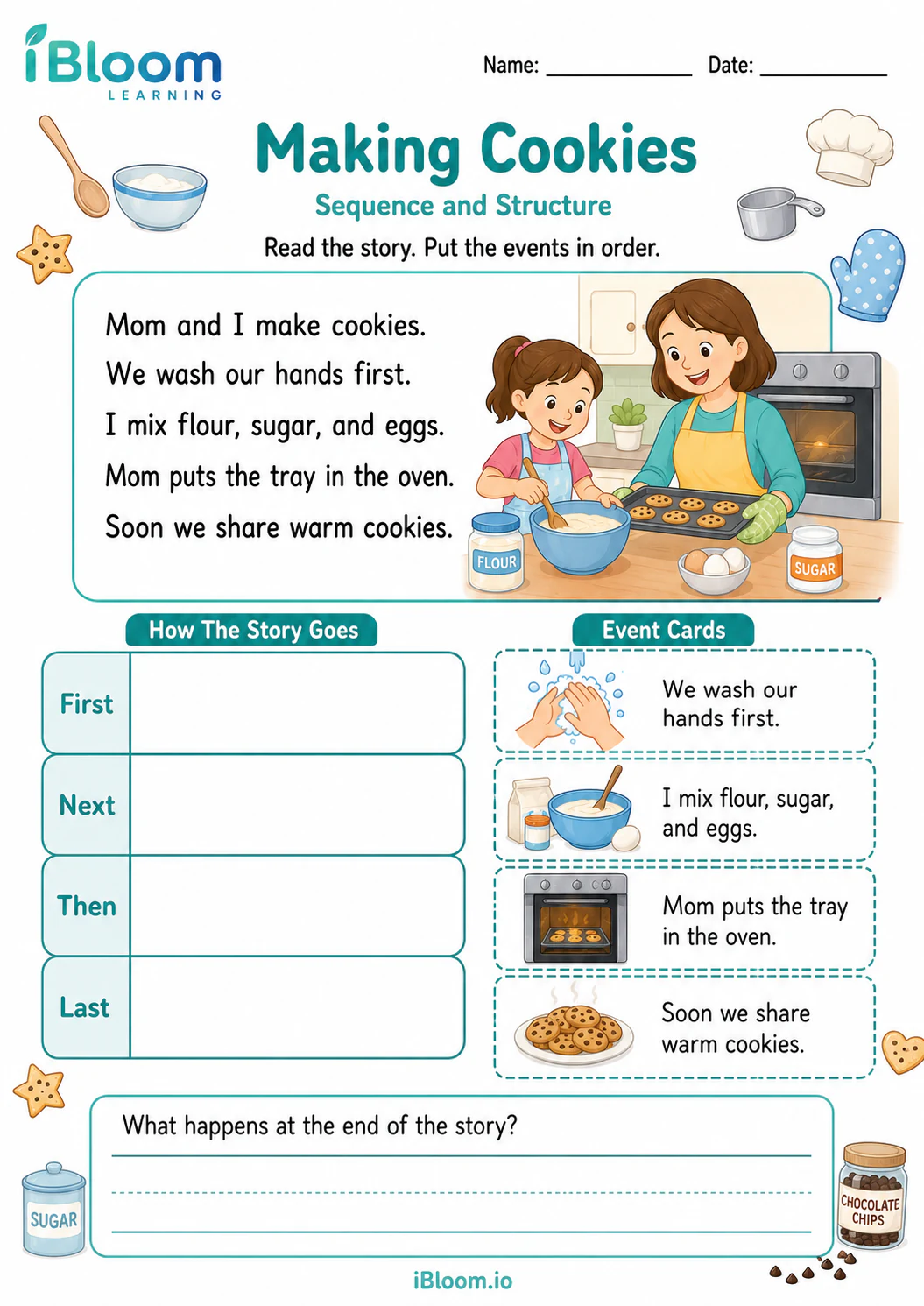
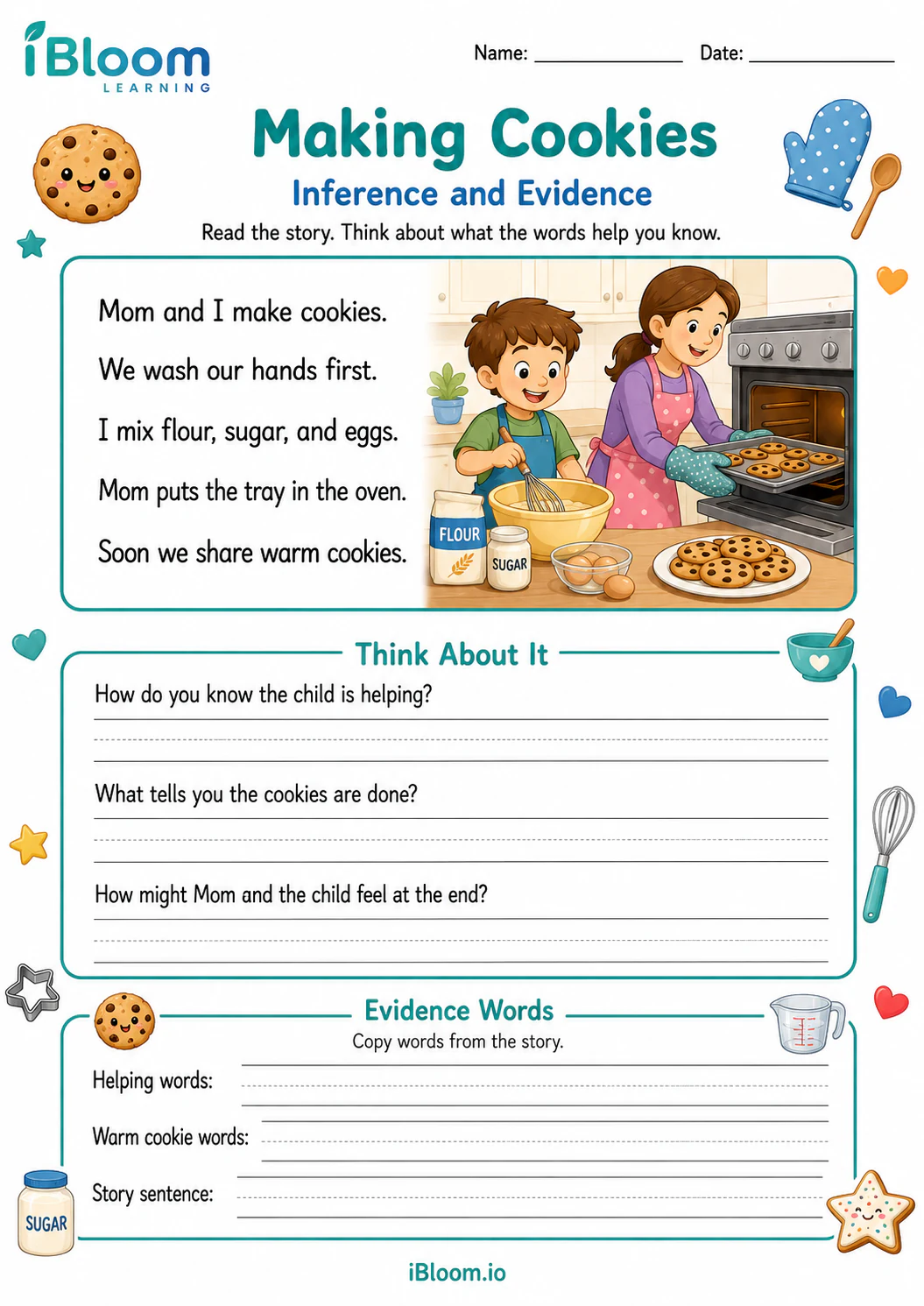
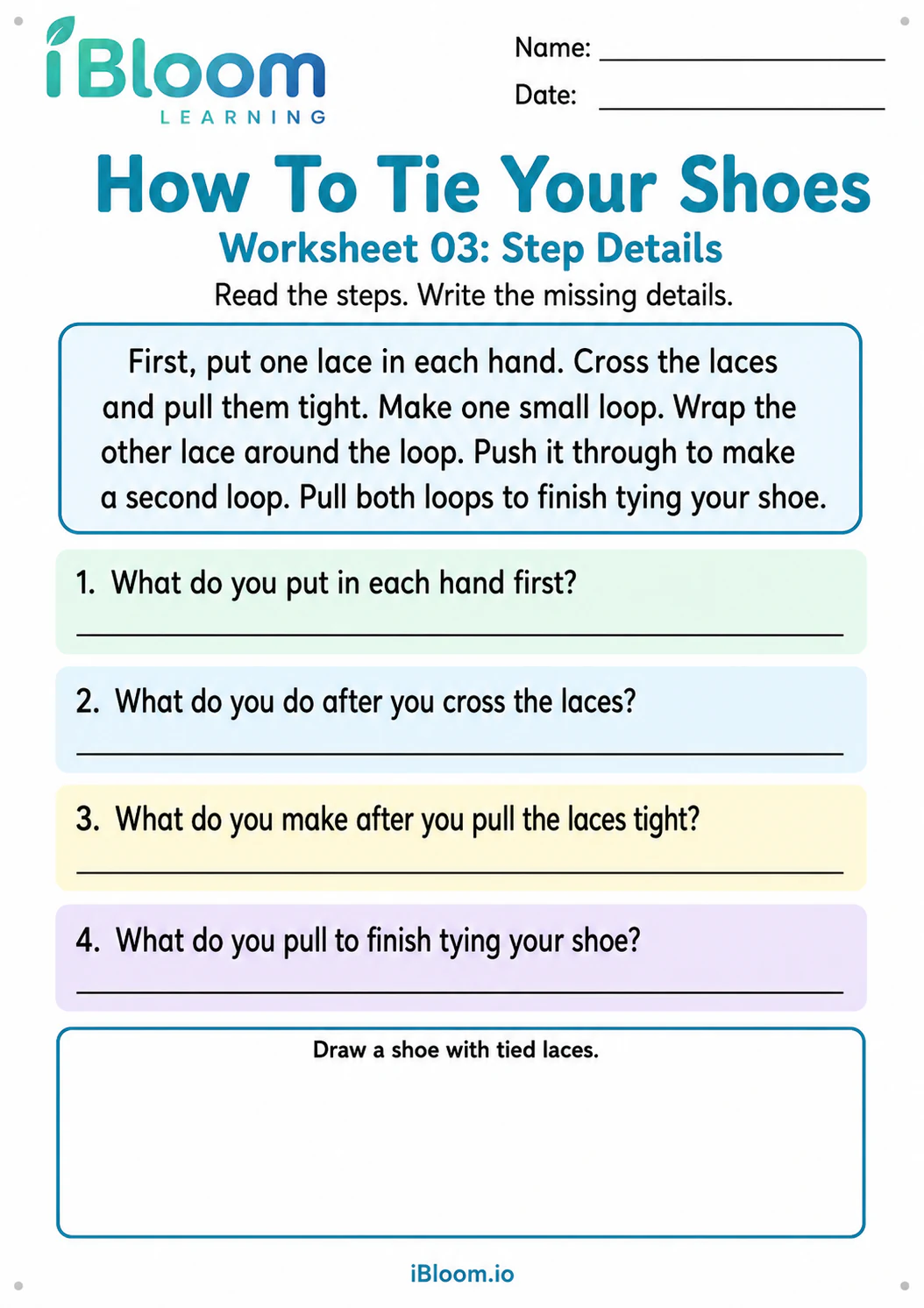
Try another short story from the Grade 1 children’s story worksheets, such as Making Cookies or Tie Shoes, and ask the same two questions: what is the story mostly about, and what small facts does it tell? Asking them out loud before writing helps children build the habit for any book.