


About this worksheet
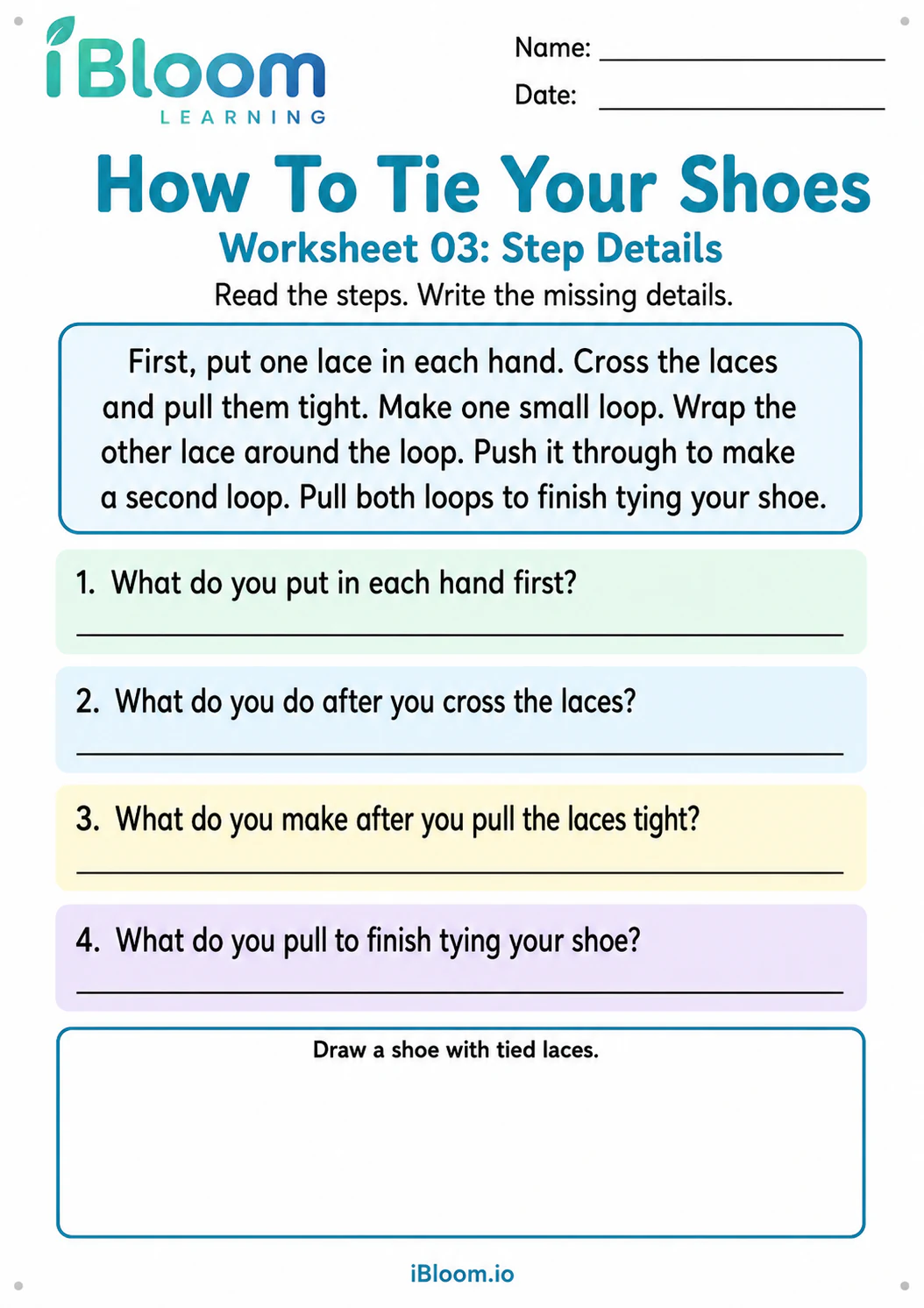
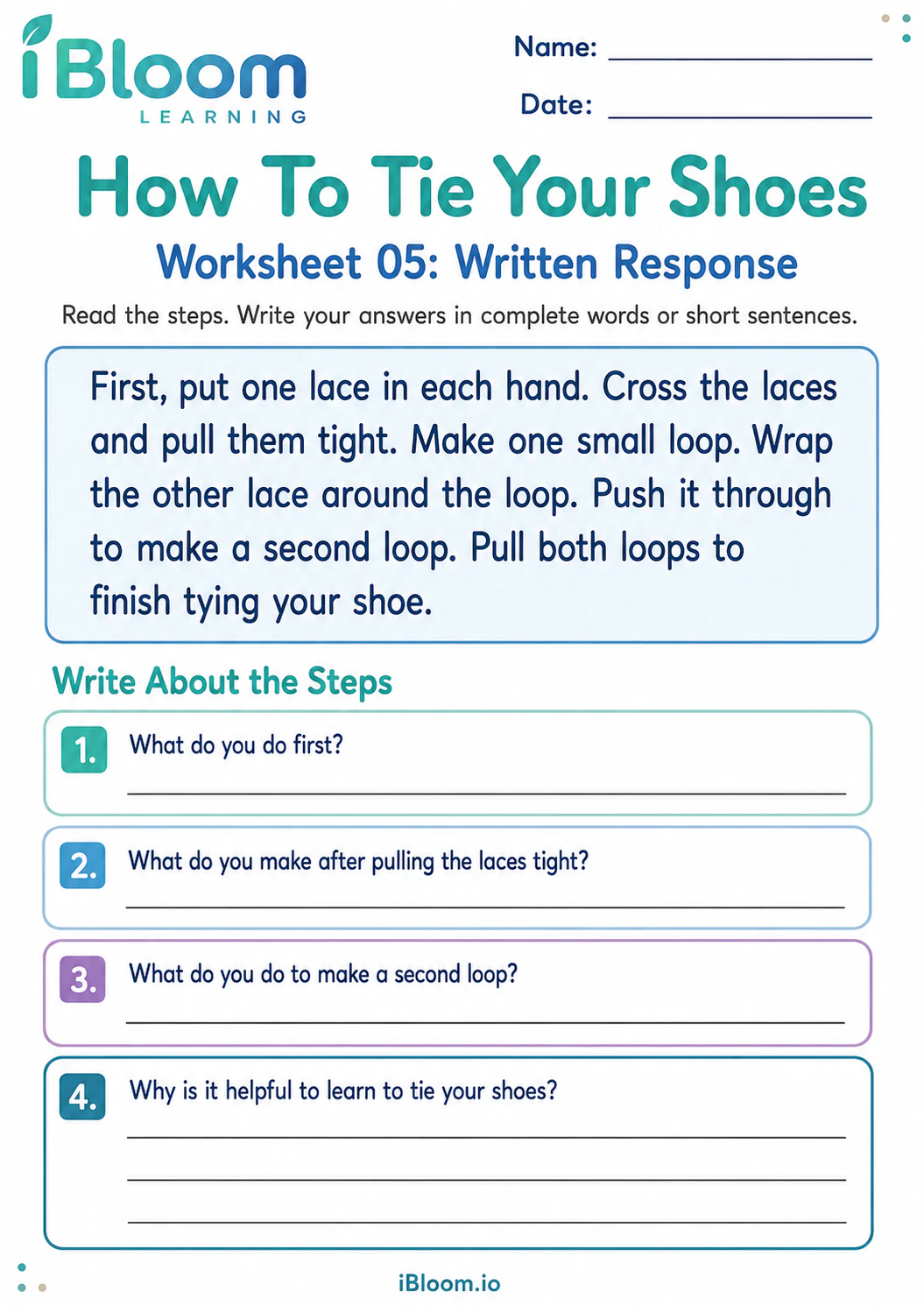
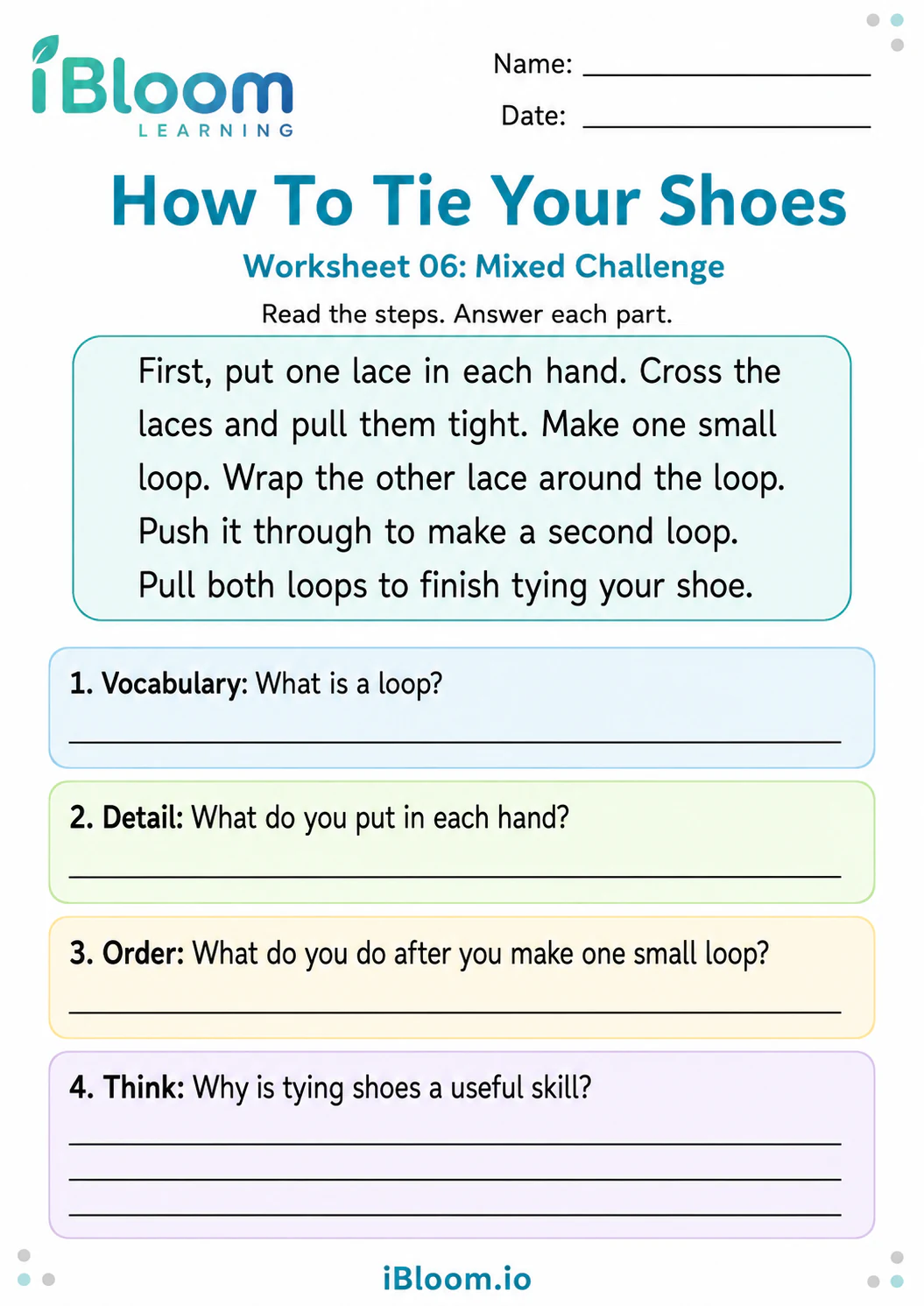
This free printable Grade 1 worksheet gets children ready to read a short how-to text, “How to Tie Your Shoes,” and then checks the four words they need to understand it: lace, cross, loop and pull. Children read the text, answer two preview questions, choose the meaning of each vocabulary word and use each word to finish a sentence. It practices Common Core RI.1.4 and L.1.4a, and a separate answer key is included.
Aligned to RI.1.4 and L.1.4a
Why preview a text before reading it?
Previewing gives a reader a plan. The title and a few key words tell a first grader what kind of text this is and what it will say. Here the title, How to Tie Your Shoes, tells children the text will give steps, and the word First in question 2 is the signal that the steps begin.
Part B has two questions that use only the title and the first word of the steps. Children can answer them before they have read anything closely, which makes the text feel familiar when they come back to read it.
How do children use the sentence to learn a word?
Each of the four words appears in a sentence of the text, and the sentence gives clues. A child who reads “Cross the laces and pull them tight” can think about what is being done to the laces. Trying each choice in the sentence shows which meaning fits.
In Part D the work turns around. Children use the words around a blank, such as “First, put one ___ in each hand,” to decide which of the four words belongs.
- 1Cross the laces and pull them tight.
- 2What does cross mean here?
- 3Try: “to jump up high the laces.” That does not make sense.
- 4Try: “put one over the other the laces.” That fits.
- 5Answer: put one over the other
What is on this worksheet?
A short how-to text and ten questions on two pages, in four parts.
- Part A, Read: a short how-to text of nine sentences about tying a shoe
- Part B, Preview: two questions, one picking the picture that matches the title and one finding the word First
- Part C, What does it mean: lace, cross, loop and pull, each with three choices
- Part D, Use the word: four sentences to finish with one of the four words
- Answer key on its own pages
How to use this worksheet at home or in class
- 1Show a shoe with laces. Ask your child to point to the lace and tell you when they use it.
- 2Read the title aloud together and ask what the text will teach. Then do Part B.
- 3Have your child read the text aloud once, then point to lace, cross, loop and pull as they find each word.
- 4Act out each word with a real lace: cross two laces, make a loop, pull one end toward you.
- 5Do Part C together. Read each choice aloud and say whether it makes sense in the text.
- 6Let your child finish Part D alone, reading each sentence back with the word in it. Check with the answer key.
Common mistakes and quick fixes
The mistake
Mixing up push and pull, since both words are in the text.
The fix
Show it with a lace. Pull moves the lace toward you, and push moves it away. The text says to pull tight and to push through.
The mistake
Choosing a word from its first letter, like loop for lace.
The fix
Read the whole sentence with the word in it. “Put one loop in each hand” does not make sense, but “put one lace in each hand” does.
The mistake
Choosing the first answer without trying the others.
The fix
Say the sentence with each meaning in place of the word. Keep the one that makes sense.
Common Core alignment
Most US states use the Common Core standards or a close state version. These Grade 1 standards describe the word work on this page.
Ask and answer questions to work out what words in a text mean.
On this sheet: Part C asks what lace, cross, loop and pull mean in the how-to text.
Show the official wordingHide the official wording
Ask and answer questions to help determine or clarify the meaning of words and phrases in a text.
Use the rest of the sentence as a clue to what a word means.
On this sheet: Part D asks children to use the sentence around each blank to choose the right word.
Show the official wordingHide the official wording
Use sentence-level context as a clue to the meaning of a word or phrase.
What to practice next
Make more practice
Further reading
Questions parents and teachers ask
What is a how-to text?
A how-to text tells a reader how to do something, step by step. It uses order words such as First and short sentences that begin with an action, like Cross and Pull. This worksheet’s text gives steps for tying a shoe, so children can act it out with a real lace.
What do lace, cross, loop and pull mean in this text?
A lace is a string on a shoe. To cross is to put one over the other, a loop is a round shape of lace, and to pull is to move something toward you. Part C asks children to choose each meaning, and Part D asks them to use the words.
Does my child need to know how to tie shoes already?
No. The questions are about words and the order of the steps, not about the skill. Children who have never tied a shoe can still answer them. It helps to have a real shoe or lace nearby so they can try crossing, looping and pulling after reading.
What should I do if my child struggles with Part D?
Read each sentence aloud with the word left out, then try each of the four words in turn. Ask which one makes sense. Question 7, “First, put one ___ in each hand,” fits only lace. Starting with the sentences that have the most clues builds confidence.
Why does the worksheet ask about the title first?
Looking at the title before reading gives children a purpose. Question 1 asks them to pick the picture that matches How to Tie Your Shoes, a shoe rather than a bike or bread, and question 2 asks which word shows what comes first. Both help children read the text with the steps in mind.
Is there an answer key for this worksheet?
Yes. The answer key has its own two pages and shows the right choice for each Part B and Part C question and the word for each Part D sentence. Print only the worksheet for your child, then use the key afterward to check the answers together, word by word.