


About this worksheet
This free Grade 1 reading worksheet pairs a short story called “Shovel Snow” with 16 questions about details, vocabulary, sequence, and a character’s actions. Children reread the passage to find who helped, what happened first, and how a nearby word helps explain meaning. The questions practice asking and answering about key details in a text under CCSS RL.1.1. An answer key gives short responses and sample wording for open questions.
Aligned to RL.1.1
How can a reader find story details?
A detail is a fact the passage tells. Look back at the sentence that answers the question, then say the answer in a few words. In question 1, the story says Mia found the shovel in the shed.
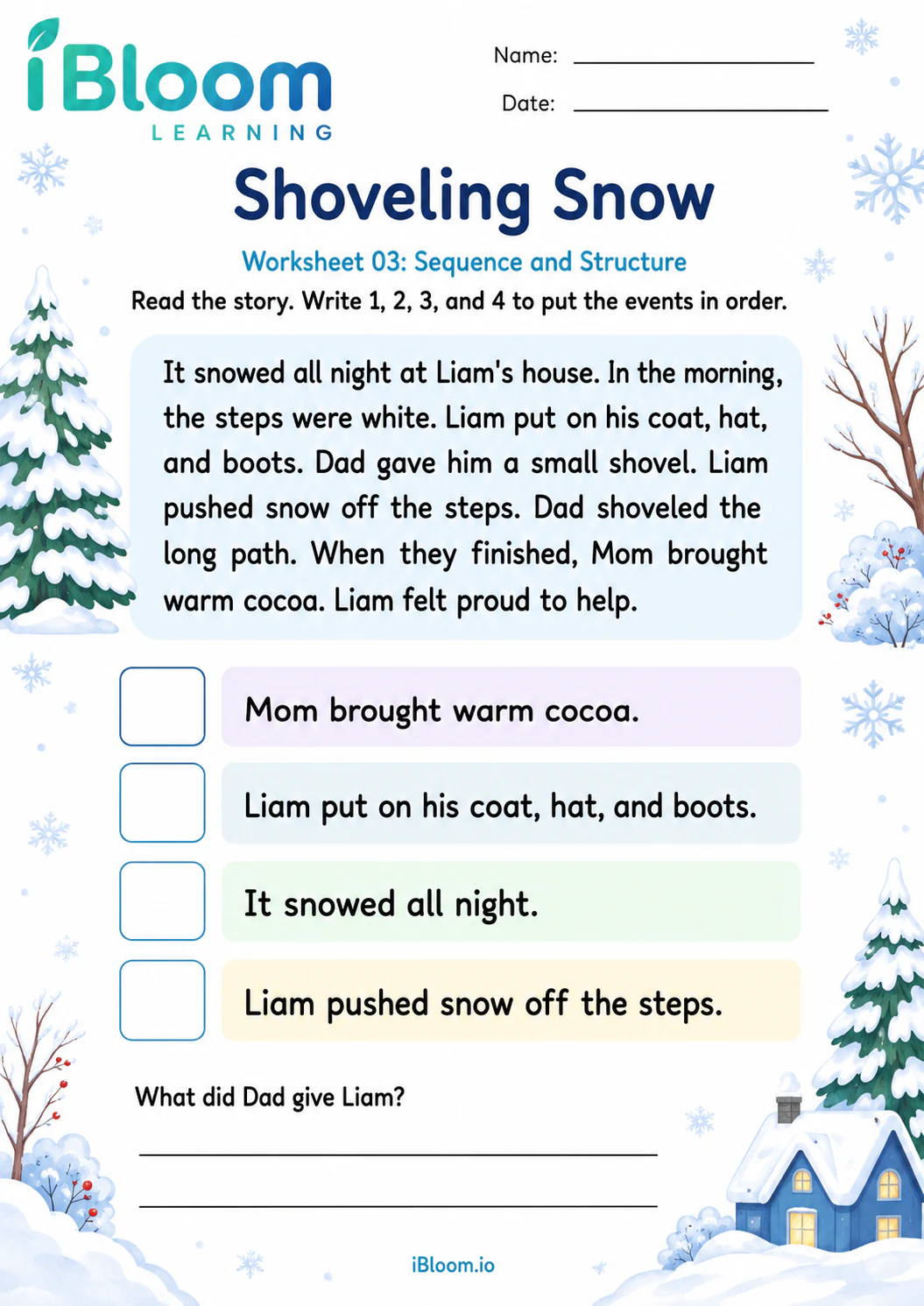
The passage also gives events in order: Mia gets ready, the children clear their walk, and then they help Mr. Lee. Using this sequence helps readers retell what happened.
- 1Question: Where did Mia find the shovel?
- 2Reread: “She found a small shovel in the shed”
- 3Answer: in the shed
How do nearby words help explain vocabulary?
A sentence can give a clue to a word’s meaning. In “pushed the snow into a pile,” the action makes a heap of snow. The answer choices ask students to connect the unknown word with what the sentence describes.
Question 9 asks what “took turns” means. The next sentence says the work was hard, which helps explain why both children shared the shoveling.
What questions follow the passage?
The sheet begins with straightforward details, then asks students to use surrounding words and think about the children’s choices. The final section asks for a retell, a kind action, and a reasonable prediction.
- Part A: five details from the story
- Part B: four vocabulary and context clues
- Part C: seven comprehension and retell questions
- The answer key includes sample answers where wording can vary
How can I support a Grade 1 reader?
- 1Read the passage aloud once while the child follows the words.
- 2Invite the child to reread a sentence before answering a detail question.
- 3For a vocabulary item, read the whole sentence and discuss what the action tells us.
- 4Ask the child to point to the part that supports an answer.
- 5For the order question, say each event aloud and put the events in story order.
- 6Use the answer key to check the idea, not to require exact wording on sample responses.
Common mistakes and quick fixes
The mistake
Answering from memory when the passage gives a clear detail.
The fix
Reread the sentence that names the person, place, or action.
The mistake
Choosing a word meaning without reading the whole sentence.
The fix
Read the words before and after it and picture the action.
The mistake
Putting the neighbor visit before the children clear their own walk.
The fix
Retell what Mia does first, next, and last using the passage.
Common Core alignment
The questions ask readers to return to the passage for people, actions, and other key details.
Ask and answer questions about who, what, and where in the story.
On this sheet: Students use the passage to answer detail and comprehension questions.
Show the official wordingHide the official wording
Ask and answer questions about key details in a text.
What to practice next
Make more practice
Further reading
Questions parents and teachers ask
How long is the Shoveling Snow passage?
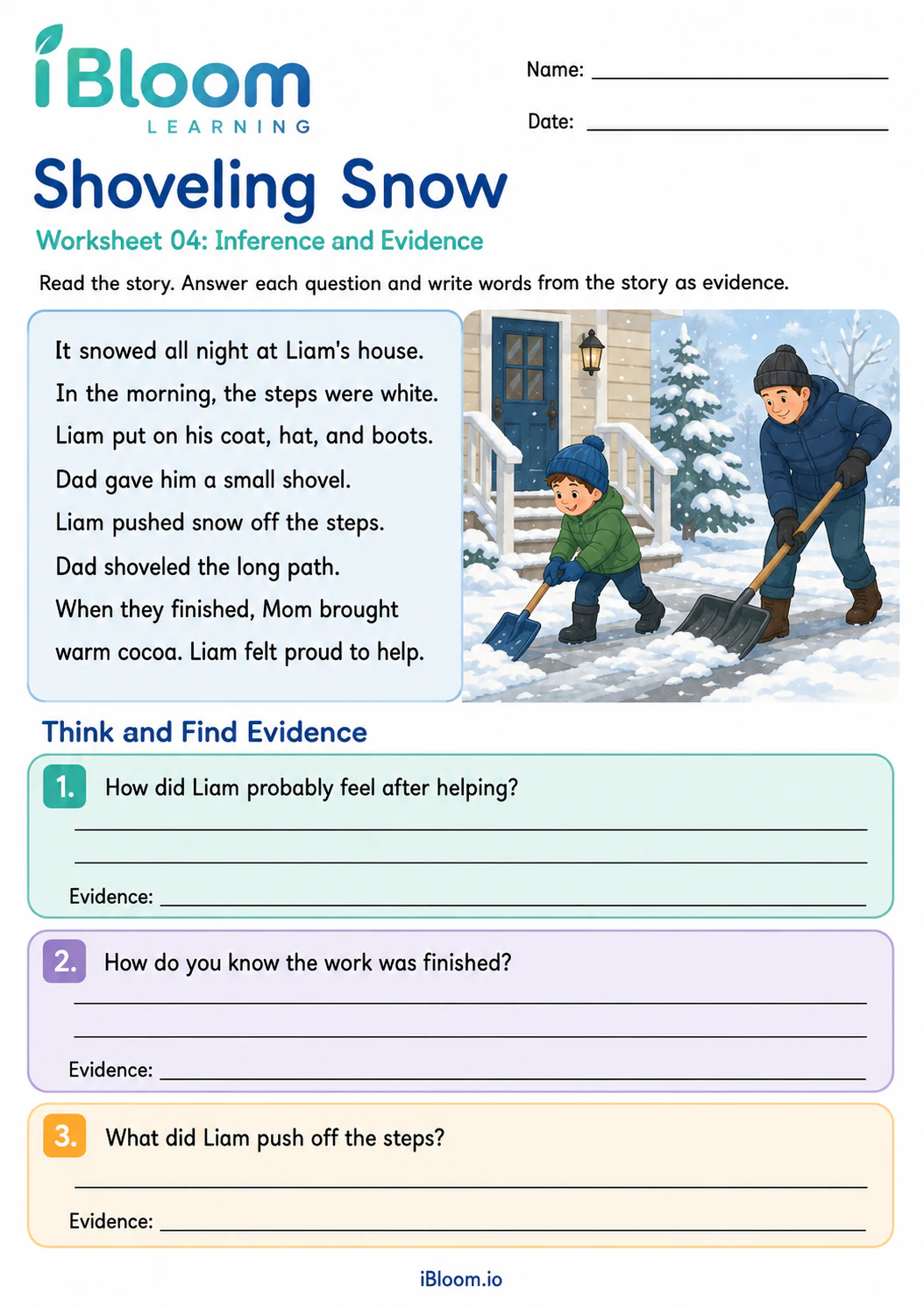
The passage is a short, two-paragraph story about Liam helping his dad clear the steps after a snowfall. It is written for Grade 1 readers and includes familiar details such as winter clothes, a shovel, and warm cocoa. Rereading the matching sentence helps children check the detail before choosing an answer.
What vocabulary does the worksheet practice?
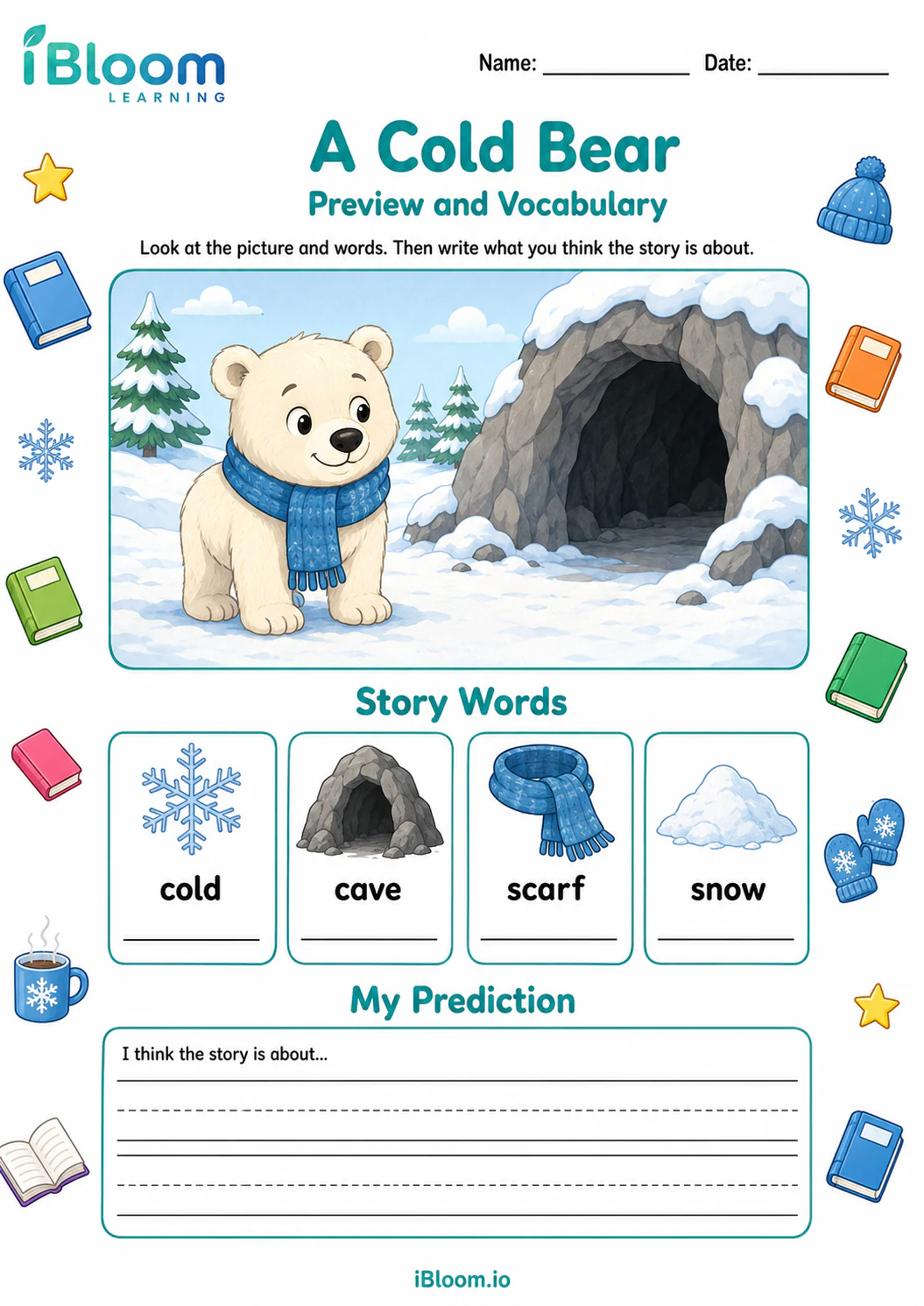
The vocabulary questions focus on words from the story: pushed, snow, boots, and cocoa. Children use the sentence or the small picture clue to connect each word with what it means in this snowy-day context. Rereading the matching sentence helps children check the detail before choosing an answer.
Are the questions answered in the passage?
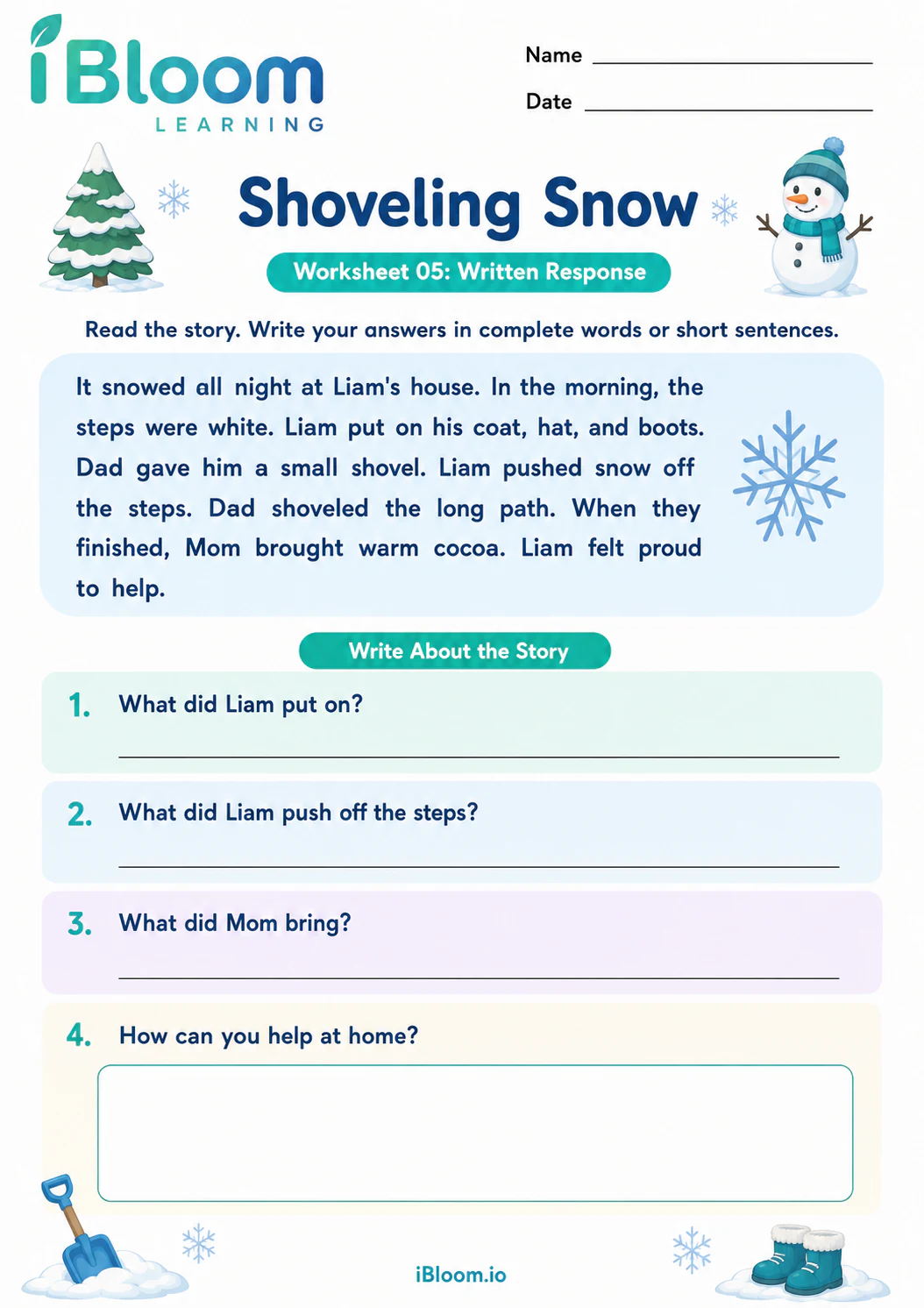
Yes. The detail questions ask children to return to the story for names, clothing, jobs, and events. The final questions also ask what Liam’s actions suggest and why he put the shovel by the door. Rereading the matching sentence helps children check the detail before choosing an answer.
How should my child answer the sequence question?
Have your child put the events in the order they happened: Liam put on winter clothes, helped shovel, and then drank cocoa with his family. The answer choices show the order with short labels. Rereading the matching sentence helps children check the detail before choosing an answer.
Does the worksheet have an answer key?
Yes. A separate three-page key follows the three worksheet pages. It lists the correct choice for each of the 16 questions, so an adult can review story details, vocabulary, sequence, and meaning. Rereading the matching sentence helps children check the detail before choosing an answer.
How can my child practice the vocabulary?
After answering, ask your child to find each target word in the story and explain it aloud. For example, Liam pushed snow off the steps, and cocoa is the warm drink Mom brought when the shoveling was done. Rereading the matching sentence helps children check the detail before choosing an answer.