





About this worksheet
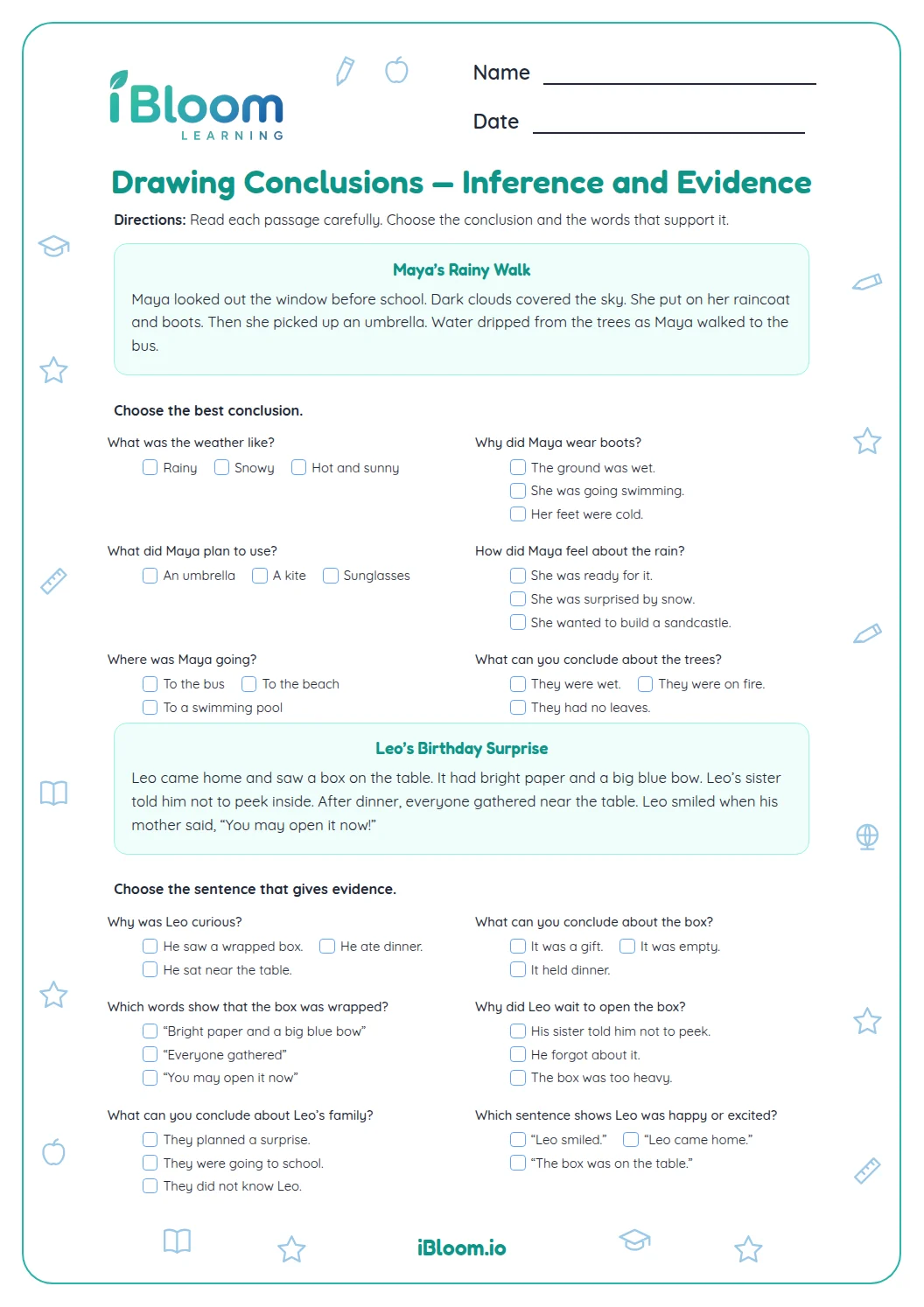
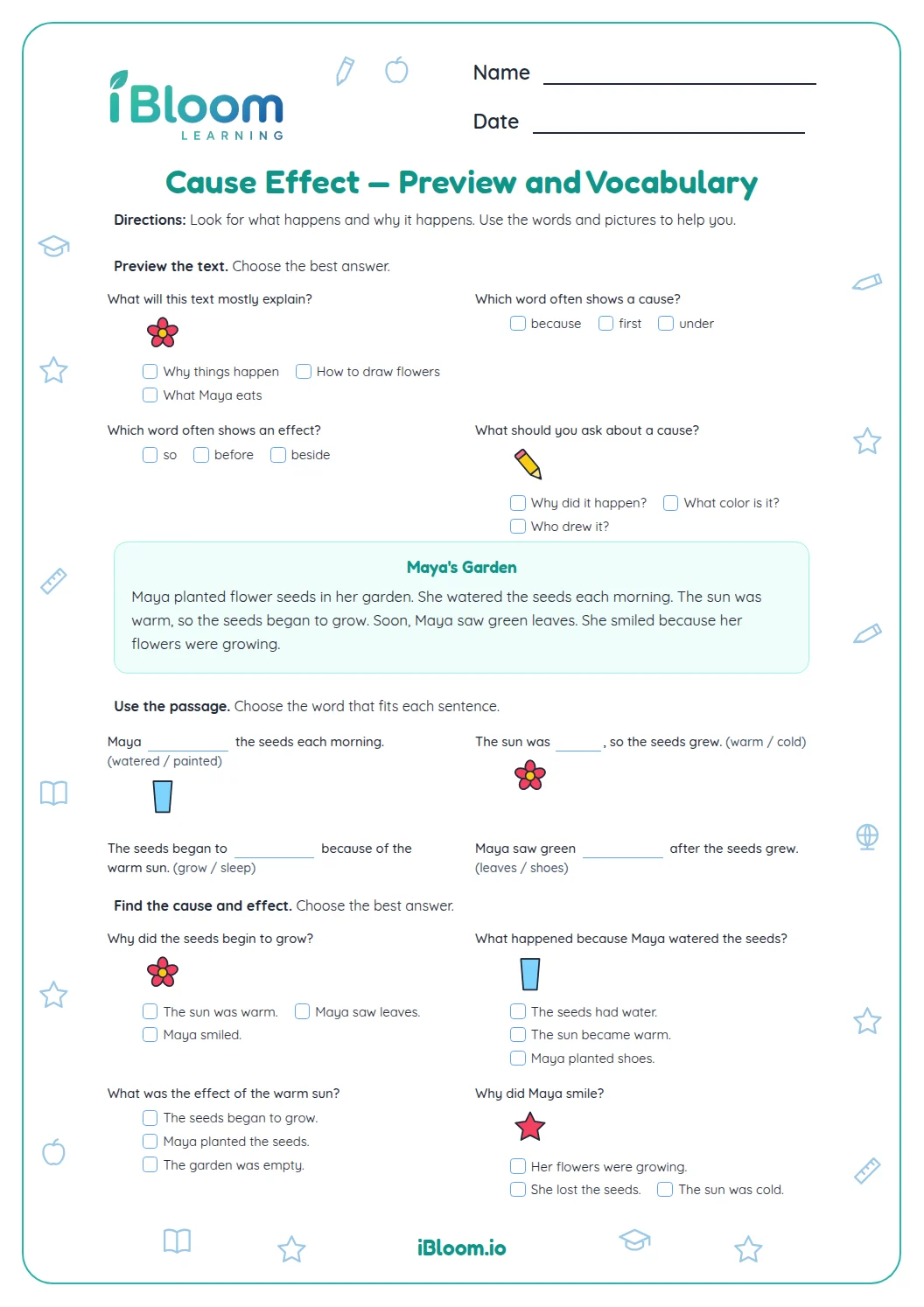
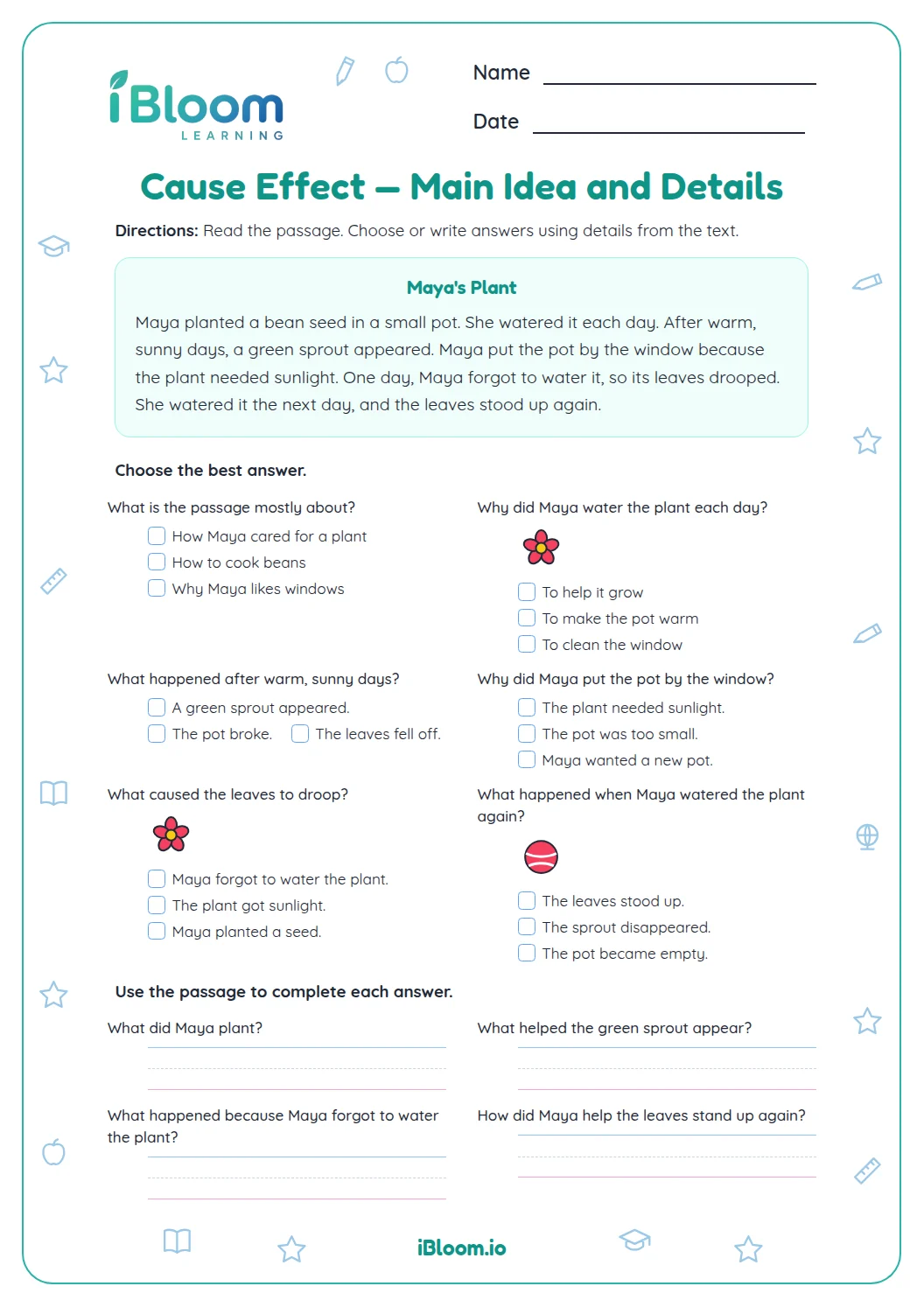
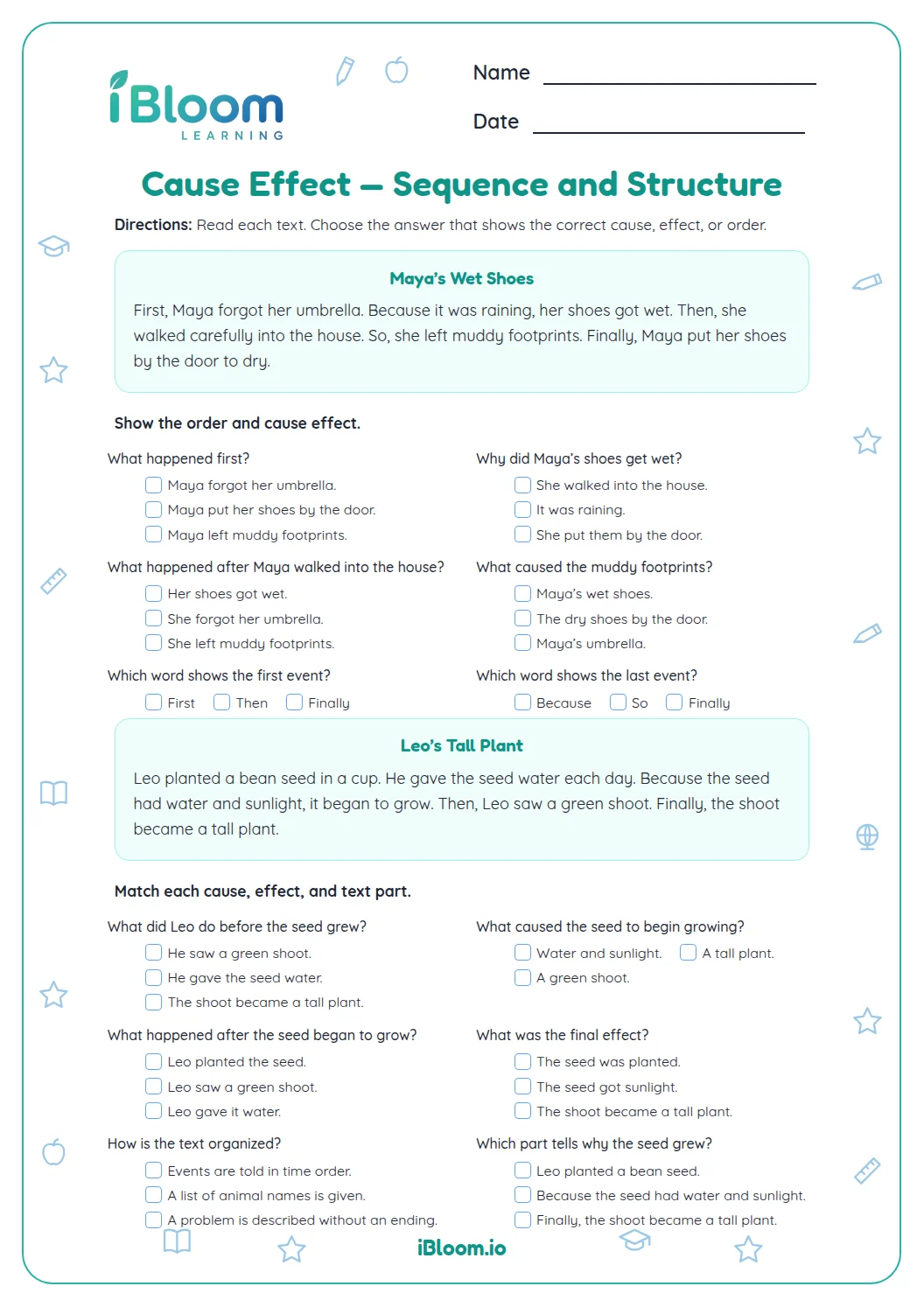
This free printable Grade 1 worksheet pairs a short story, “The Class Garden,” with questions about the main idea, the clues behind it and the proof in the text. Children first find what the story is mostly about, then use clues to figure out things the story does not say outright, such as why the children pour water on the plants. Last, they choose the words that prove an idea and write two short answers. It practices Common Core RL.1.1 and RL.1.3, and a separate answer key is included.
Aligned to RL.1.1 and RL.1.3
How do you find the main idea of a short story?
Ask, “What is most of the story about?” In “The Class Garden,” the children water the plants, pull weeds, check leaves for bugs and make signs. Every one of those details is about caring for the garden, so that is the main idea.
A title is a good test. “Our Class Garden” fits the whole story, but a title like “Bugs at Lunch” names a small detail and a place that is not even in the story.
- 11) What is the story mostly about? → Caring for a garden
- 2Why not “Buying new beans”? Nobody buys beans in the story.
- 32) Which title fits best? → Our Class Garden (it fits the whole story)
What is an inference for a first grader?
An inference is an answer the story does not say in so many words. The story never tells why Maya and Leo pour water on the plants. Children use clues in the story and what they know about plants to figure out that water helps them grow.
Part C has four of these questions. They ask about a reason, a feeling and what may happen next. The question line says it plainly: the story does not say it, so use the clues.
- 14) How does Leo feel?
- 2Clue: Leo says, “Our plants are happy!”
- 3A child who says that about plants is glad and pleased with them → Proud of the plants
How do children find proof in the story?
Part D gives an idea, such as “The plants grow well,” and asks which words from the story show it. Children go back to the page and point to the words. “Bright flowers bloom” proves the plants are growing, while “They pull out weeds” is something the children do.
Going back to the text, instead of choosing what sounds right, is the habit this part builds.
What is on this worksheet?
A two-paragraph story of 65 words, then eleven questions in four parts, each asking for a different thing.
- Part B, Find the main idea: what the story is about and which title fits
- Part C, Think about the clues: four questions about a reason, a feeling and what may happen next
- Part D, Find the proof: three ideas, each with the words that show it
- Part E, Write the detail: two short answers taken from the story
- Answer key on its own pages
How to use this worksheet at home or in class
- 1Read “The Class Garden” aloud with your child, then let them read it again, pointing at each word.
- 2Ask the first question before looking at the choices: “What is most of the story about?”
- 3For Part C, remind your child that the answer is not written in the story. Ask, “What in the story tells you?”
- 4In Part D, have your child touch the words in the story that match their choice before coloring the circle.
- 5For Part E, have your child look back at the story and write the answer. Copying the story's words is fine.
- 6Check with the answer key and reread the sentence behind any missed answer.
Common mistakes and quick fixes
The mistake
Picking “Bugs at Lunch” in question 2 because the story mentions bugs.
The fix
Ask whether the title fits the whole story or just one sentence. Bugs are one small detail, and the whole story is about the garden.
The mistake
Looking for the answer to a clue question word for word in the story, then choosing “To scare the bugs” in question 3 because it names bugs.
The fix
Say that the story does not tell us why, so we think about what water does for plants and what the children are trying to do.
The mistake
Choosing a true detail that does not prove the idea in Part D, such as “They pour water” for how the teacher feels.
The fix
Ask whether the detail shows the teacher's feelings. “Their teacher smiles” does, and pouring water is something the children do.
Common Core alignment
Most US states teach reading with the Common Core standards or a close state version. These Grade 1 literature standards name the key-detail and character questions on this sheet.
Answer questions about key details in a story.
On this sheet: Parts B to E send children back to details such as the water can, the weeds, the signs and the teacher's smile.
Show the official wordingHide the official wording
Ask and answer questions about key details in a text.
Use story details to describe the characters and what happens.
On this sheet: Parts C and D use details to tell how Leo and the teacher feel and what Maya and Leo will do next.
Show the official wordingHide the official wording
Describe characters, settings, and major events in a story, using key details.
What to practice next
Make more practice
Further reading
Questions parents and teachers ask
What is the main idea of “The Class Garden”?
The main idea is that Maya and Leo care for their class garden. Everything they do in the story, watering, weeding, checking for bugs and making signs, is part of taking care of it. Question 1 asks for this idea, and question 2 checks it again with a title that fits the whole story.
What does infer mean in first grade?
To infer is to figure out something the story does not say directly, using clues and what you already know. The story does not say why the children pour water, but plants need water, so the children must be helping them grow. Part C practices four inferences, each with a clue in the story.
How is evidence different from the main idea?
The main idea is what the whole story is about, and evidence is the small detail that shows something is true. “Bright flowers bloom beside the beans” is evidence that the plants are growing. Part D gives an idea and asks which words from the story prove it, so children go back to the page.
Is this story fiction or nonfiction?
“The Class Garden” is a short made-up story about two children, Maya and Leo, with one line of dialogue. The habits on this sheet work on any short story: find what it is mostly about, answer questions about key details and point back to the words that prove an idea.
My child cannot read all the words alone. What can we do?
Read the story aloud together first, then let your child read it again, pointing at each word. The questions and choices are short. You can read each question aloud too. Reading aloud together lets your child practice the thinking skills without being slowed down by a few harder words.
Is there an answer key for this worksheet?
Yes. A separate two-page answer key shows the correct choice for each of the nine multiple-choice questions and the answers to the two short written questions, signs and weeds. Print the two worksheet pages on their own and keep the key for checking, then reread the story sentence behind any miss.