






About this worksheet
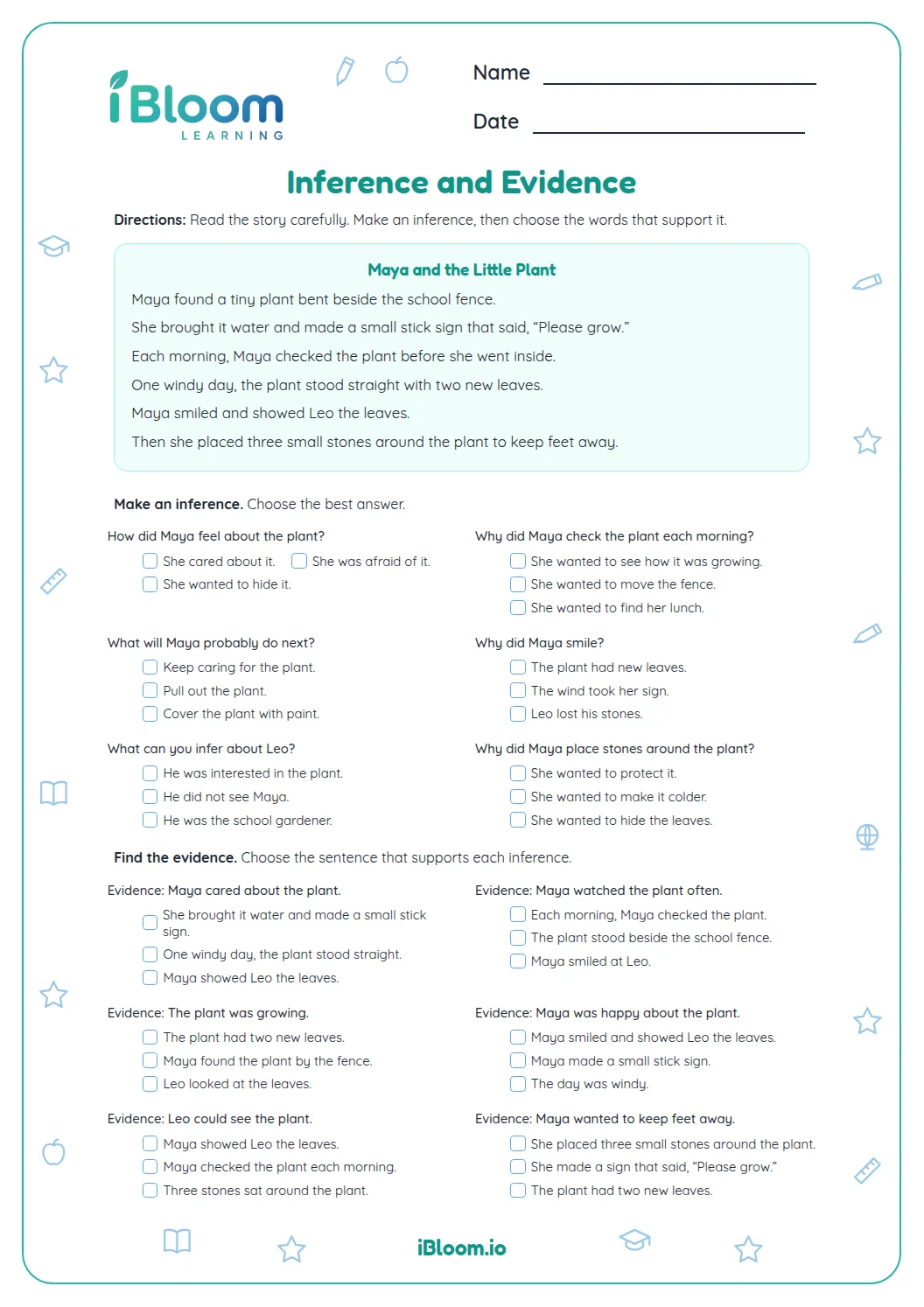
This free printable worksheet is a Level F story for Grade 1 readers, with questions about what the story does not say outright. Children read “Maya Finds a Nest,” about two friends who find baby birds under a bush. In Part B, they answer four inference questions, such as why the baby birds' beaks were open. In Part C, they go back to the story and color the sentence that proves each answer. It practices Common Core RL.1.1 and RL.1.3, asking and answering questions about key details and describing characters, and a separate answer key is included.
Aligned to RL.1.1 and RL.1.3
What is an inference, and how do first graders make one?
An inference is an answer the story does not say in plain words. The reader puts clues from the story together with what they already know. When Maya shakes her head as Leo reaches for the nest, children can work out that she does not want the birds to be disturbed.
The story gives no sentence that says “Maya cares about the birds.” Children must decide it from what Maya says and does, then check that the clue fits.
- 1Question: Why were the baby birds' beaks open?
- 2Clue in the story: Their beaks were open.
- 3What I know: baby birds open their beaks to be fed.
- 4Answer: They were hungry.
- 5Proof: “Their beaks were open.”
Why look for proof after each answer?
In Part C, each question asks which sentence shows the answer, and every choice is a true detail from the story. In question 5, the friends really did sit on the grass, but that does not show that Maya cares. Only “Do not scare them” does.
Finding proof teaches children to go back to the story and point to the words that support an idea, a habit they will need in every grade.
What is the story about?
“Maya Finds a Nest” is a 70-word Level F story with short sentences and words like nest, robin and whispered. Two friends hear tiny peeps in a bush by an old oak tree and find three baby birds. Leo wants to touch the nest and Maya says no, so they sit and watch until a robin flies down with a worm.
What is on this worksheet?
The story is printed as Part A, and the eight questions follow in two parts, each with three choices.
- Part A: the story “Maya Finds a Nest”
- Part B, What can you tell?: four inference questions about feelings, causes and what happens next
- Part C, Find the proof: four questions that pick the sentence from the story that supports an answer
- A two-page answer key with the right choice marked for every question
How to use this worksheet at home or in class
- 1Read the story aloud together first. Ask your child to say what happened in their own words.
- 2Do question 1 together. Ask “Does the story tell us how Maya feels? What does she say and do?”
- 3Let your child finish Part B, rereading the story if they need to.
- 4In Part C, have your child point to the sentence in the story before they color it.
- 5Check with the answer key. If a proof answer is missed, ask your child to read the sentence aloud and say why it fits.
- 6Finish by asking one more inference of your own, such as “Why do you think the robin came back?”
Common mistakes and quick fixes
The mistake
Choosing a true detail that does not prove the point, such as “They sat on the grass” for question 5.
The fix
Ask, “Does this sentence show that Maya cares?” A true sentence is not always the right proof. The best proof directly fits the answer.
The mistake
Guessing what the story does not support, such as saying the birds were cold because it is outdoors.
The fix
Ask “What clue in the story tells you that?” If your child cannot point to one, the answer needs a better clue.
The mistake
Choosing “Eat the worm” for question 4, because robins do eat worms.
The fix
Ask who in the story is waiting with open beaks. The babies are hungry and the robin has just arrived, so the clue points to feeding them.
Common Core alignment
Most US states use the Common Core reading standards or a close state version. These two Grade 1 standards match the sheet.
Answer questions about key details in a story.
On this sheet: All eight questions ask about details in the story, and Part C finds the sentences that prove the answers.
Show the official wordingHide the official wording
Ask and answer questions about key details in a text.
Describe characters and what happens, using details.
On this sheet: Questions 1 and 3 ask how Maya and Leo feel, and question 4 asks what happens next.
Show the official wordingHide the official wording
Describe characters, settings, and major events in a story, using key details.
What to practice next
Make more practice
Further reading
Questions parents and teachers ask
What does Level F mean?
Level F is one of the guided reading levels used in first grade, with short sentences, familiar words and a simple plot. “Maya Finds a Nest” is about 70 words long, with one setting and two characters. If your child reads it easily, try Level G. If it is a struggle, try Level E.
What is the difference between an inference and a detail?
A detail is written in the story, like “Their beaks were open.” An inference is what the reader works out from details, like “They were hungry.” Part B asks for inferences, and Part C asks for the details that prove them. Together they teach children to support ideas.
Why are there answer choices that sound reasonable but are wrong?
Wrong choices help show whether your child is really using the story. “They were sleepy” could be true of baby birds in general, but nothing in the story points to it. The clues in the story, such as open beaks and a worm, support only hungry.
Can my child answer Part C without reading the story again?
Part C is meant to send children back to the story. Each choice is a sentence from it, so your child can find the exact words and compare them to the answer they chose. If they guess without looking, ask them to point to the sentence and read it aloud.
Is a worksheet with only multiple choice enough practice?
It is a good start for Grade 1, because children can focus on the idea without a lot of writing. For more practice, ask your child to say the answer in a full sentence, using “because.” That turns every correct answer into an oral explanation.
Is there an answer key for this worksheet?
Yes. A separate two-page answer key marks the correct choice for all eight questions. Print the worksheet by itself and keep the key for checking, or download both as a free PDF from this page. For each proof question, ask your child to find that sentence in the story too.