


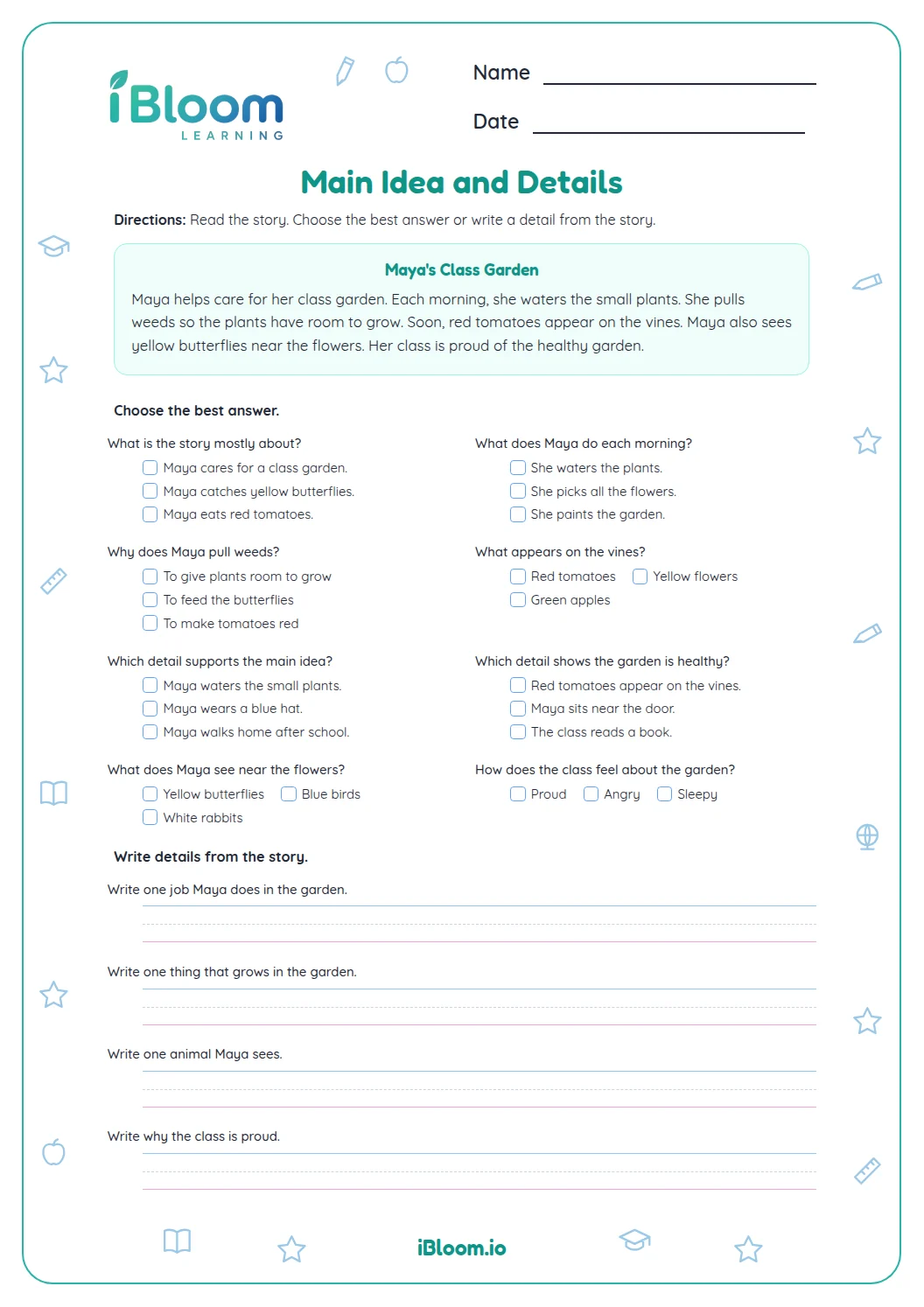


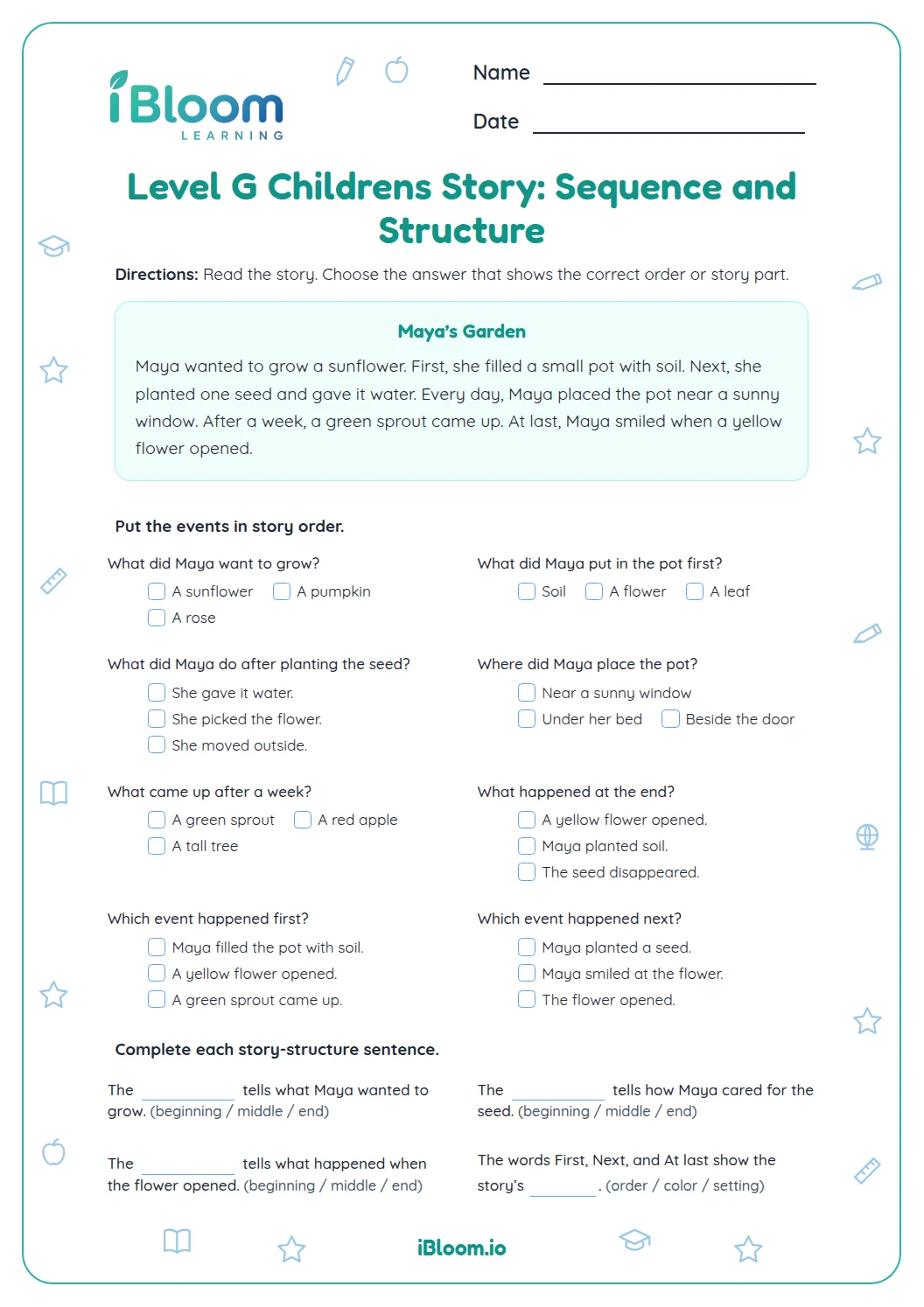

About this worksheet
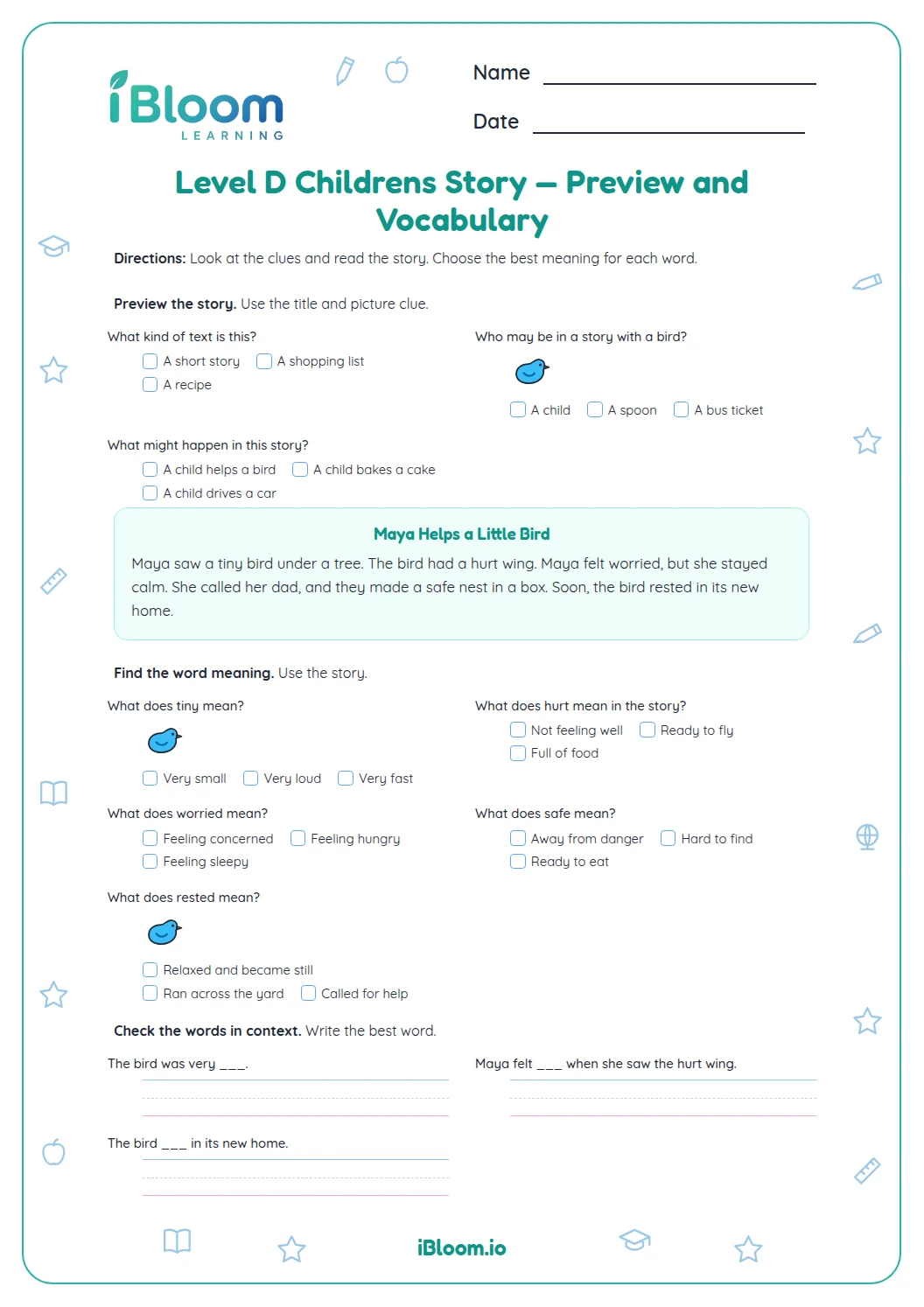
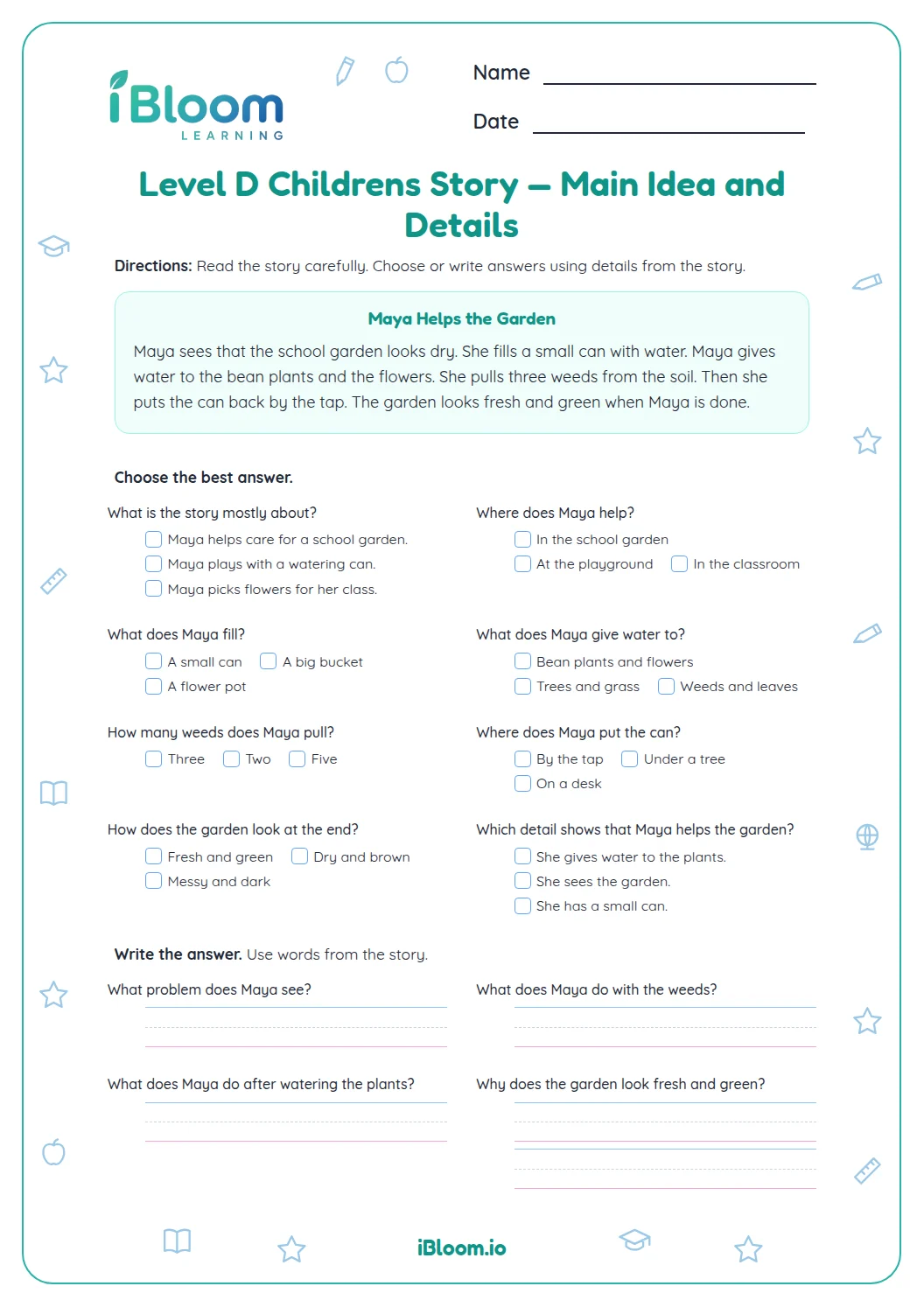
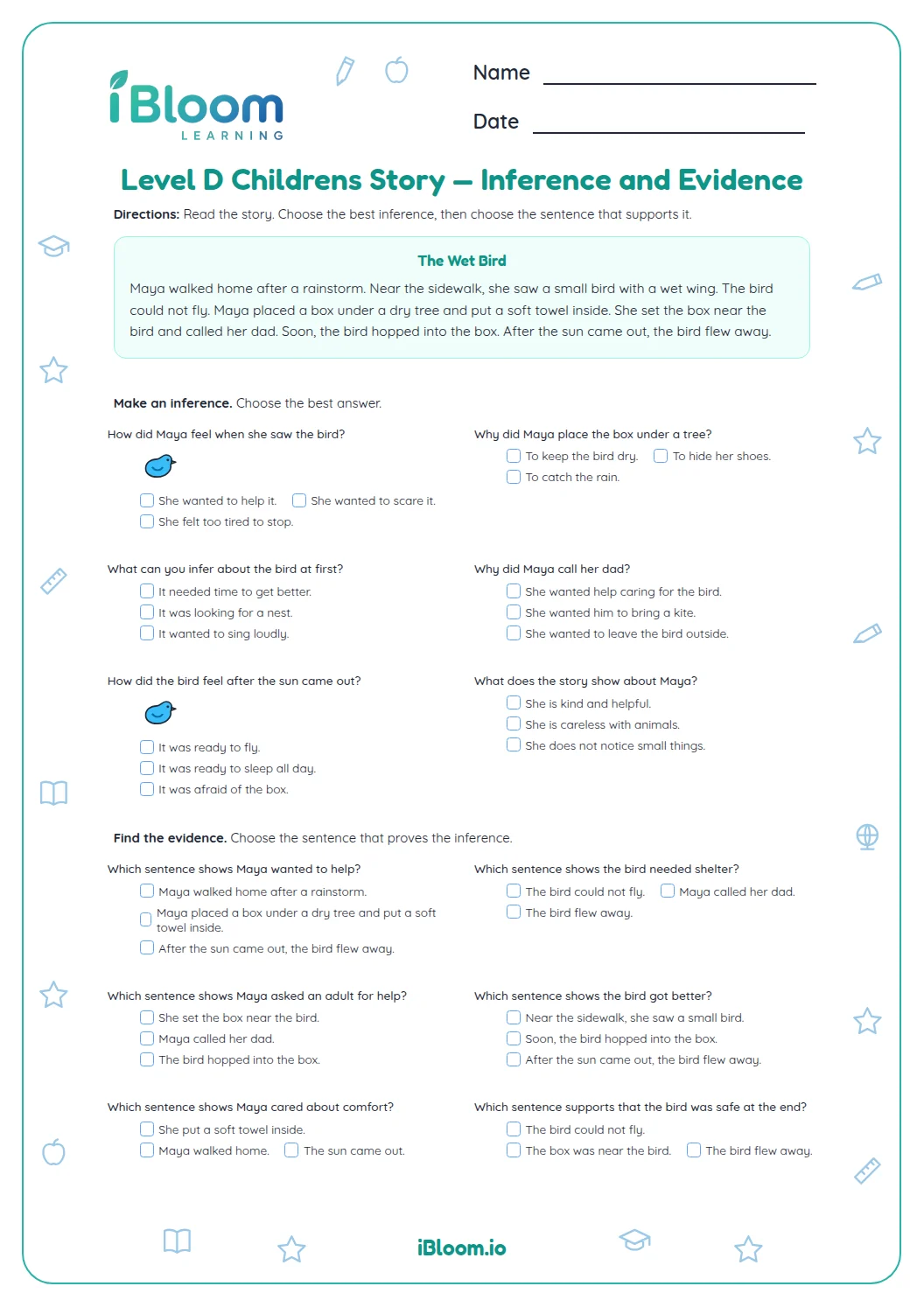
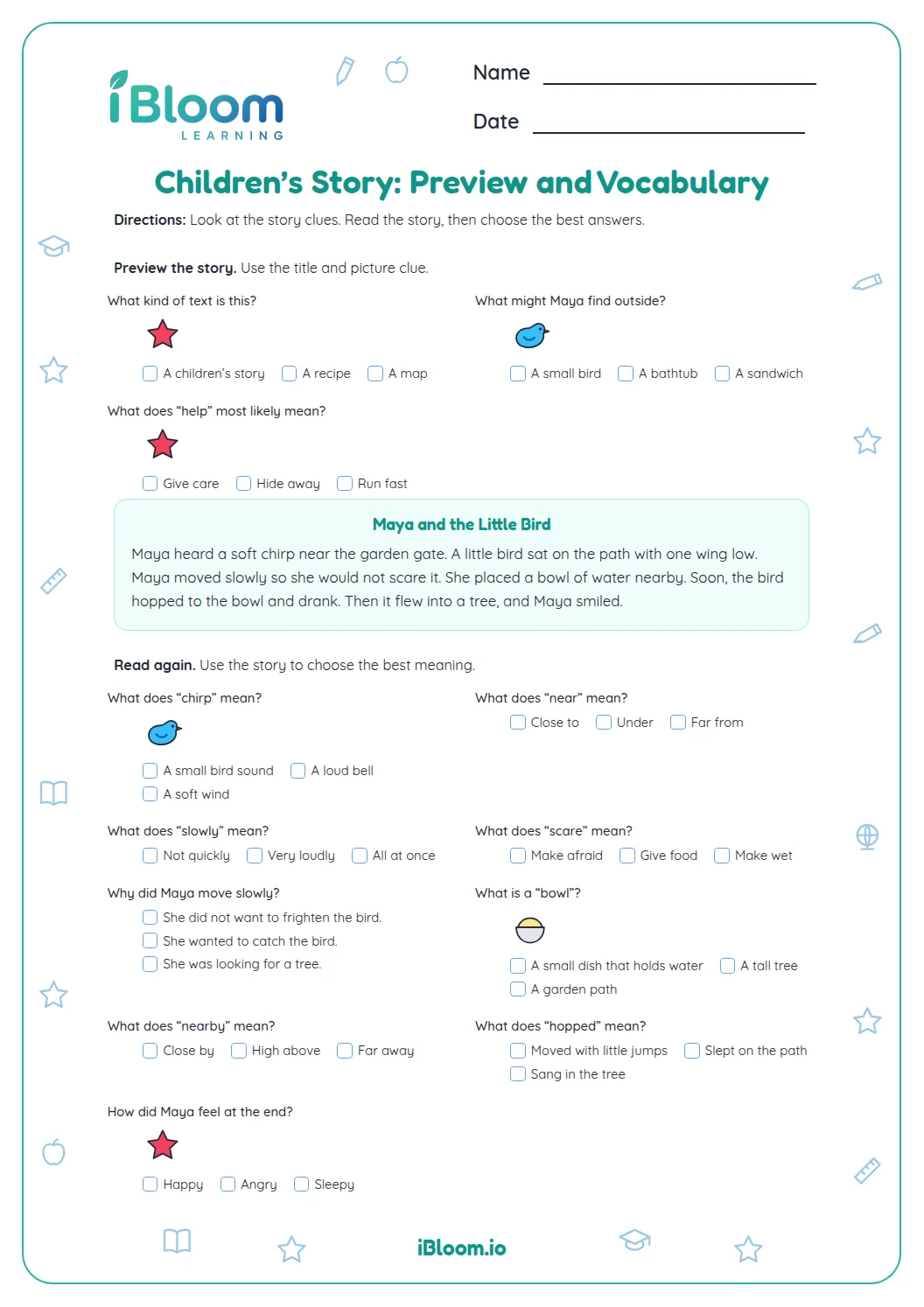
This Grade 1 Level E worksheet pairs a short garden story with 14 multiple-choice questions. Children preview the text, follow Maya and Leo as they help a bird, and use sentence clues to understand words such as notices, gentle, and return. The answer key supports a quick check of story details and vocabulary.
Aligned to RI.1.1 and L.1.4a
What happens in Mia’s Seed?
Maya and Leo find a small bird with a wet wing. Maya calls Dad, who helps the bird return to a safe tree. The questions check who, what, why, and where details from that short sequence.
How can story clues explain a new word?
The passage gives useful context for path, notices, wet, gentle, safe, and return. For example, “one wing is wet” explains why the bird cannot fly. Children can reread the sentence before choosing a meaning.
- 1The bird cannot fly because one wing is wet.
- 2Clue: it cannot fly.
- 3“Wet” means covered with water.
What does the worksheet ask readers to show?
The questions check story events and vocabulary clues from the passage. Children use nearby words to understand the bird’s problem, then return to the events and the story’s main idea.
How to use this worksheet
- 1Read the story once to learn what happens.
- 2Read each question and look back for names, actions, and details.
- 3For a vocabulary question, reread the sentence around the word.
- 4Answer written questions with a clear story detail.
- 5Check each answer against the passage and answer key.
Common mistakes and quick fixes
The mistake
Choosing a detail that sounds possible but is not in the story.
The fix
Point to the sentence that supports the answer.
The mistake
Guessing a word meaning without reading nearby clues.
The fix
Reread the sentence and notice the action or object near the word.
The mistake
Writing an answer with no story evidence.
The fix
Add a detail such as “the green sprout peeked through the soil.”
Common Core alignment
The detail and context questions connect the passage to these Grade 1 reading standards.
Ask and answer questions about details in Mia’s seed story.
On this sheet: The questions ask readers to find story details and explain what those details show.
Show the official wordingHide the official wording
Ask and answer questions about key details in a text.
Use the sentence around a word as a clue to its meaning.
On this sheet: Vocabulary questions use nearby story words and actions to determine word meanings.
Show the official wordingHide the official wording
Use sentence-level context as a clue to the meaning of a word or phrase.
What to practice next
Make more practice
Further reading
Questions parents and teachers ask
What is the story about?
Maya and Leo find a small bird near a flower. Its wing is wet, so Maya calls Dad; he helps the bird return to a safe tree. The questions revisit that sequence and the words used to describe it.
What does preview and vocabulary practice mean here?
The worksheet asks about path, notices, wet, gentle, safe and return, along with story details. Children can reread the sentence containing a word and use the nearby action or description to choose its meaning. The short choices let them check each clue as they read.
How can a child figure out what “sprout” means?
The sentence says the bird cannot fly because one wing is wet. That clue points to water on the wing. The worksheet gives short choices, and an adult can ask the child to show the sentence that helped. Rereading the full sentence makes the meaning easier to explain.
Can an adult read the story aloud?
Yes. An adult can read the passage and questions aloud while the child points to details and chooses an answer. If the child is reading independently, encourage them to return to the story and find the sentence that supports each response.
How many questions and pages are included?
There are 14 multiple-choice questions about previewing the text, story events, word meanings, and the overall story. The passage and its key are arranged as two pages each. Children can point back to the story before checking an answer.
Which reading standard does this sheet practice?
The page lists CCSS RI.1.1 for questions about key details and L.1.4a for using sentence context to understand words. Children answer questions about the bird’s problem and use nearby clues to explain vocabulary. These standards connect directly to the passage and its questions.