




About this worksheet
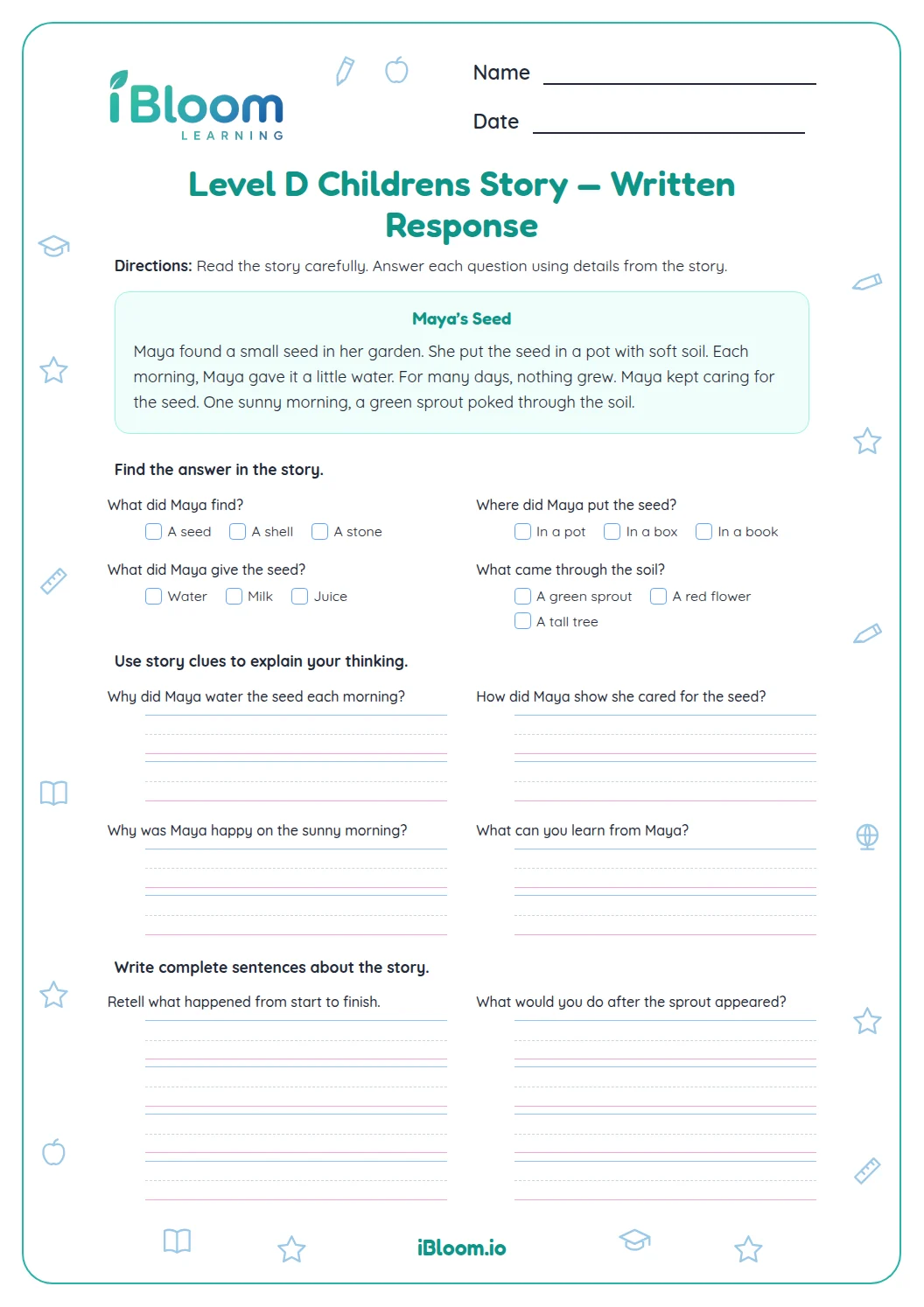
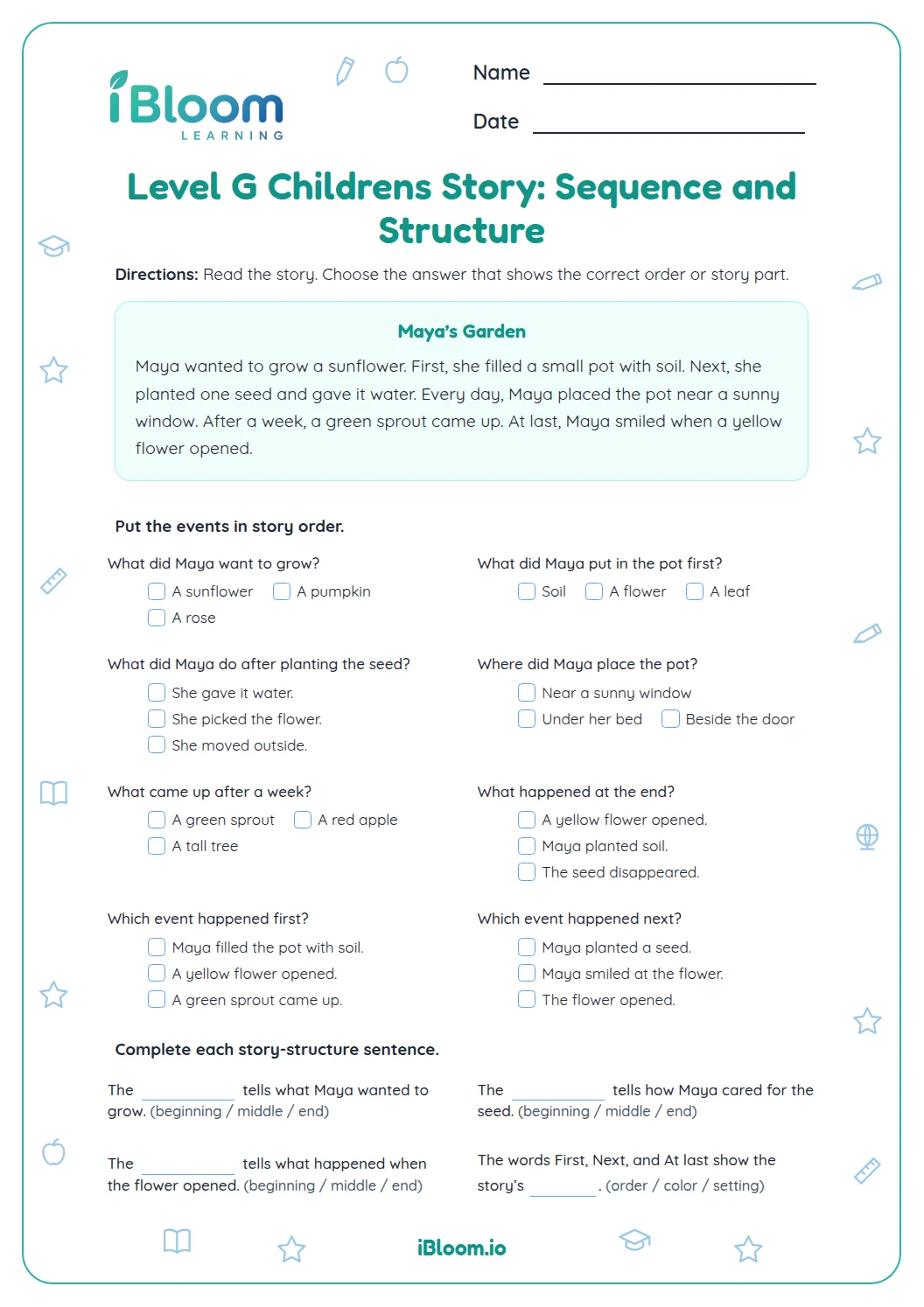
This Grade 1 Level D worksheet follows Maya as she finds a seed, plants it, cares for it, and shares the growing plant with her class. Fourteen questions ask readers to recall details, track what happens before and after, notice a transition phrase, and explain why an event makes sense. The passage uses a clear beginning, middle, and ending. A separate answer key includes sample responses.
Aligned to RL.1.2 and RL.1.3
What happens at the beginning?
The beginning introduces Sam and the seed near the garden gate. Questions 1 and 2 ask readers to remember where the seed was and what Sam planted it in.
- 1Sam first puts the seed in soil.
- 2Next he gives it water.
- 3Answer: He watered it.
Which words help you follow the events?
Time words such as “each day” and “at last” help readers track when events happen. Question 12 asks about the phrase that signals the final move.
How does the story end?
Sam moves the pot outside because he wants the plant to grow in the garden. Questions 13 and 14 ask readers to explain a reason and recall an event.
How to use this worksheet
- 1Read the story once to learn who and what it is about.
- 2Read it again and notice what Sam does in order.
- 3Look back at the passage for names, places, and actions.
- 4Use time words to decide which event came first or last.
- 5Answer the why question with a detail from the ending.
Common slips and quick fixes
The mistake
Mixing up the order of events
The fix
Point to each event in the story and say first, next, then, last.
The mistake
Choosing a detail from another part of the story
The fix
Reread the sentence named by the question and compare the choices.
The mistake
Giving a why answer without a reason
The fix
Finish the sentence with the story’s purpose: so the plant could grow.
Common Core alignment
This worksheet gives children a chance to apply the standard to a focused set of printable questions.
Retell a story and include key details.
On this sheet: Learners recall and order key events in Sam’s story.
Show the official wordingHide the official wording
Retell stories, including key details, and demonstrate understanding of their central message or lesson.
Describe story events and how they connect.
On this sheet: The questions focus on Sam, the garden setting, and the events in sequence.
Show the official wordingHide the official wording
Describe characters, settings, and major events in a story, using key details.
What to practice next
Further reading
Questions parents and teachers ask
What happens in Maya’s story?
Maya finds a seed in her pocket, plants it in a cup of soil, and gives it water. She puts the cup by a sunny window. A sprout and leaves appear, and she later shows the plant to her class.
How does the worksheet practice sequence?
Several questions ask what happened first, before, or after another event. Readers can look for the story’s time words, including “First,” “Next,” “Then,” and “At last,” and use them to track the order. The transition words are part of the passage, so children can reread them as needed.
What does the final written question ask?
It asks the child to explain why Maya put the cup by a sunny window, using a story detail. The key gives a sample explanation; another clear answer that connects the sunlight with caring for the seed is acceptable.
What is the story’s beginning, middle, and end?
At the beginning, Maya finds a seed. In the middle, she plants and waters it, then watches it sprout. At the end, she shows the plant to her class and tells them how she cared for it. The questions follow the same order as the story, with some items asking readers to look back.
How can an adult support a reader using this page?
Ask the child to return to the passage and point to the sentence that supports an answer. For sequence prompts, invite them to retell the event before and after the one named in the question. This keeps the response tied to what the story actually says.