


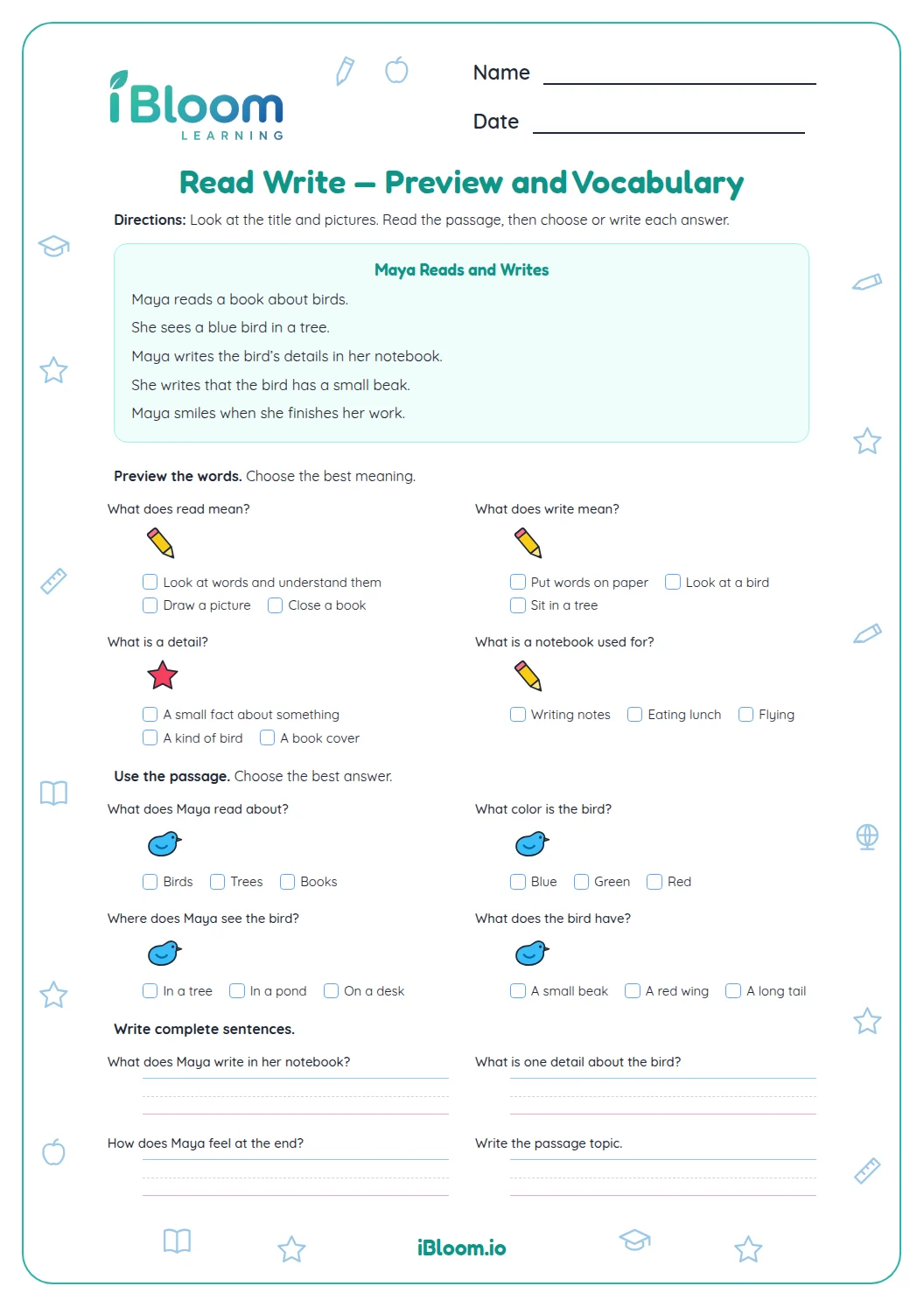
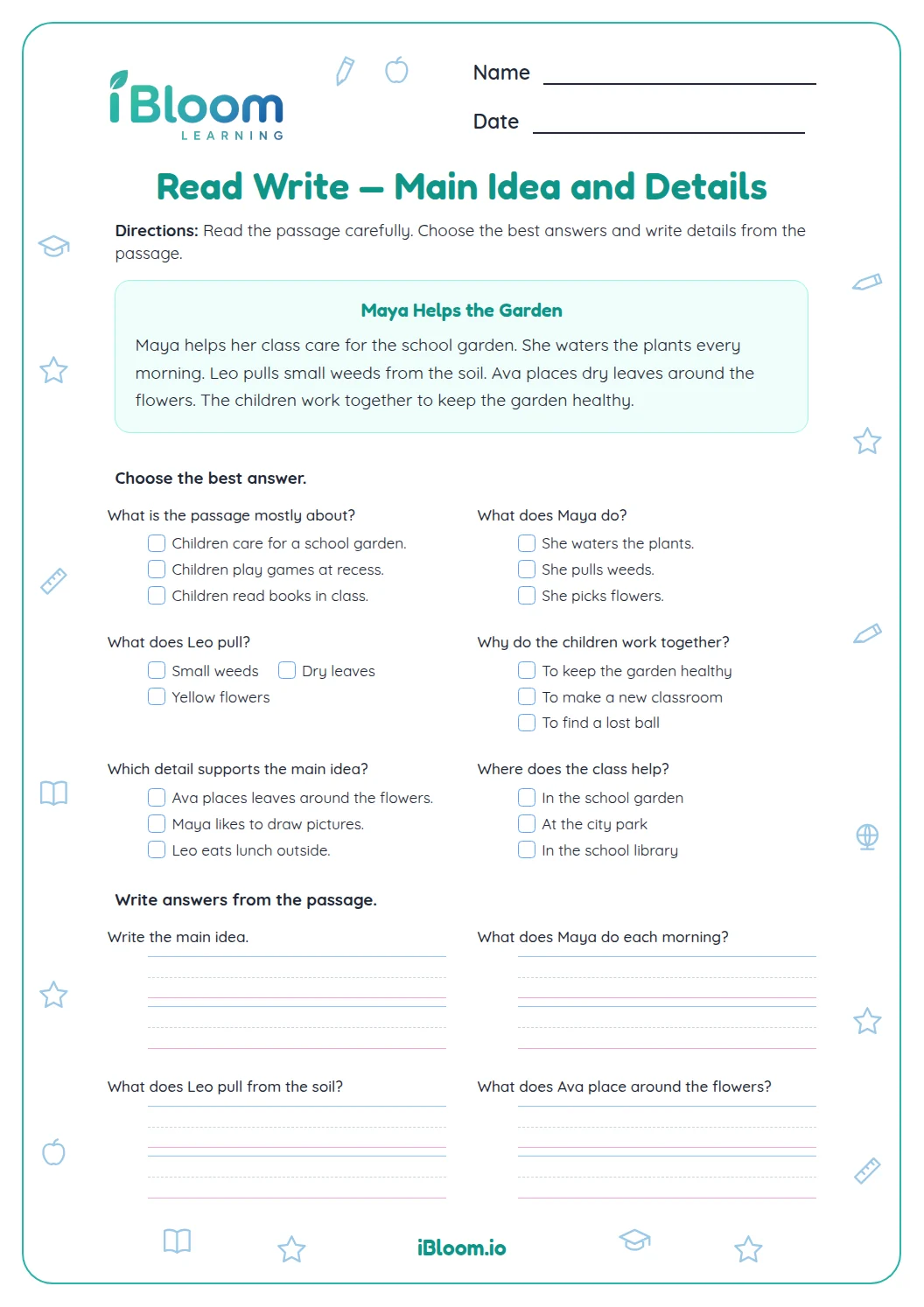

About this worksheet
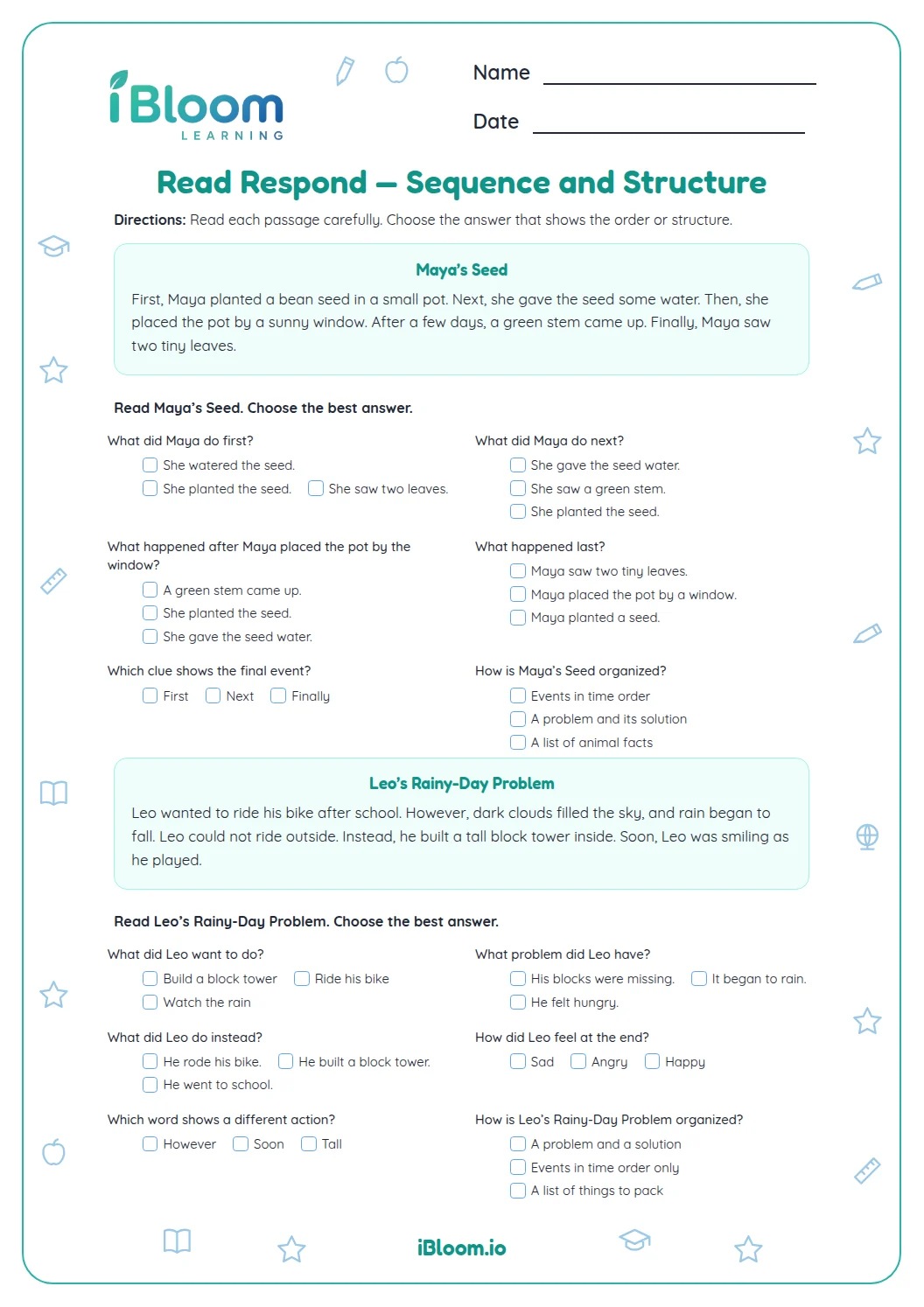
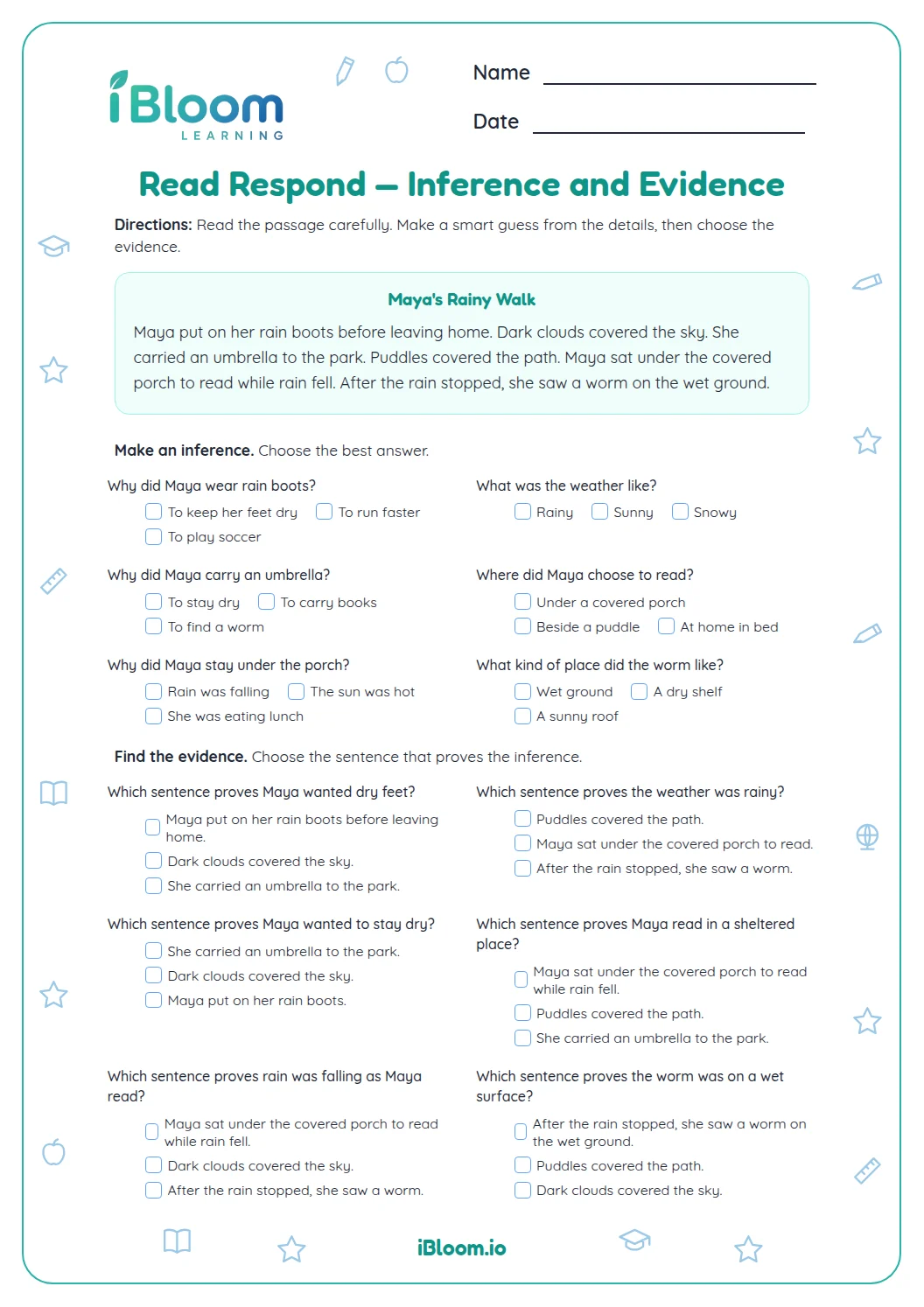
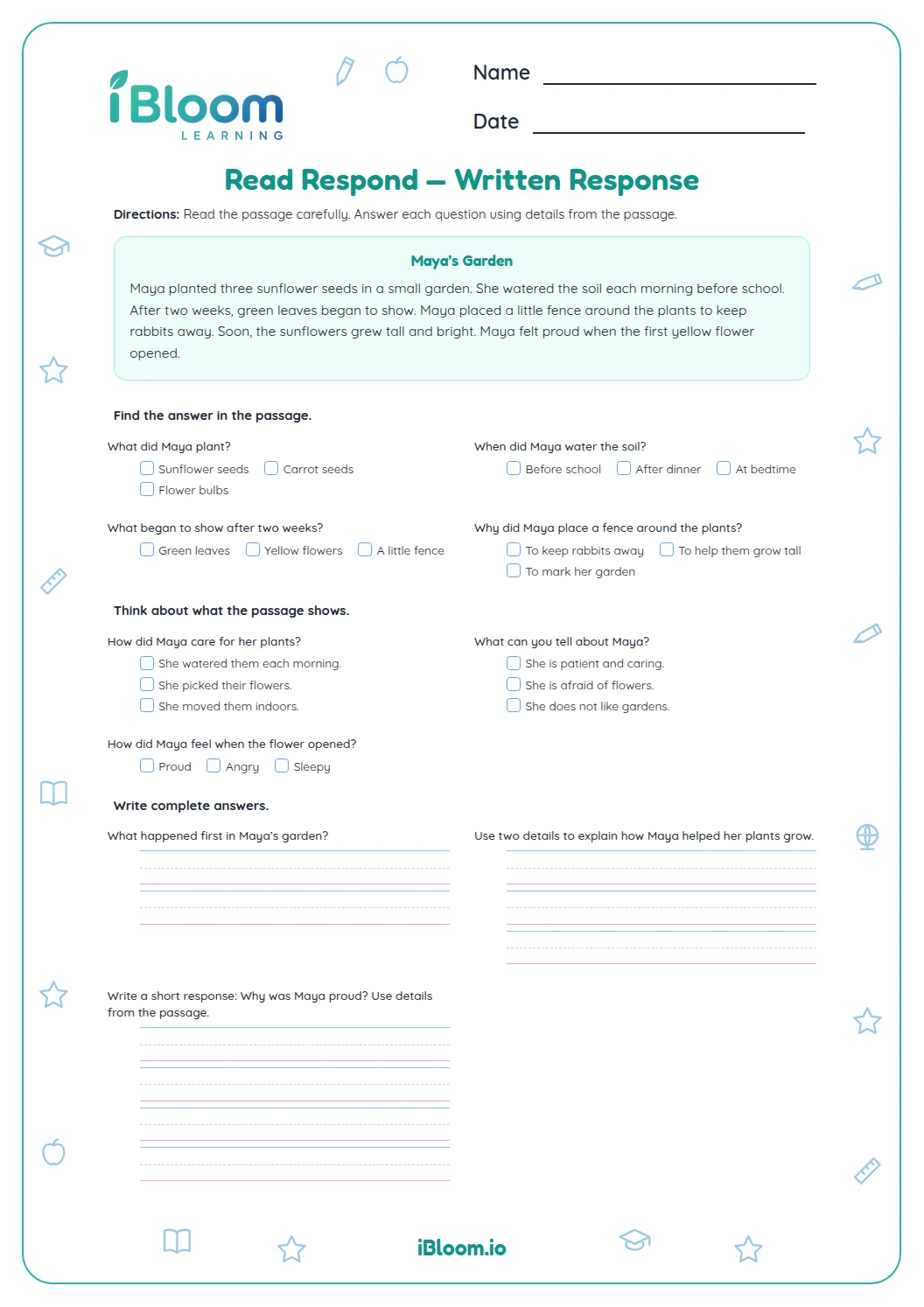
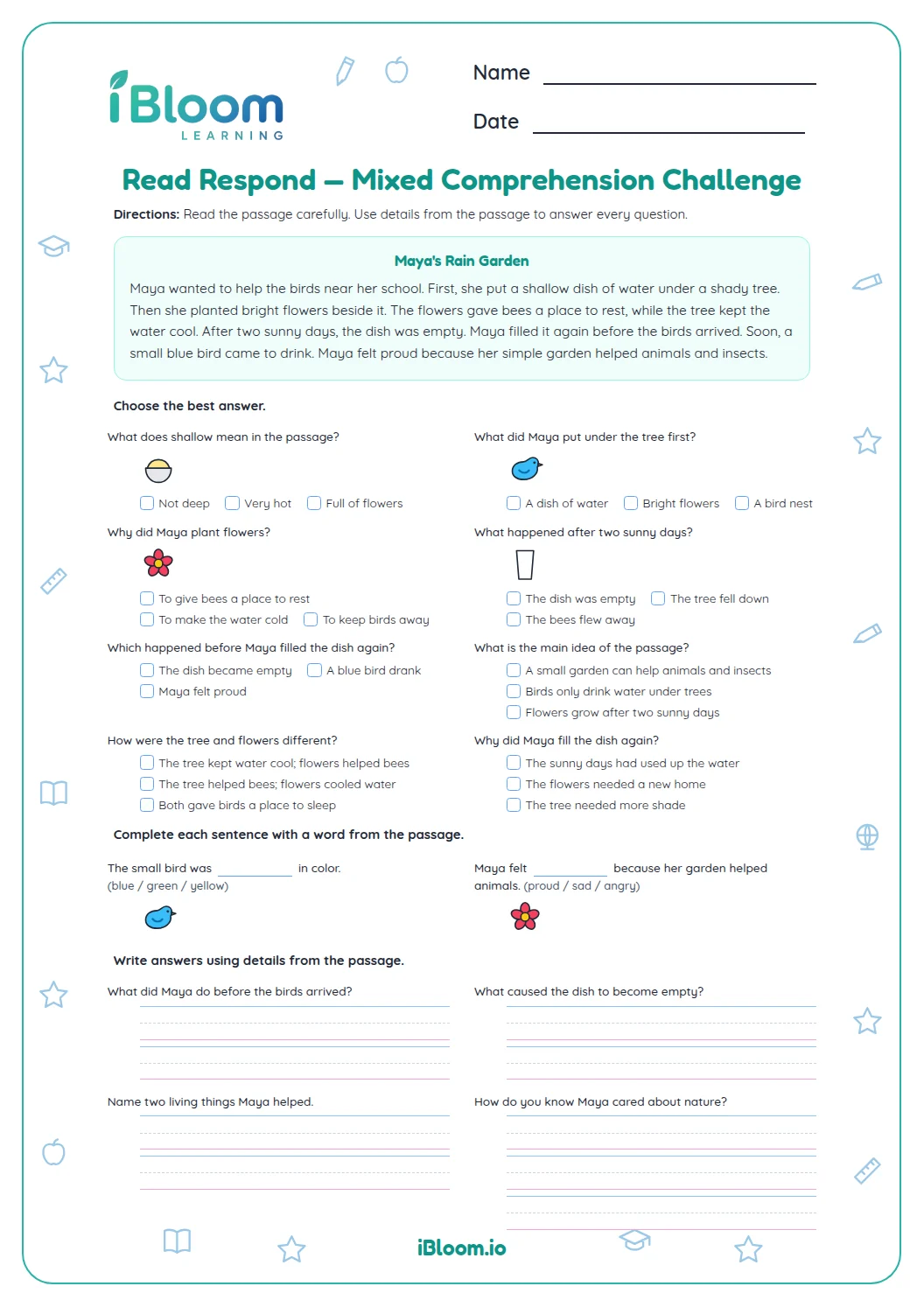
This free Grade 1 worksheet uses a short passage about Maya watching a tiny bird in her garden. Children preview the title, answer two title questions, reread for six story details, and use sentence clues to choose meanings for four words. The activity practices Common Core L.1.4a with context clues and RL.1.1 with questions about key details. A separate answer key is included.
Aligned to L.1.4a and RL.1.1
How should children start with the title?
Have children read “Maya’s Tiny Visitor” and answer Part B before reading the passage in Part A. The title names Maya and calls the visitor tiny, which helps children anticipate the subject. These answers come from the title alone.
Invite a prediction about the visitor, then read to check it against the passage. Keep predictions separate from details the text actually states.
Where can children find the story details?
Part C asks six questions about the passage. Maya sits in her garden after school; the bird has a yellow chest, chirps, and rests on a branch. Children can point to a sentence that supports each choice.
For example, question 8 asks where the bird rests. The passage says it “rested on a branch,” so that detail supports “On a branch.”
How do the sentences explain new words?
Part D asks about tiny, chirp, branch, and bright. The passage gives direct clues for three: tiny is followed by “or very small,” chirp by “a short bird sound,” and branch by “a tree limb.” The phrase “bright yellow” helps a reader picture a noticeable color.
Try each meaning in the original sentence and see whether it still makes sense.
- 1The bird began to chirp, a short bird sound.
- 2Question: What does chirp mean here?
- 3The sentence explains chirp directly.
- 4Choose: a short bird sound
How to use this worksheet
- 1Read the title and complete Part B before reading.
- 2Read Part A together and invite a prediction about the visitor.
- 3Reread the passage and answer the six Part C detail questions.
- 4Use nearby phrases to answer the four Part D vocabulary questions.
- 5Check each answer in the key and point to its title or sentence clue.
Mistakes to notice and fix
The mistake
Treating a prediction as a passage detail.
The fix
Point to a sentence that states the detail.
The mistake
Choosing a familiar meaning without reading the nearby clue.
The fix
Use “a short bird sound” to explain chirp.
The mistake
Mixing up where Maya sits and where the bird rests.
The fix
Reread each sentence and match the place to the right character.
Common Core alignment
Use clues in Mia’s story to understand six words.
On this sheet: Six vocabulary questions ask children to use nearby words to choose a meaning.
Show the official wordingHide the official wording
Use sentence-level context as a clue to the meaning of a word or phrase.
Answer questions about Mia’s seed, pot, and actions.
On this sheet: Four questions ask about the seed, the sprout, where Mia sets the pot, and how she cares for it.
Show the official wordingHide the official wording
Ask and answer questions about key details in a text.
What to practice next
Make more practice
Further reading
Questions parents and teachers ask
What does title practice look like on this sheet?
Children read “Maya’s Tiny Visitor” and answer two questions before reading the passage. They identify Maya and use the words tiny visitor as a clue about the subject. Then they read to find out what the visitor is and check their prediction against the story.
Which vocabulary words does the worksheet practice?
The four words are tiny, chirp, branch, and bright. The passage explains tiny as very small, chirp as a short bird sound, and branch as a tree limb. Children use those nearby clues and the phrase bright yellow to choose a meaning for each word.
Can I read the passage aloud to my child?
Yes. Read the passage aloud while your child follows along, then reread the sentences with the target words. Pause at “a short bird sound” and ask which word it explains. Children can use the same routine to answer the detail questions and find evidence.
Does my child need to write full sentences?
No. All twelve questions use answer choices. The six detail questions ask children to locate information such as when Maya sees the bird and where it rests. After choosing, your child can say the answer aloud and point to the sentence that supports it.
How do we check answers together?
Ask your child to point to the clue before checking the key. For example, “a tree limb” explains branch, while “a short bird sound” explains chirp. For a detail question, reread the sentence about the bird resting and match it to the answer choice.