







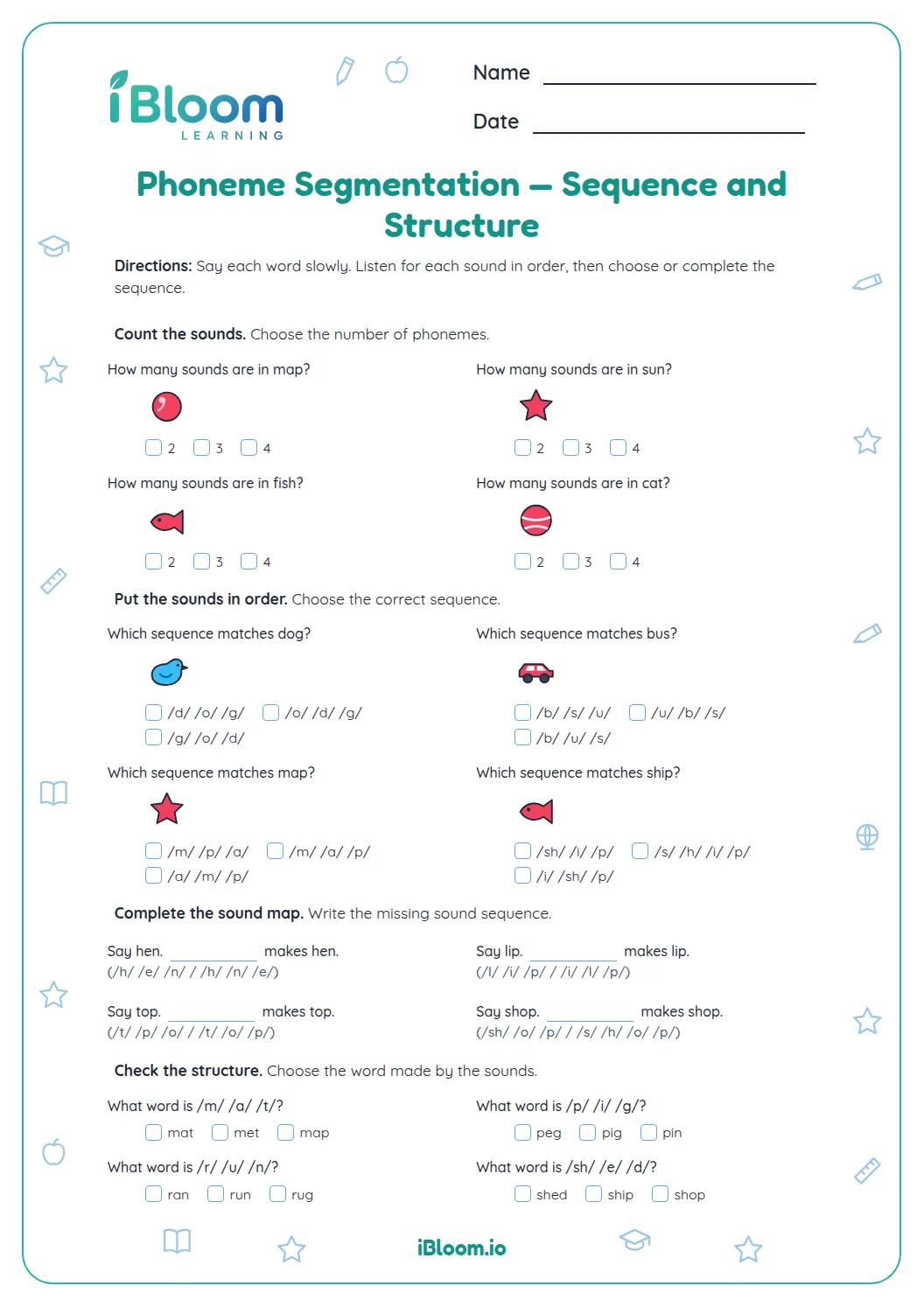
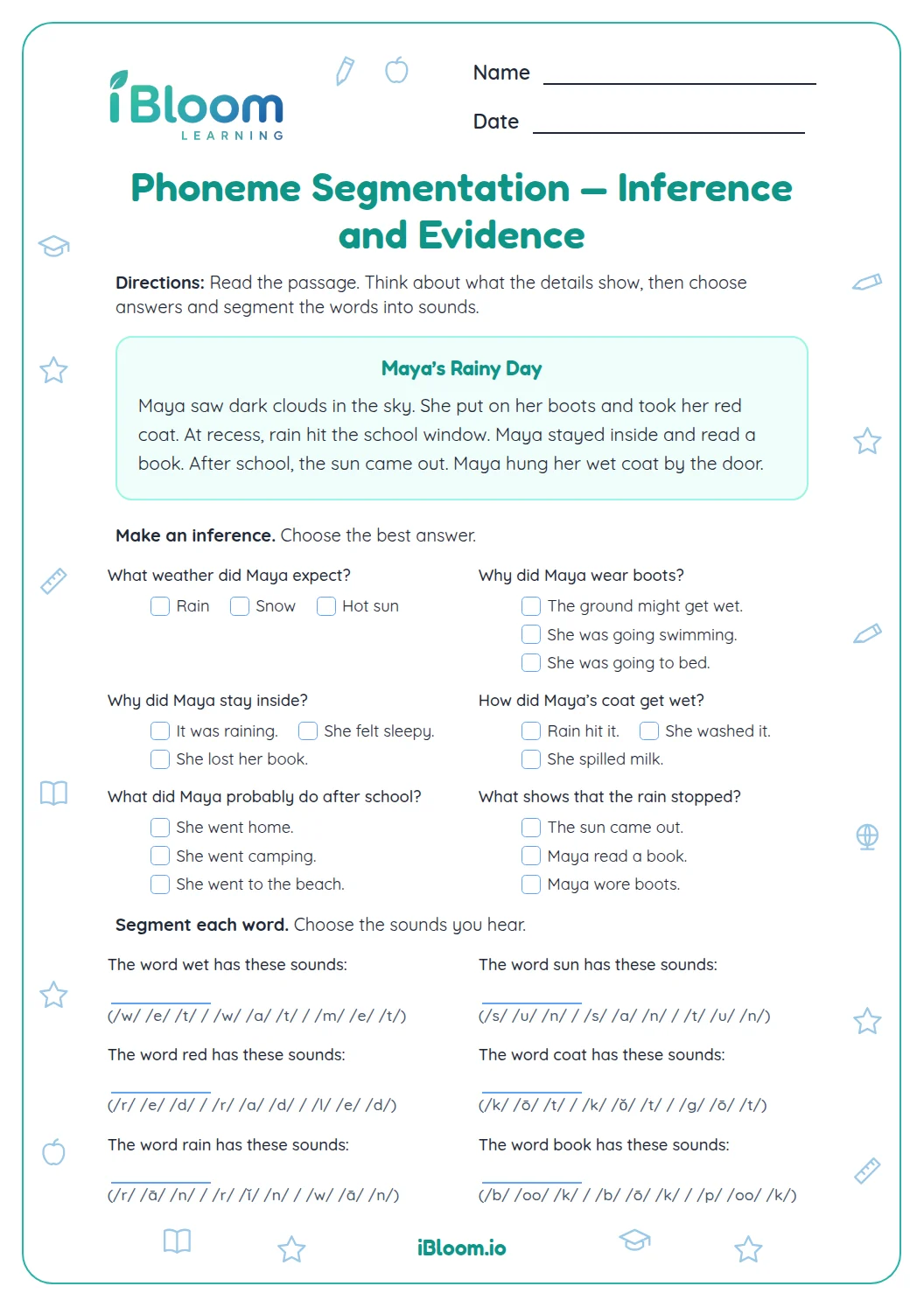
About this worksheet
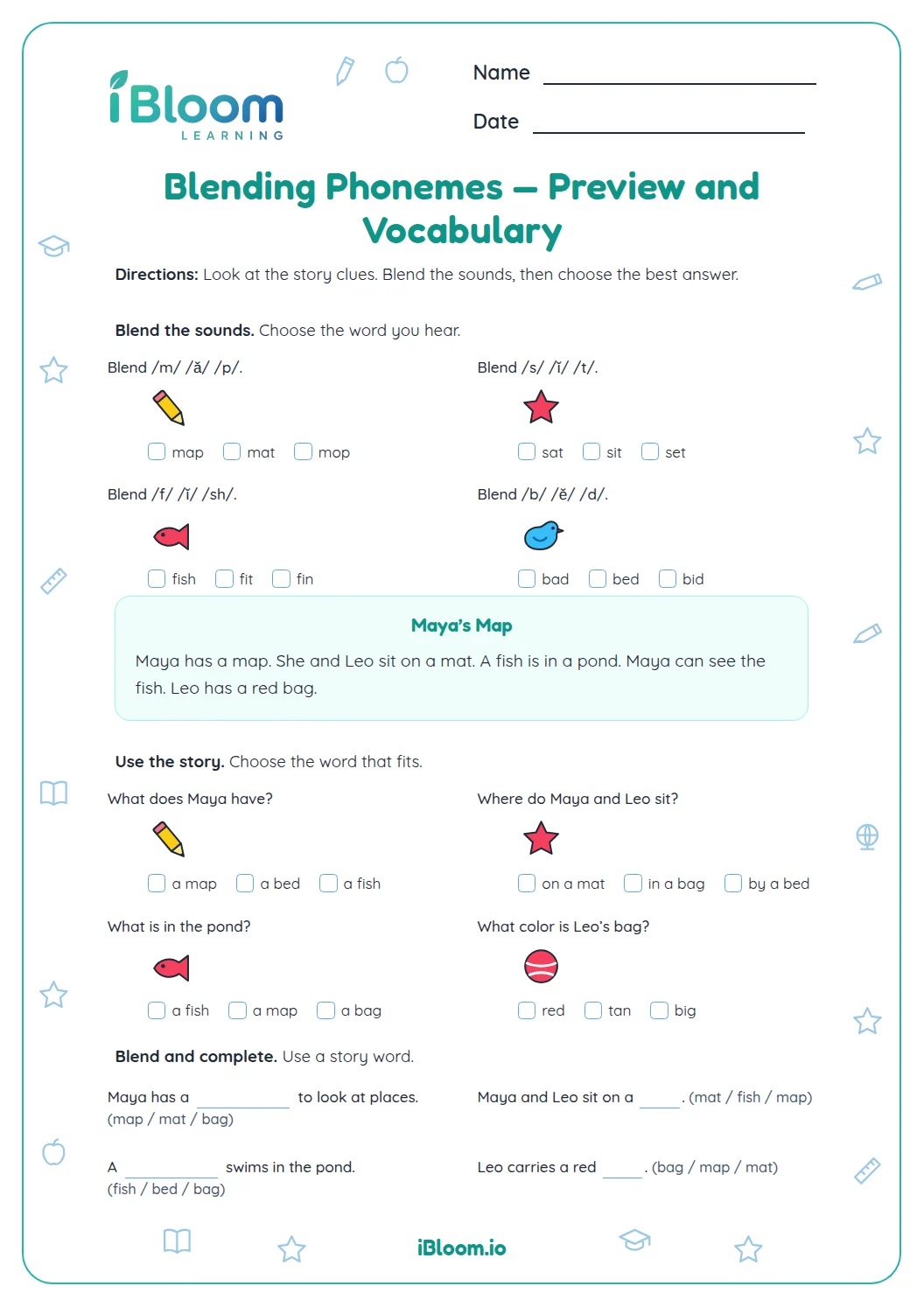
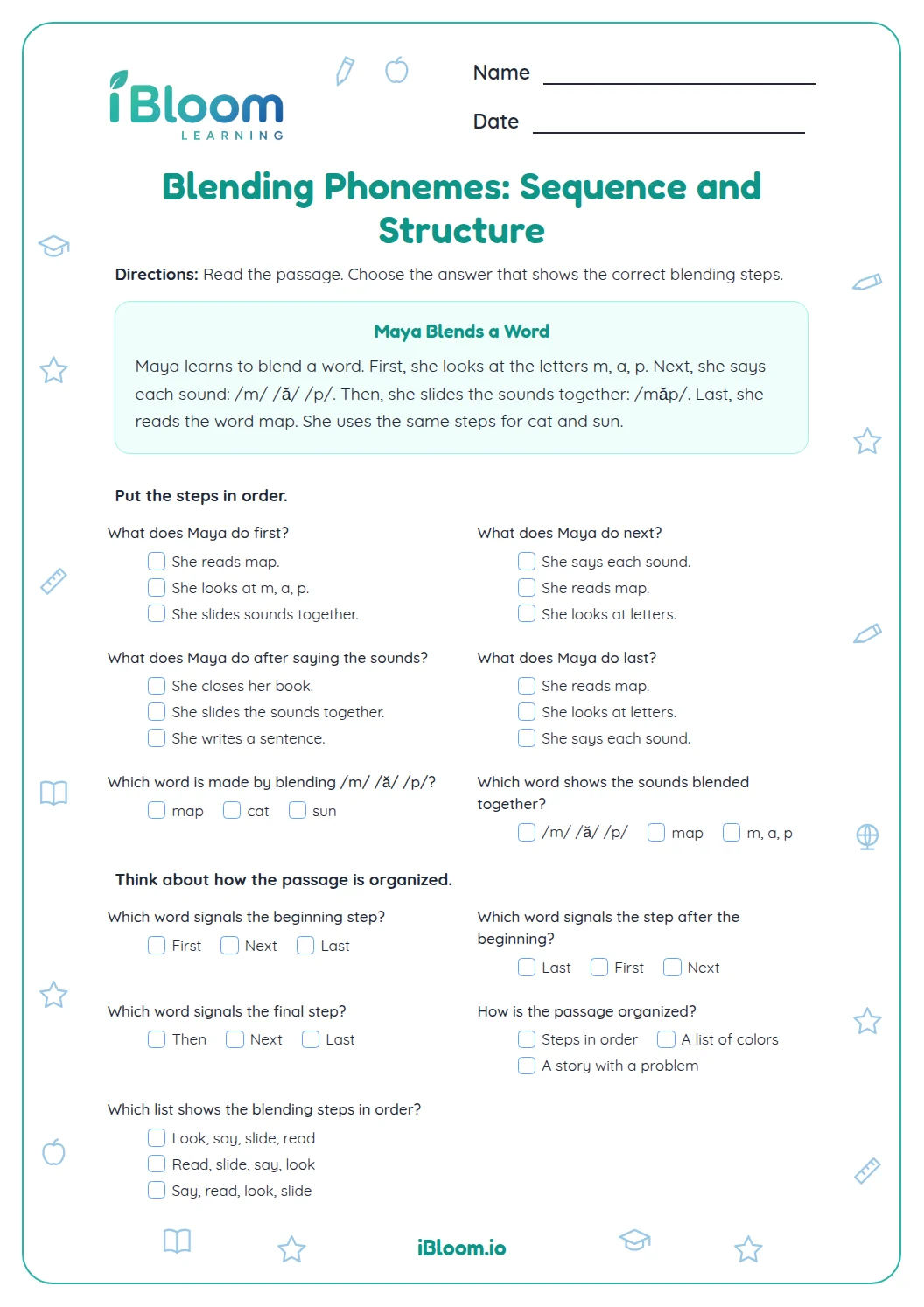
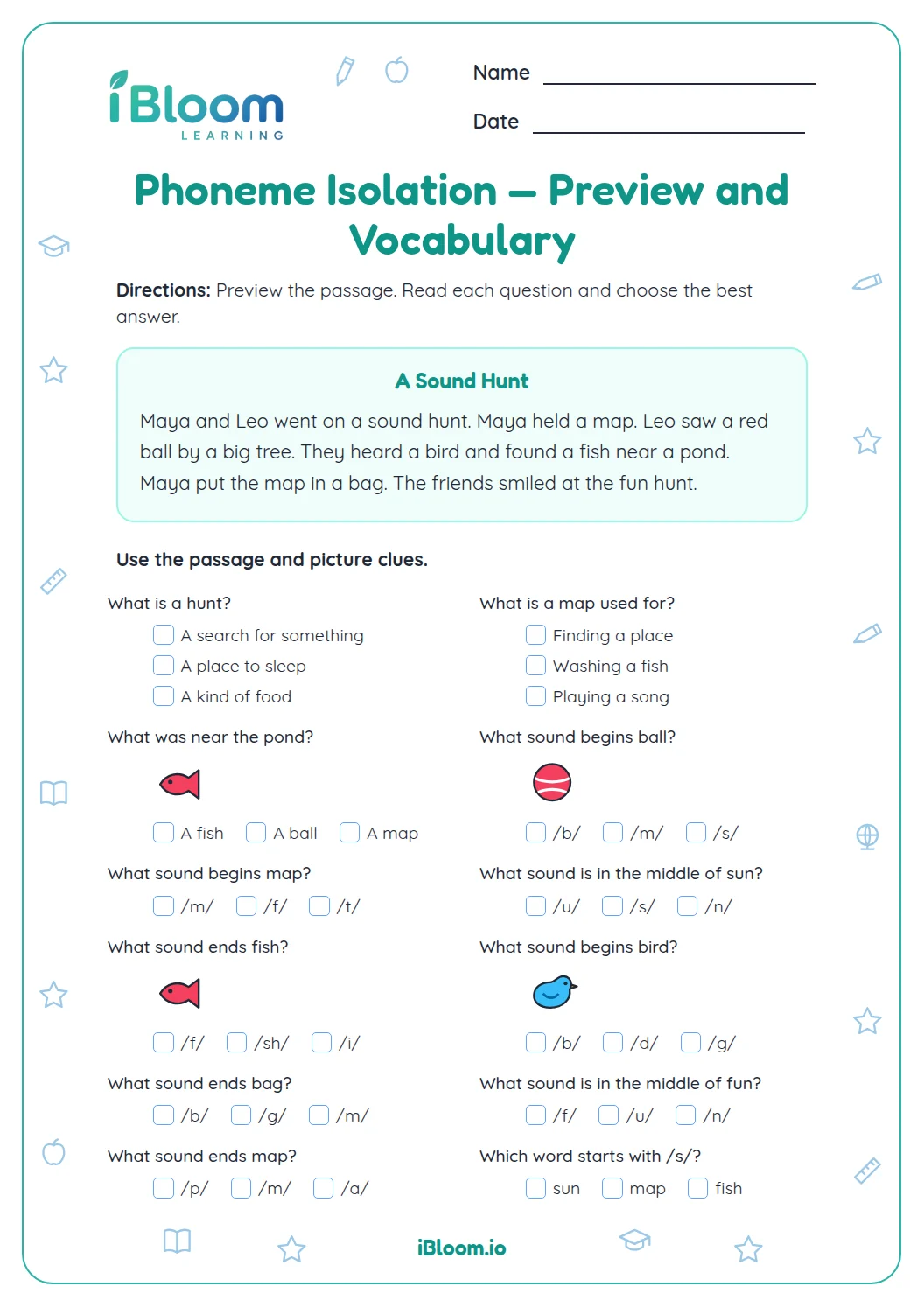
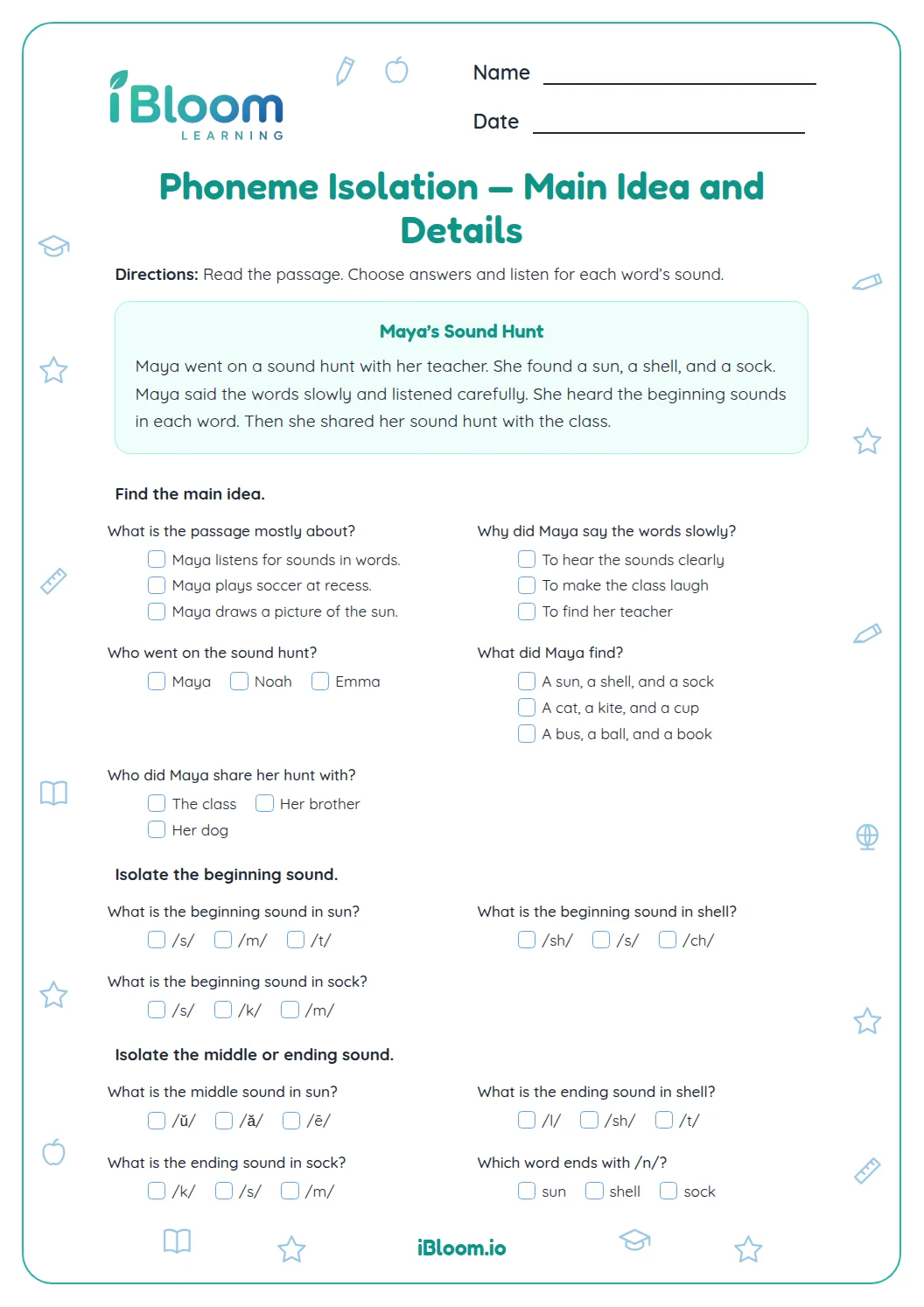
This free Grade 1 reading worksheet connects blending sounds with understanding a short text. Part A is a short passage about Maya joining sounds to make words. Part B asks children to blend four sound sequences aloud and write the words. Part C has four multiple-choice questions about the main idea and details, and Part D has two short written responses. An adult can say the separate sounds for Part B. The sheet practices CCSS RF.1.2b and RI.1.2, with a separate answer key for the ten questions.
Aligned to RF.1.2b and RI.1.2
How should an adult present the sound sequences?
Say the separate sounds in Part B and ask the child to slide them together into a whole word. Use short vowel sounds in map, sun, sit, and stop. Keep consonants brief and avoid adding an extra “uh” sound after them.
For the clearest oral practice, cover the printed sound sequence while saying it. Let the child blend aloud first, then uncover it and write the word. The slashes mark individual sounds; they are not spoken.
What is the main idea of the passage?
The text explains that joining separate sounds makes words. Maya’s examples, tapping, and repeated whole words all help explain that idea. A choice about a map or the sun names something in the passage but misses what the passage teaches.
- 1Question: What is the text mostly about?
- 2Maya joins /m/ /a/ /p/ to make map.
- 3She also joins sounds to make sun and stop.
- 4These details support: Blending makes words.
How do the final questions check understanding?
Part C asks children to recognize the main idea and three details. Part D asks them to tell Maya’s routine in their own words and name two words she blends. The passage stays available for rereading.
A response about listening, tapping, and joining sounds fits question 9. For question 10, accept any two of map, sun, and stop. Sit belongs to the extra blending practice in Part B; it is not one of Maya’s examples in the passage.
Use the sheet step by step
- 1Read the passage together once, helping with unfamiliar words.
- 2Say each Part B sound sequence while the child blends aloud.
- 3Let the child write each blended word after saying it.
- 4Reread the passage and complete Part C, pointing to evidence for each choice.
- 5Ask for oral answers to Part D before the child writes, then compare with the key.
Mistakes to watch for
The mistake
Saying letter names instead of the sounds in /m/ /a/ /p/.
The fix
Model the three sounds with a short a, then slide them together to say map.
The mistake
Choosing the sentence about maps because map appears in the text.
The fix
Check whether that choice also explains the sun and stop examples; blending makes words explains all three.
The mistake
Naming sit as one of Maya’s words in question 10.
The fix
Look back at the passage itself and choose two of its examples: map, sun, and stop.
Common Core alignment
Blend spoken sounds into one-syllable words, including stop.
On this sheet: An adult says the separate sounds in Part B; children blend each sequence aloud before writing the word.
Show the official wordingHide the official wording
Orally produce single-syllable words by blending sounds (phonemes), including consonant blends.
Identify what the text teaches and retell details about blending.
On this sheet: Parts C and D ask for the main idea, supporting details, and a retelling of Maya’s blending routine.
Show the official wordingHide the official wording
Identify the main topic and retell key details of a text.
What to practice next
Make more practice
Further reading
Questions parents and teachers ask
Can I read the passage aloud to my child?
Yes. Read it together or read it aloud once, then let your child revisit the sentences while answering. For the blending section, say the individual sounds and have your child produce the whole word. This keeps listening, speaking, and understanding involved even when the child needs help reading.
What do the slashes around letters mean?
The slashes tell the adult to say individual sounds. For /m/ /a/ /p/, use the sound at the start of map, the short a sound, and the final p sound. Do not say the letter names. The child joins those three sounds and says the whole word, map.
Why does the sheet include stop?
Stop gives practice joining four sounds, including the two beginning consonants s and t. Maya blends it in the passage, and the child blends it again in Part B. Say each consonant sound briefly, then let the child join the sounds without inserting an extra vowel between s and t.
What counts as a good answer to the last question?
Any two of map, sun, and stop are correct because Maya blends those words in the passage. The key gives map and sun as a sample and lists the other acceptable combinations. A child may write the two words alone; a complete sentence is also welcome.
How can I tell whether my child understands the main idea?
Ask why the chosen answer fits more than one part of the passage. Your child might explain that Maya makes map, sun, and stop by joining sounds. That connects several details to one idea. If the child only names a word, reread the first and last sentences together.