



About this worksheet
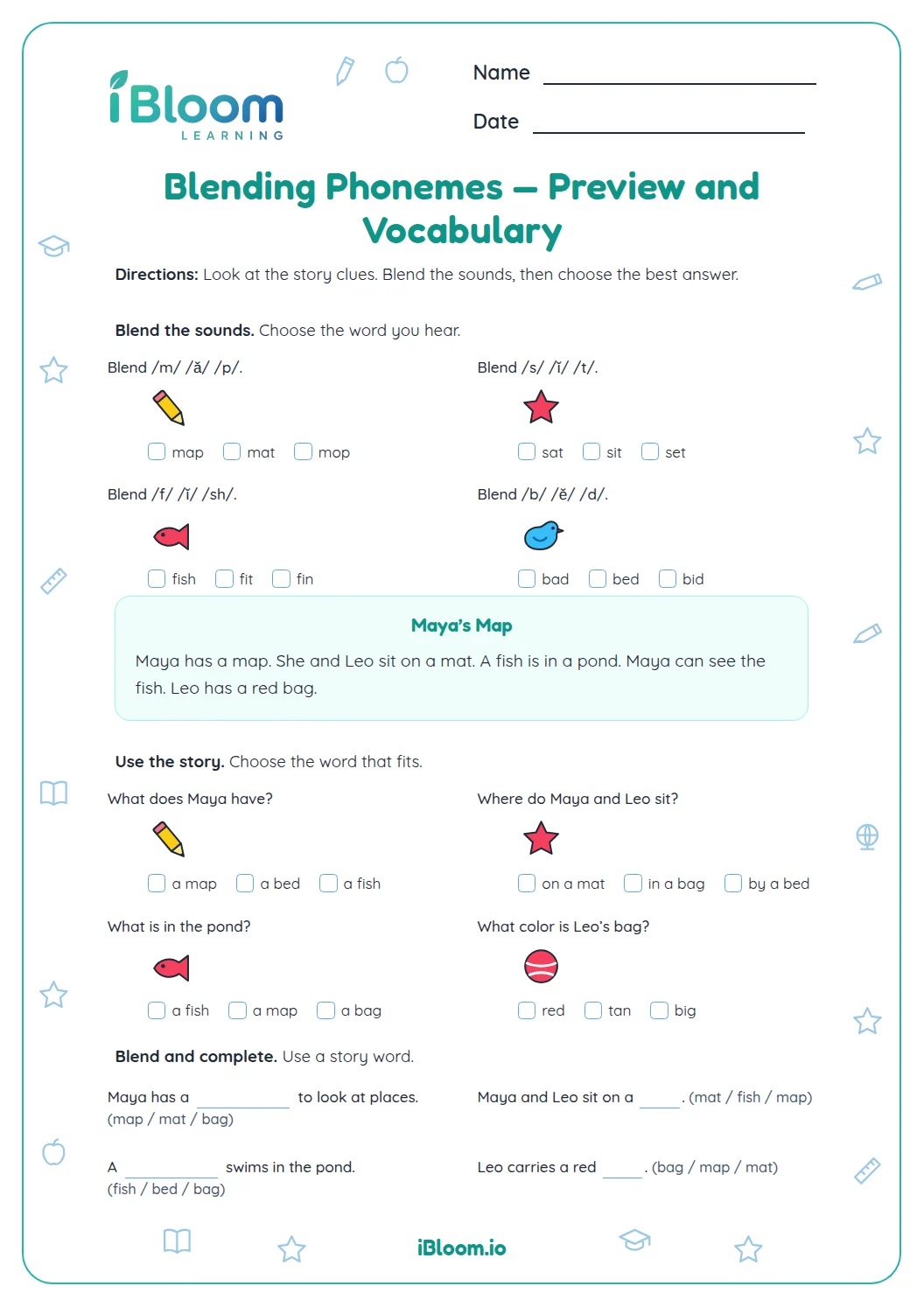
This free Grade 1 phonics worksheet links saying words with understanding them. Part A is a short story about Maya and Leo at the park. In Part B, children say the separate sounds in six printed letter sequences, blend them, and choose the matching word. Part C uses story sentences for four word-meaning clues. Part D checks four details from the story. Common Core RF.1.2b supports the spoken blending practice, while L.1.4a supports using sentence clues for meaning. The answer key identifies all fourteen choices for checking at home or in a reading group.
Aligned to RF.1.2b and L.1.4a
What should children hear in a consonant blend?
Children should hear each consonant sound. In flag, f and l both have a sound before the short a and final g. Have the child say sounds rather than letter names, then bring those sounds closer together.
Part B uses fl, cr, dr, fr, st, and cl at the beginning of words. Each item has three word choices, so the child must carry the sounds through to the end.
How do you model the first blending question?
Read the printed letter sequence as separate sounds. Hold continuous sounds briefly, then slide through the whole word without adding an extra vowel after a consonant. Finally, find the matching word among the choices.
- 1Question 1: f-l-a-g
- 2Say the sounds for f, l, short a, and g.
- 3Blend them to say flag.
- 4Choose flag; check the last sound, g.
How does the passage help with vocabulary?
The park story gives a setting and actions that help explain four words. “It could hop” helps identify the frog, “flapped in the wind” fits the flag, and “a loud crash” tells what the box makes when it falls.
In Part C, read the sentence clue before looking at the choices. Ask the child to put the selected word back into the sentence and check whether it makes sense.
How to use this worksheet
- 1Read the park story together and talk briefly about what Maya and Leo see.
- 2Model the sounds in f-l-a-g and blend them into one word.
- 3Let the child say every Part B word aloud before choosing.
- 4Reread the sentence clues in Part C, then answer the story questions in Part D.
- 5Check the key and reread any word whose beginning or ending was missed.
Mistakes to discuss and fix
The mistake
Saying letter names instead of sounds.
The fix
Model f as its sound, then blend the sounds into flag.
The mistake
Dropping one consonant and reading frog as fog.
The fix
Point to f and r separately, say both sounds, then blend again.
The mistake
Choosing a familiar meaning of still that does not fit.
The fix
Reread “does not move” and try “not moving” in the sentence.
Common Core alignment
Say separate sounds and blend them into six one-syllable words.
On this sheet: Part B explicitly asks children to say sounds aloud and blend consonant-blend words.
Show the official wordingHide the official wording
Orally produce single-syllable words by blending sounds (phonemes), including consonant blends.
Use story sentences as clues to choose four word meanings.
On this sheet: Part C uses story clues about the frog, flag, and crash to help children choose words that fit.
Show the official wordingHide the official wording
Use sentence-level context as a clue to the meaning of a word or phrase.
What to practice next
Make more practice
Further reading
Questions parents and teachers ask
Which consonant blends are practiced?
The six blending items begin with fl, cr, dr, fr, st, and cl. Children build flag, crab, drum, frog, stop, and clap from separate sounds. The choices include words with similar beginnings, so listening for the vowel and final sound matters as well as hearing the blend.
Should I read the hyphens aloud?
No, the hyphens only separate the printed letters for the sound practice. Say each letter’s sound, pause briefly if needed, and then blend the sounds into a whole word. For f-l-a-g, use a short a sound. Ask the child to say flag before choosing it.
Does my child need to read the story independently?
An adult may help with the passage while the child follows along. The story supplies useful context for four word-meaning questions and four story-detail questions, while the blending items provide focused oral practice. After the questions, reread a familiar sentence together so the child can recognize a practiced word in connected text.
Why does the sheet include word meanings?
The meaning questions connect sounding out words with understanding a sentence. Children use clues such as “It can hop” to identify frog and “a loud crash” to understand what happens when the box falls. This gives them a concrete way to check whether a word fits its sentence.
How should I use the answer key?
Use the key after the child has said the words and made the choices. If an answer differs, return to the sound sequence or the quoted sentence before giving the answer. Ask the child to explain the new choice, then reread the complete word or sentence once more.