




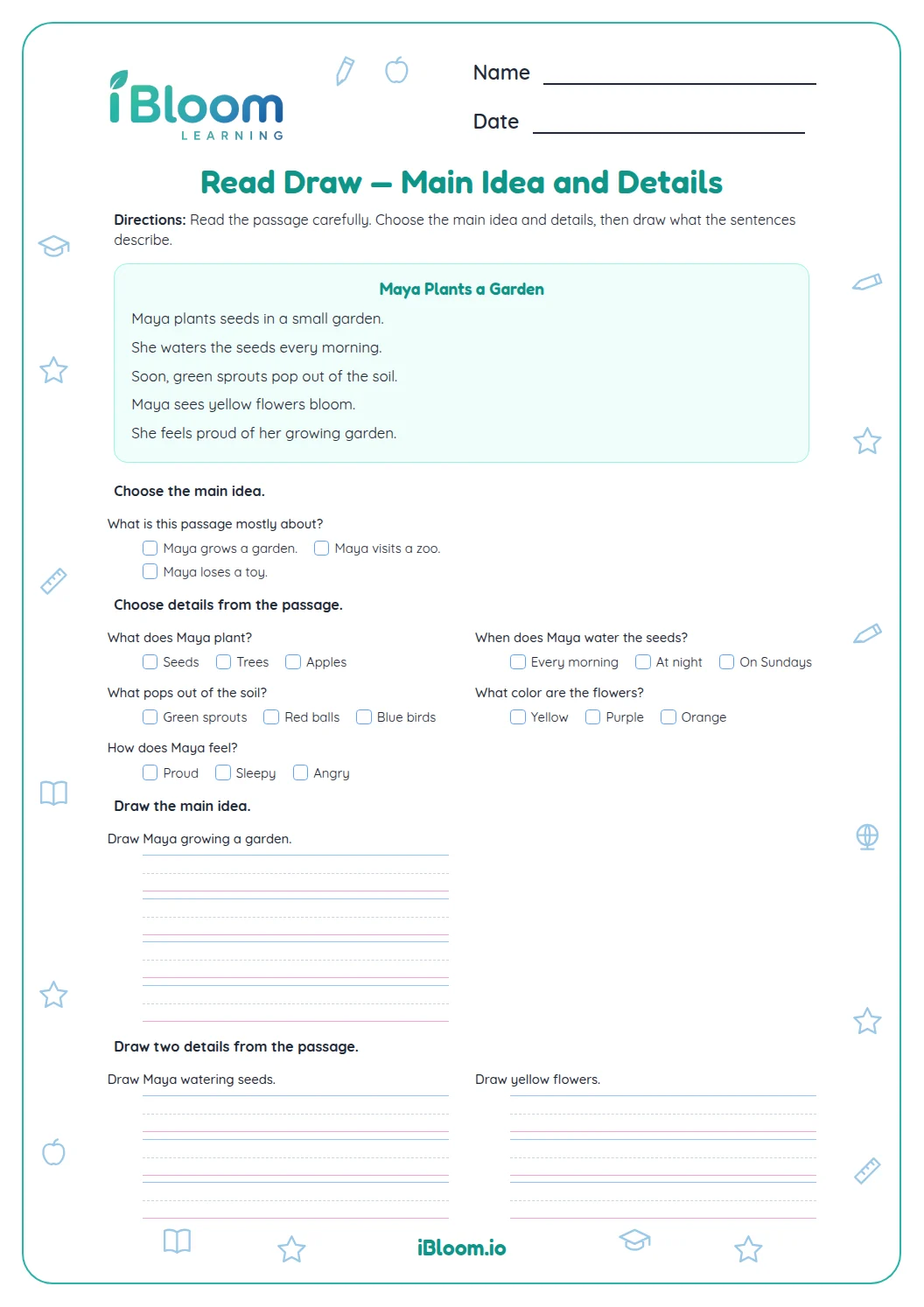
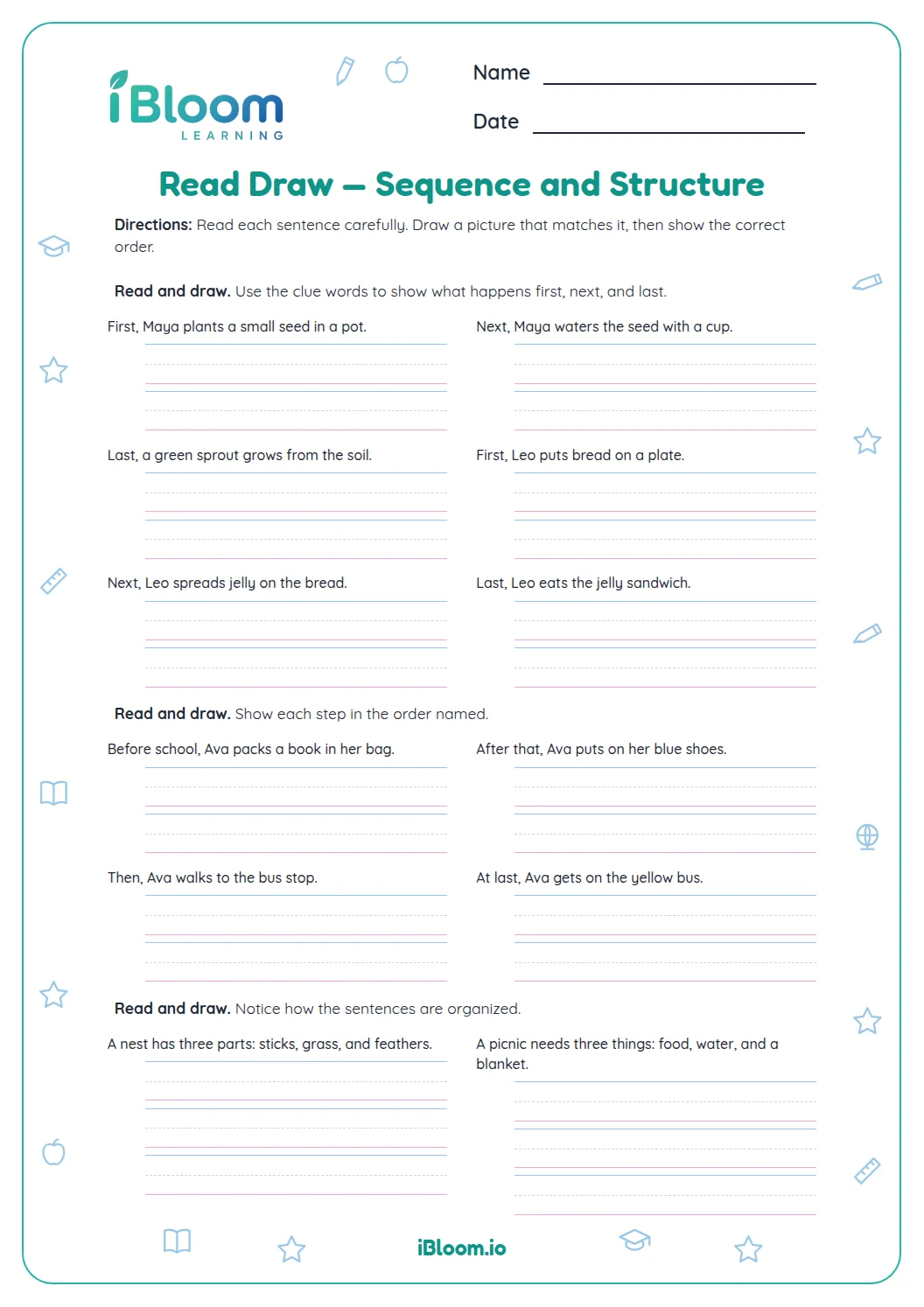


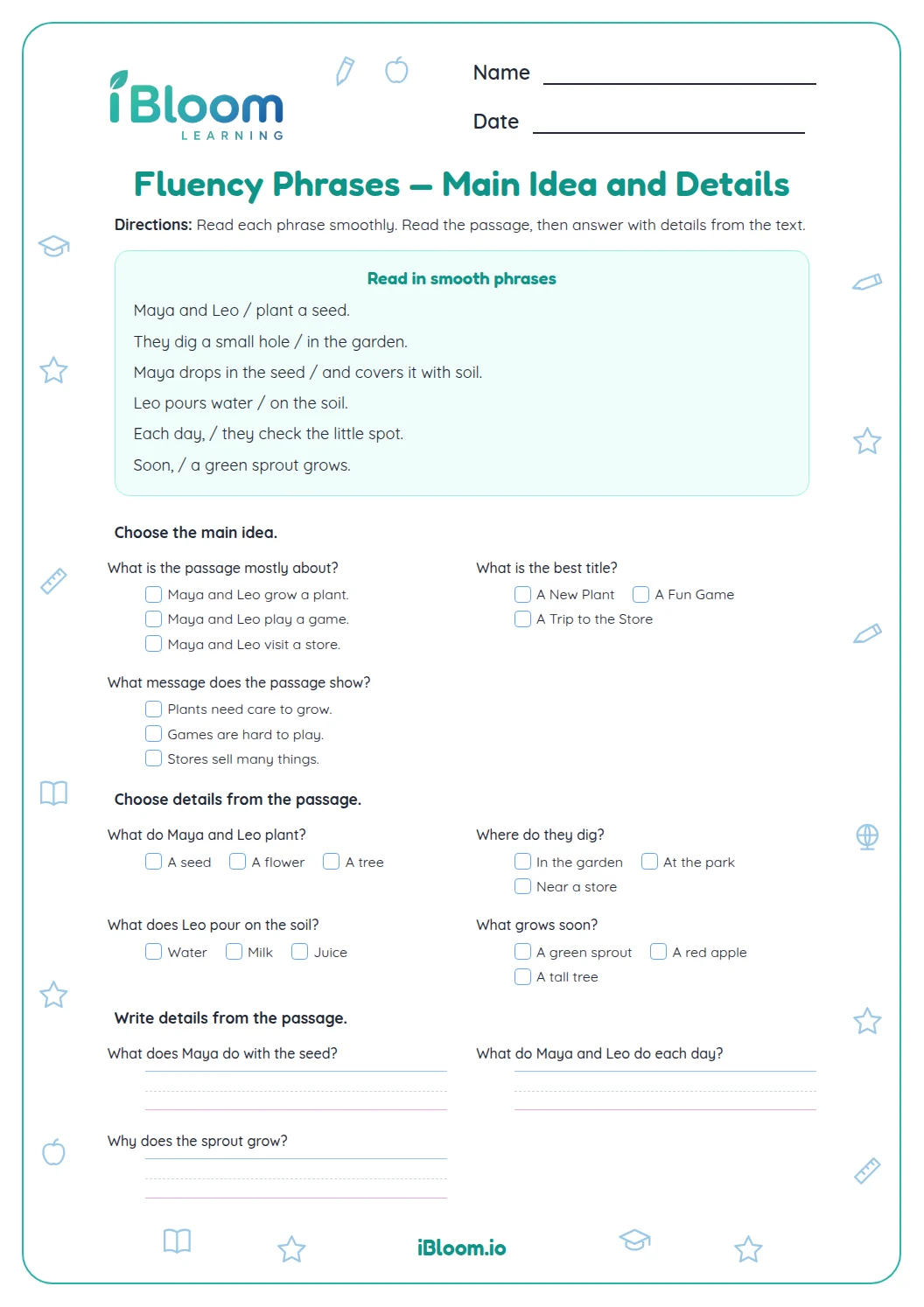

About this worksheet
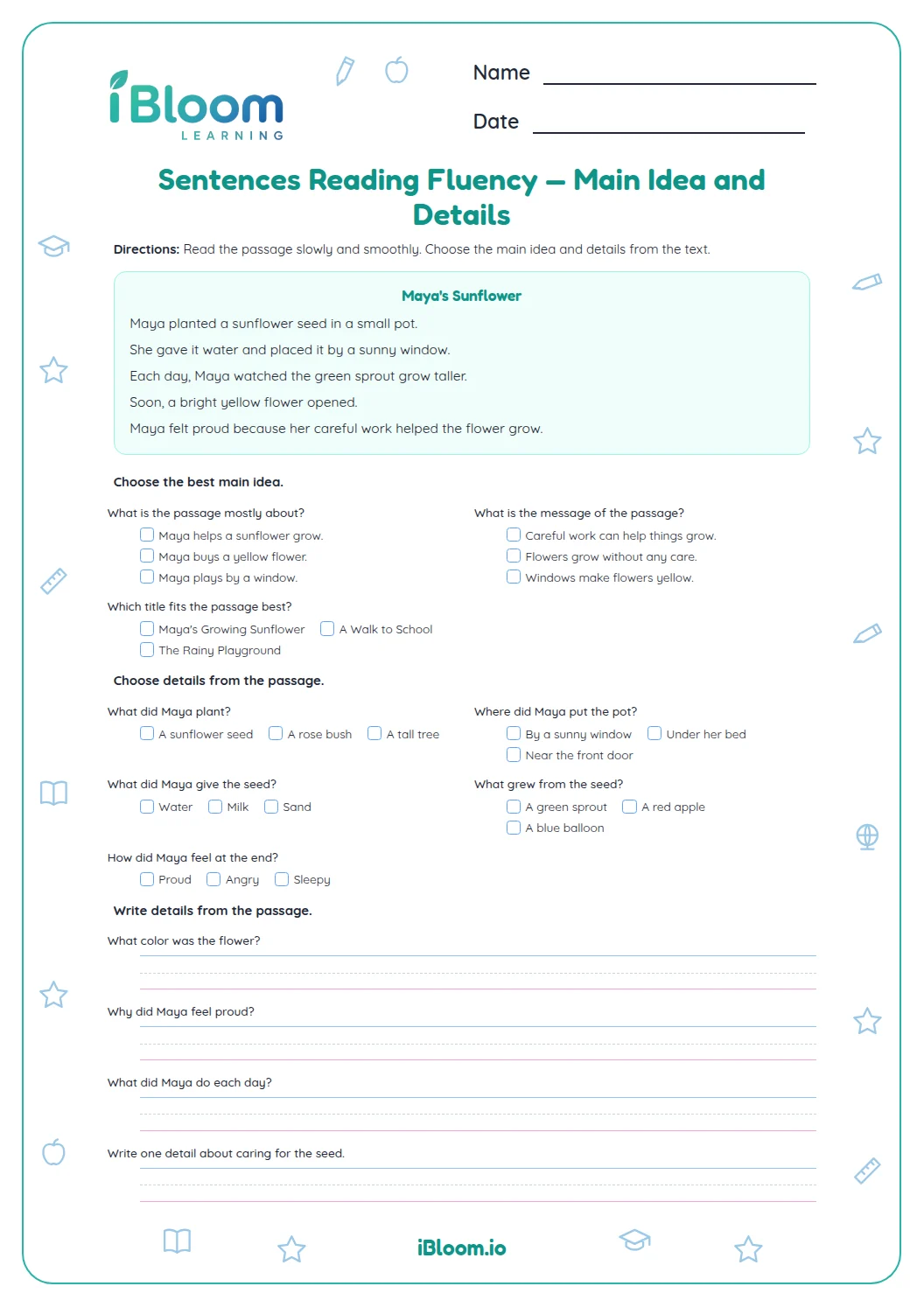
This free printable gives Grade 1 readers an original 82-word story about Mia caring for a seed, followed by 16 questions. Children find details, put events in order, connect an action with a story clue, and name the main idea. A separate answer key gives concise answers and sample sentences. The detail questions practice CCSS RI.1.1.
Aligned to RI.1.1
How should a first grader use the passage?
Read the story once to understand what is happening, then reread when a question asks for a detail. Children may read aloud, echo-read with an adult, or listen before answering.
Question 6 asks what Mia and Ben used to measure the sprout. The passage says they used a paper strip, so that phrase is the precise answer.
- 1Find the sentence: “They measured the sprout with a paper strip.”
- 2Answer: a paper strip
How does the sheet practice sequence and clues?
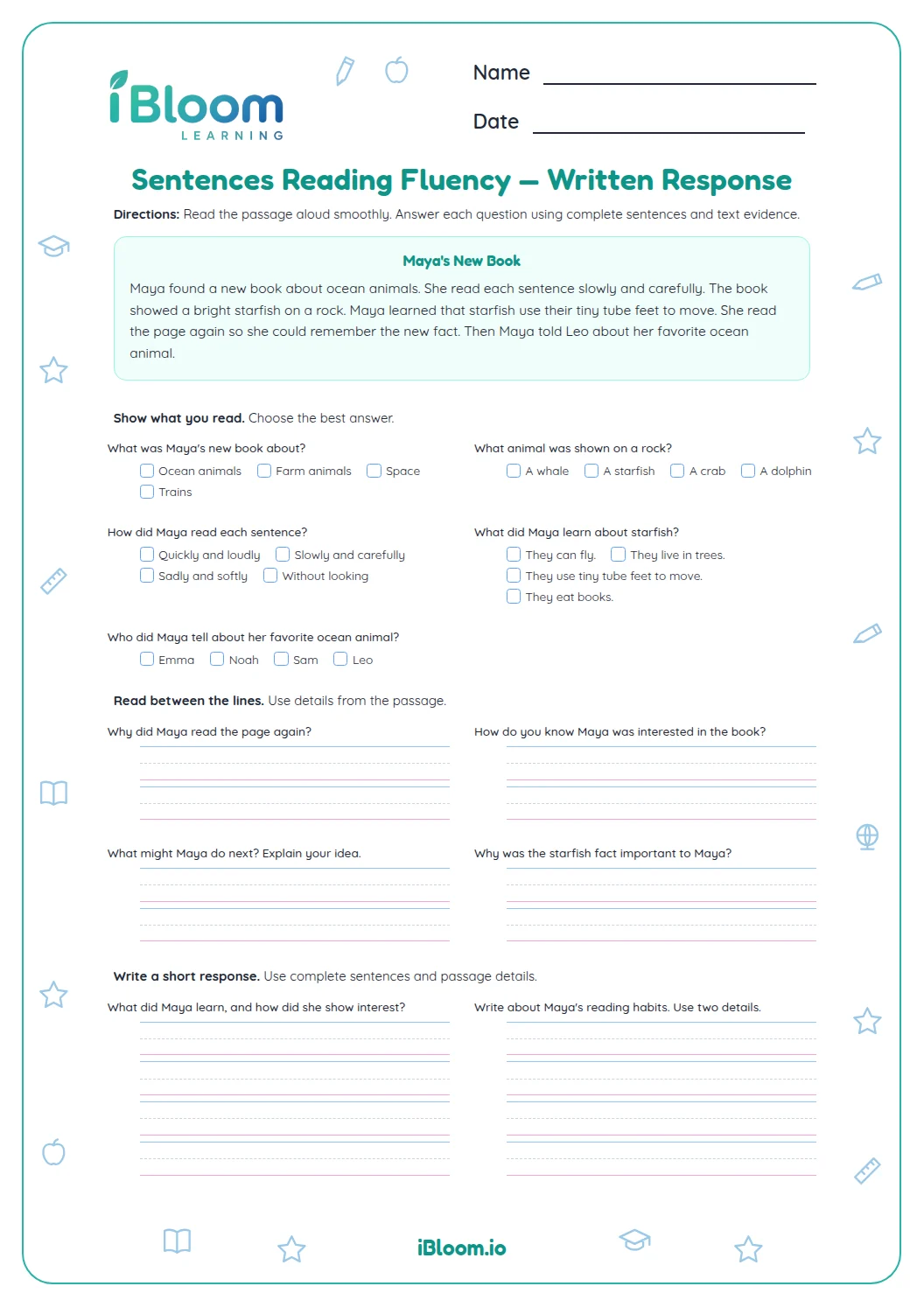
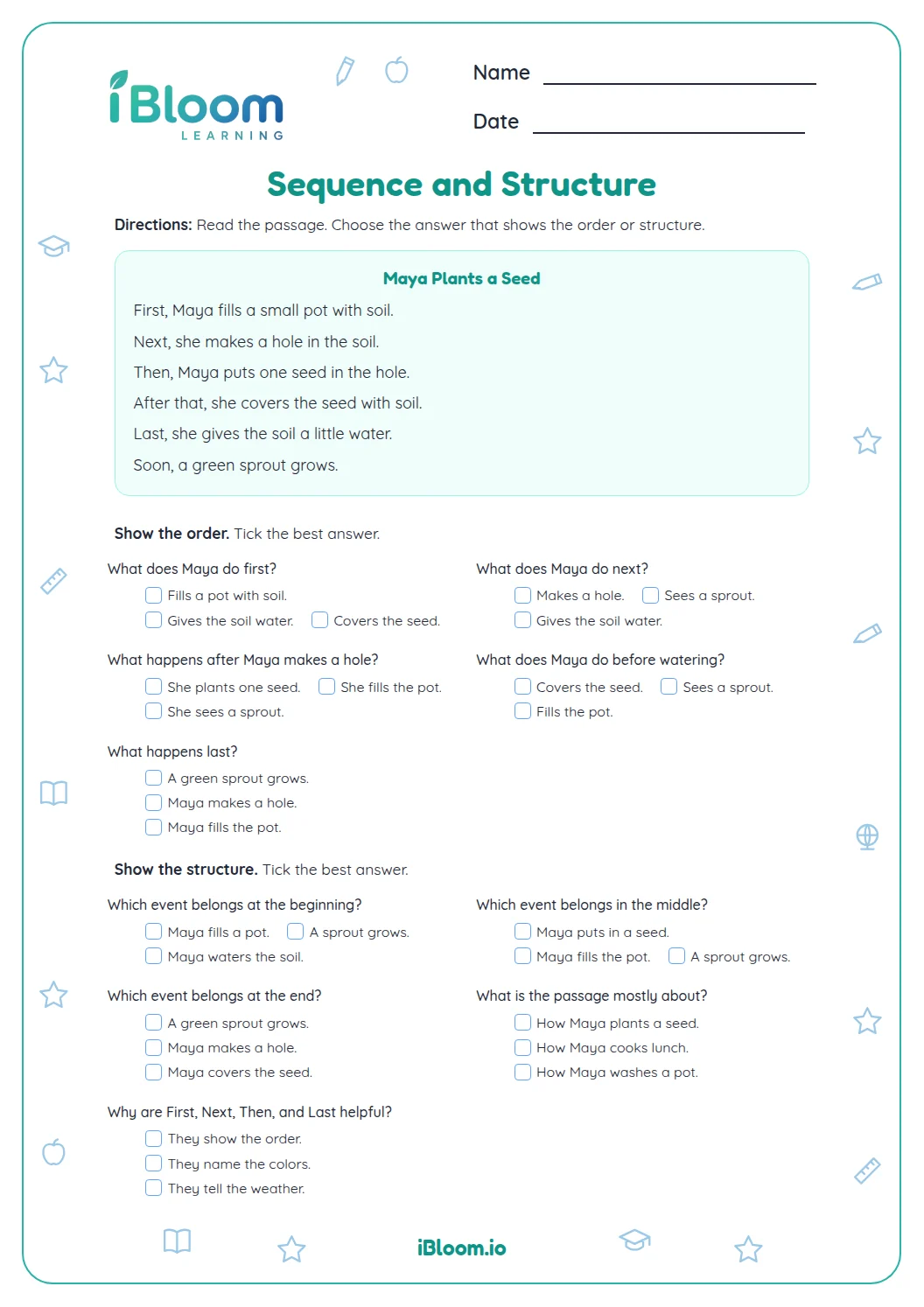
Questions 11 and 12 ask readers to put events in order and tell what Mia did next. Question 13 asks for a detail showing that Mia checked the plant’s growth. Encourage children to point to the words in the passage that support each answer.
How can a reader find the main idea?
Think about what Mia does across the whole story, not only one sentence. She plants, waters, observes, and records the growing seed. The main idea combines those details: a seed grows when Mia cares for it.
How to use this worksheet
- 1Read the passage aloud or take turns reading sentences.
- 2Retell the story in one sentence before answering.
- 3Reread the passage for names, places, and actions.
- 4For sequence questions, look for what happened before and after.
- 5For the main idea, connect several details instead of copying one.
- 6Check each answer against the passage.
Mistakes to watch for
The mistake
Answering from memory without checking
The fix
Reread the sentence that names the person, place, or event.
The mistake
Using a single detail as the main idea
The fix
Ask what most of the story is about and combine related events.
The mistake
Mixing up the order of events
The fix
Look for time cues such as “one day” and trace the events in order.
Common Core alignment
This page gives children focused practice with the skills named in these standards.
Answer questions about details stated in a short text.
On this sheet: Answer questions about details stated in a short text.
Show the official wordingHide the official wording
Ask and answer questions about key details in a text.
What to practice next
Make more practice
Further reading
Questions parents and teachers ask
How long is the reading passage?
The original passage is 82 words, and the question set gives Grade 1 readers a short text to revisit. It follows Mia as she plants a seed, notices a sprout, and records what the growing plant needs. A reader can point to the sentence that supports an answer before moving on.
What kinds of questions are included?
There are 16 questions about details stated in the passage, event order, a clue about Mia’s actions, and the main idea. Most answers are short words or phrases, with five prompts inviting a complete sentence. Rereading one short section is a useful way to check a detail.
Should my child read the story aloud?
Reading aloud is a useful option, but children can also echo-read after an adult or listen first. The goal is to understand the passage and return to it for evidence, while practicing at a comfortable pace. Ask the child to say which event happened before the next one.
How can we find an answer in the passage?
Look for the same person, object, or action named in the question. For example, question 6 asks what the children used to measure the sprout; rereading the sentence reveals “a paper strip.” A complete sentence can make the answer clearer, even when a phrase is correct.
What does the main-idea question ask?
It asks what the whole story is mostly about. A strong answer brings together Mia’s planting, watering, and watching the seed grow instead of repeating only one event. The key gives a sample, and concise wording is fine when it keeps the passage meaning.
Is an answer key included?
Yes. A separate key lists all 16 answers and gives sample sentence responses where a child explains a clue or retells an event. Children can compare ideas with the key after finishing the questions. Ask them to point to the sentence that supports each response.