





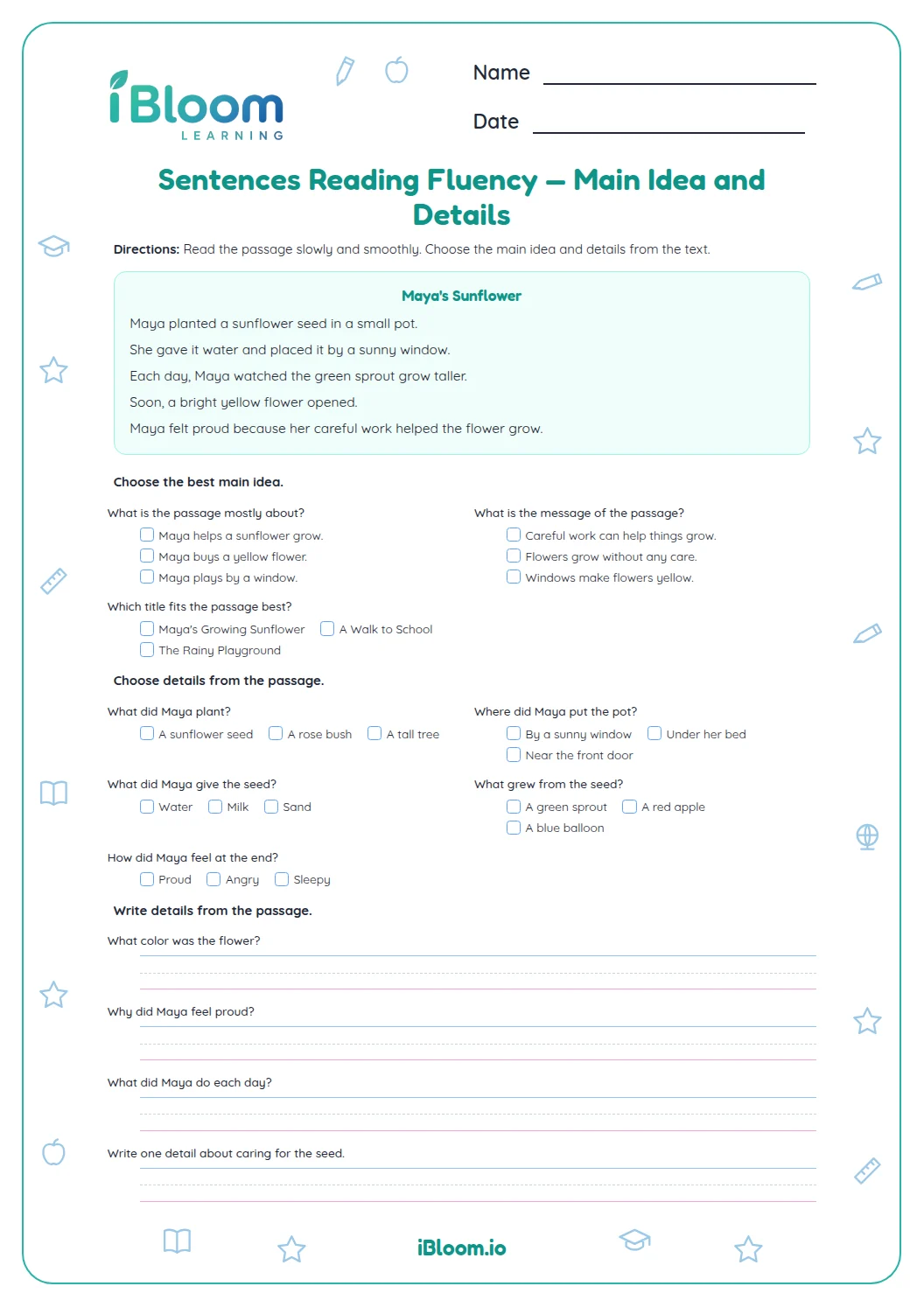

About this worksheet
This free printable Grade 1 worksheet uses a short seed story to practice event order, sequence words, and smooth phrase reading. Children read the story aloud twice, answer four questions about what happens and when, complete four order-word blanks, and reread two short phrases before answering. Its 10 questions keep the focus on the same sequence and phrase structure as the earlier sheet. A separate answer key lists the responses.
Aligned to RF.1.4 and RL.1.3
How should children read the passage twice?
On the first reading, help with unfamiliar words and check that Mia’s actions make sense. On the second, ask children to keep familiar word groups together and pause at periods. The aim is accurate, connected reading.
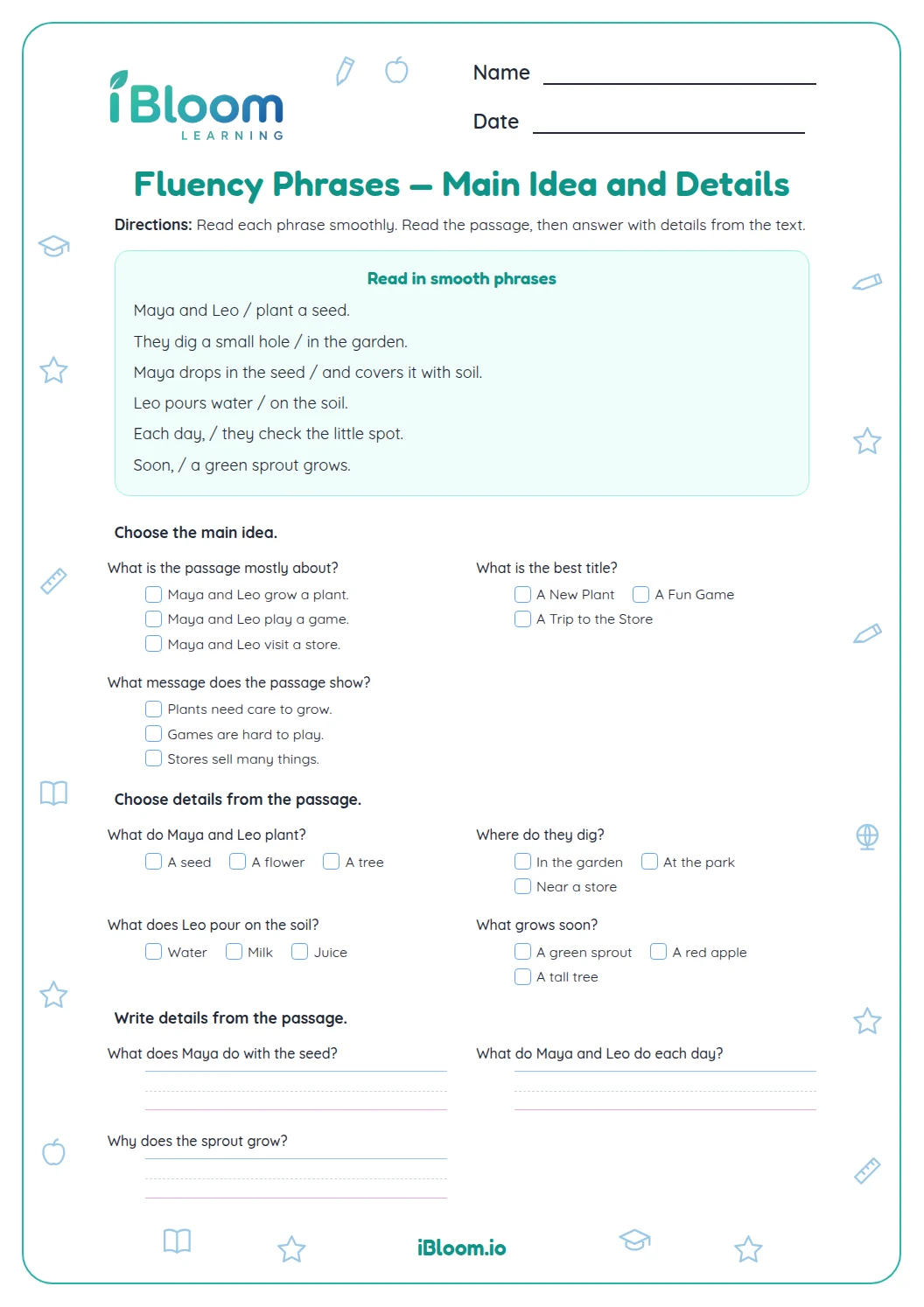
Part D marks two groups with a slash. The slash is a guide for grouping words; it is not a word to say aloud. Read “Mia” and “pats the soil” as meaningful groups, then join them into a smooth sentence.
How do the order words organize Mia’s actions?
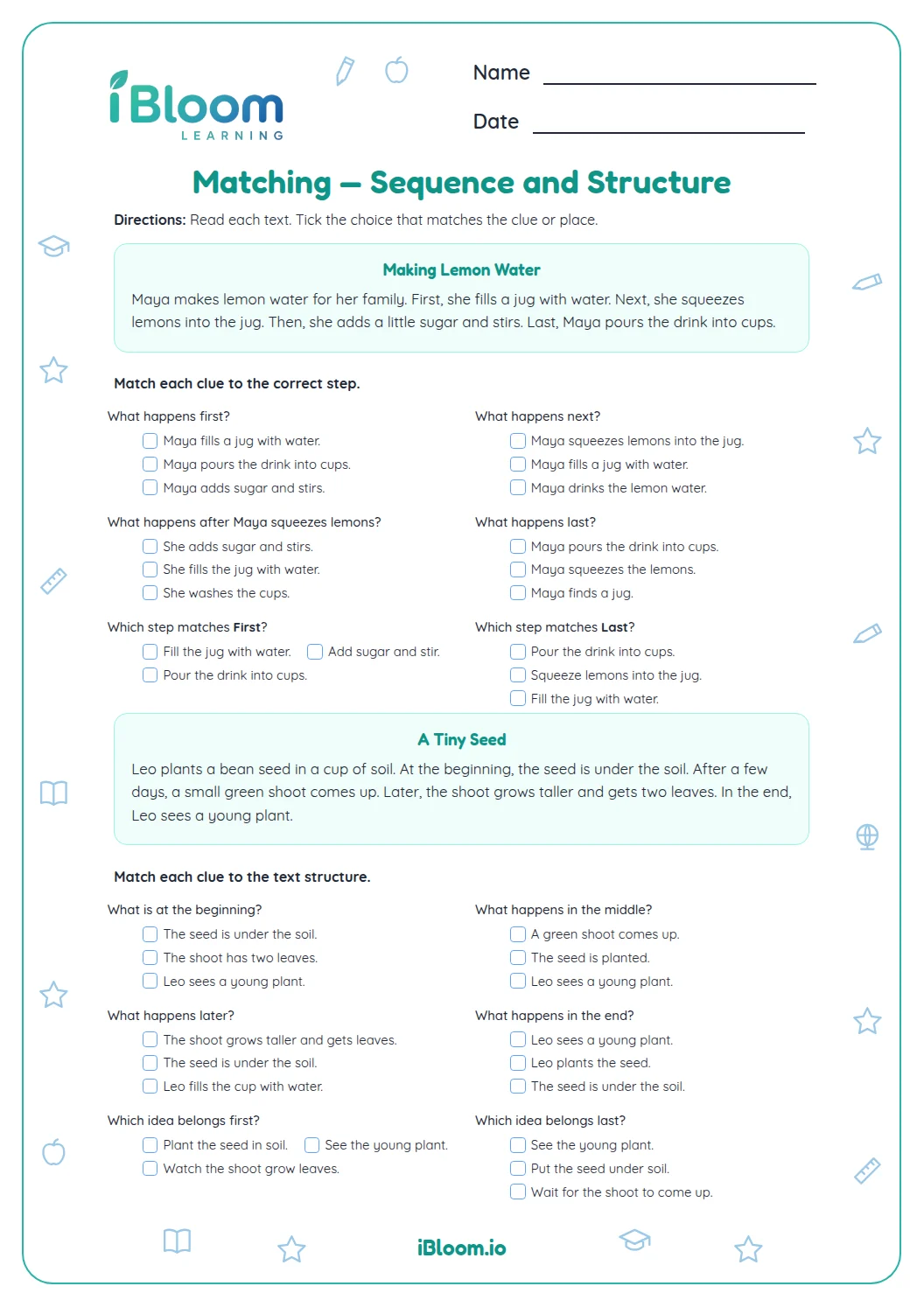
First, Next, Then, and At last mark points in the planting sequence. Children can look back at the passage to fill Part C. They use each word or phrase once, matching it to the action rather than guessing from the blank’s position.
- 1___, she makes a little hole.
- 2Mia puts soil in the pot first.
- 3Making a hole is the next marked action.
- 4Answer: Next
How do the questions connect fluency with meaning?
Part B asks children to locate actions in the sequence: putting soil in the pot, planting the seed, setting the pot by the window, and seeing a leaf. Returning to the sentence that supports a choice gives another purposeful reading.
Part D checks who acts and where the pot goes. A child who reads the phrases smoothly can still look back to answer. Ask the child to point to “Mia” or “by the window” as evidence.
Read, revisit, and check
- 1Read the title and talk briefly about planting a seed.
- 2Listen to the first oral reading and help with unfamiliar words.
- 3Reread the story, keeping short phrases together and pausing at periods.
- 4Complete Parts B and C with the passage available.
- 5Read each Part D sentence twice, then answer its question.
- 6Use the key to check written answers and listen once more to a tricky sentence.
Small changes that help reading
The mistake
Racing through the second reading and skipping small words.
The fix
Ask the child to track the words and keep every word, including “a” and “the.”
The mistake
Choosing an event that happens later instead of just after making the hole.
The fix
Find the hole sentence, then read the very next sentence.
The mistake
Saying the slash aloud or stopping too long at it.
The fix
Model each group, then join the groups in one natural sentence.
Common Core alignment
Reread the story and phrases aloud with accuracy and expression.
On this sheet: Children reread the story and short phrases aloud to build accuracy and smooth phrasing.
Show the official wordingHide the official wording
Read with sufficient accuracy and fluency to support comprehension.
Describe the order of events and how actions lead to what happens next.
On this sheet: Children identify the order of Mia’s actions and use story details to answer questions.
Show the official wordingHide the official wording
Describe characters, settings, and major events in a story, using key details.
What to practice next
Make more practice
Further reading
Questions parents and teachers ask
What is the story about?
The story follows Mia planting a seed in a small pot. She adds soil, makes a hole, plants the seed, waters it, and puts the pot by a window. Later she sees a green leaf. The short sequence gives children concrete events to revisit during reading.
Should children memorize the passage before answering?
No, children should keep the passage available while answering. Looking back helps them connect a choice to the exact event or phrase that supports it. For Part C, they can locate each action in the passage and copy the order word that begins that sentence.
What do the slashes in Part D mean?
The slashes mark groups of words to read together. Children read each group smoothly, then join the groups into a sentence without saying the slash. A brief grouping pause is fine. The period marks the sentence ending, where the voice can come to a natural stop.
Can an adult help with unfamiliar words?
Yes, an adult can supply a difficult word and invite the child to reread the whole phrase. Keep the child involved in both oral readings. After helping, ask what Mia did in that sentence so the word practice stays connected to the story’s meaning and sequence.
Does the key assess oral fluency?
The key checks the ten written responses, while an adult listens to the oral reading. Listen for accurate words, meaningful groups, and pauses at periods on the second reading. Use the phrase questions to check meaning, then reread a sentence together if its words still sound disconnected.