







About this worksheet
This free Grade 1 reading worksheet pairs phrase reading with a short original passage about Mia helping a frog in her garden. Children read phrases smoothly, locate details, sequence events, and write short responses supported by the text. The page includes 14 questions and an answer key. It supports CCSS RF.1.4 through accurate, purposeful reading and rereading.
Aligned to RF.1.4
How does phrase reading support fluency?
Readers group words that belong together instead of stopping after every word. Punctuation gives helpful places to pause.
Question 2, “outside after the rain stopped,” keeps the time phrase together. A reader can pause at the period at the end of the sentence.
How to use this worksheet
- 1Read the four practice phrases aloud once slowly.
- 2Read each phrase again, keeping words that belong together in a group.
- 3Read the story once for what happens.
- 4Return to the passage to find evidence for detail questions.
- 5Write a complete thought for the final questions.
Common mistakes and quick fixes
The mistake
Pausing after every word.
The fix
Sweep your voice across a group of words that make one idea.
The mistake
Guessing instead of checking the passage.
The fix
Point to the sentence that gives the answer.
The mistake
Ignoring punctuation.
The fix
Pause briefly at a period, question mark, or comma.
Common Core alignment
This worksheet gives focused practice with the standard below.
Read grade-level text with purpose, understanding, and appropriate fluency.
On this sheet: Children reread phrases and a short passage for accurate, meaningful reading and understanding.
Show the official wordingHide the official wording
Read with sufficient accuracy and fluency to support comprehension.
What to practice next
Make more practice
Further reading
Questions parents and teachers ask
What are fluency phrases?
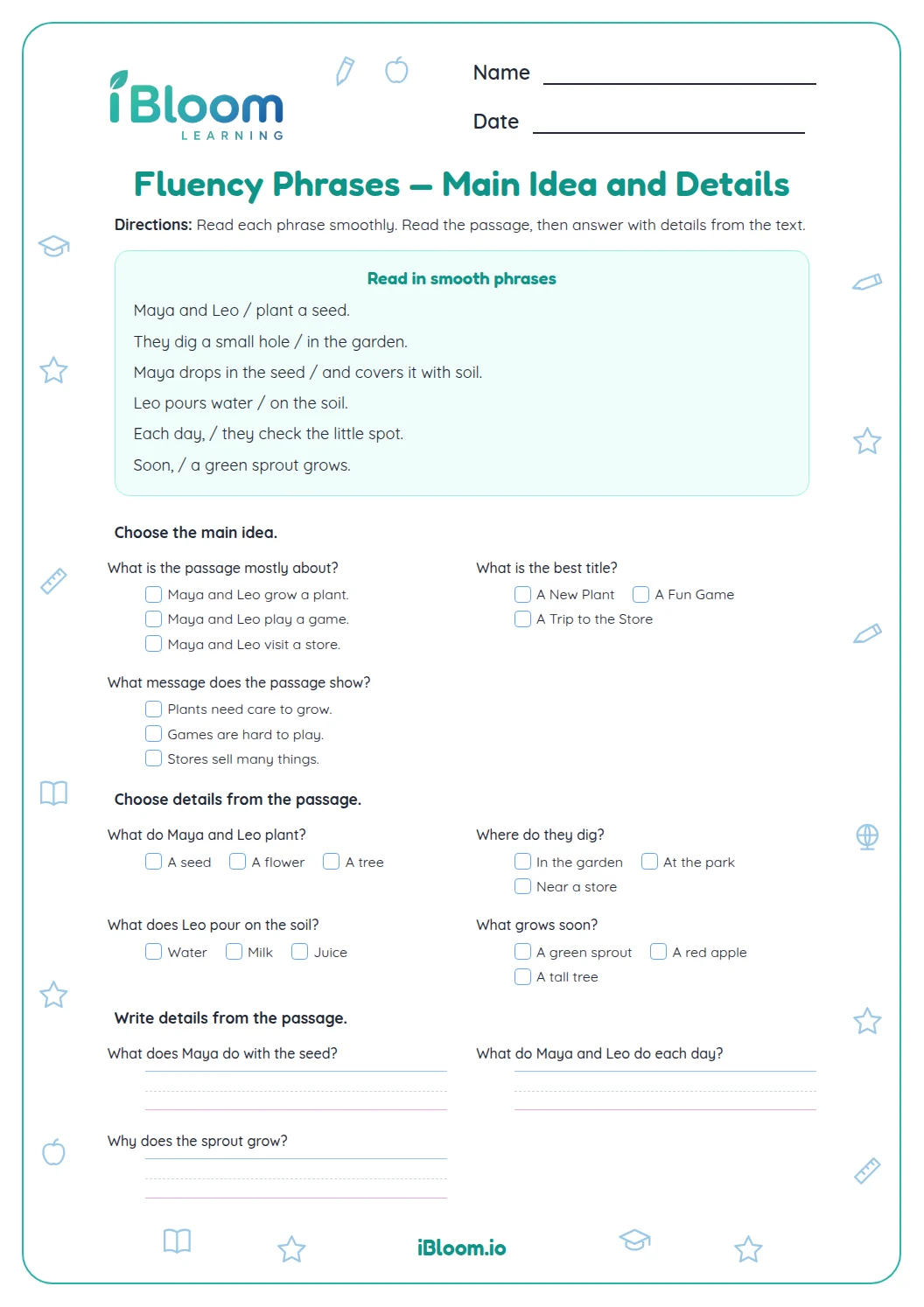
Fluency phrases are groups of words that belong together in a sentence. This sheet asks children to read four phrases from Mia’s garden story, then reread a short passage and answer questions. The phrases use the story’s own words so children can connect smooth reading with meaning.
How long is the passage?
The original passage about Mia and a frog is a short Grade 1 story. Children reread it to find details that support their answers. The phrase prompts are short groups of familiar words. Read them aloud more than once, aiming for a natural pause at the end.
Should children answer from memory?
Children can return to the passage and point to a detail that supports each answer. This connects accurate reading with understanding the story. For example, the passage says Mia moves the bucket so the frog can hop safely. That detail supports an answer about helping the frog.
Does the sheet include an answer key?
Yes. The key lists direct answers and sample responses. Answers to the prediction and personal response can vary when they fit the story. A prediction is not one fixed answer. A response should connect to something in the story, such as watering flowers or watching the frog.
Are the practice phrases taken from the story?
Yes. Each of the four phrases uses wording from the passage about Mia, her bucket, and the frog. Children can read a phrase aloud, then find it in the story. This lets them practice grouping words and notice how those words contribute to the events.