







About this worksheet
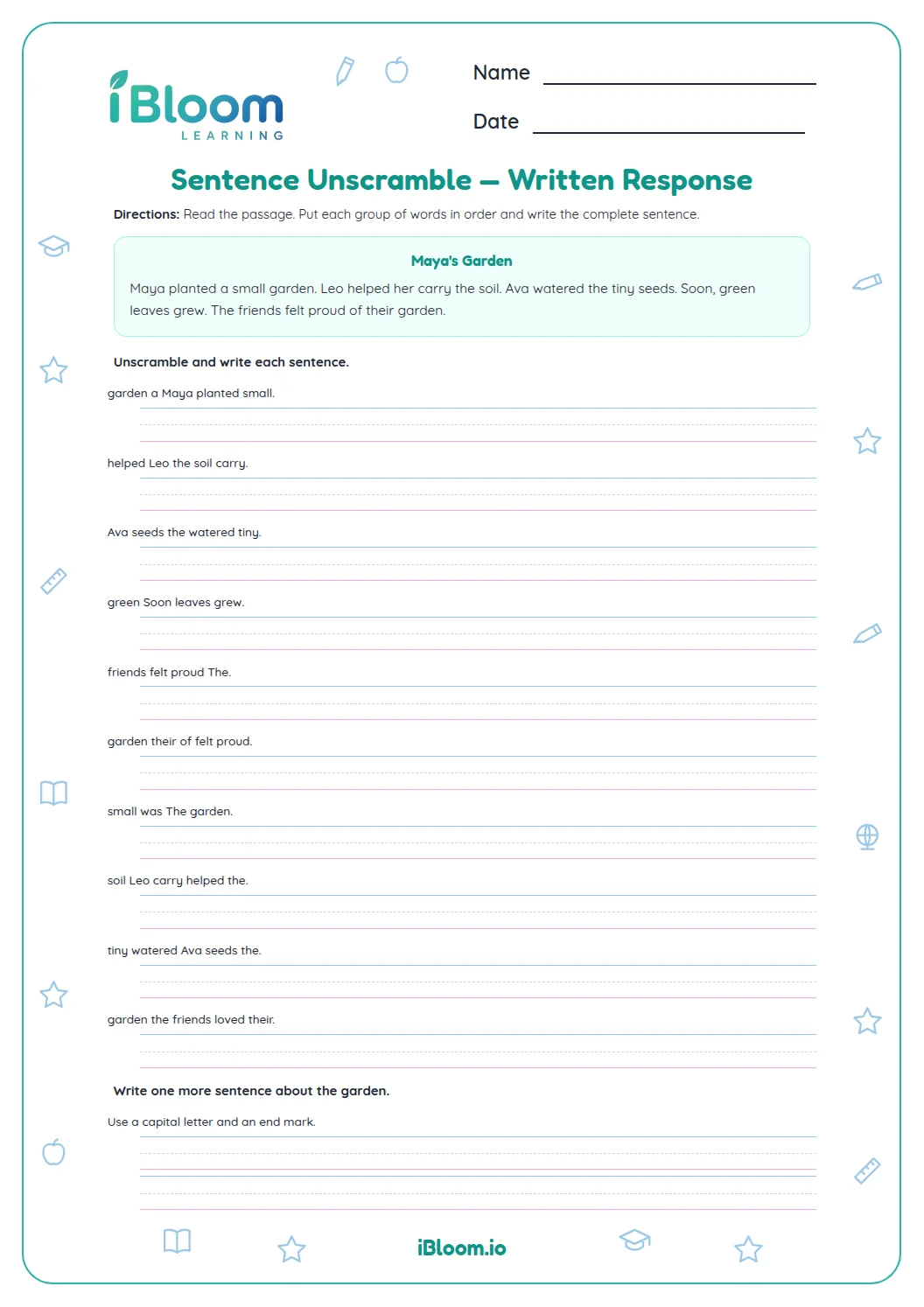
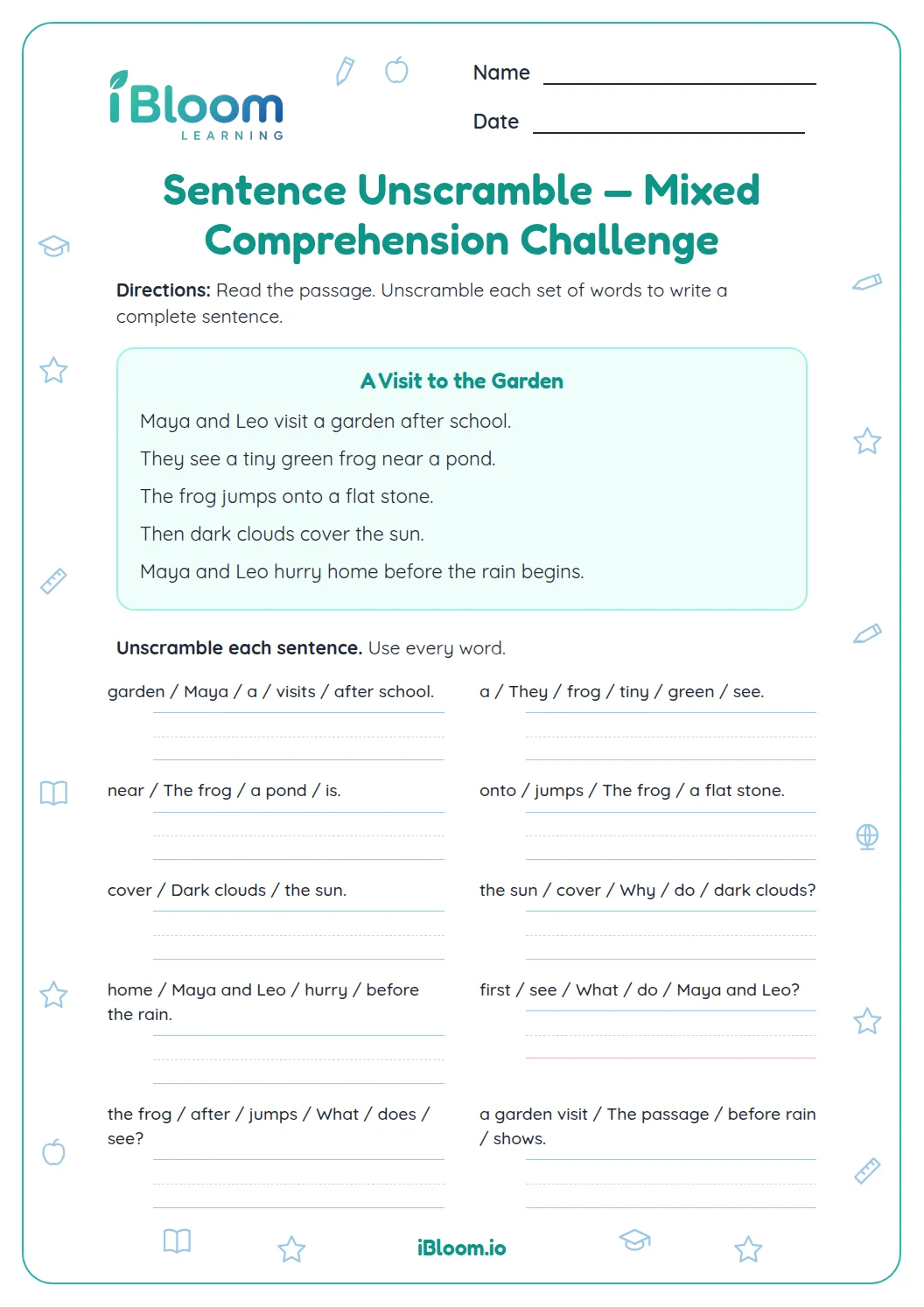
This free printable gives Grade 1 students 14 short word banks to put in a sensible order. The practice moves from simple statements to questions, exclamations, commands, and longer sentences with a time phrase. Children write each full sentence with a capital and the correct end mark. It practices producing complete sentence types in response to prompts, as described in Common Core L.1.1.j. A separate answer key gives one model for each bank.
Aligned to L.1.1.j
What is on the worksheet?
Fourteen word banks ask children to arrange every word into a complete sentence. The first part uses statements; later parts add questions, exclamations, commands, and a few longer phrases.
The answer key gives a model sentence for each bank. Children can compare word order, capitalization, and punctuation after writing.
- Questions 1–5: statements
- Questions 6–9: questions and an exclamation
- Questions 10–12: commands
- Questions 13–14: statements
How do you put a scrambled sentence in order?
Find who or what the sentence is about, then look for the action or the words that ask something. Put small words such as the, a, and can beside the words they belong with. Read the result aloud to check that it sounds complete.
- 1Word bank: is / your / book / where
- 2Ask the question aloud: “Where is your book?”
- 3Capitalize Where and use a question mark.
How do capitals and end marks help?
A capital marks the beginning of a sentence and the names of people or places. A period ends a telling sentence or a polite command. A question mark closes a question; an exclamation point can show strong feeling or an energetic command.
Question 9 starts with What and expresses excitement, so it needs an exclamation point. A question that asks for information, such as question 7, ends with a question mark.
How can an adult support this practice?
Ask the child to read the scrambled words first and point out any word that signals a question, such as where or why. Have them build the sentence aloud before writing it. If two word orders seem possible, read both and check whether each keeps all the words and makes a complete thought.
How to work through the page set
- 1Read the direction under each part before starting.
- 2Say the word bank aloud without changing or skipping a word.
- 3Look for the person, place, thing, or question word that can begin the sentence.
- 4Arrange the remaining words and read the whole sentence aloud.
- 5Write a capital at the beginning and choose the end mark that matches the sentence.
- 6Use the key to check the order and punctuation.
Common sentence-order slips
The mistake
Leaving a small word such as the or can out of the sentence.
The fix
Touch each word in the bank once as it is copied, then reread and compare.
The mistake
Writing a question as a statement because it ends with a period.
The fix
Check for question words like where or why, then use a question mark.
The mistake
Capitalizing every word in the sentence.
The fix
Use one capital at the beginning, plus capitals for names when they appear.
Common Core alignment
This sentence-building practice connects word order and sentence types with Grade 1 language conventions.
Build complete sentence types from word prompts, including statements, questions, and commands.
On this sheet: Children arrange prompted words into complete declarative, interrogative, imperative, and exclamatory sentences.
Show the official wordingHide the official wording
Produce and expand complete simple and compound declarative, interrogative, imperative, and exclamatory sentences in response to prompts.
What to practice next
Make more practice
Further reading
Questions parents and teachers ask
How many questions are on this sentence worksheet?
There are 14 word banks on the worksheet, plus a separate answer key. The first five build statements, the next five mix questions and exclamations, and the final four practice commands and longer sentences. Each answer is a complete sentence with capitalization and ending punctuation.
Should my child rearrange every word?
Yes. Each word in a bank belongs in the answer, and the child should not add or leave out words. Reading the bank aloud and touching each word while copying helps track the whole set. Then reread the finished sentence to check that it says a complete thought.
How can I tell if the sentence needs a question mark?
Look at what the sentence is doing. A question asks for information, often with words such as where or why, and ends with a question mark. An exclamation expresses strong feeling or emphasis. A telling sentence or a calm command usually ends with a period.
Why are some word banks longer than others?
Short banks let students focus on basic order, while longer ones add a describing word, a time phrase, or another detail. The child still uses each word once and writes one complete thought. This gradual increase lets the same routine work through both pages.
What can we do if two word orders sound possible?
Have the child read both versions aloud and check whether each one is grammatical, uses every word, and matches the intended question or statement. The key shows a model order. If another order is also complete and natural, accept it when the meaning and punctuation still fit.