
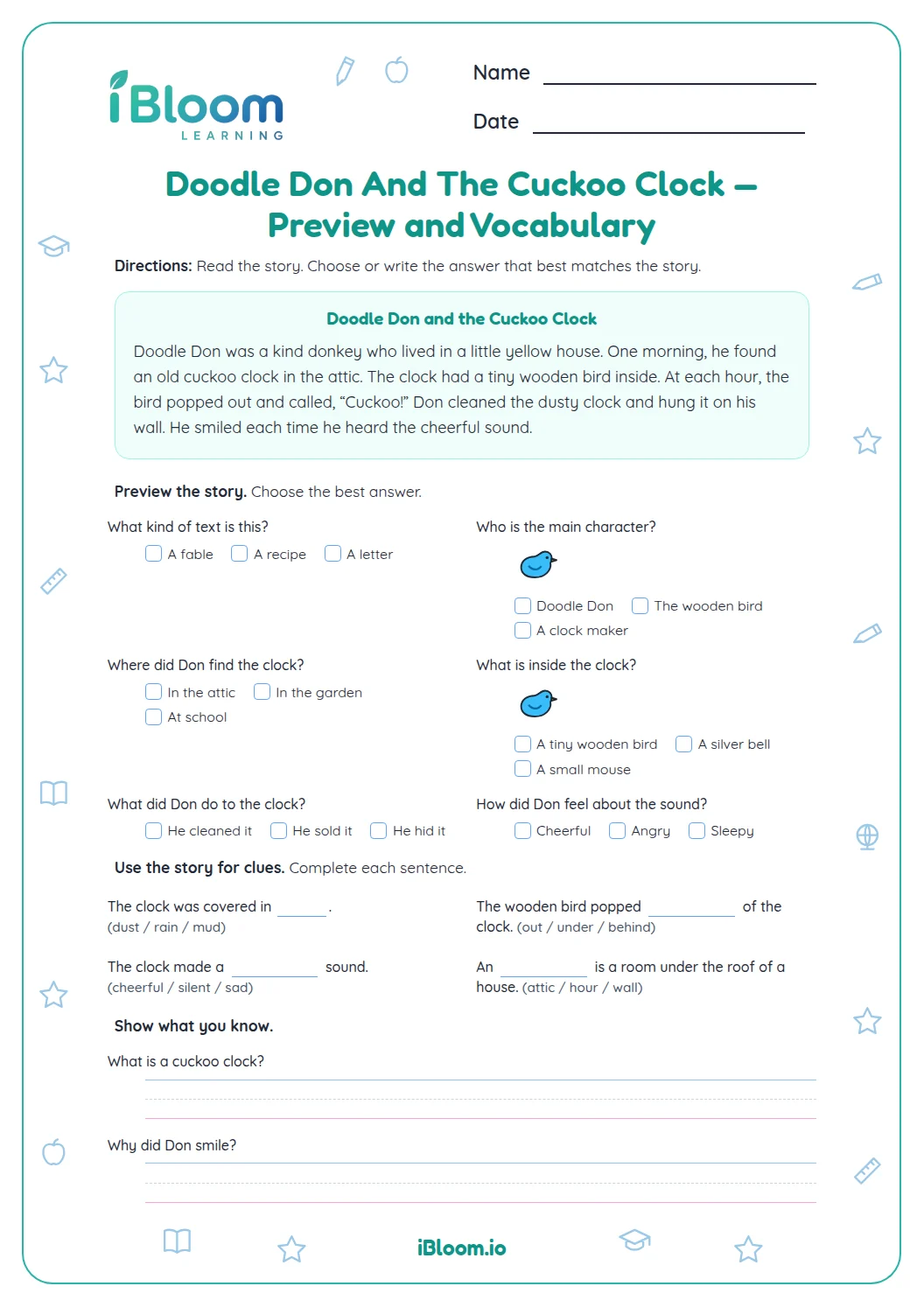
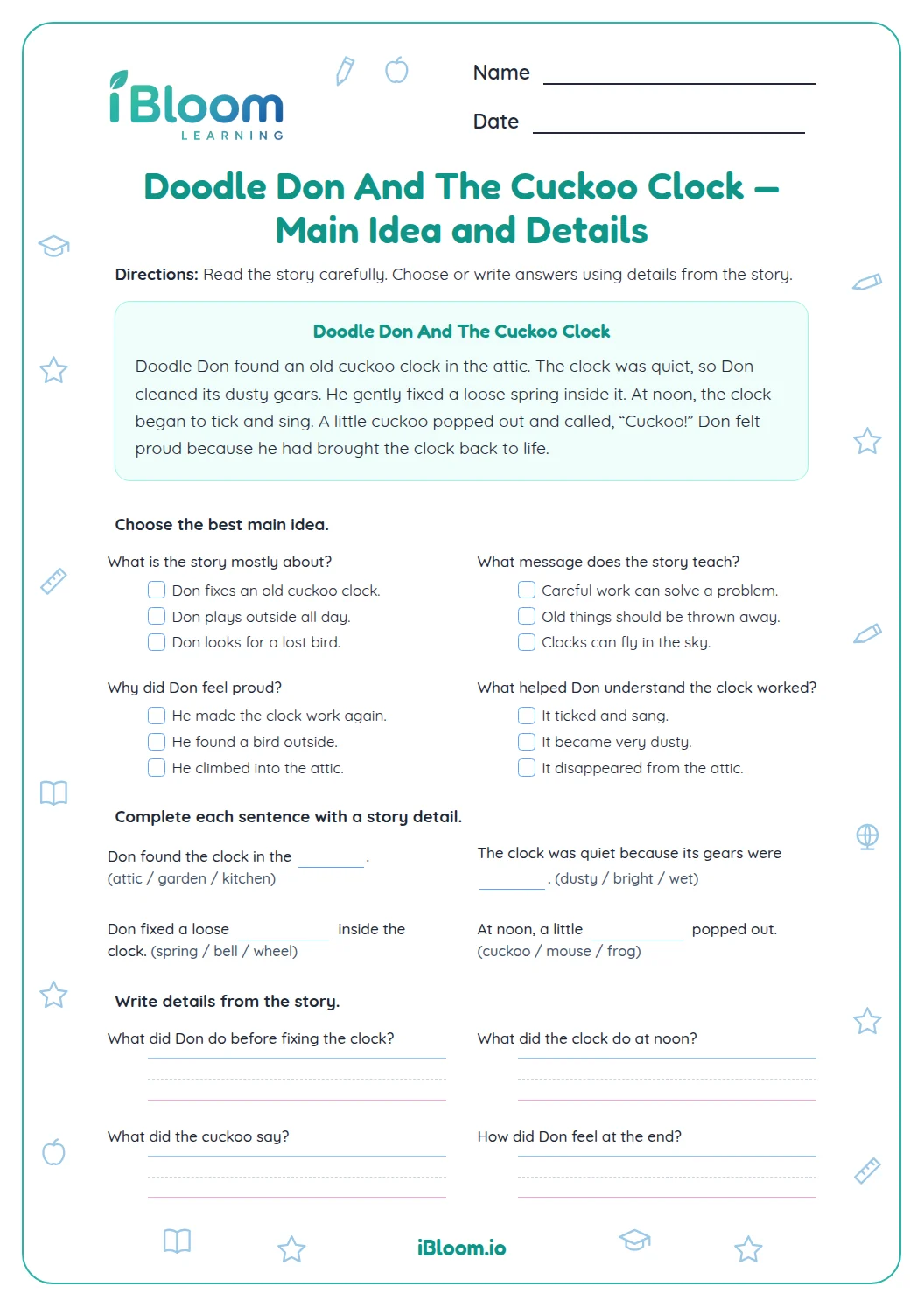
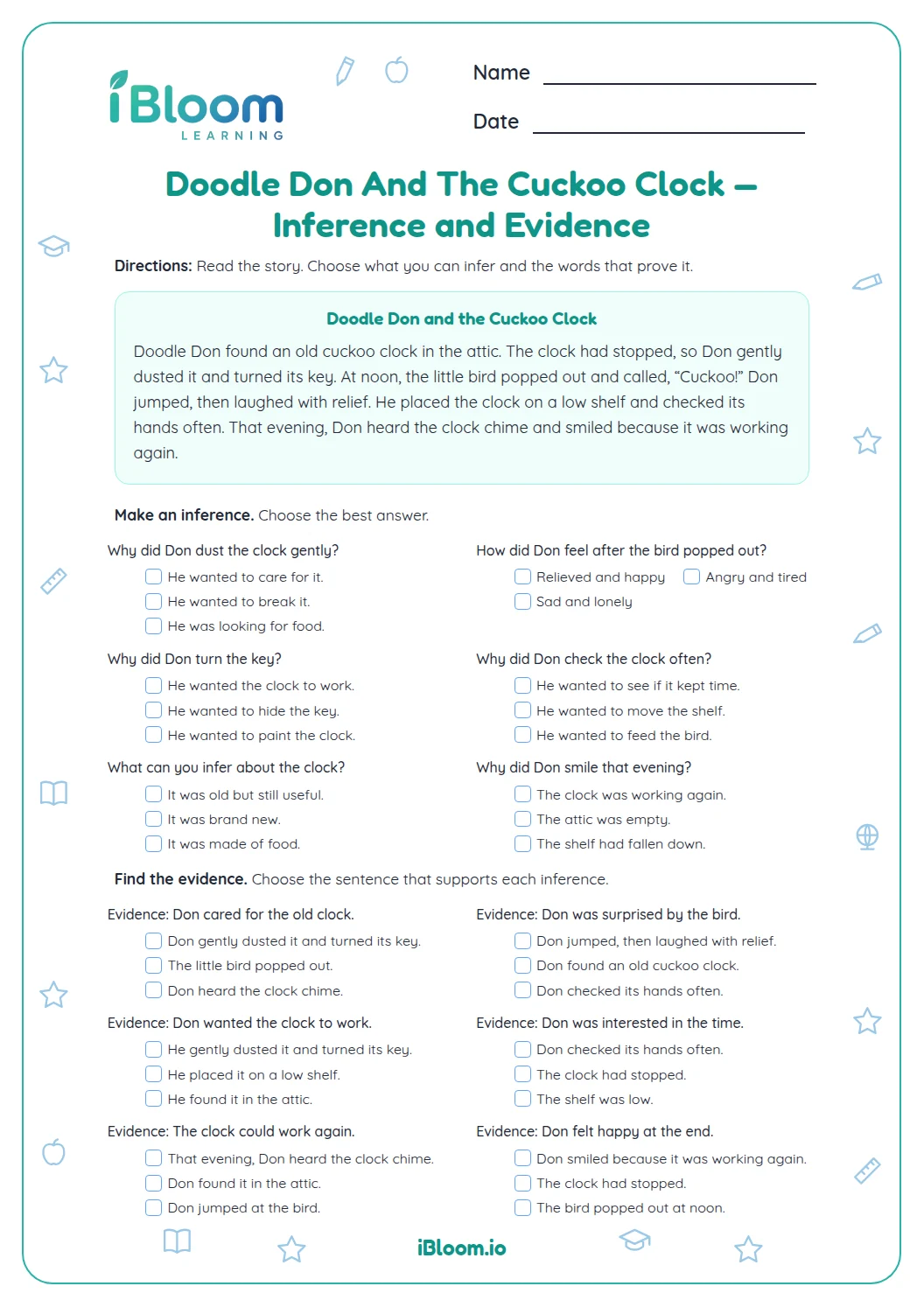
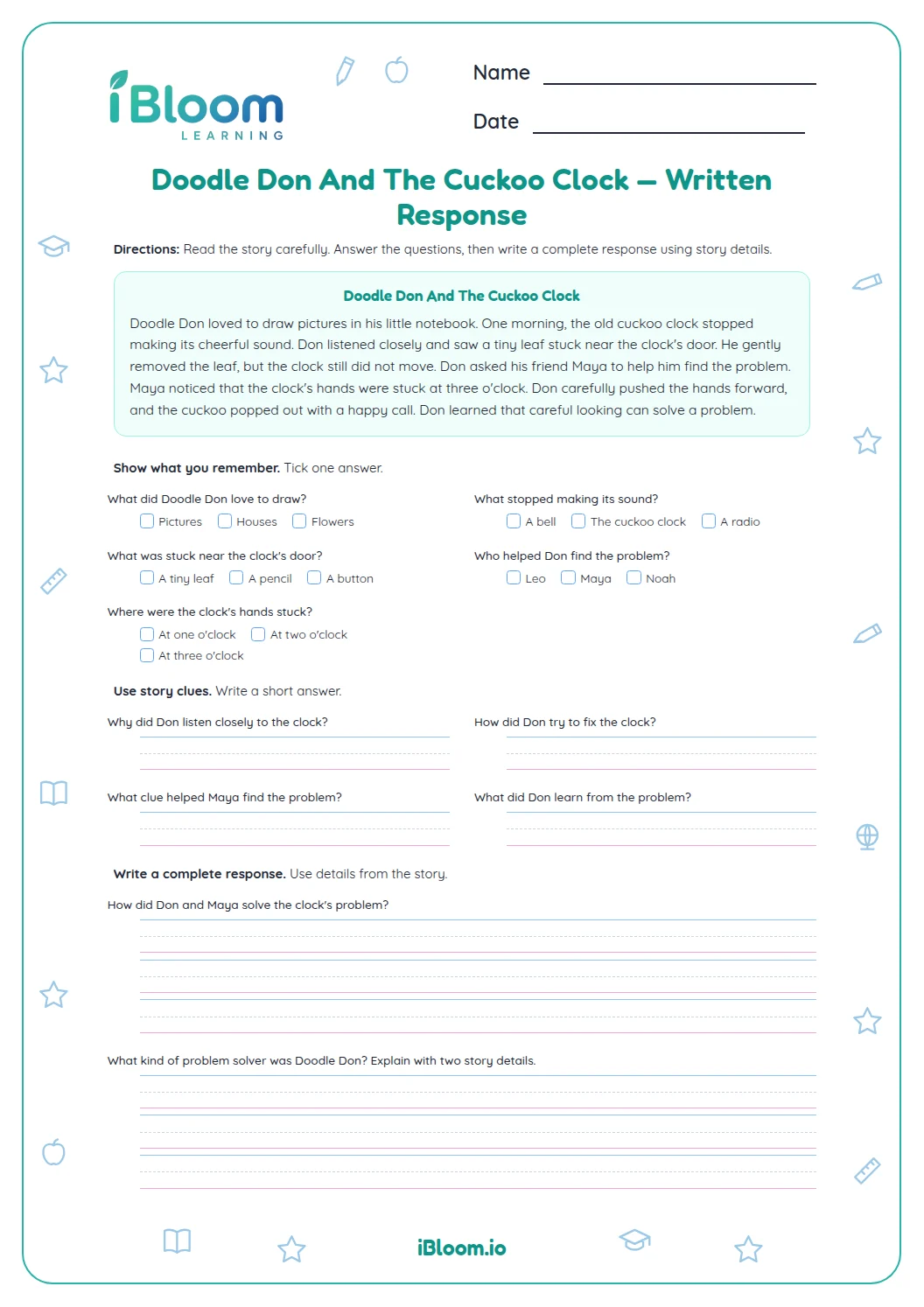


About this worksheet
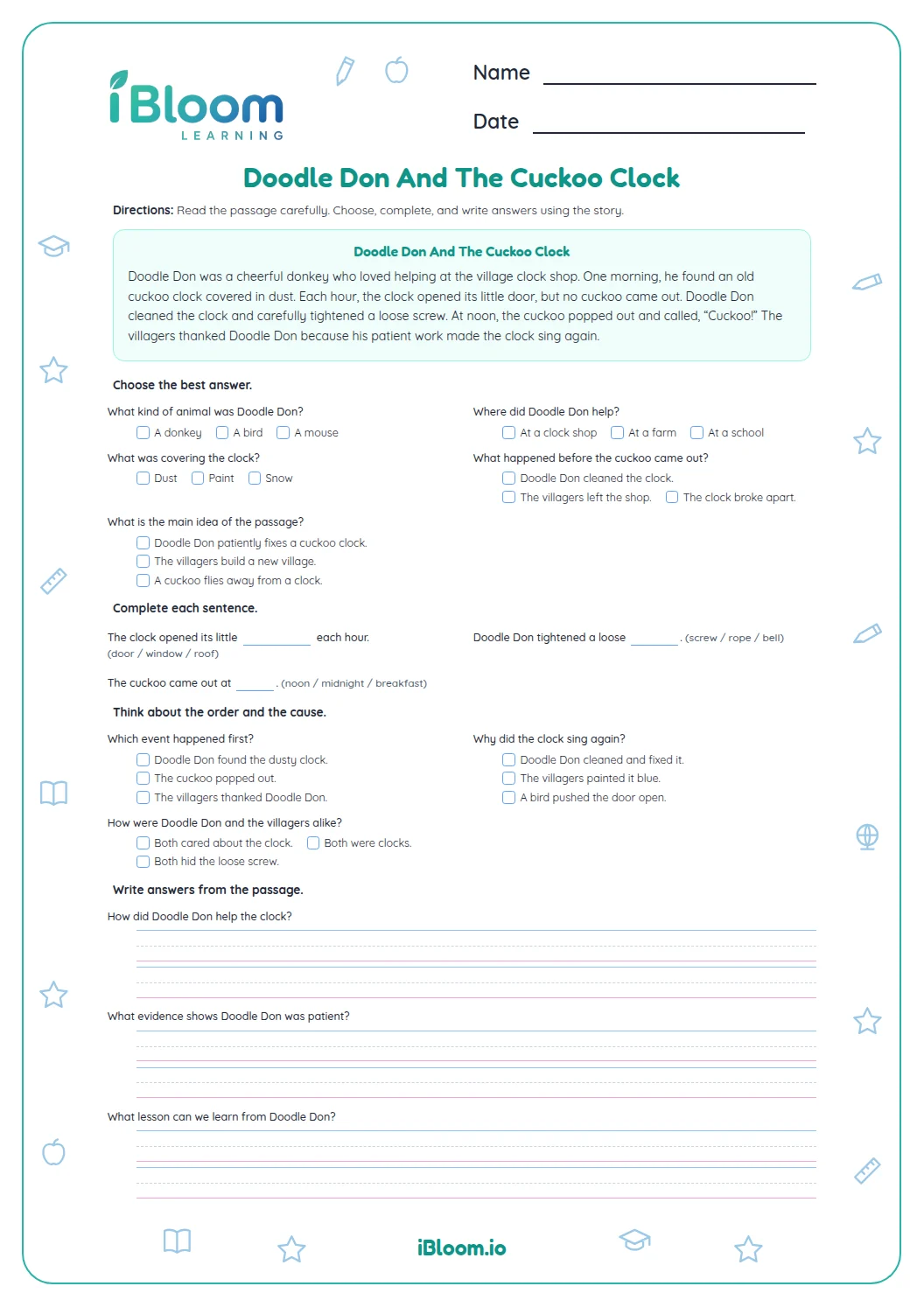
This Grade 1 printable pairs a 76-word Doodle Don story with 14 questions about its details, event order, problem, and lesson. Children follow how the cuckoo clock stays quiet, find out what blocks it, and see what changes after Don removes the feather. The questions move from locating details to retelling and explaining the story.
Aligned to RL.1.1 and RL.1.2
Which details explain the clock problem?
Part B asks readers to find what Don finds, what he tries, and what keeps the clock from calling. Each answer comes directly from the passage.
How do the clock events unfold?
Part C follows the story from Don’s first action to the cuckoo’s final call. Readers use the time words and actions in the passage to place events.
- 1At noon, the clock stays quiet.
- 2Next, Don checks inside and finds the feather.
- 3Finally, the clock calls “Cuckoo!”
What does the ending show?
The last two questions ask children to connect Don’s search with the clock’s change. A good answer points to a detail, such as the clock staying quiet before Don checks inside.
How to use this worksheet
- 1Read the whole story once.
- 2Reread the sentence that matches each detail question.
- 3Use first, next, and finally to track the events.
- 4Check that each answer matches what Don actually does.
- 5For the last two questions, include a story clue in your explanation.
Common mistakes and quick fixes
The mistake
Mixing up the first and last event.
The fix
Retell the actions in the order they appear, using first, next, and finally.
The mistake
Saying the clock worked before Don removed the feather.
The fix
Reread the passage from the quiet noon moment to the final call.
The mistake
Giving a lesson that does not connect to the story.
The fix
Name an idea shown by Don’s careful search for the cause of the problem.
Common Core alignment
The questions ask children to answer from key story details and retell events in order, including the story’s lesson.
Answer questions about Don’s actions and the clock using details stated in the story.
On this sheet: The worksheet questions practice this skill directly.
Show the official wordingHide the official wording
Ask and answer questions about key details in a text.
Retell the clock story’s key events and explain a lesson supported by its ending.
On this sheet: The worksheet questions practice this skill directly.
Show the official wordingHide the official wording
Retell stories, including key details, and demonstrate understanding of their central message or lesson.
What to practice next
Make more practice
Further reading
Questions parents and teachers ask
What is the sequence in Doodle Don’s story?
Don finds and dusts the clock, sets its hands, and winds it. When it stays quiet at noon, he checks inside, removes a feather, and hears it call “Cuckoo!” at the end. The passage gives the clues needed to check each response after the reader finishes the questions.
How many questions are on the worksheet?
There are 14 questions after the passage. They cover details, the order of events, a clue about the clock problem, and two short written responses. The passage gives the clues needed to check each response after the reader finishes the questions.
What should a child use to answer the last questions?
The final questions ask why Don checked the clock and what lesson the story may teach. Children can point to the quiet clock and the feather as evidence for their ideas. The passage gives the clues needed to check each response after the reader finishes the questions.
How long is the passage?
The original story is 76 words long. It is about a clock that stays quiet at noon until Don finds and removes a feather near its bell. The passage gives the clues needed to check each response after the reader finishes the questions.
What does the answer key include?
The key gives answers for the detail and multiple-choice questions and sample responses for the two written questions. A child’s wording can differ if the answer is supported by the story. The passage gives the clues needed to check each response after the reader finishes the questions.