





About this worksheet
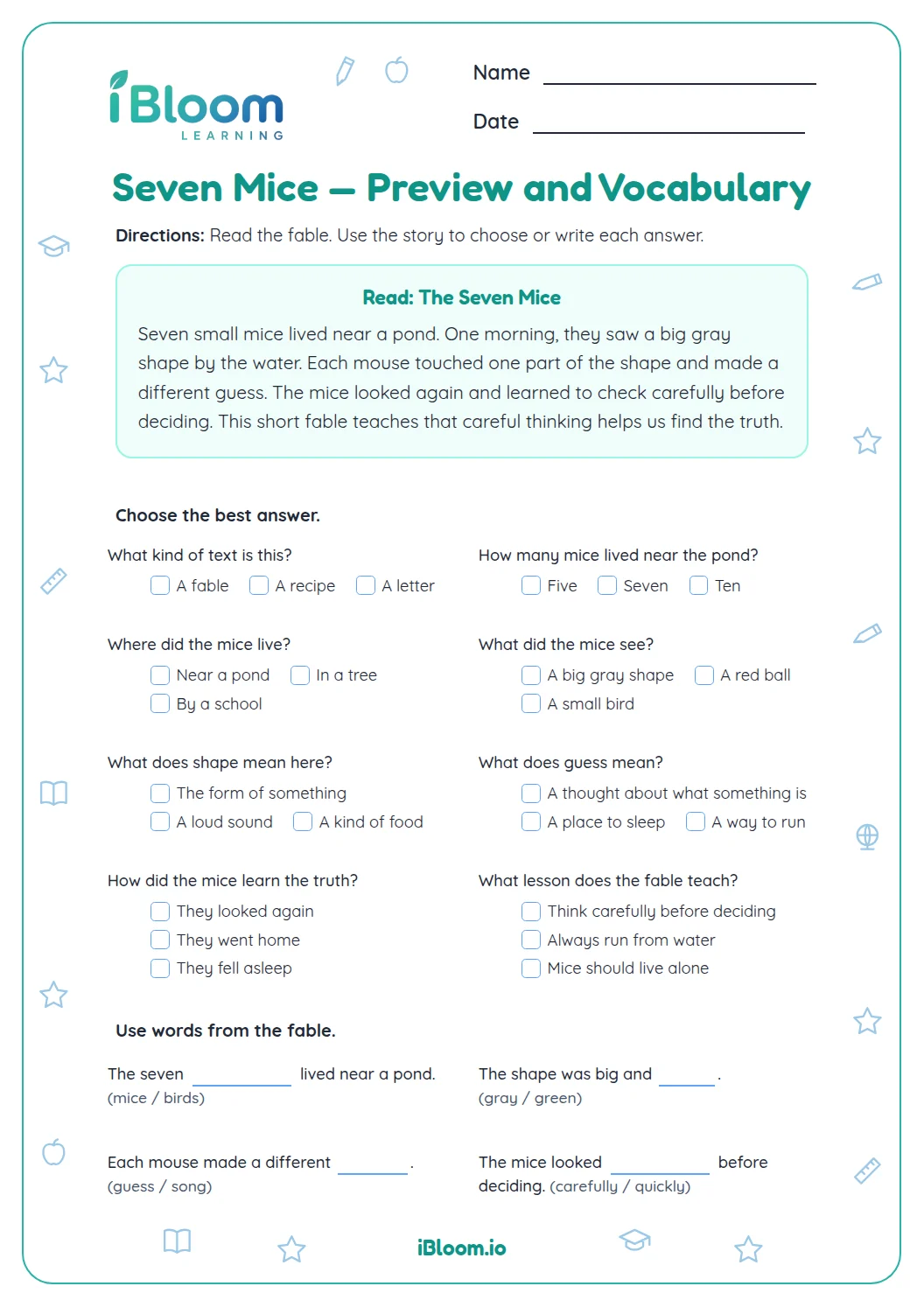
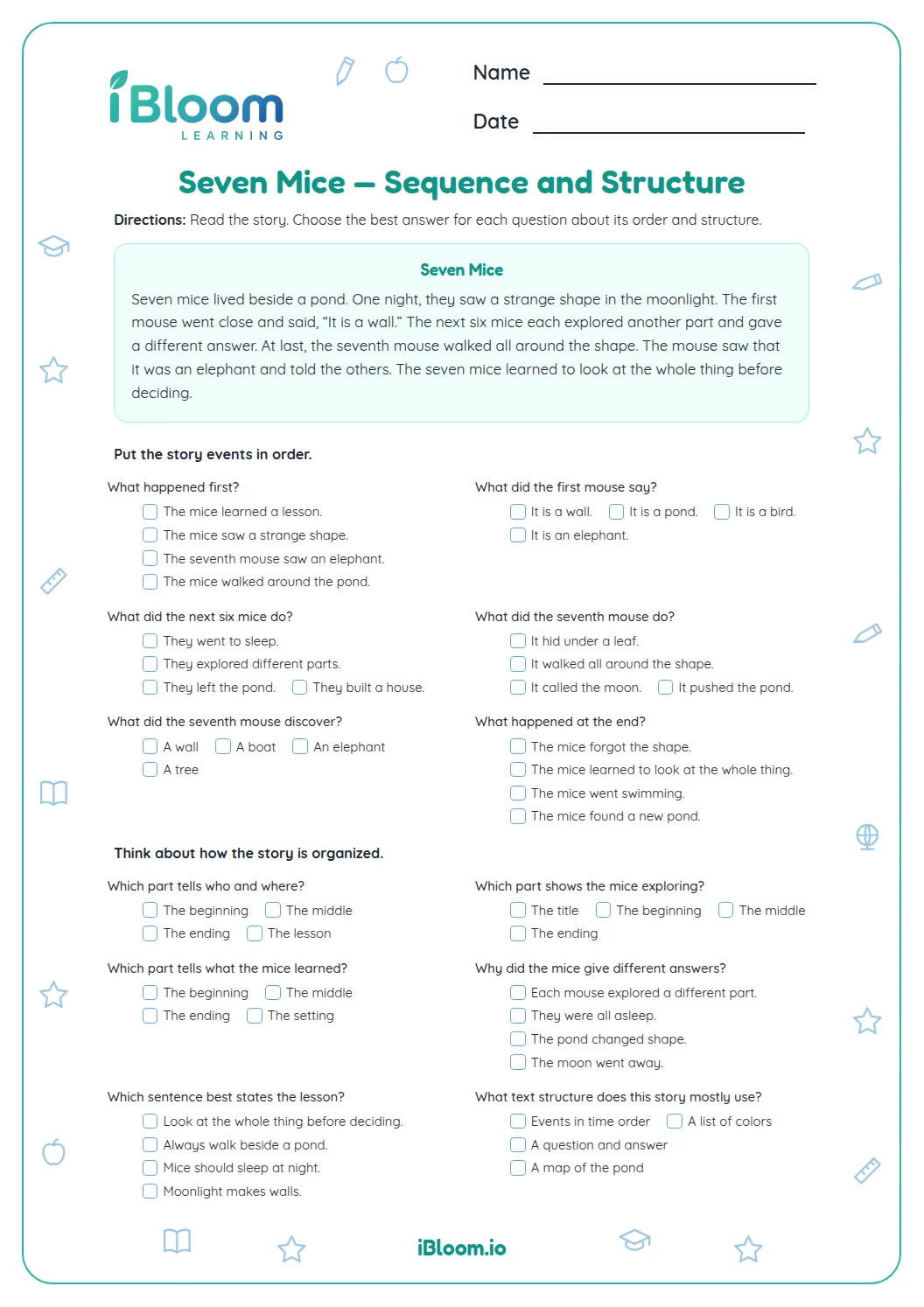
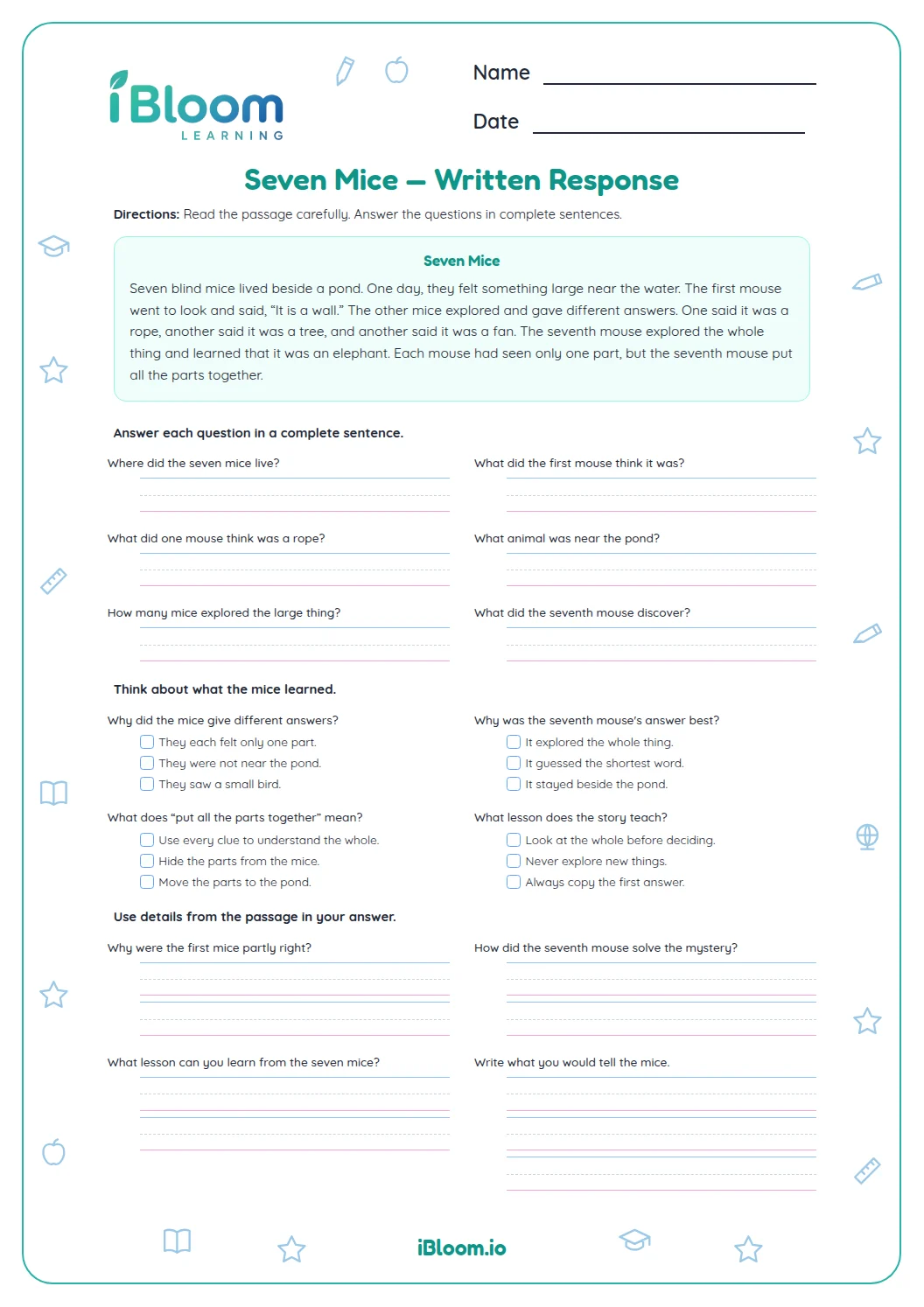
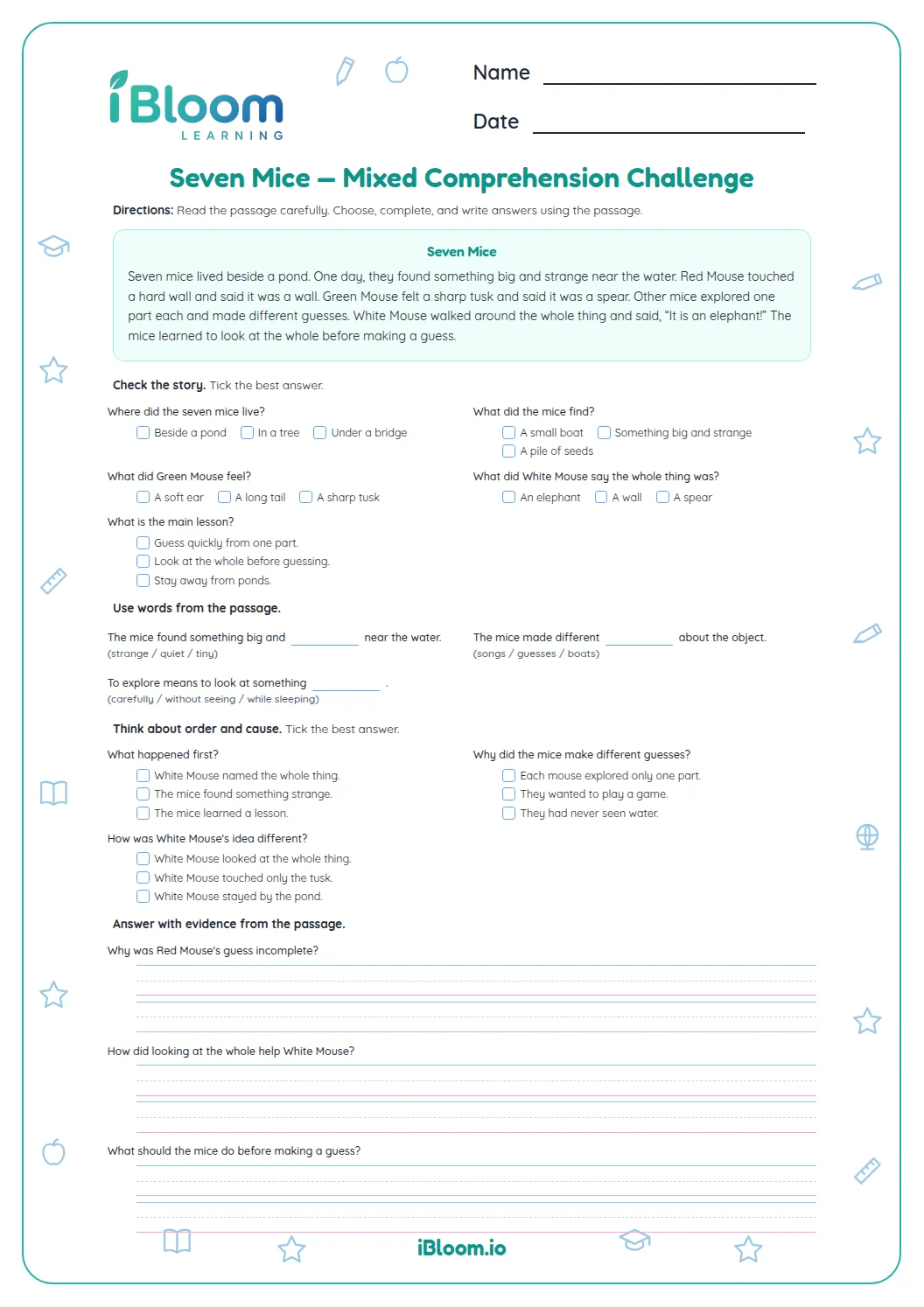
This printable Grade 1 worksheet features Seven Mice, a short fable about a cat, a wall hole, and a careful escape. Students answer 14 questions about what the mice do, infer why they make a plan, and identify details that support their thinking. The answer key gives selected answers and sample responses. Questions about key details connect to CCSS.ELA-Literacy.RL.1.1.
Aligned to CCSS.ELA-Literacy.RL.1.1
What is the mice’s problem?
Seven mice share a small house until a cat waits by their door. They whisper a plan to leave through a small hole in the wall. The mice wait for the cat to turn away, then escape together. The ending gives readers clues about why their plan works.
How do students use story clues?
Questions 1–11 ask about details and simple inferences. Questions 12–14 invite students to point to evidence, describe how the mice help one another, and predict what could happen if the cat saw them.
- Find the sentence that tells what happened.
- Use the clue to explain an idea that the story suggests.
What makes an answer evidence-based?
A good answer names a detail the story gives, rather than adding an unrelated guess.
- 1Which detail shows the mice waited for a safe moment? → They waited until the cat turned away.
How to use this worksheet
- 1Read the fable and notice what the cat does.
- 2Read each question and find its story clue.
- 3Answer detail questions with what the text says.
- 4Use a clue to support an inference.
- 5Write a short response for the final questions.
- 6Check your work with the answer key.
Mistakes to watch for
The mistake
Treating a guess as an inference.
The fix
Connect the idea to a detail the passage gives.
The mistake
Confusing where the cat sat with where the mice lived.
The fix
Reread the sentence that describes each place.
The mistake
Repeating the question without giving evidence.
The fix
Add the story action that explains the answer.
Curriculum alignment
Students answer questions about the mice’s actions and use passage details as clues.
Students answer questions about the mice’s actions and support ideas with story details.
On this sheet:
Show the official wordingHide the official wording
Ask and answer questions about key details in a text.
What to practice next
Further reading
Questions parents and teachers ask
What can students infer from the Seven Mice story?
Students can infer that the mice plan carefully because they wait until the cat looks away before leaving. The story does not state every thought the mice have, so readers use their actions as clues. Several worksheet questions practice that link between a detail and an idea.
How many questions are on the worksheet?
The worksheet has 14 questions. Most are multiple choice and focus on the mice’s actions, the cat, and the escape plan. Three questions ask students to give a detail or explain an idea in their own words. The answer key includes sample responses for those items.
What is the evidence for the mice’s plan?
The passage says the mice whisper a plan to slip through a small hole, then wait until the cat turns away. Those details support the idea that they are careful. Students can point to either detail when a question asks how the mice planned their escape.
Can a first grader complete the page independently?
A student who can read the passage and directions may try the questions independently. An adult can read the story aloud or help the child return to a sentence for evidence. The short answer key makes it easy to review each response after the first attempt.
What does the fable suggest about teamwork?
The mice escape safely by planning and moving together. The lesson question asks students to connect the ending to the events in the story. Encourage the child to mention what the mice did, not only say that teamwork is helpful.