


About this worksheet
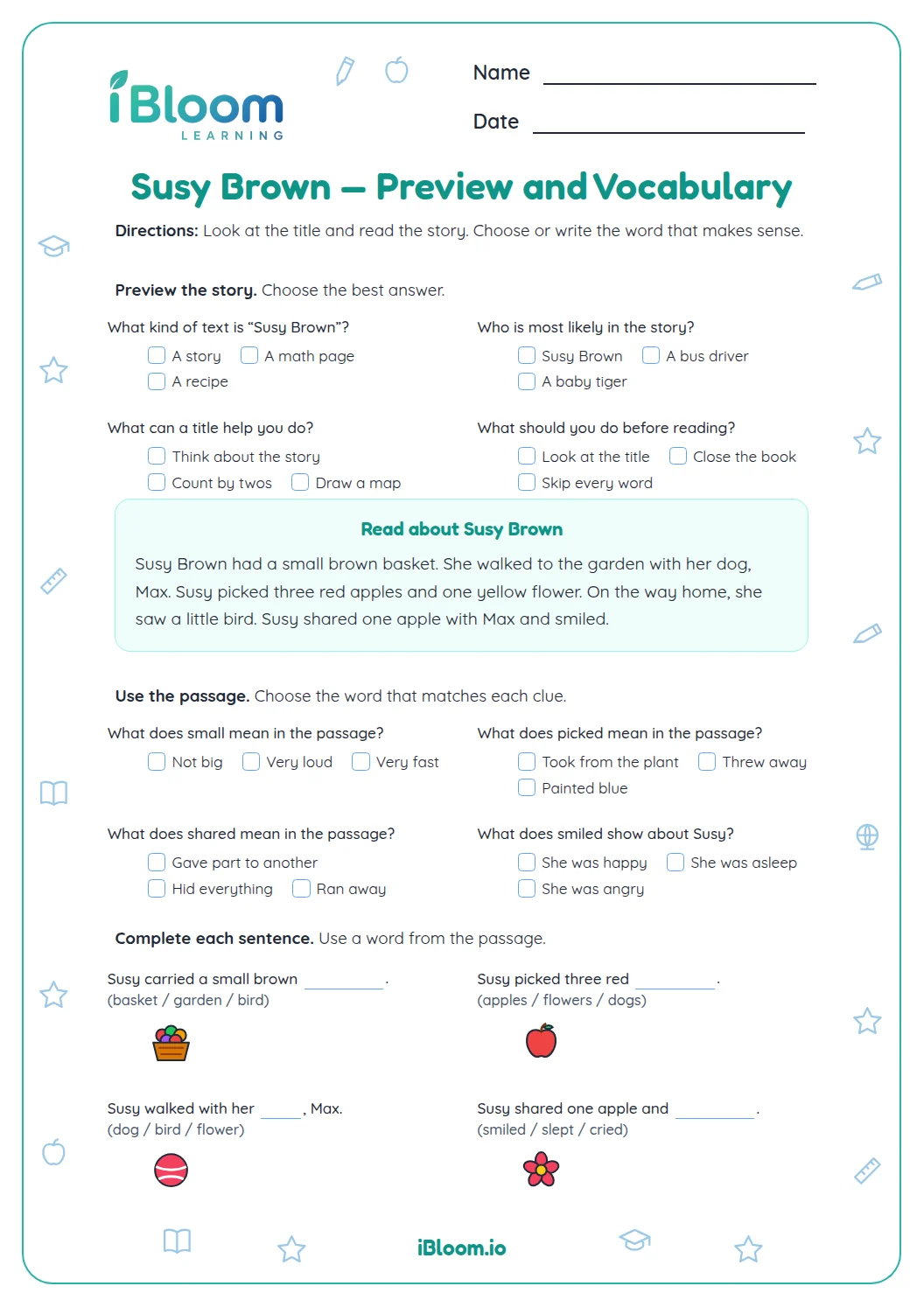
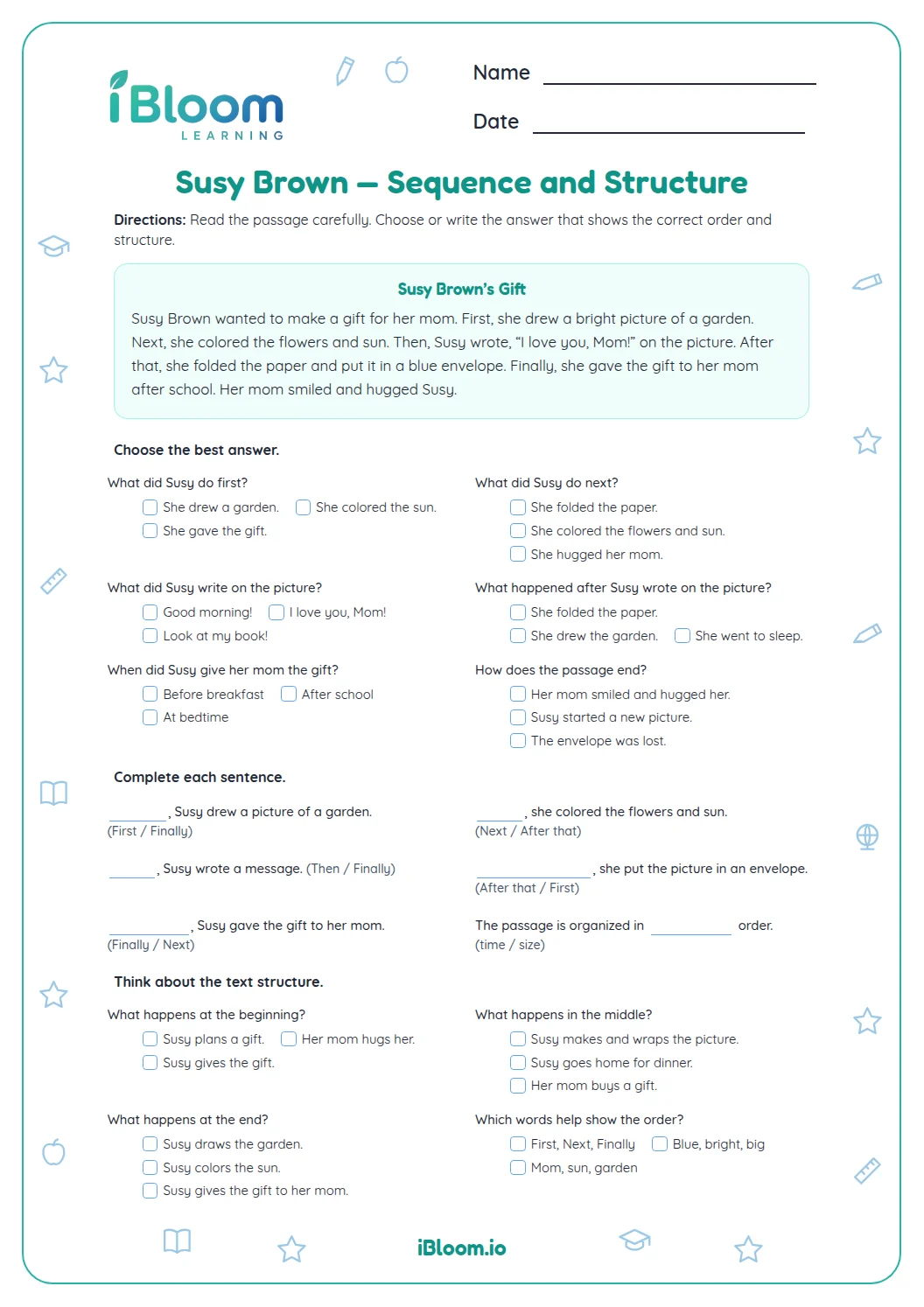
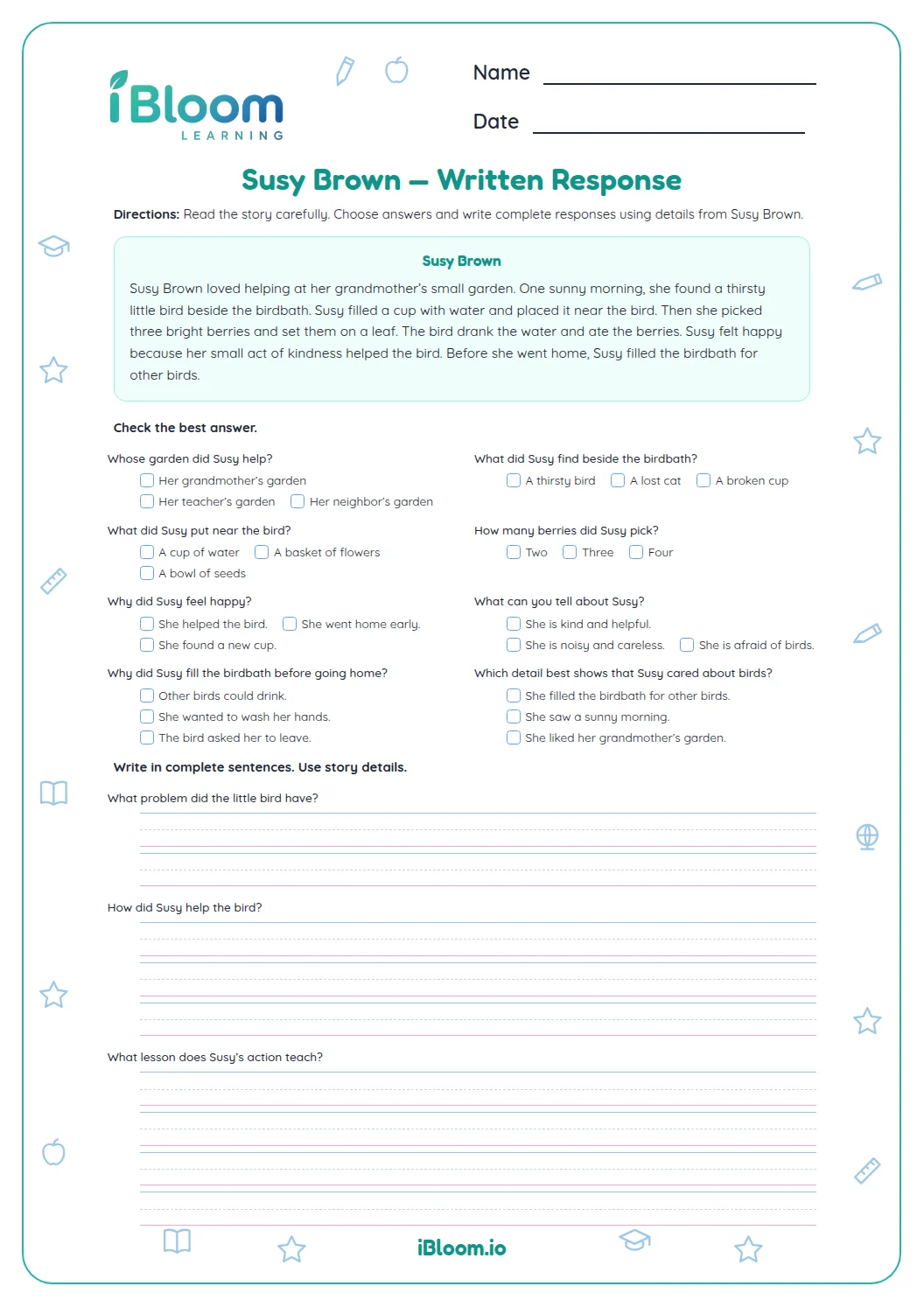
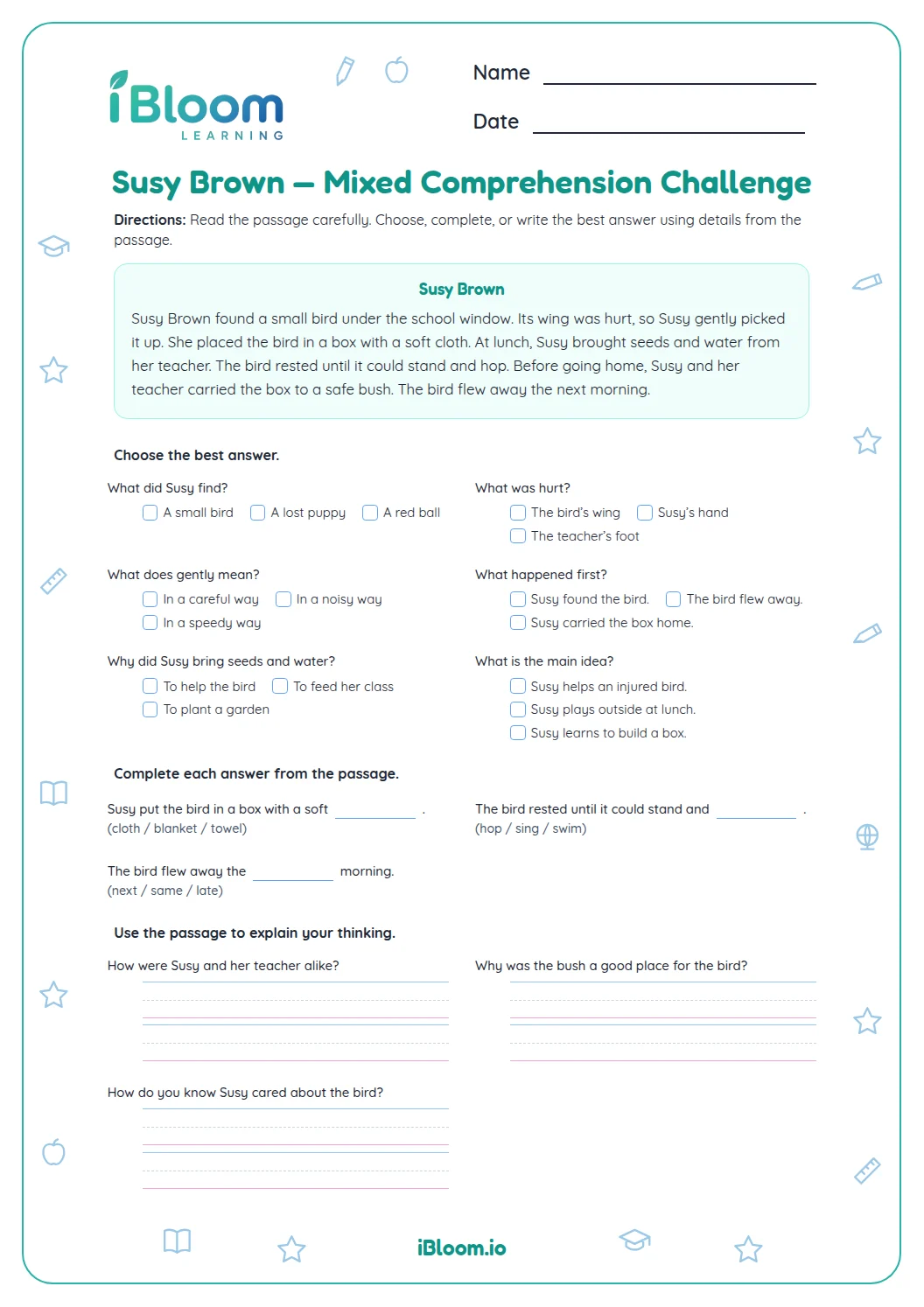
This Grade 1 printable pairs a short story passage about Susy Brown with questions on main idea and details. Students select answers to key-detail questions, then write short responses using information from the text. The passage and questions are designed around one clear topic so young readers can practice telling what the text is mostly about and recalling supporting details. An answer key includes correct choices and sample responses. It practices Common Core RI.1.2.
Aligned to CCSS RI.1.2
How can a reader find the main idea?
Read the whole passage and ask what most of its sentences have in common. The answer should cover the passage as a whole, not just name one event or object.
- 1Susy sees a hurt bird.
- 2She moves it to a safe box and gives it water.
- 3Her mom helps care for it each day.
- 4Main idea: Susy and her mom help the hurt bird.
Which details support the main idea?
A useful detail is stated in the passage and helps explain its topic. Reread the sentence around the detail instead of guessing from what might happen in real life.
How should students answer the written questions?
Use a short phrase or sentence that matches the text. Answers can vary when students explain the main idea in their own words; the key gives a sample response.
How to use this worksheet
- 1Read the title and passage once.
- 2Think about what most sentences are about.
- 3Reread the sentence that holds a needed detail.
- 4Choose the option supported by the text.
- 5Use a short text-based response for written questions.
Common mistakes and quick fixes
The mistake
Choosing a detail as the main idea.
The fix
Ask which answer covers the whole passage.
The mistake
Adding something not in the passage.
The fix
Point to the sentence that supports the response.
The mistake
Copying an unrelated sentence.
The fix
Check that the detail explains the main topic.
This worksheet practices CCSS RI.1.2.
Identify the passage topic and retell details that support it.
On this sheet:
Show the official wordingHide the official wording
Identify the main topic and retell key details of a text.
What to practice next
Make more practice
Further reading
Questions parents and teachers ask
What is the difference between a main idea and a detail?
The main idea tells what the whole passage is mostly about. A detail gives one piece of information that helps explain it, such as what Susy gave the bird or how she moved the bird to safety. For example, Susy watering the bird is a detail that supports the idea that she cared for it.
Can I read the passage aloud?
Yes. An adult may read the passage and choices aloud while the child listens and points to text details. This keeps the focus on understanding the passage and answering from its information. An adult can pause after a sentence and ask the child to point to a matching detail.
Do written answers need to match the key word for word?
No. Some written questions allow more than one clear answer. A response should match a detail in the passage; the answer key offers a sample for questions where wording can vary. The key accepts clear responses that match the story rather than requiring identical phrasing.
How can a child check a multiple-choice answer?
Reread the relevant line and see whether it supports the choice. The best answer should fit the passage rather than a guess based on what usually happens. Use the story itself to confirm each response. The passage is available on the printed worksheet for quick reference.
Is there an answer key?
Yes. The separate key lists each selected response and gives sample wording for open responses, so a teacher or caregiver can check the work. Sample responses help adults check meaning while allowing children to use their own words. The passage is available on the printed worksheet for quick reference.