
About this worksheet
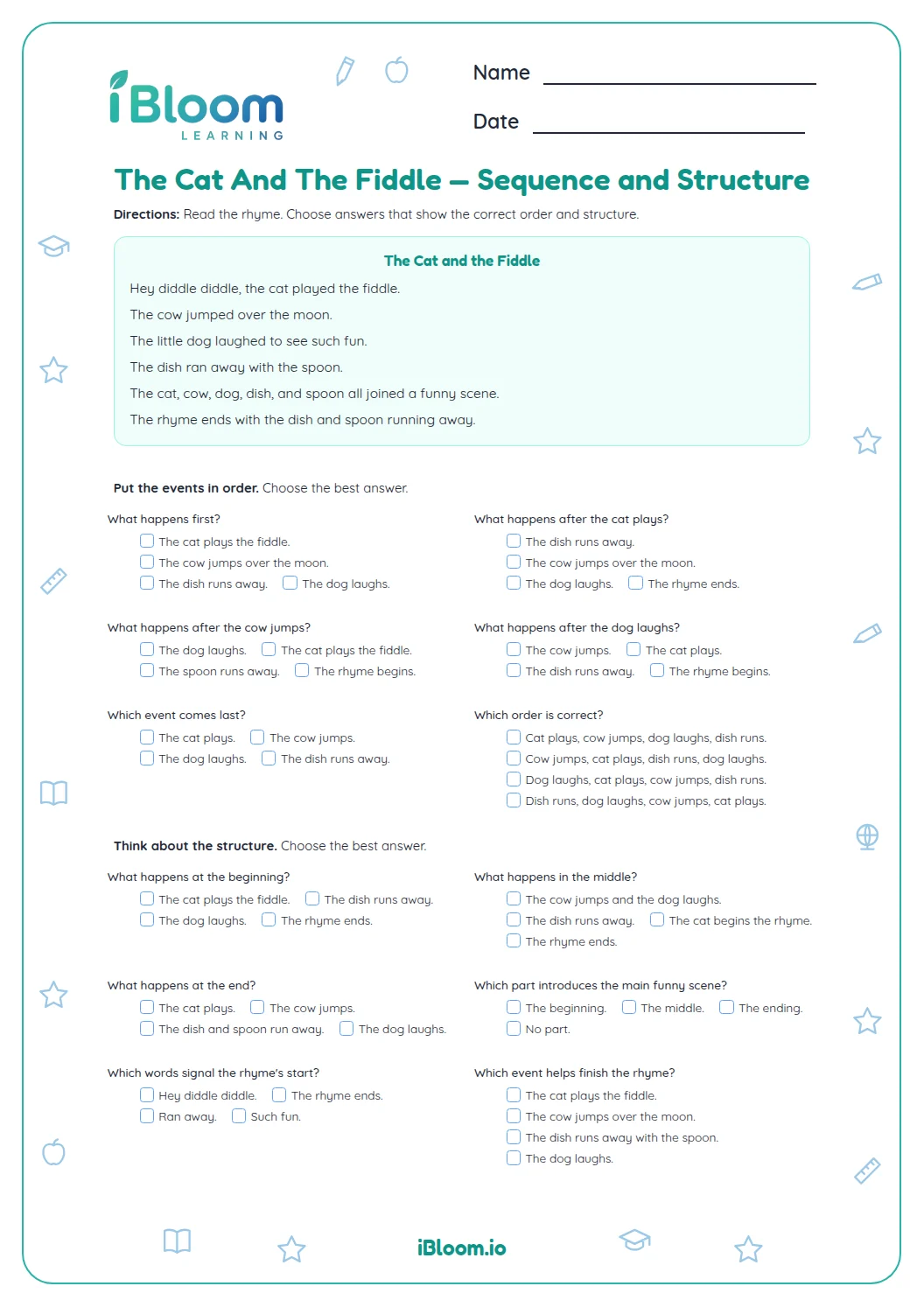
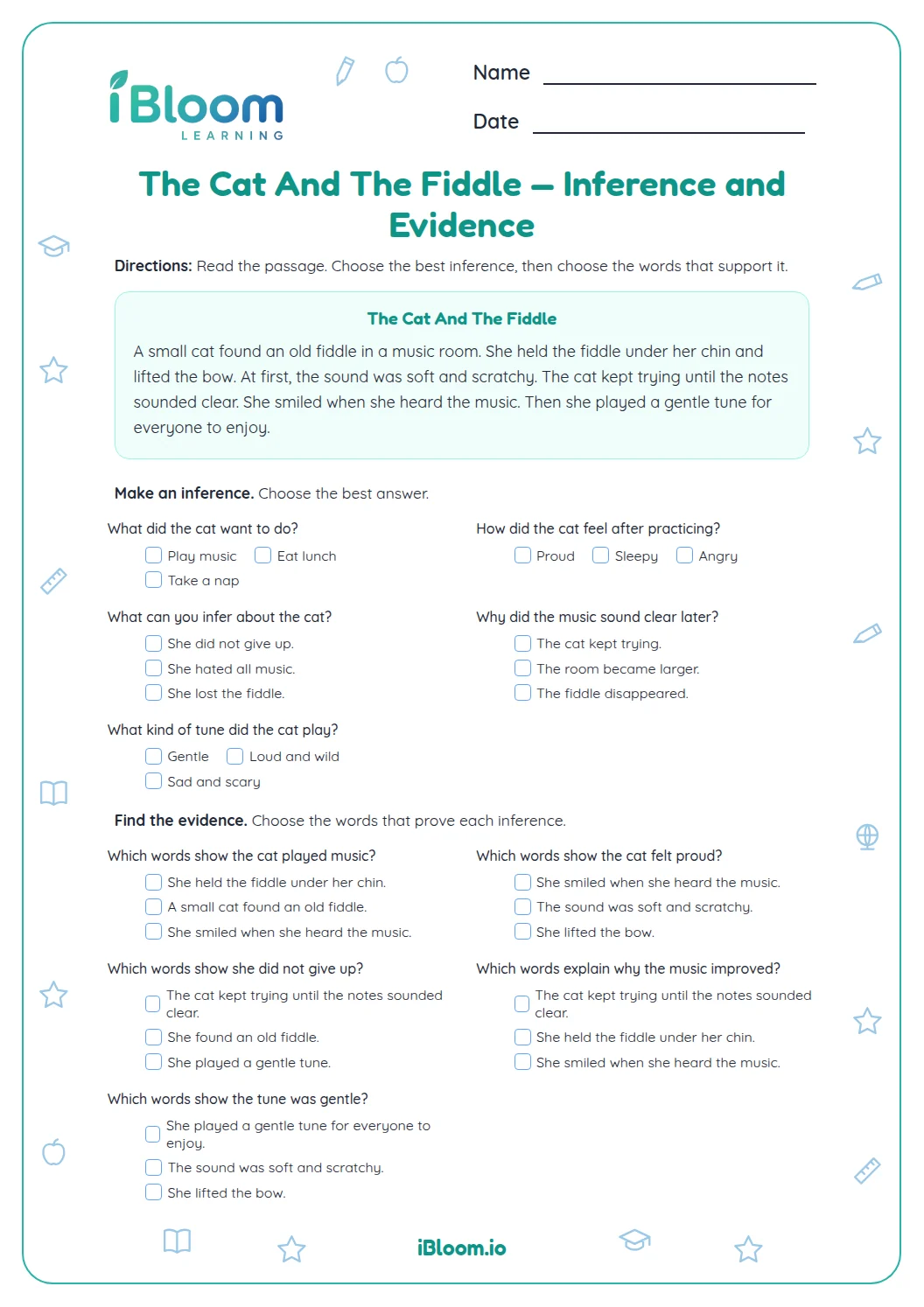
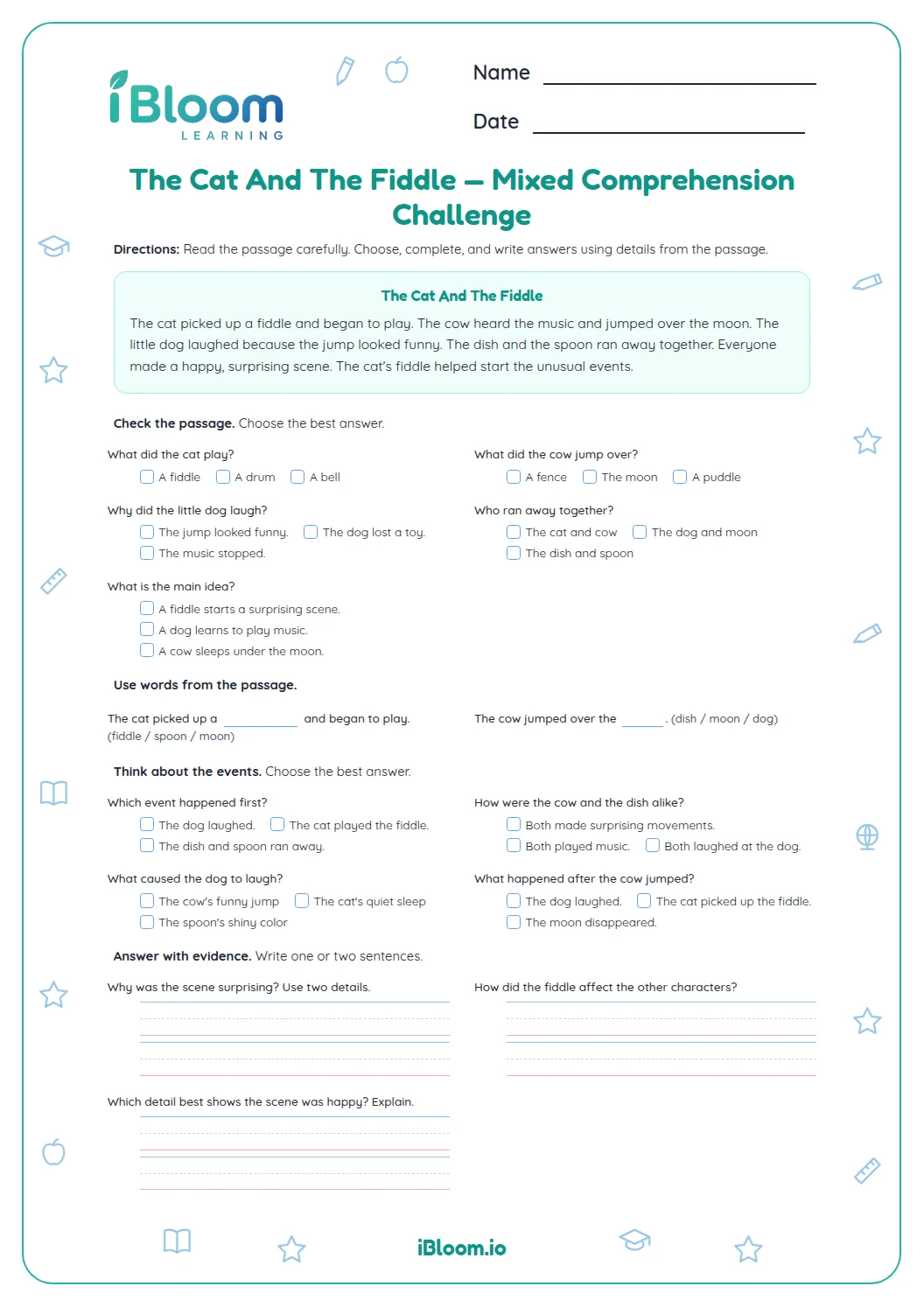
This Grade 1 reading worksheet pairs a short passage about the cat and the fiddle with questions about its main idea and details. Students choose what the whole story is mostly about, answer who and what questions, and write details from the passage. The 14-question printable includes an answer key and practices CCSS RL.1.2 and RL.1.1.
Aligned to RL.1.2 and RL.1.1
What does this worksheet practice?
The passage is followed by six multiple-choice questions, five written responses, and three short answers. Students identify the main idea, recall characters and events, and select or write details that support their understanding.
- Complete each part in order.
- Use the key to check answers.
How can a reader find a story’s main idea?
The answer “Cat plays; friends gather” fits the whole passage. “The cow jumped over the moon” is an important detail, but it does not describe everything that happens.
- 1What is the story mostly about? → A cat plays a fiddle as a silly scene unfolds
How can a student check the work?
For a written response, students can return to the passage and name an event. The key’s sample for one animal action is that the cow jumped over the moon.
How to use this worksheet
- 1Read the story once to learn what happens.
- 2Ask what the story is mostly about from beginning to end.
- 3Answer who, what and why questions with details.
- 4For written answers, return to the story for evidence.
- 5Compare answers with the key; wording may vary.
Common mistakes and quick fixes
The mistake
Choosing one small detail as the main idea.
The fix
Look for an answer that fits the whole story.
The mistake
Mixing up who said something.
The fix
Find the character’s name beside the spoken words.
The mistake
Giving an answer without a story detail.
The fix
Point to an event or action that supports the answer.
Common Core alignment
Students retell story details and identify its central idea.
Retell key story details and identify the story’s central idea.
On this sheet: Retell key story details and identify the story’s central idea.
Show the official wordingHide the official wording
Retell stories, including key details, and demonstrate understanding of their central message or lesson.
Answer questions about characters and events using story details.
On this sheet: Answer questions about characters and events using story details.
Show the official wordingHide the official wording
Ask and answer questions about key details in a text.
What to practice next
Make more practice
Further reading
Questions parents and teachers ask
What is the passage about?
The five response questions provide room to write, and the key uses short sample responses. For direct questions such as what the cat played, a clear phrase is enough; complete sentences are also fine. The passage gives details that students can find again while answering.
How is a main idea different from a detail?
Students may cite the cat playing a fiddle, the unusual animal actions, or the animals returning to listen. A relevant detail should come from the passage and help explain the story’s larger event. The question asks readers to choose an idea that fits every major event.
Do students need to write full sentences?
The passage and its 11 questions span three worksheet pages, with a separate three-page answer key. The printout contains six multiple-choice items and five written responses. A phrase from the passage can answer a direct who or what question. A phrase from the passage can answer a direct who or what question.
What details can support the main idea?
Students may cite the cat playing a fiddle, the unusual animal actions, or the animals returning to listen. A relevant detail should come from the passage and help explain the story’s larger event. The passage supplies several events students can use as text evidence.
How many pages are included?
The passage and its 14 questions span three worksheet pages, with a separate three-page answer key. The printout contains six multiple-choice questions, five written responses, and three short answers. The question types give children several ways to show what they understood.