
About this worksheet
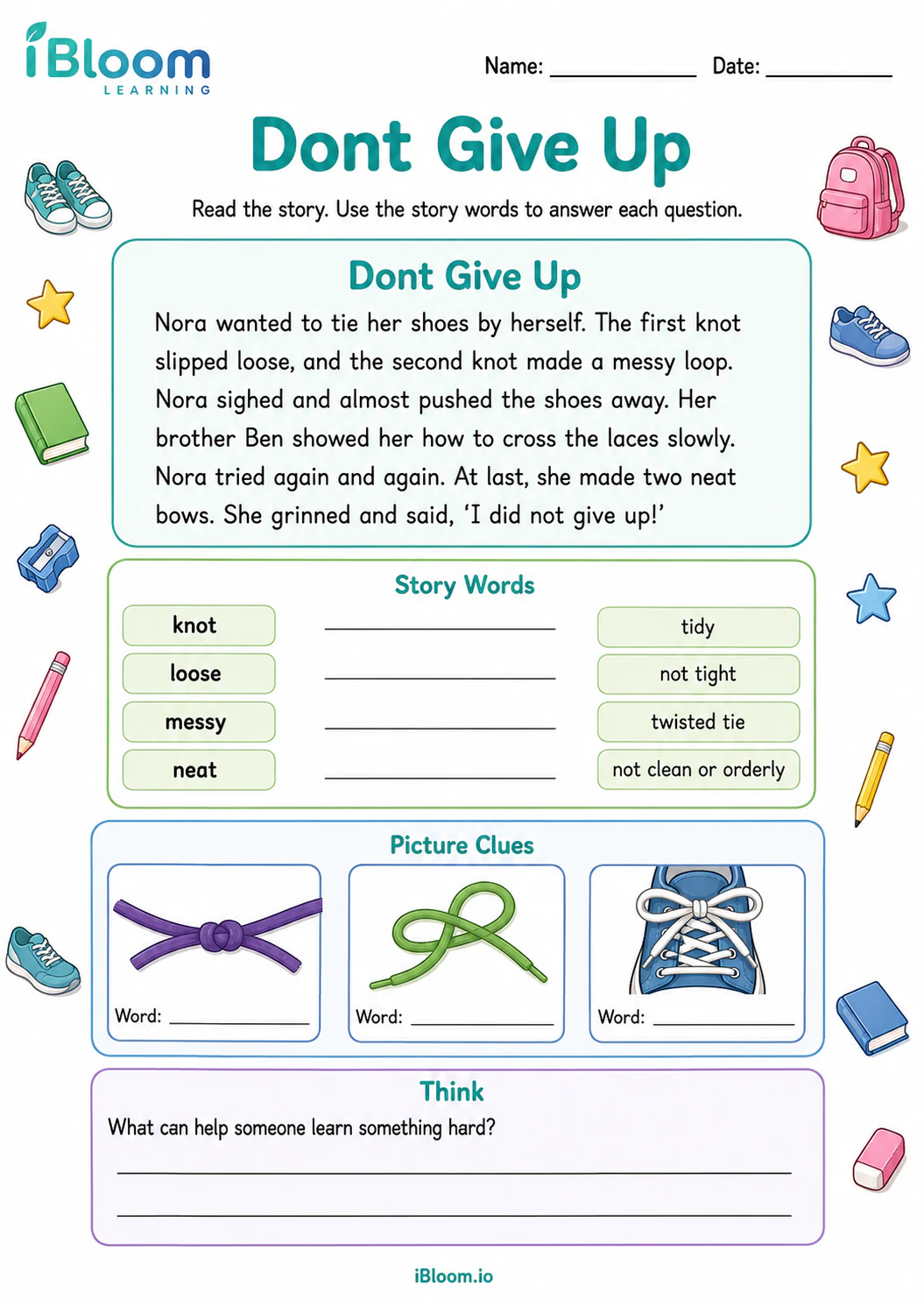
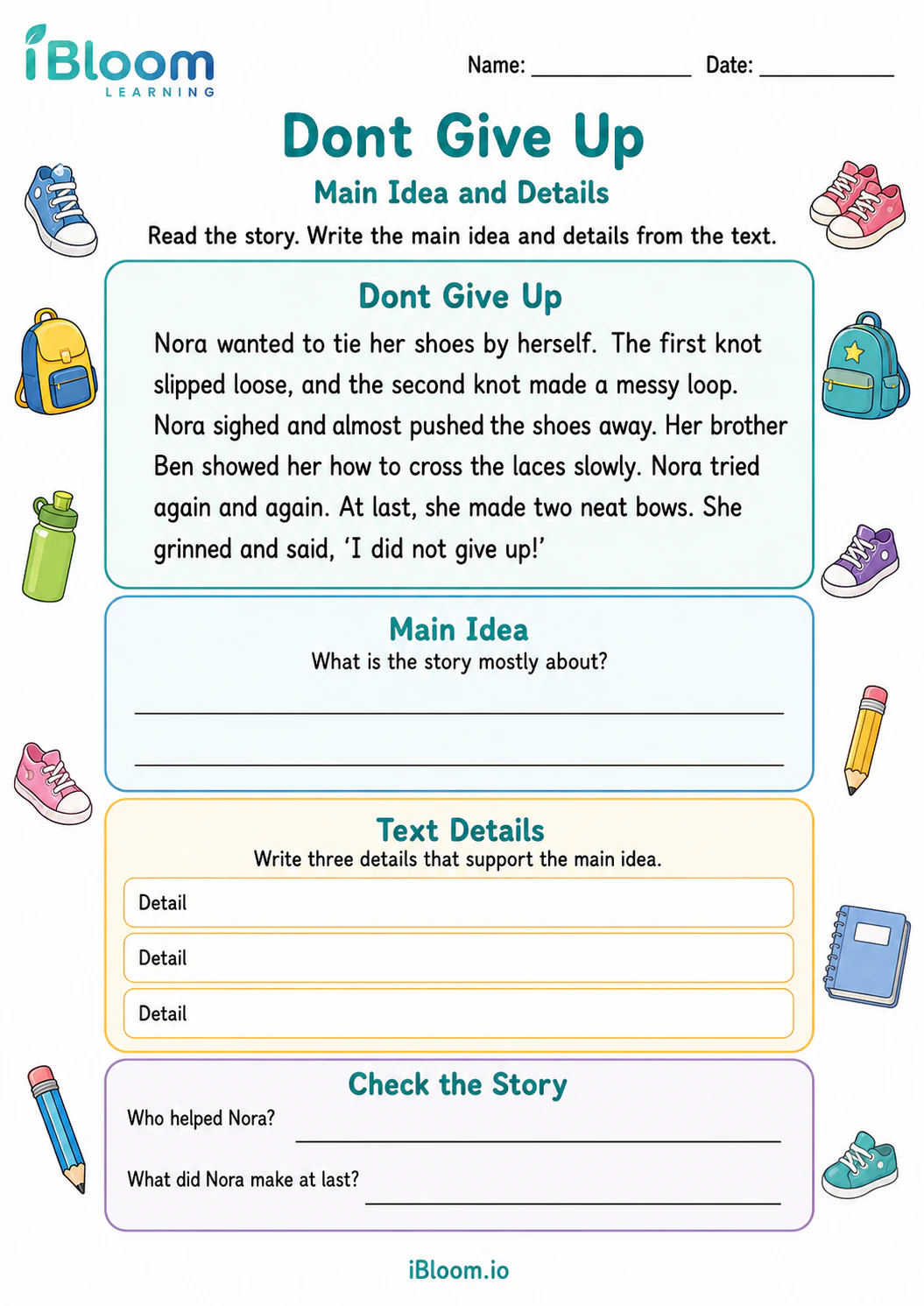
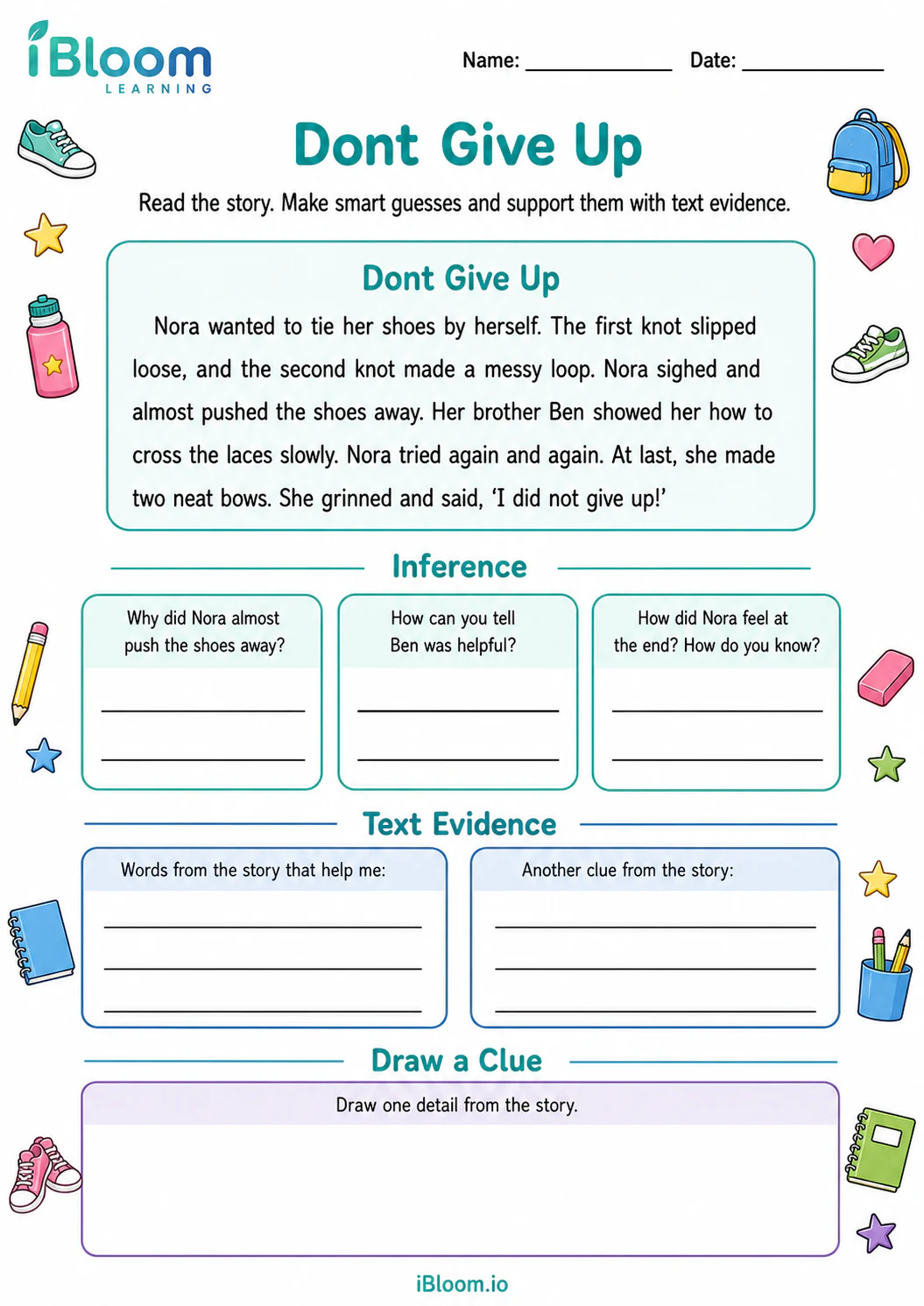
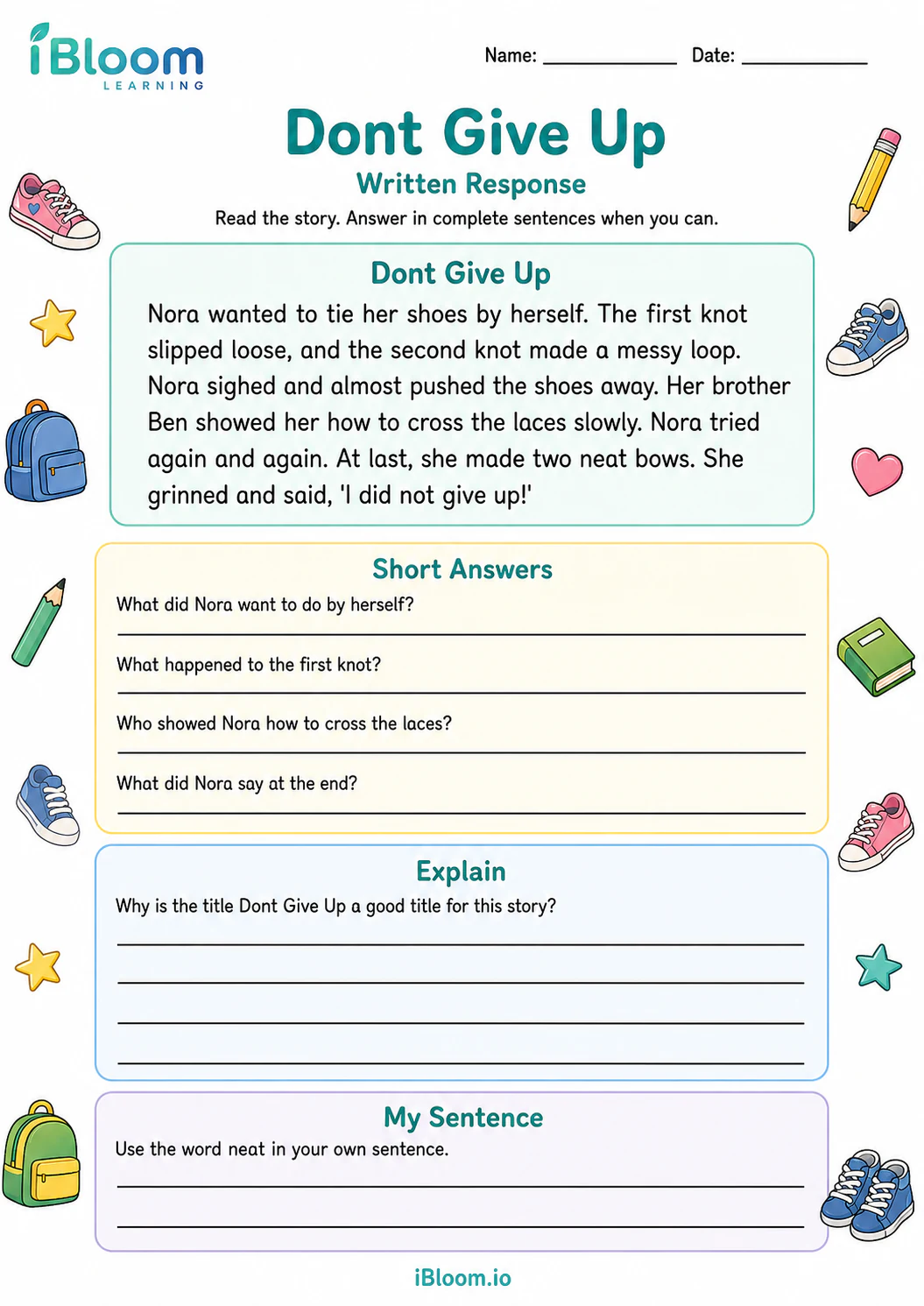
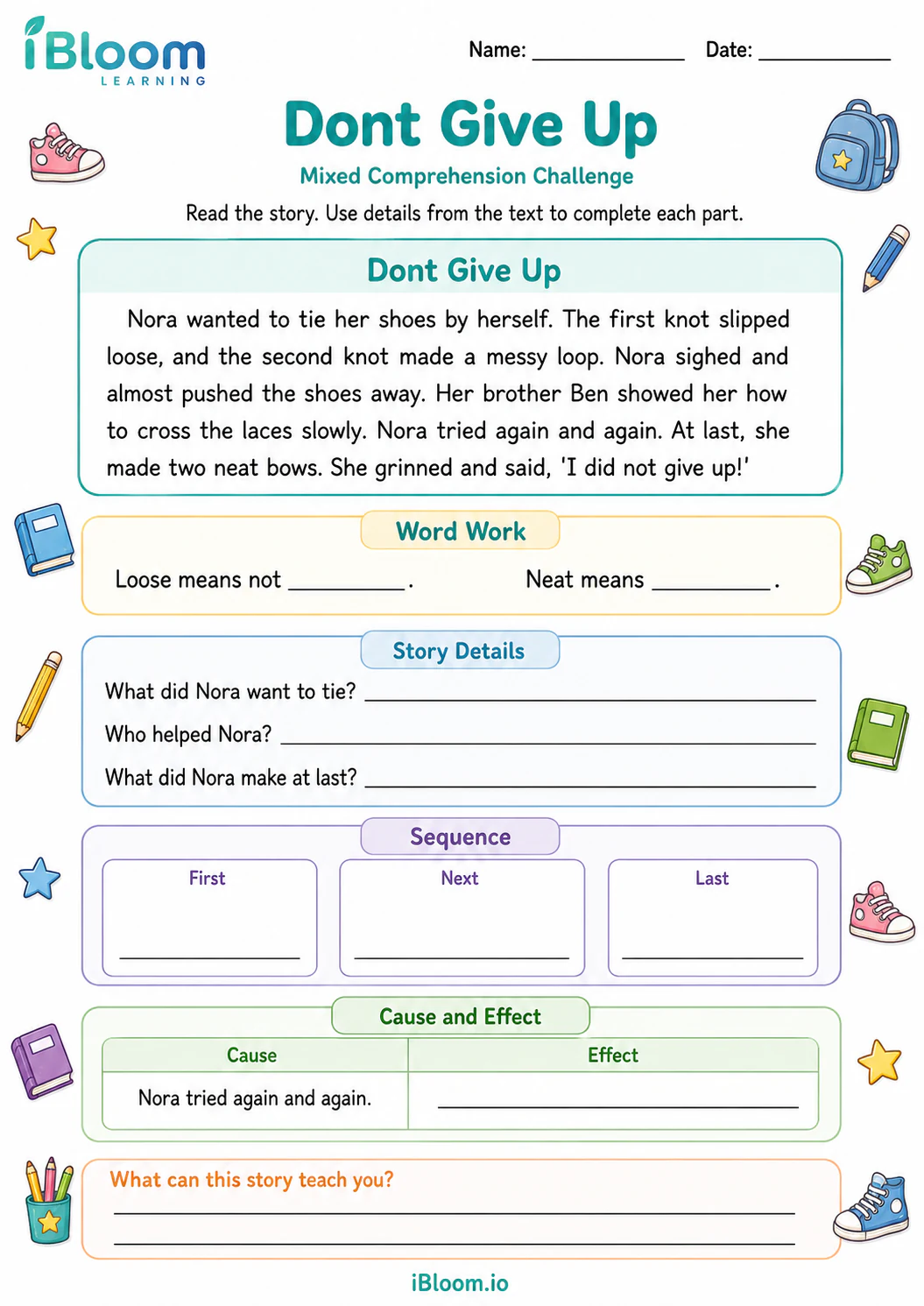
In this original Grade 2 story, Nora wants to tie her shoes by herself. After two knots go wrong, her brother Ben shows her how to cross the laces slowly, and Nora tries again. Fourteen questions ask readers to recall details, put events in order, connect actions to causes, and explain the lesson. The answer key includes sample responses for open-ended questions.
Aligned to RL.2.3 and RL.2.2
How can readers follow a story’s events?
Readers notice what happens first, next, and last. In Nora’s story, Ben shows her how to cross the laces before she tries again, and the neat bows come at the end.
Cause-and-effect questions connect what a character does with what happens next. Nora nearly pushes the shoes away because her first knots do not work.
What does this worksheet ask readers to do?
The passage gives Nora a clear challenge, a helpful suggestion from Ben, and an ending in which she ties two neat bows. The questions move from story details to ordering events, explaining Nora’s choices, and naming a lesson. Open responses can use different wording, so the key gives sample answers.
How can readers put events in order?
Question 6 asks readers to sequence three events. Ben shows Nora how to cross the laces first, Nora tries again next, and she ties two neat bows last. The order follows the actions in the passage from help to practice to success.
A simple reading routine
- 1Read once to learn what Nora wants to do and what goes wrong.
- 2Notice what Ben shows Nora before she tries again.
- 3Retell the events from the first knot to the neat bows.
- 4Use a detail from the passage to support an explanation.
Common reading slips
The mistake
Putting Nora’s success before Ben gives his suggestion.
The fix
Retell the passage from the loose knot through the final bows.
The mistake
Guessing how Nora feels without using what she says or does.
The fix
Connect her sigh and almost pushing the shoes away to the failed knots.
The mistake
Naming a lesson that is not supported by the ending.
The fix
Use Nora’s decision to keep trying and her final success as evidence.
Common Core alignment
This Grade 2 story supports reading literature skills.
Describe how characters respond to major events and challenges.
On this sheet: Questions ask readers to describe how Nora reacts when her knots go wrong and responds to Ben’s help.
Show the official wordingHide the official wording
Describe how characters in a story respond to major events and challenges.
Recount stories and determine their central message or lesson.
On this sheet: The final questions ask readers to recount and state a lesson.
Show the official wordingHide the official wording
Recount stories, including fables and folktales from diverse cultures, and determine their central message, lesson, or moral.
What to practice next
Make more practice
Further reading
Questions parents and teachers ask
What does sequence mean in a story?
Sequence is the order in which events happen. Readers can use time clues and cause-and-effect details to place events. In Nora’s story, Ben shows her how to cross the laces before she tries again, and she ties two neat bows at the end. Retelling the events helps readers see how the problem is solved.
How does Nora respond to her challenge?
Nora sighs and almost pushes the shoes away when her first knots go wrong. Ben shows her how to cross the laces slowly. She keeps trying and finally ties two neat bows. The story shows her response through what she does after facing the problem.
What is the problem in Don’t Give Up?
Nora wants to tie her shoes by herself, but her first attempts do not work. One knot slips loose and another makes a messy loop. Ben helps by showing her how to cross the laces slowly, and Nora uses that advice as she tries again.
What answer should children give about the story lesson?
Answers can use different words. A suitable response is that Nora learns to keep trying when something is difficult. Readers can support that lesson with the events: her knots go wrong, she listens to Ben’s suggestion, and she keeps practicing until she ties two neat bows.
Is there an answer key for the open responses?
Yes. The separate key lists the event order and gives sample responses for questions that can be answered in more than one way. A child’s wording does not need to match exactly if it explains a story detail or lesson. The other questions have a specific answer supported by the passage.