
About this worksheet
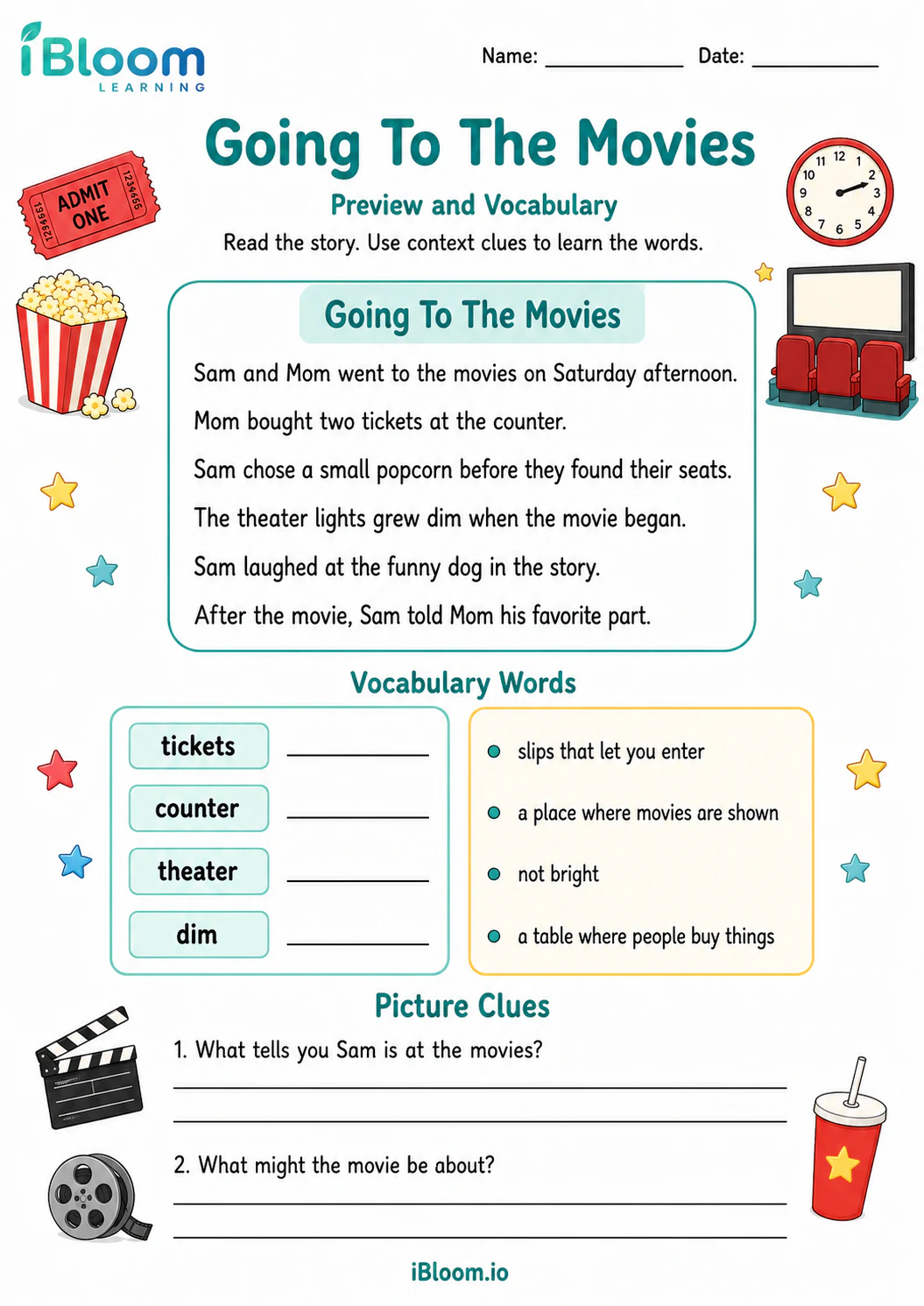
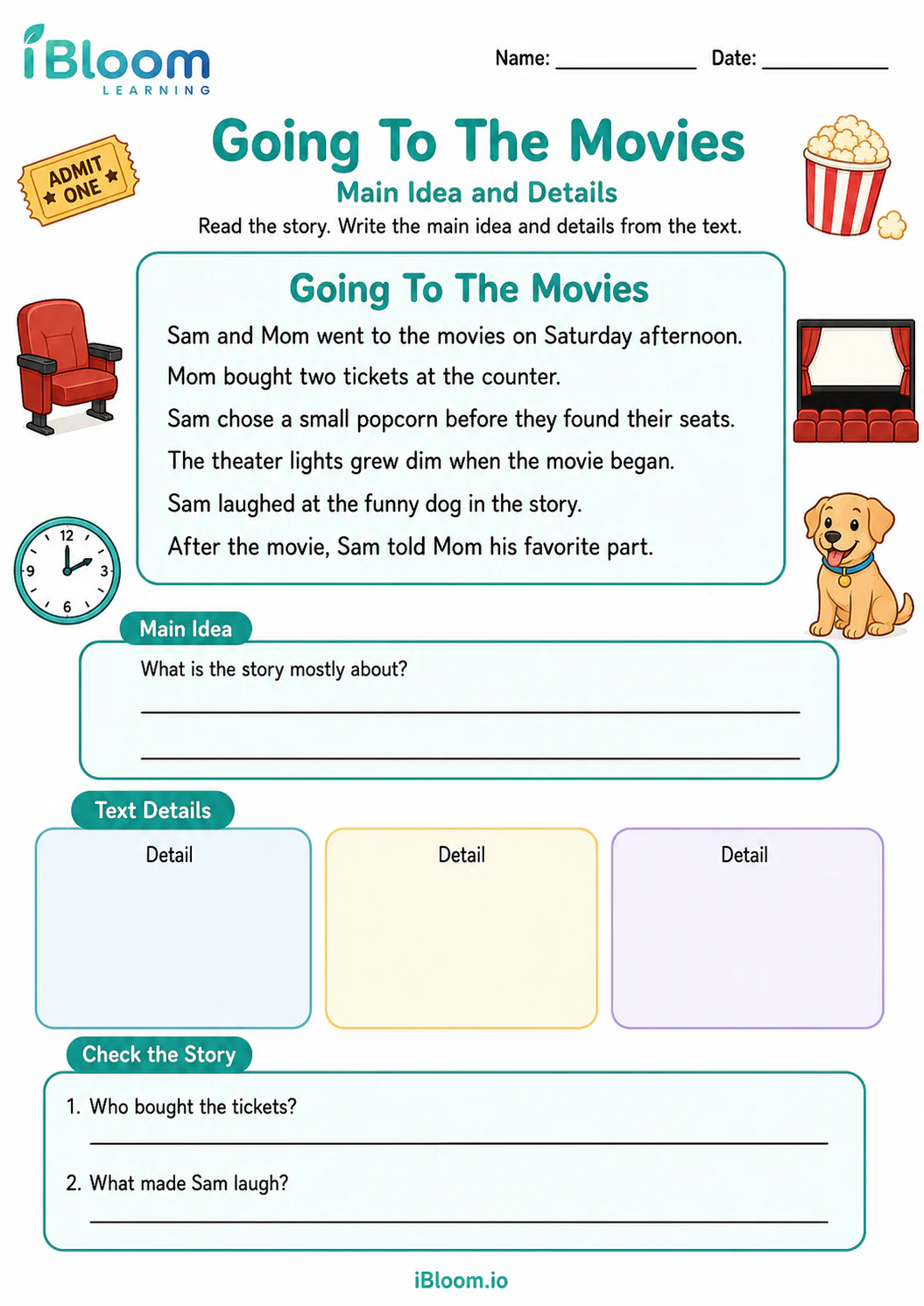
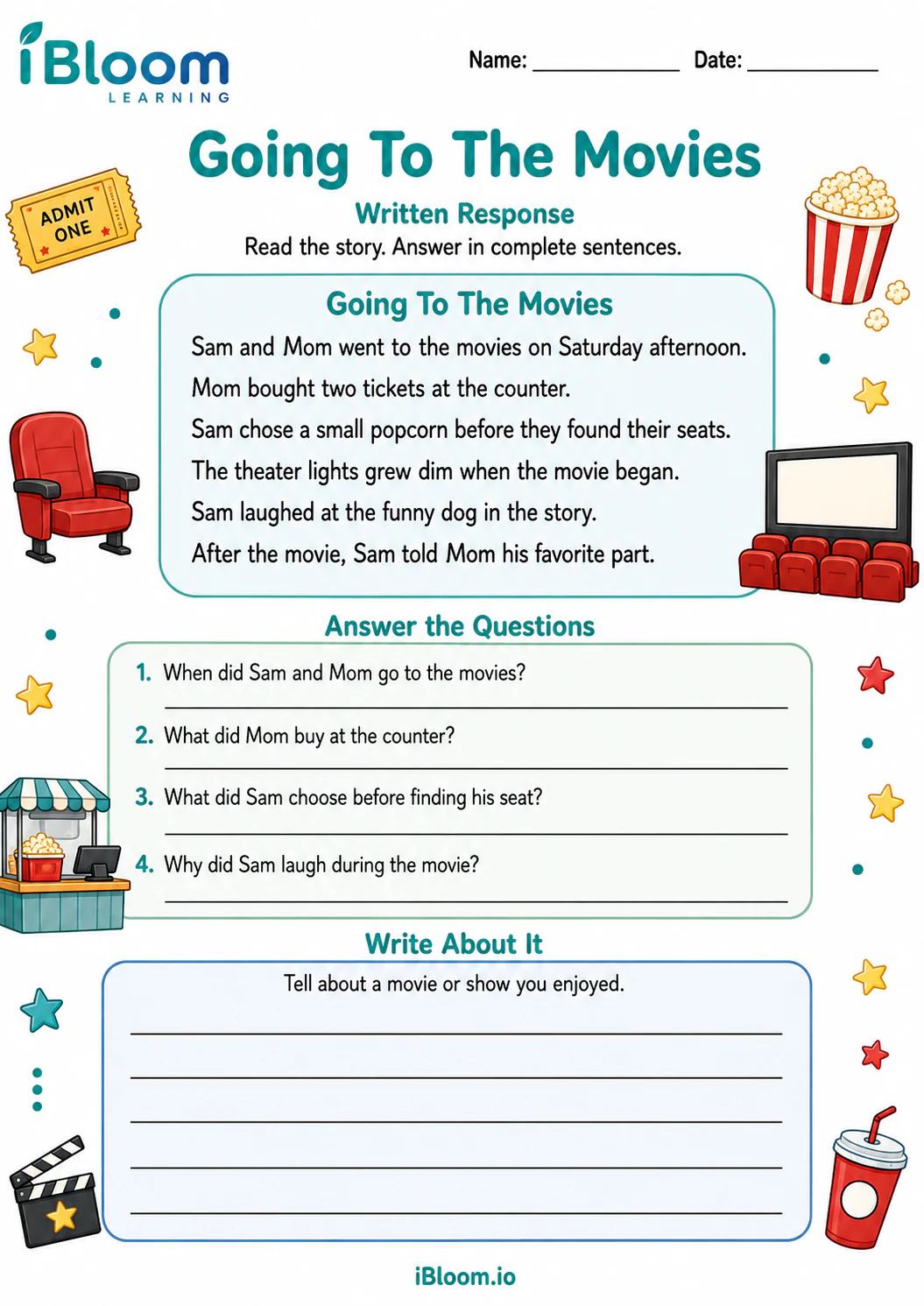
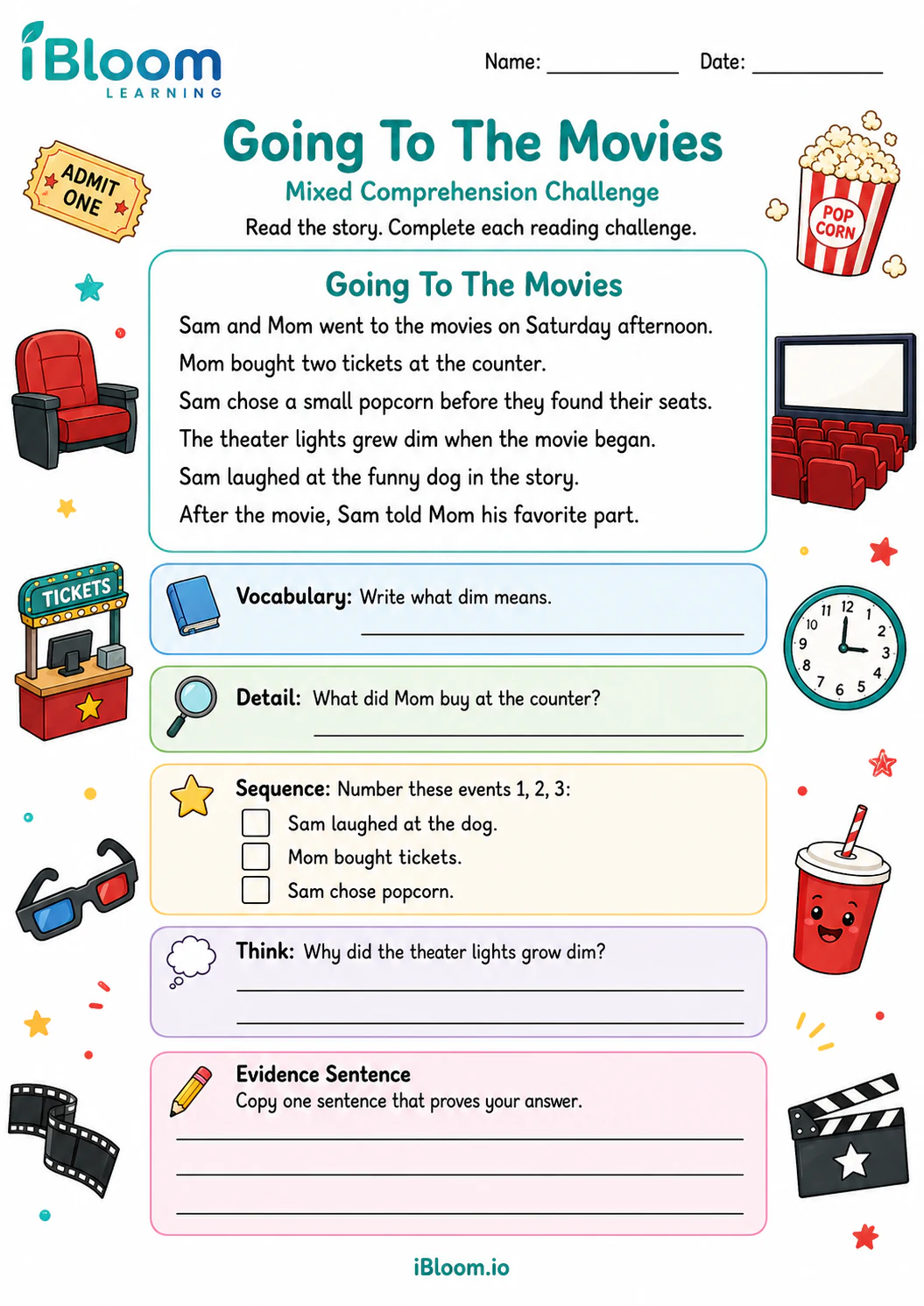
This Grade 2 reading worksheet follows Sam and Mom on a Saturday trip to the movies. Students read an original short story, then answer 14 questions about what happened first, before the film, during it, and afterward. They use time words, identify story details, and explain events in two short responses. The separate answer key provides choices and sample written responses. The questions practice answering about key details in a text, connecting with Common Core RL.2.1.
Aligned to RL.2.1
How can a reader track what happens first and next?
Notice time words and reread the sentence around them. The story begins with Sam and Mom going to the movies, moves to buying tickets and choosing popcorn, and ends with Sam telling Mom his favorite part.
- 1What did Mom do at the counter?
- 2She bought two tickets, before Sam chose popcorn.
What do time words tell us about a story?
Words such as Saturday afternoon, before, when, and after show when events occur. Question 10 asks what “After the movie” helps the reader understand: when Sam tells Mom his favorite part.
- 1“After the movie” tells when Sam shares his favorite part.
How do the beginning, middle, and ending fit together?
The beginning introduces Sam and Mom’s Saturday trip. The middle shows them buying tickets, choosing popcorn, and watching the film. The ending tells what Sam says after the movie. Questions 6 and 12 connect details with those parts.
How to use this worksheet
- 1Read the passage once to understand Sam and Mom’s trip.
- 2Reread it and notice time words such as before and after.
- 3For order questions, number the events in the margin.
- 4Return to the passage to find the detail that supports each answer.
- 5Write a short sentence for questions 13 and 14.
Common mistakes and quick fixes
The mistake
Choosing an event that happened but putting it in the wrong place.
The fix
Use the time words and the story’s beginning, middle, and ending.
The mistake
Guessing why a character acted without checking the text.
The fix
Find the sentence that explains the event, such as why Sam laughs during the film.
The mistake
Giving a broad answer instead of a story detail.
The fix
Name the exact action or event from the passage.
Common Core alignment
Students answer questions about story details and use the events to describe the text.
Answer who, what, when, and how questions using story details.
On this sheet: Questions ask students to retrieve and explain key details from the story.
Show the official wordingHide the official wording
Ask and answer such questions as who, what, where, when, why, and how to demonstrate understanding of key details in a text.
What to practice next
Make more practice
Further reading
Questions parents and teachers ask
What story does the worksheet use?
The original passage follows Sam and Mom on a Saturday trip to the movies. Mom buys two tickets, Sam chooses popcorn, the theater lights dim, and Sam laughs at a funny dog in the film. Afterward, he tells Mom his favorite part.
How does this worksheet practice sequence?
Students identify what happens first, before the film, during it, and after it ends. They also interpret time phrases such as “before” and “After the movie” and choose the correct order for tickets, popcorn, the film, and Sam’s favorite part.
What does story structure mean here?
Students look at how the story moves from the opening trip to the theater, through the movie, and to Sam’s comment afterward. They answer questions about opening details and the ending, using specific events from the passage. The beginning, middle, and end each contribute a part of Sam and Mom’s outing.
How can a child find an answer in the passage?
Reread the sentence that matches the question. To learn what Mom did at the counter, find the sentence about buying two tickets. For Sam’s action during the film, find the sentence that says he laughed at the funny dog.
What should a written answer include?
A short answer should name a story detail. For question 13, a child might say that Sam and Mom went to the movies on Saturday afternoon. For question 14, the answer should say that Sam laughed at the funny dog during the movie.
Can a child answer in different words?
Yes. The key gives a model, and a response is correct when it clearly states the same event. For example, “Sam thought the dog in the movie was funny” gives the detail asked for in question 14. For question 13, a child can mention the Saturday trip or buying tickets at the counter.