
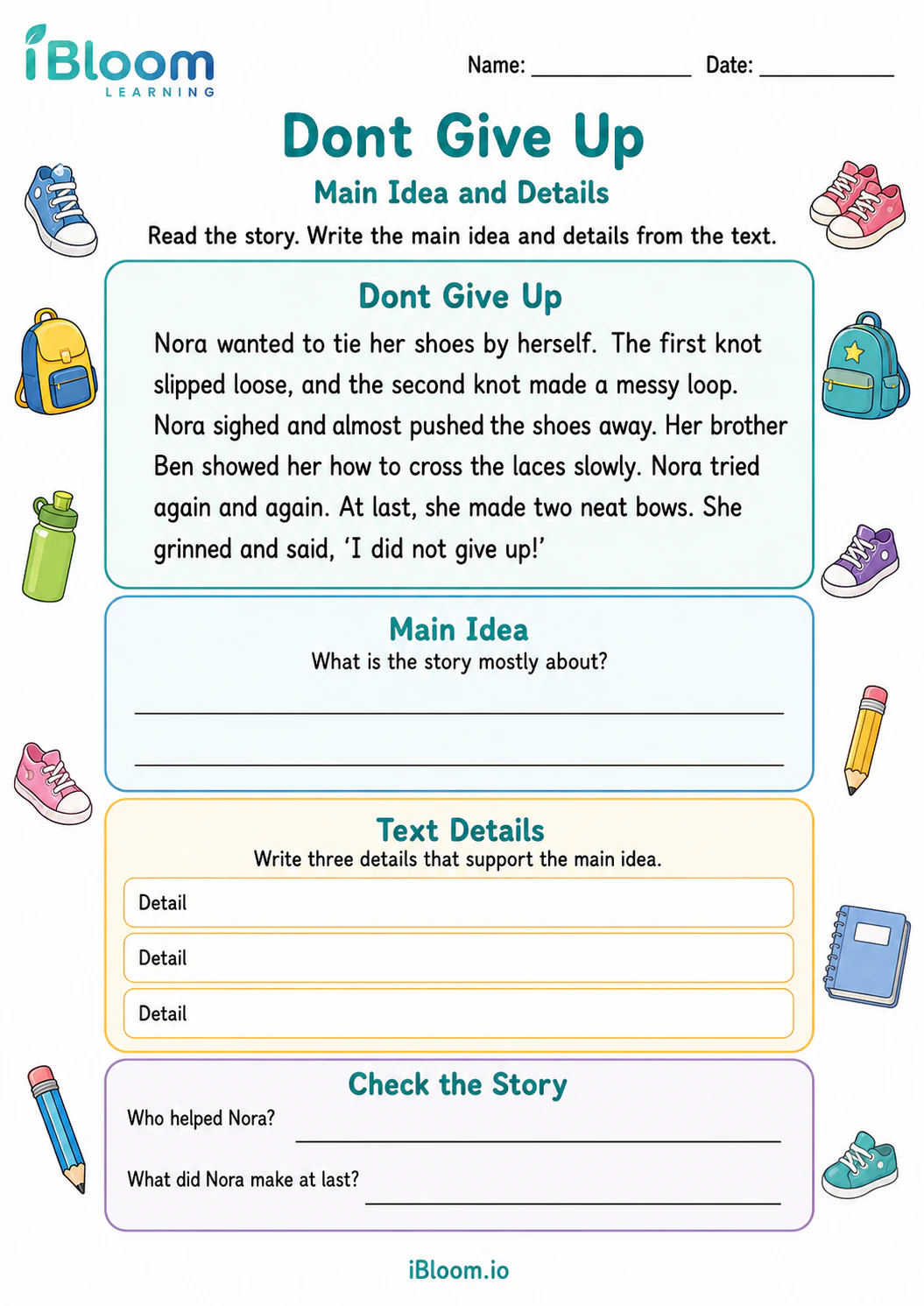
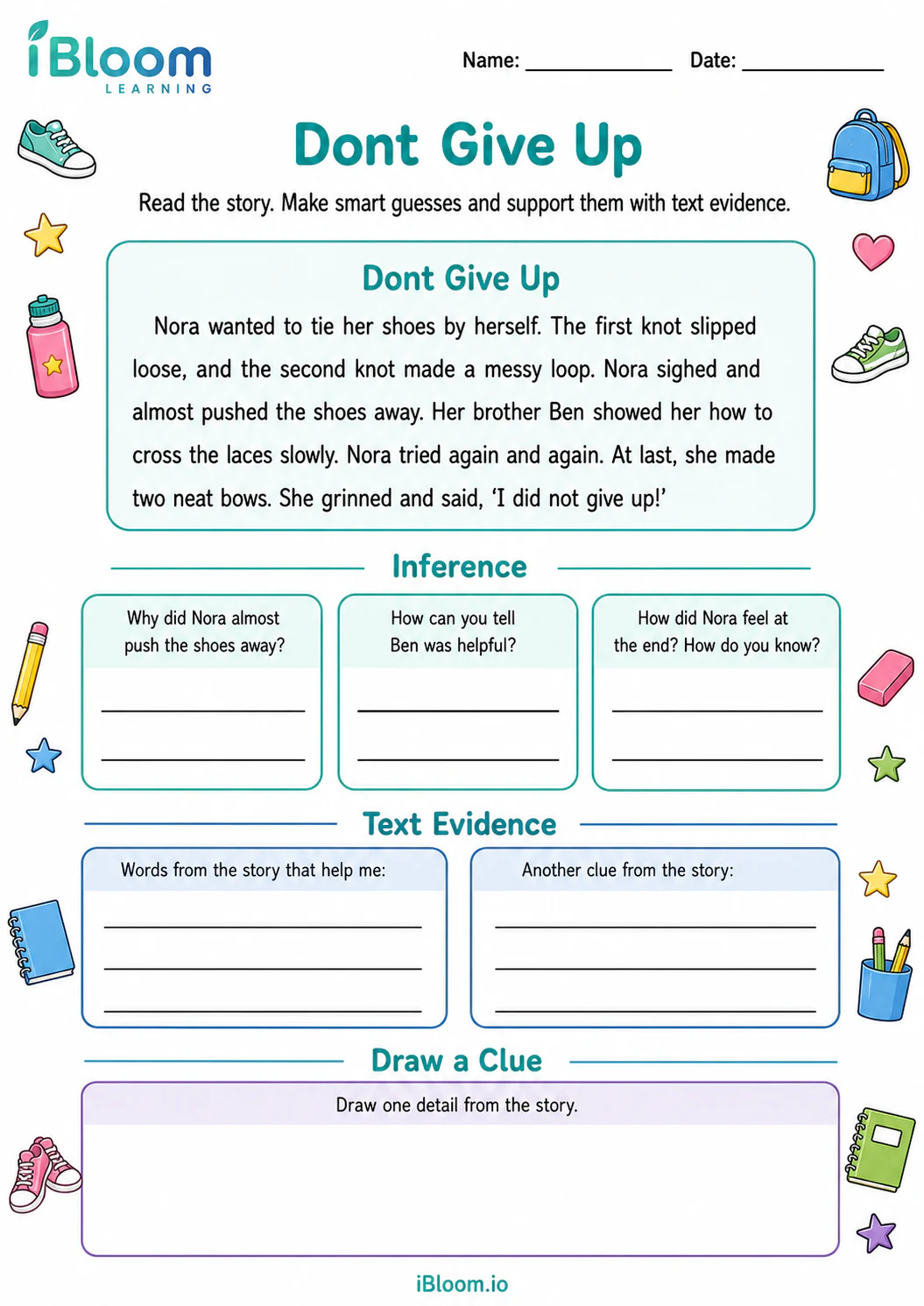
About this worksheet
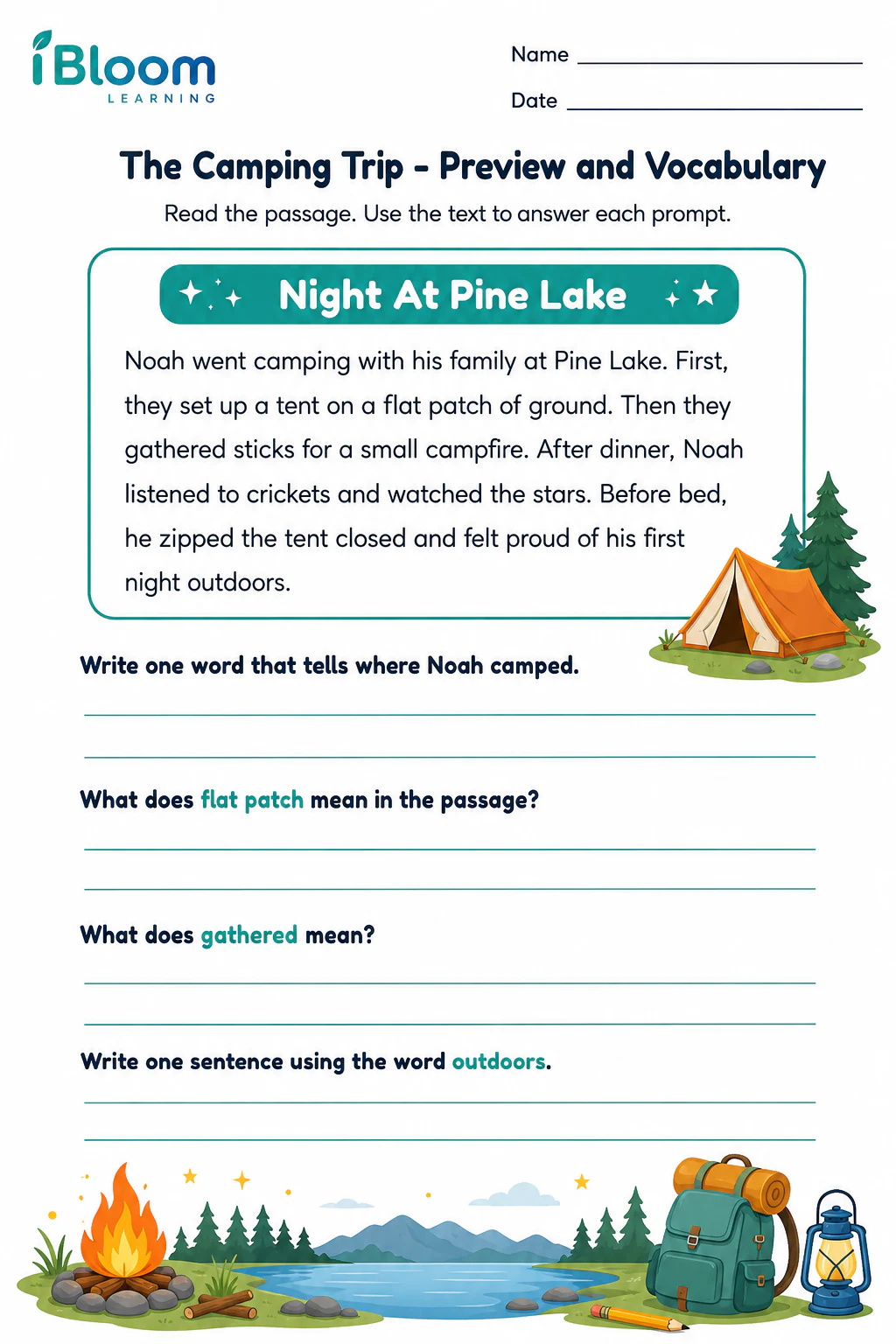
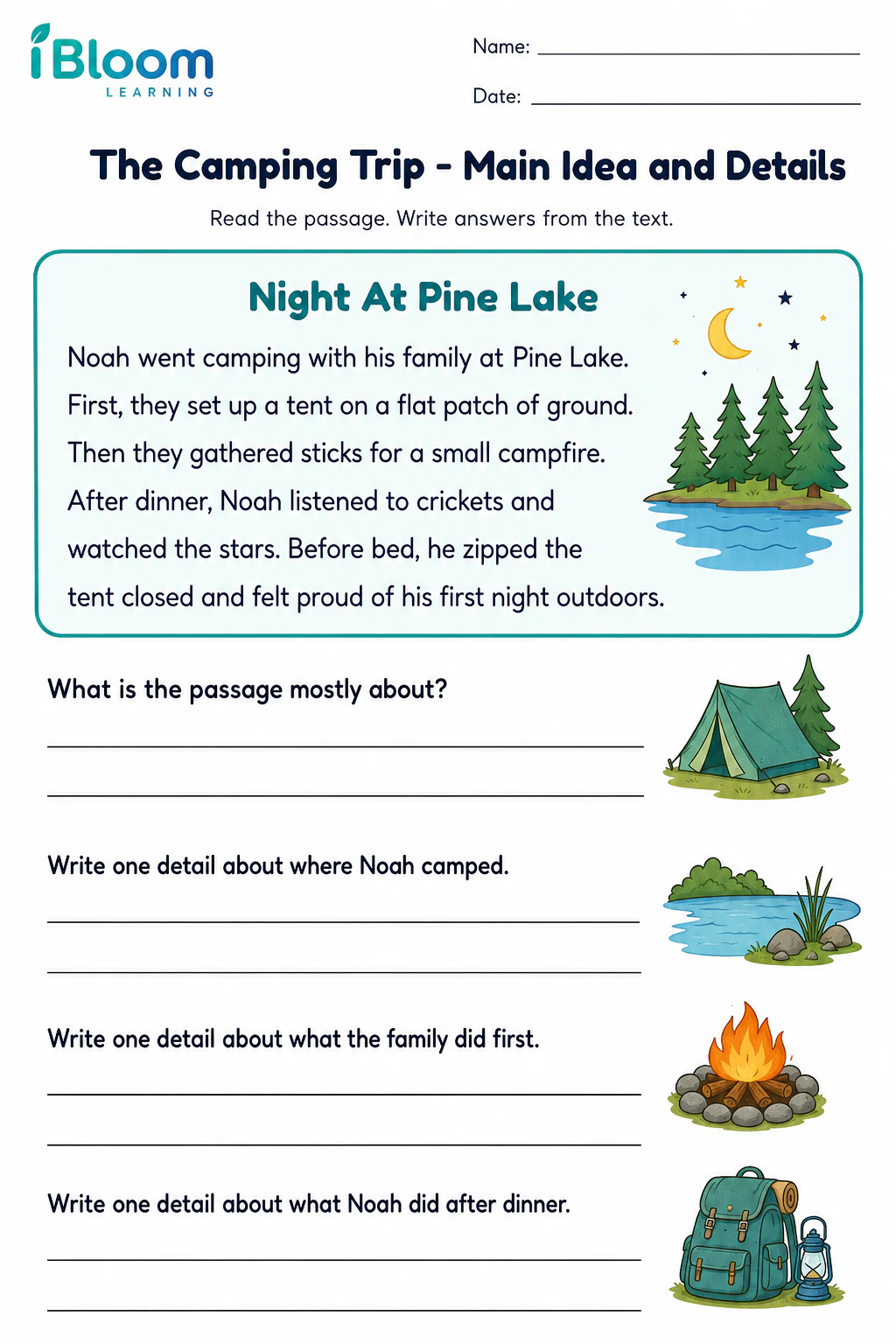
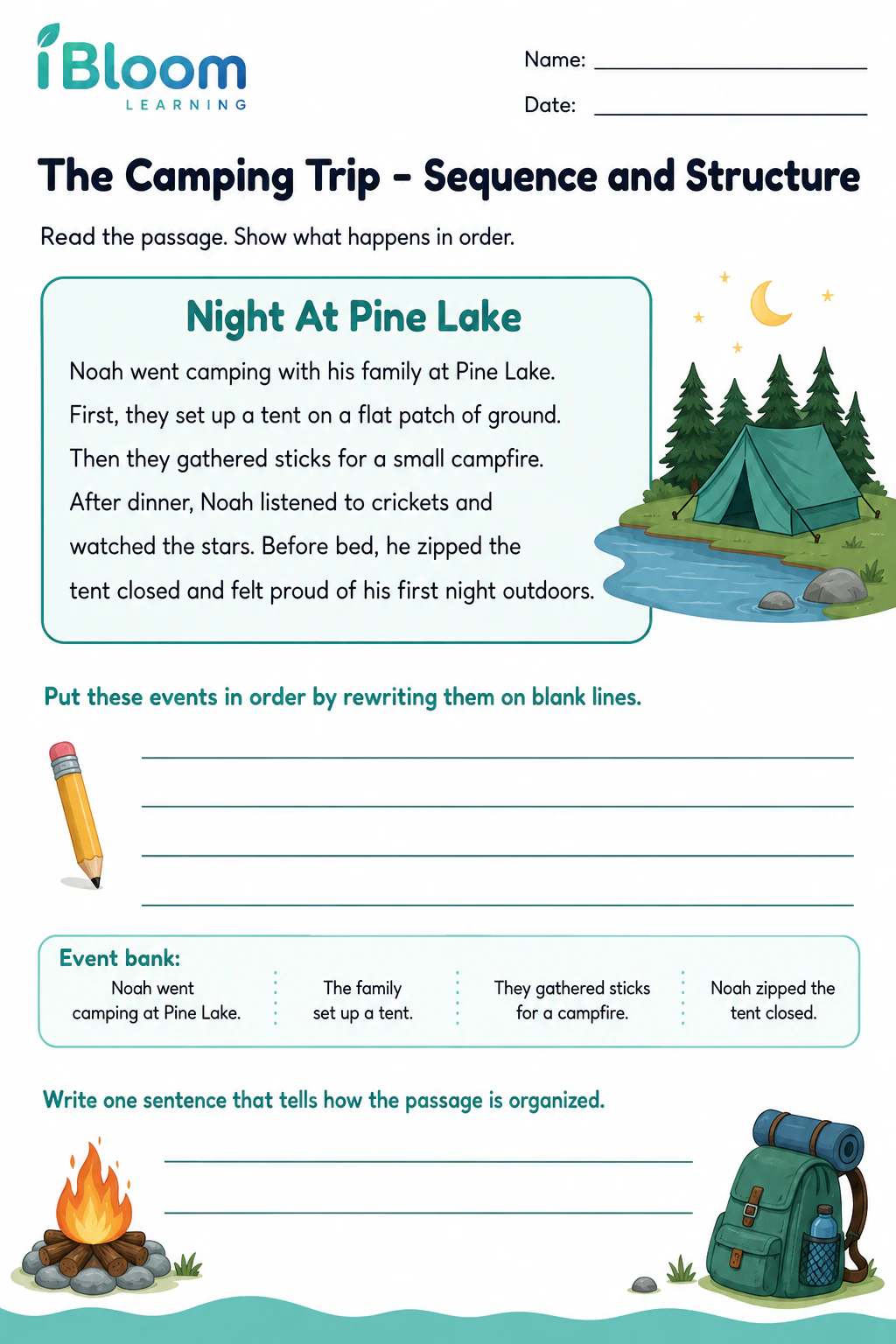
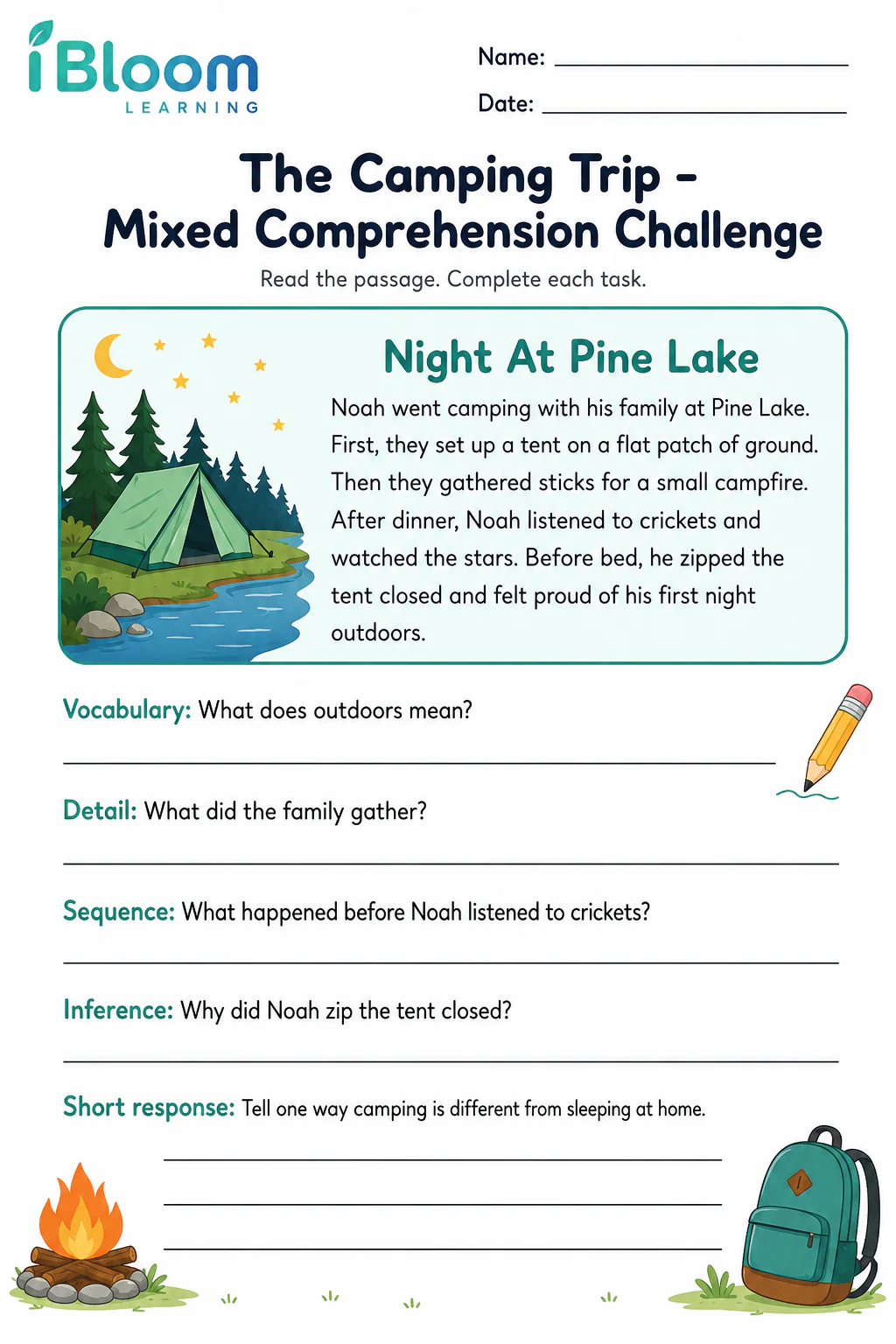
This free Grade 2 reading worksheet pairs a camping story with 14 written questions. Noah and his family set up a tent at Pine Lake, gather sticks, listen to crickets, and watch stars. Children begin with short factual answers and move toward complete sentences that use details from the story. The questions practice Common Core RL.2.1 by asking readers to answer who, what, where, when, why, and how questions about key details. The separate answer key offers sample wording for every response.
Aligned to RL.2.1
What happens in The Camping Trip?
Noah camps with his family at Pine Lake, helps set up a tent and gather sticks, then listens to crickets and watches stars. Before bed, he zips the tent closed and feels proud that he spent his first night outdoors.
Part A contains the story. Part B asks six short detail questions, Part C asks four complete-sentence questions, and Part D asks four responses that use story details.
How can children find a story detail?
Question 13 asks children to connect Noah’s feeling of pride with the story’s detail that it is his first night outdoors. Encourage children to find that sentence before writing. They may quote it or restate it accurately.
- 1Question 13: How do you know this was Noah’s first night camping?
- 2Answer: The story says it was his first night outdoors.
- 3This answer uses a specific story detail.
What makes a written response correct?
A response is correct when it answers the question and matches the story. For question 9, it should include the tent and gathering sticks for the fire. For question 14, it should place listening to crickets and watching stars before bedtime.
The key gives sample sentences, not a script to memorize. Accept equivalent wording that uses the passage accurately.
How to use this worksheet
- 1Read the story once for meaning, pausing after the tent is fixed.
- 2Reread to locate the six details requested in Part B.
- 3Say each Part C answer aloud as a sentence before writing.
- 4For Part D, point to the words or action that supports the answer.
- 5Compare with the sample key, accepting accurate answers in the child’s own words.
Mistakes to discuss and fix
The mistake
Saying Noah went camping somewhere other than Pine Lake.
The fix
Reread the opening sentence, which names Pine Lake.
The mistake
Mixing up what Noah did before and after dinner.
The fix
Follow the sequence: set up the tent, gather sticks, then listen to crickets and watch stars.
The mistake
Adding a feeling the passage does not give Noah.
The fix
Use the stated detail: he feels proud because it is his first night outdoors.
Common Core alignment
Answer questions about Noah’s camping trip using details from the passage.
On this sheet: Children write answers about the setting, supplies, actions, and reasons in the story.
Show the official wordingHide the official wording
Ask and answer such questions as who, what, where, when, why, and how to demonstrate understanding of key details in a text.
What to practice next
Make more practice
Further reading
Questions parents and teachers ask
Is the story printed on the worksheet?
Yes, the full story appears as Part A, so children can reread it while answering. Parts B through D contain 14 questions: six short detail answers, four complete-sentence responses, and four answers supported by story details. The three-page answer key follows.
Who is the main character in this camping story?
Noah is the main character. He camps with his family at Pine Lake, helps gather sticks, listens to crickets, and watches the stars during his first night outdoors. The title, Night at Pine Lake, names the setting, and the story ends the next morning.
Do children need to write full sentences for every answer?
Part B allows short written answers. Parts C and D ask for sentence responses, and the questions tell children when to use a detail from the passage. The key offers sample wording while allowing other accurate answers. The directions identify those parts clearly.
What detail shows Noah feels proud?
The passage says Noah feels proud because it is his first night outdoors. It also says that in the morning he tells his family he wants to camp again. Either detail helps explain his positive reaction and supports a response with evidence from the story.
How can I help a child find evidence?
Ask the child to reread the sentence that mentions the event or feeling in the question. For example, question 13 asks why Noah feels proud; the passage directly says it is his first night outdoors. The child can quote or restate that detail.