

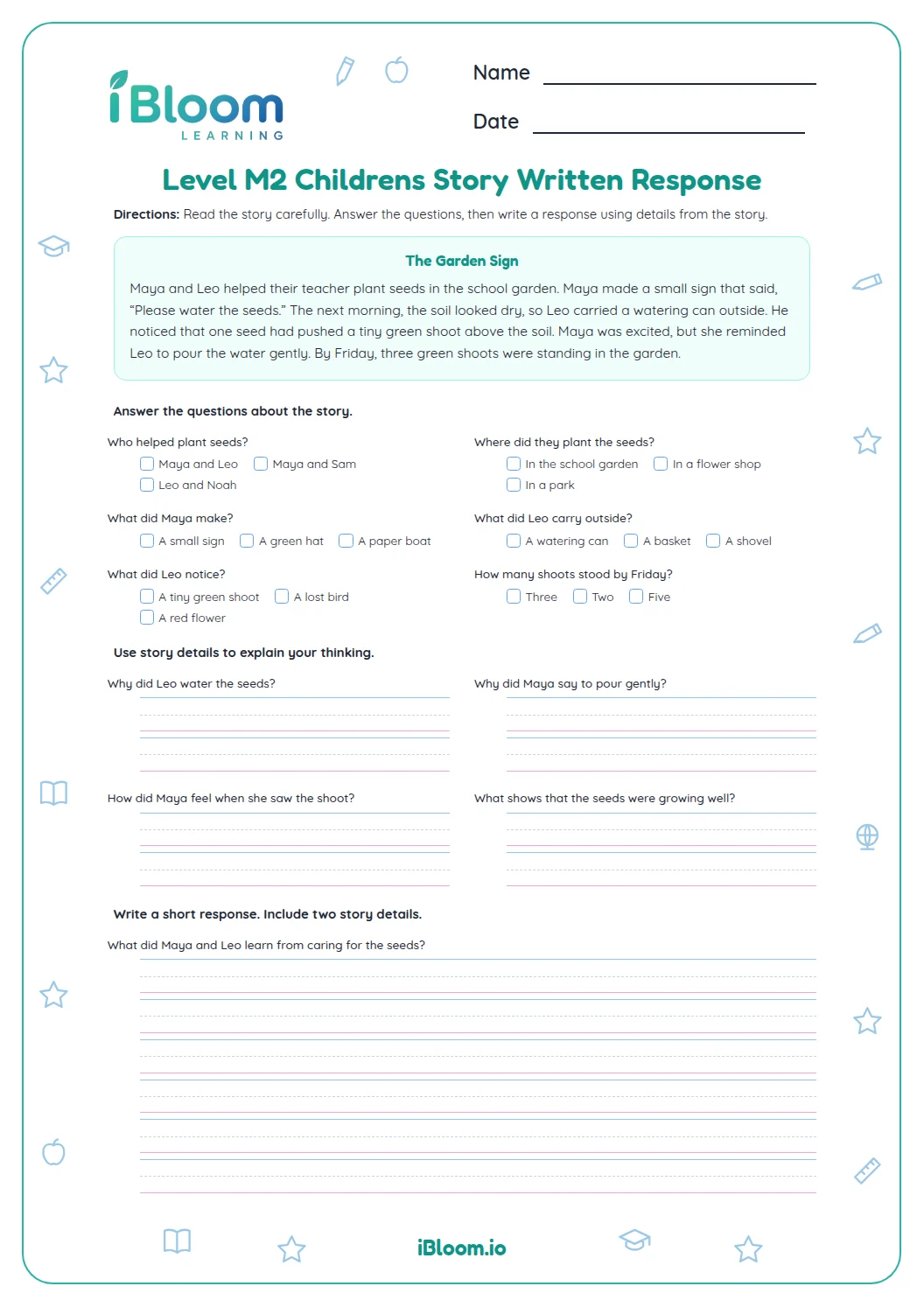

About this worksheet
This Grade 2 printable uses the original story “Maya Helps a Puppy” to practice inference and evidence. Students consider Maya’s choices, the puppy’s response, and what details support a conclusion. Four parts move from inferences to evidence and brief written responses. The answer key is separate. Questions practice CCSS RL.2.1 by asking about key story details.
Aligned to RL.2.1
What skill does this worksheet practice?
This Grade 2 printable uses the original story “Maya Helps a Puppy” to practice inference and evidence. Students consider Maya’s choices, the puppy’s response, and what details support a conclusion. Four parts move from inferences to evidence and brief written responses. The answer key is separate. Questions practice CCSS RL.2.1 by asking about key story details.
How can students work through the questions?
Pair a conclusion with the sentence or action that supports it. If the evidence is not stated directly, make sure the inference still follows from what the characters do.
- 1What kind of friend does Maya seem to be?
- 2She gently frees the puppy with Leo.
- 3That action supports “caring.”
How can readers make an inference?
Combine a story clue with what you know about a situation. Maya stops picking berries to help the trapped puppy, which supports the idea that she is caring.
Which detail supports an idea?
Choose a detail that connects directly to the conclusion. Calling Leo supports that Maya needed help; the color of her basket does not explain why she called.
How should a written answer explain?
State the inference and add a story detail. For example, Maya is glad because the puppy is safe and she smiles at the picnic.
Common mistakes and quick fixes
The mistake
Choose an operation from one keyword alone.
The fix
Use the quantities and what the story asks you to find.
The mistake
Lose track of the sign or unit.
The fix
Carry it through the equation and check it against the story.
The mistake
Stop after the first step in a multistep item.
The fix
Reread the final question and use every required operation.
Common Core alignment
Answer questions and cite story details that support an inference.
On this sheet: Infer feelings and character traits, then match each idea to a story detail.
Show the official wordingHide the official wording
Ask and answer such questions as who, what, where, when, why, and how to demonstrate understanding of key details in a text.
What to practice next
Further reading
Questions parents and teachers ask
What is an inference?
An inference is an idea supported by story clues. Maya puts down her berry basket and calls Leo when she sees the puppy caught in a rope, so readers can infer that she wants to help it. The passage gives both actions as evidence.
What counts as evidence in the story?
Evidence is a detail the passage states, such as Maya calling Leo or the puppy licking her hand. A useful detail supports the conclusion directly; a true detail about the blue basket may not support an idea about Maya’s kindness. Choose the closer clue.
How many questions are on the worksheet?
The worksheet contains 16 questions: 14 multiple-choice items and 2 written responses. They refer to “Maya Helps a Puppy.” A four-page answer key gives choices and sample wording for responses that can be phrased in different ways. It follows the story.
Can an inference have more than one correct wording?
A student can word an inference in different ways if the idea fits the story clues. The multiple-choice questions have one strongest supported choice; written responses should name a relevant detail and connect it to the conclusion. The key offers sample wording.
How can I help a child who is stuck?
Ask the child to reread the part about the puppy or the picnic. Then ask what Maya or Leo did and which sentence supports an idea about their feelings or actions. Pointing back to a specific detail keeps the inference grounded in the story.