



About this worksheet
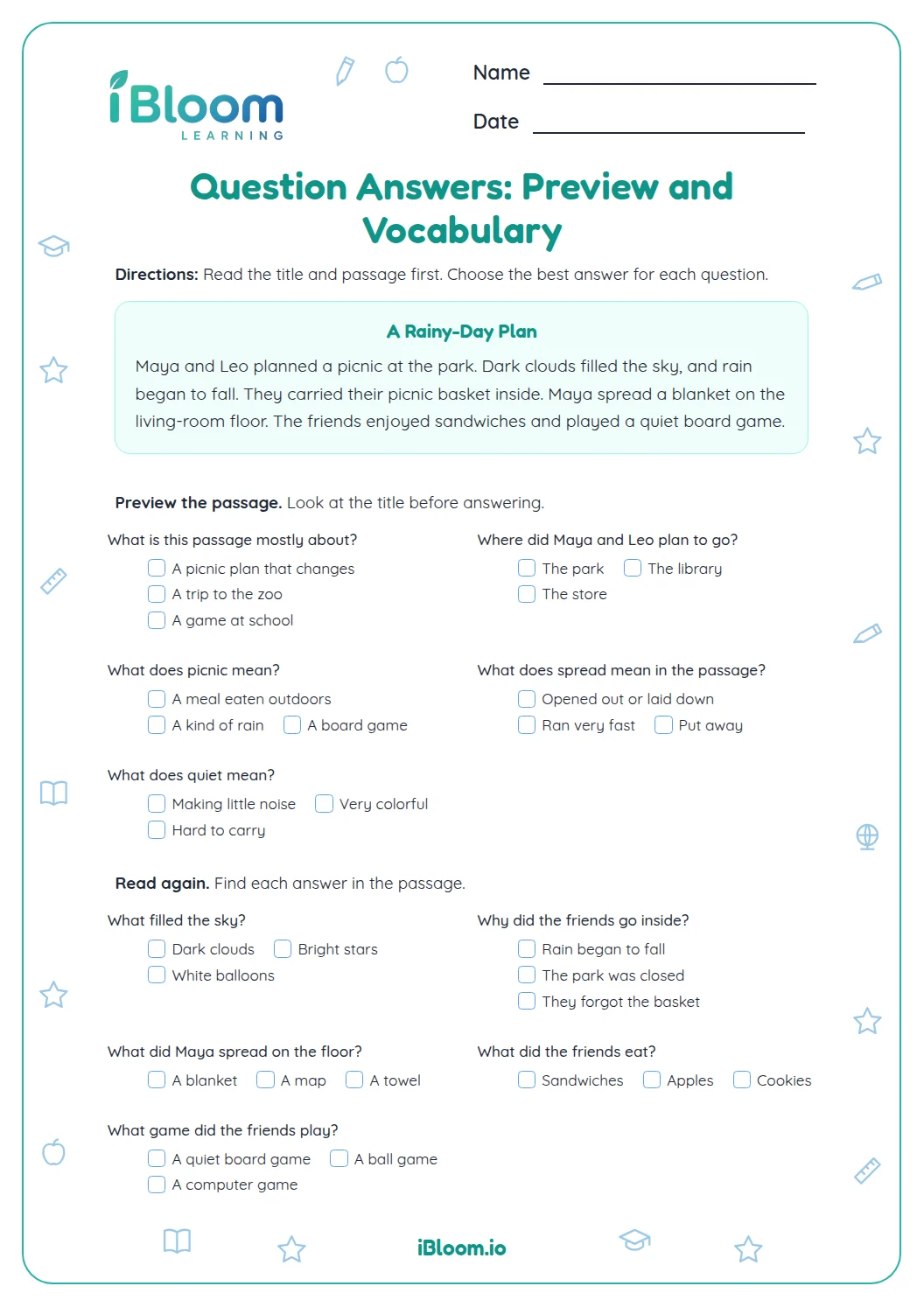
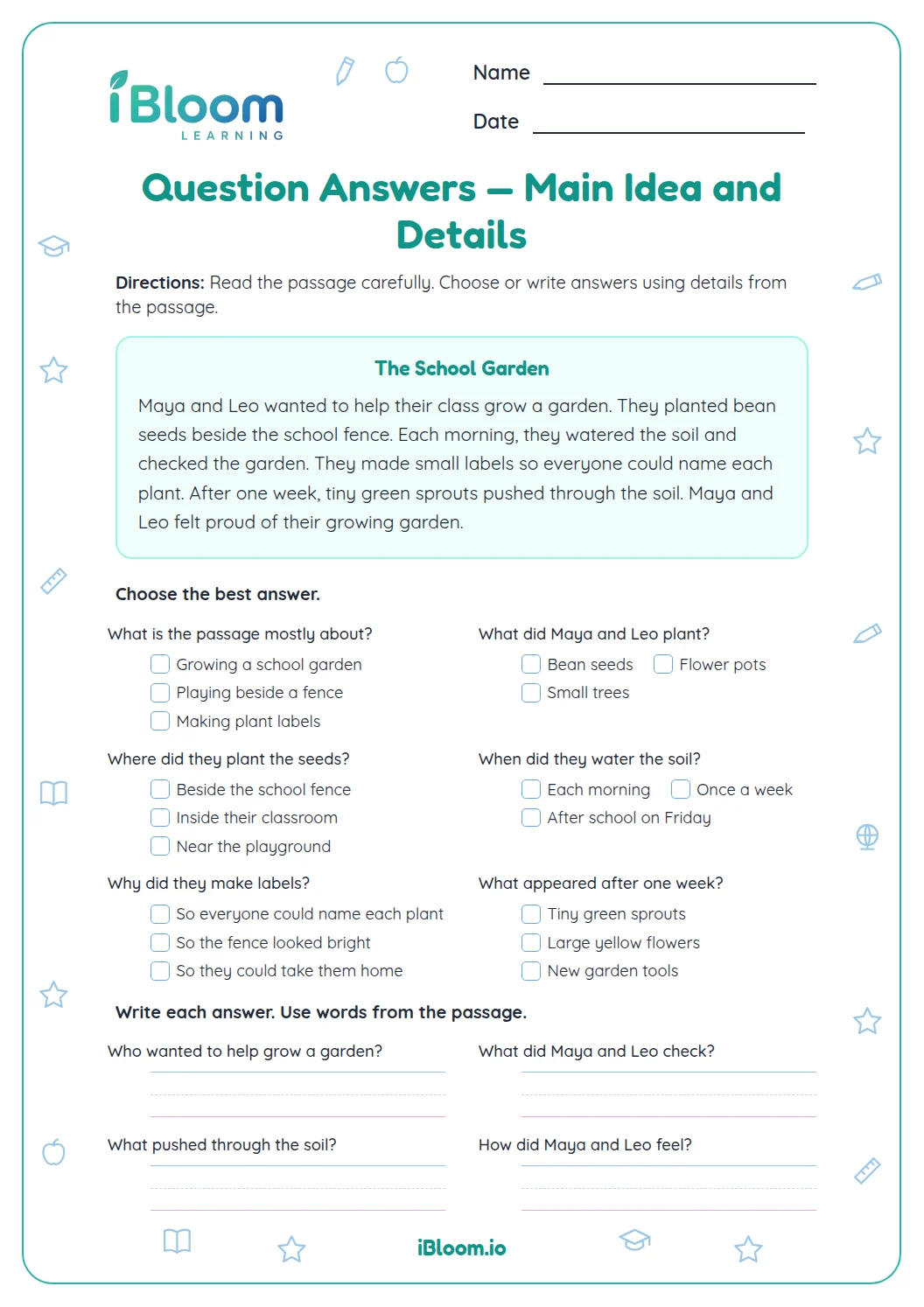
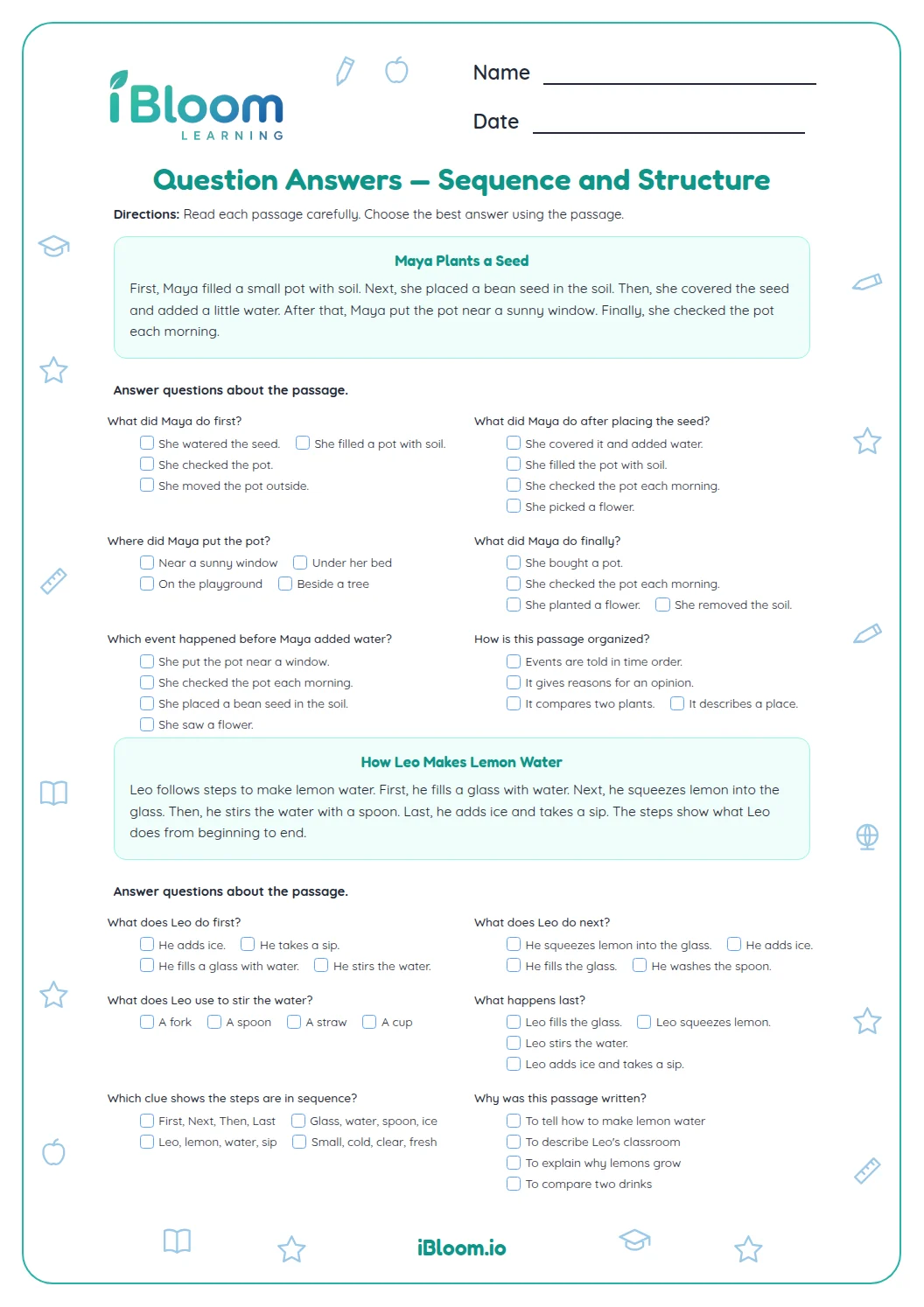
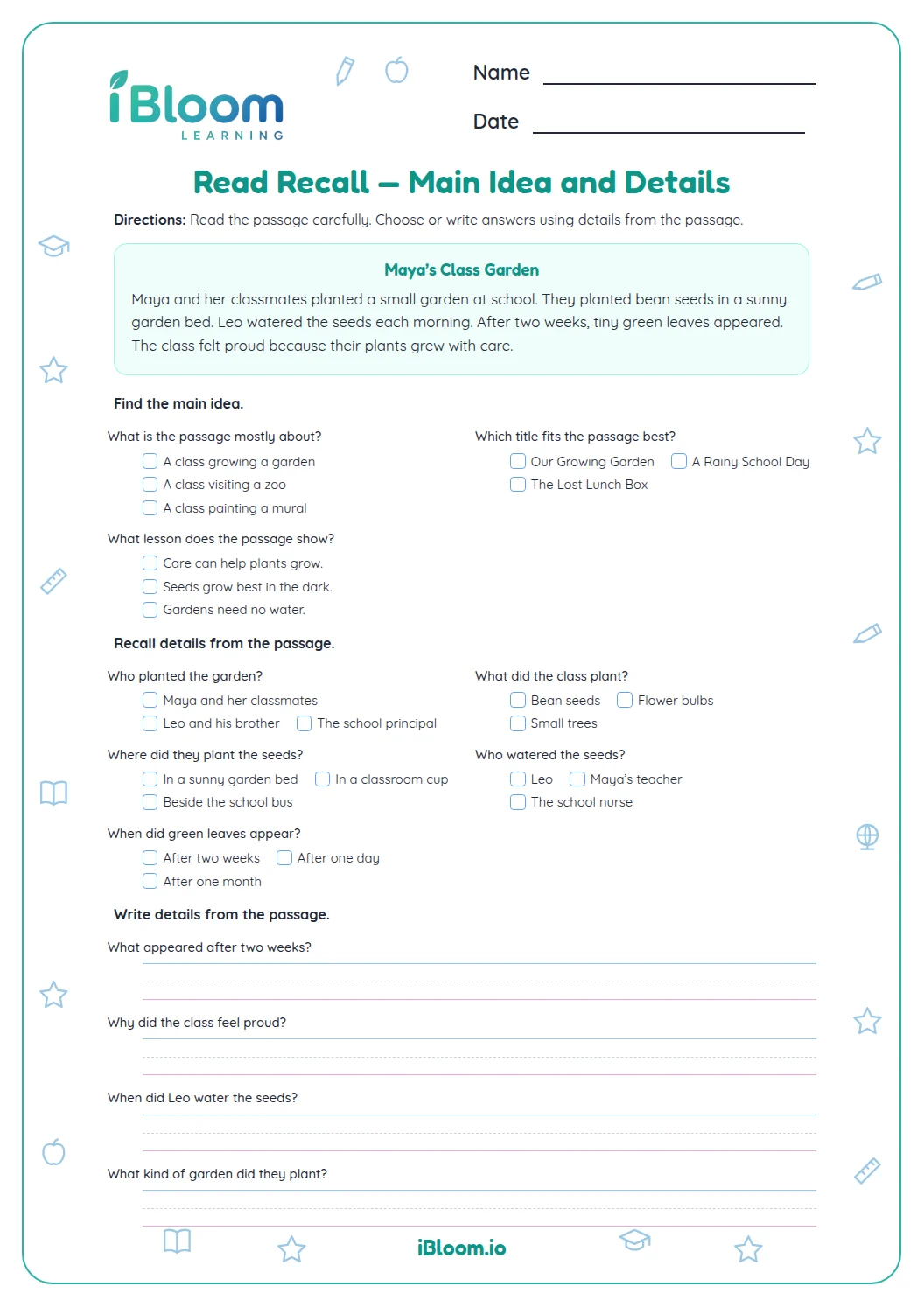
This Grade 2 reading worksheet centers on the original passage “A Garden for Everyone,” about Maya, Leo, and classmates caring for a school garden. Fourteen questions ask students to locate details, put events in order, identify the main idea, and use a passage detail to explain a lesson about teamwork. Most questions offer answer choices; the final response asks students to explain their thinking in writing. The three-page answer key marks choices and gives a sample evidence-based response. The questions practice CCSS RL.2.1 and RL.2.2.
Aligned to RL.2.1 and RL.2.2
What happens in “A Garden for Everyone”?
Maya and Leo begin by helping in the school garden. Classmates pull weeds, water plants, loosen soil, and spread compost. Rain arrives as the group goes inside, and fresh leaves appear the next morning.
- 1What did Leo spread around the tomato plants?
- 2Answer: compost
How can students find a text detail?
Return to the sentence that names the person, object, or event in the question. For example, the passage says Leo spread compost around the tomato plants, so “compost” answers what he spread.
How do details support the main idea?
A main idea covers the whole passage, while a detail tells one part. The children’s different jobs support the idea that they cared for the garden together. In the final response, students name a teamwork lesson and cite one job as evidence.
- 1Lesson: Working together helps.
- 2Detail: Maya watered while Leo spread compost.
How to use this worksheet
- 1Read the passage once to follow the events.
- 2Reread the sentence connected to each who, what, where, or when question.
- 3For sequence, find the event that happened before the others.
- 4Choose the main idea that fits the whole passage, not one detail.
- 5Use a specific garden job as evidence in the final response.
Common mistakes and quick fixes
The mistake
Choosing a detail that appears in the passage but answers a different question.
The fix
Match the question word to the sentence: who, what, where, when, or why.
The mistake
Choosing one event as the main idea.
The fix
Ask which answer describes the whole passage, including several garden jobs.
The mistake
Giving a teamwork lesson without evidence.
The fix
Add a passage detail, such as Maya watering while Leo spread compost.
Common Core alignment
This worksheet practices the listed Common Core skill through its questions.
Answer who, what, where, when, why, and how questions from the story.
On this sheet: Questions ask readers to locate and explain details in the passage.
Show the official wordingHide the official wording
Ask and answer such questions as who, what, where, when, why , and how to demonstrate understanding of key details in a text.
Recount the story and identify its message.
On this sheet: A final response asks for a lesson supported by what characters do.
Show the official wordingHide the official wording
Recount stories, including fables and folktales from diverse cultures, and determine their central message, lesson, or moral.
What to practice next
Make more practice
Further reading
Questions parents and teachers ask
What is the passage about?
“A Garden for Everyone” follows Maya, Leo, and their classmates as they care for a school garden. They pull weeds, add compost, water plants, and put tools away before rain begins. The questions ask students to use these events to understand the story.
How many questions are on the worksheet?
There are 14 questions across three worksheet pages. They include passage-detail questions, an event-order question, a main-idea question, and a written response about the teamwork lesson. The three-page answer key gives the correct choice for each selected response and a sample final answer.
How should a student answer a detail question?
Reread the sentence that contains the requested information. If the question asks what Leo spread around the tomato plants, locate the sentence about Leo and select compost. Matching the question’s key word to the text helps distinguish a nearby but incorrect detail.
What is the difference between a detail and a main idea?
A detail tells one specific thing, such as Maya filling a watering can. The main idea tells what the whole passage is mostly about: children helping care for a school garden. Students compare the answer choices with more than one event before choosing the main idea.
What should students include in the last answer?
The final question asks students to state a lesson about teamwork and support it with one detail. A suitable answer might say that shared work helps, because Maya watered while Leo spread compost. The answer key gives a model, and other clear responses supported by the passage can also work.