



About this worksheet
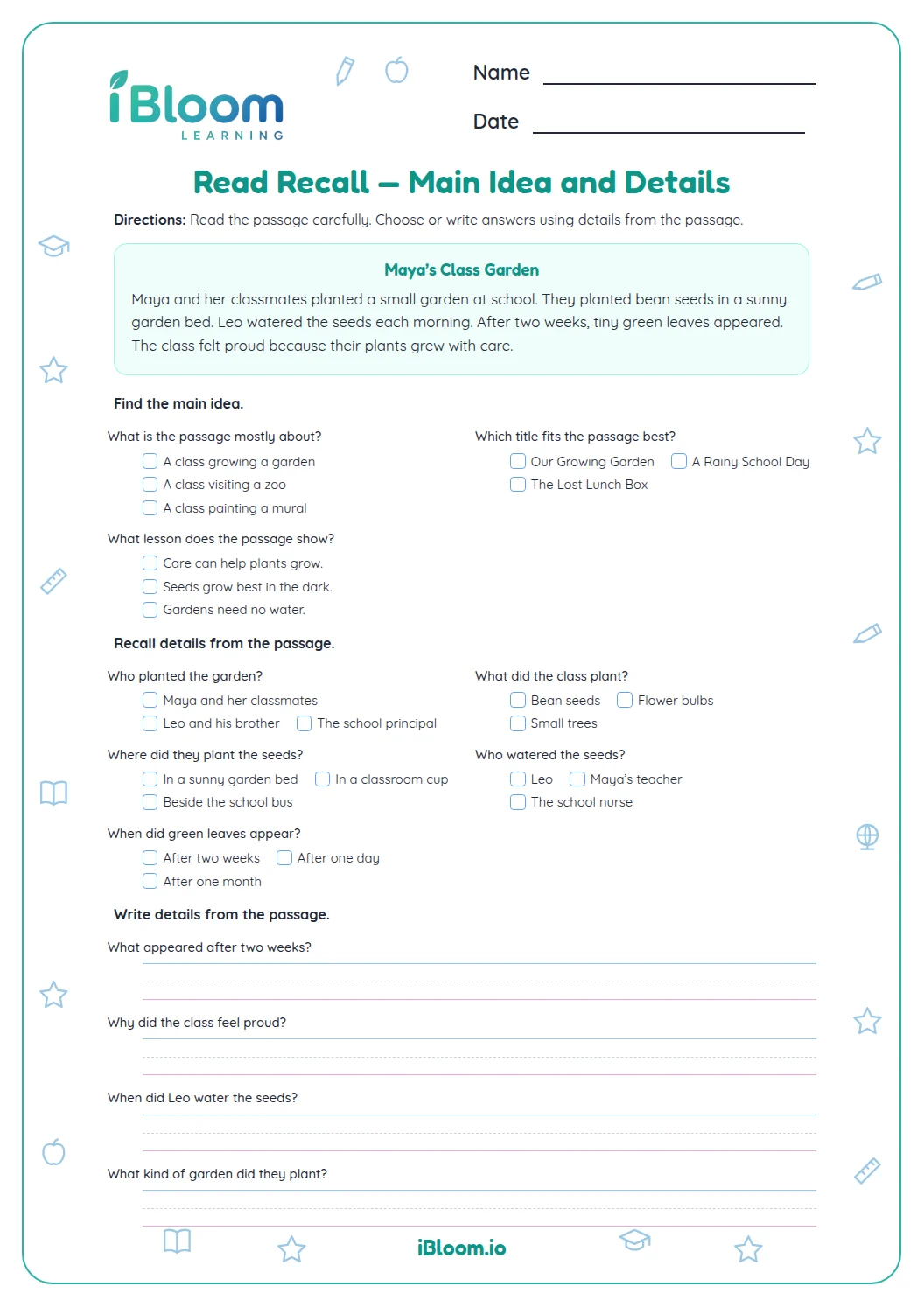
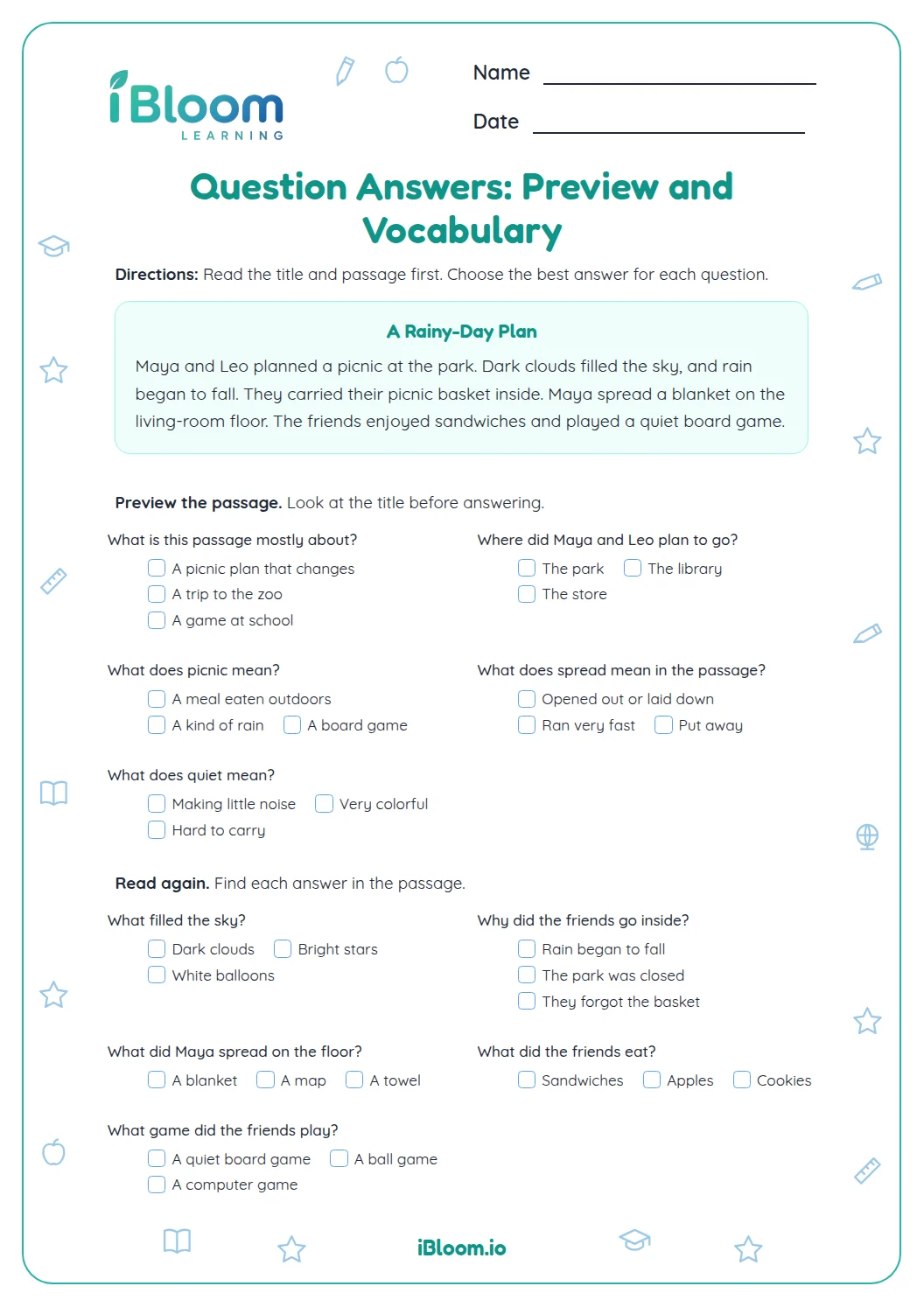
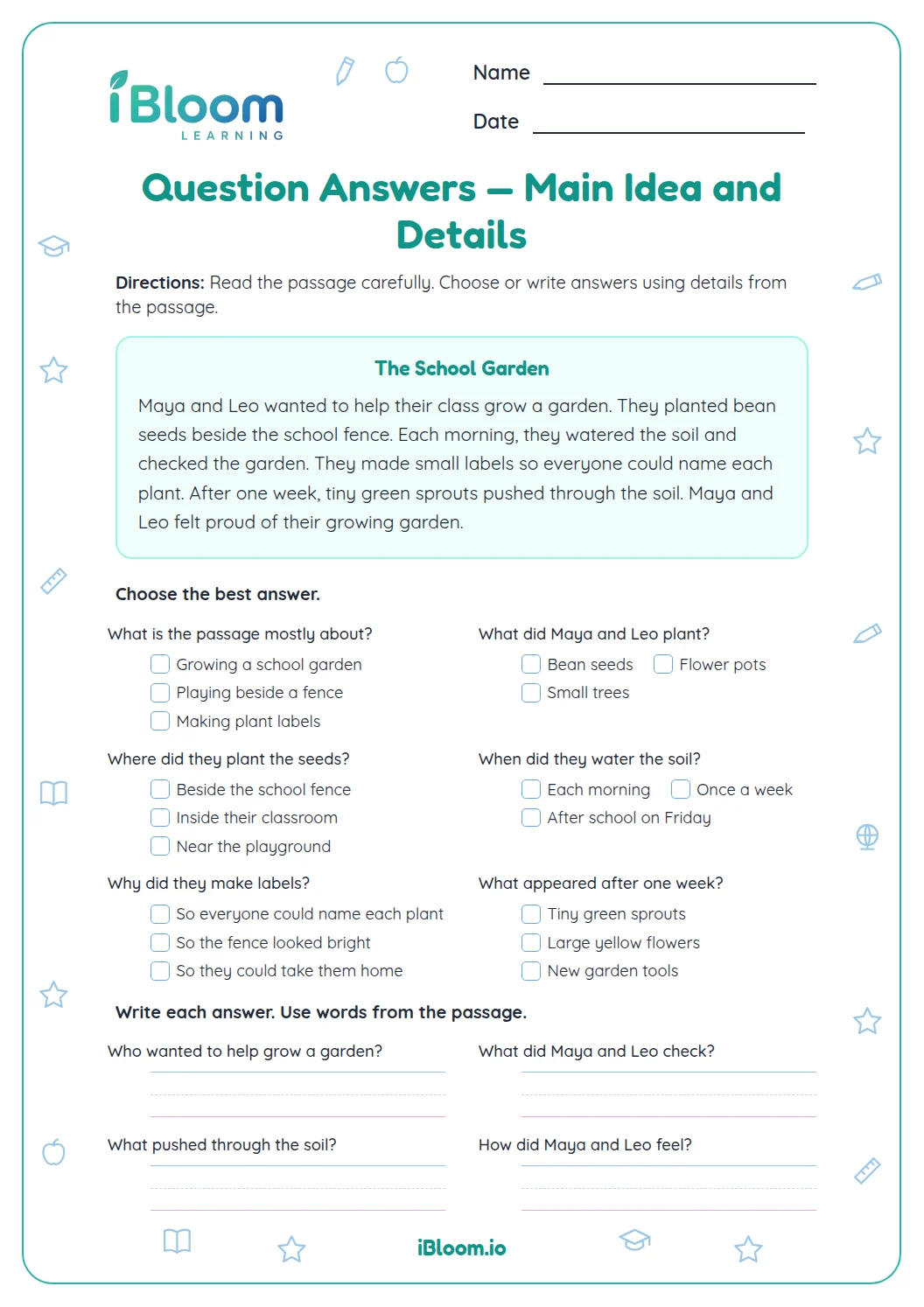
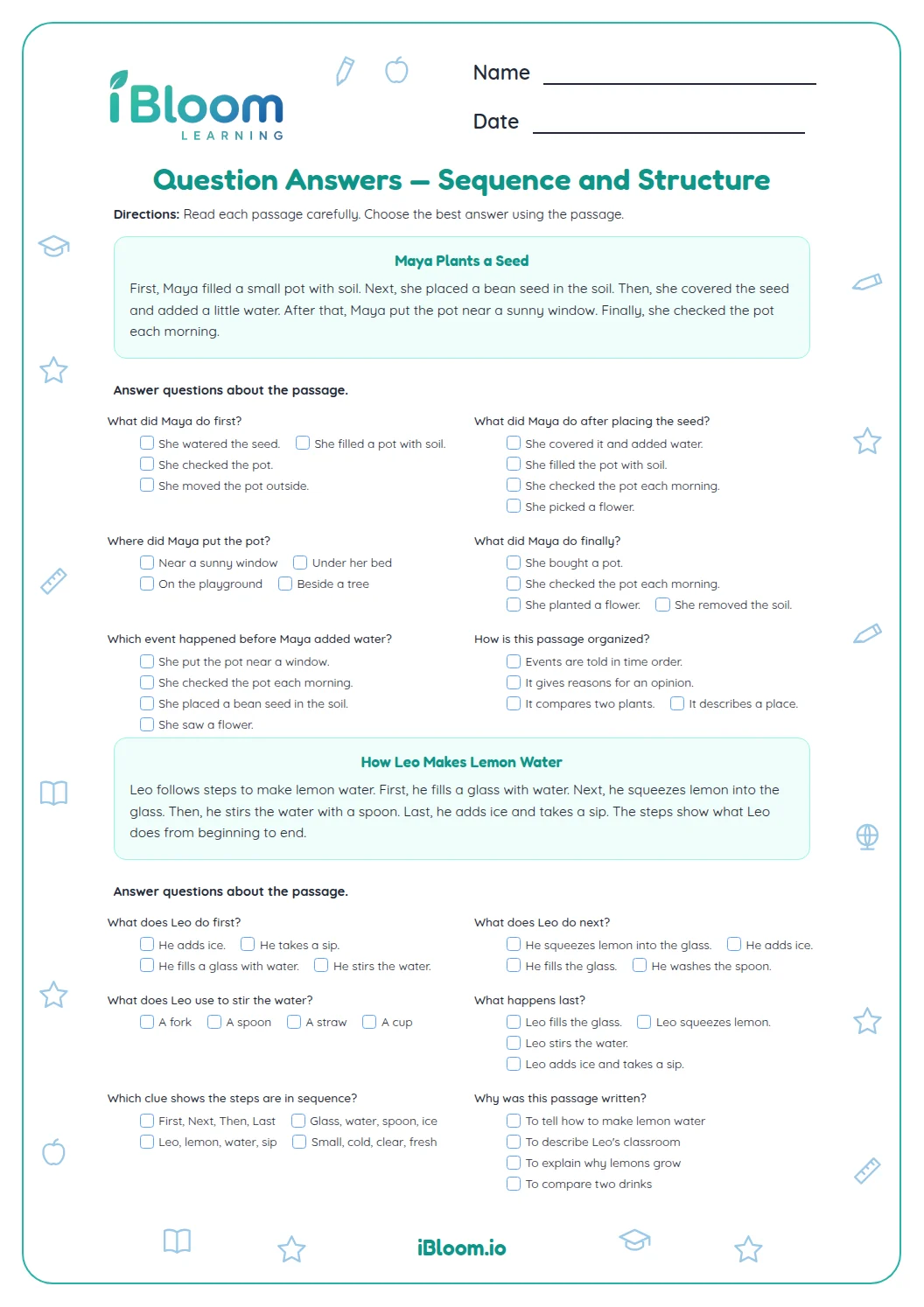
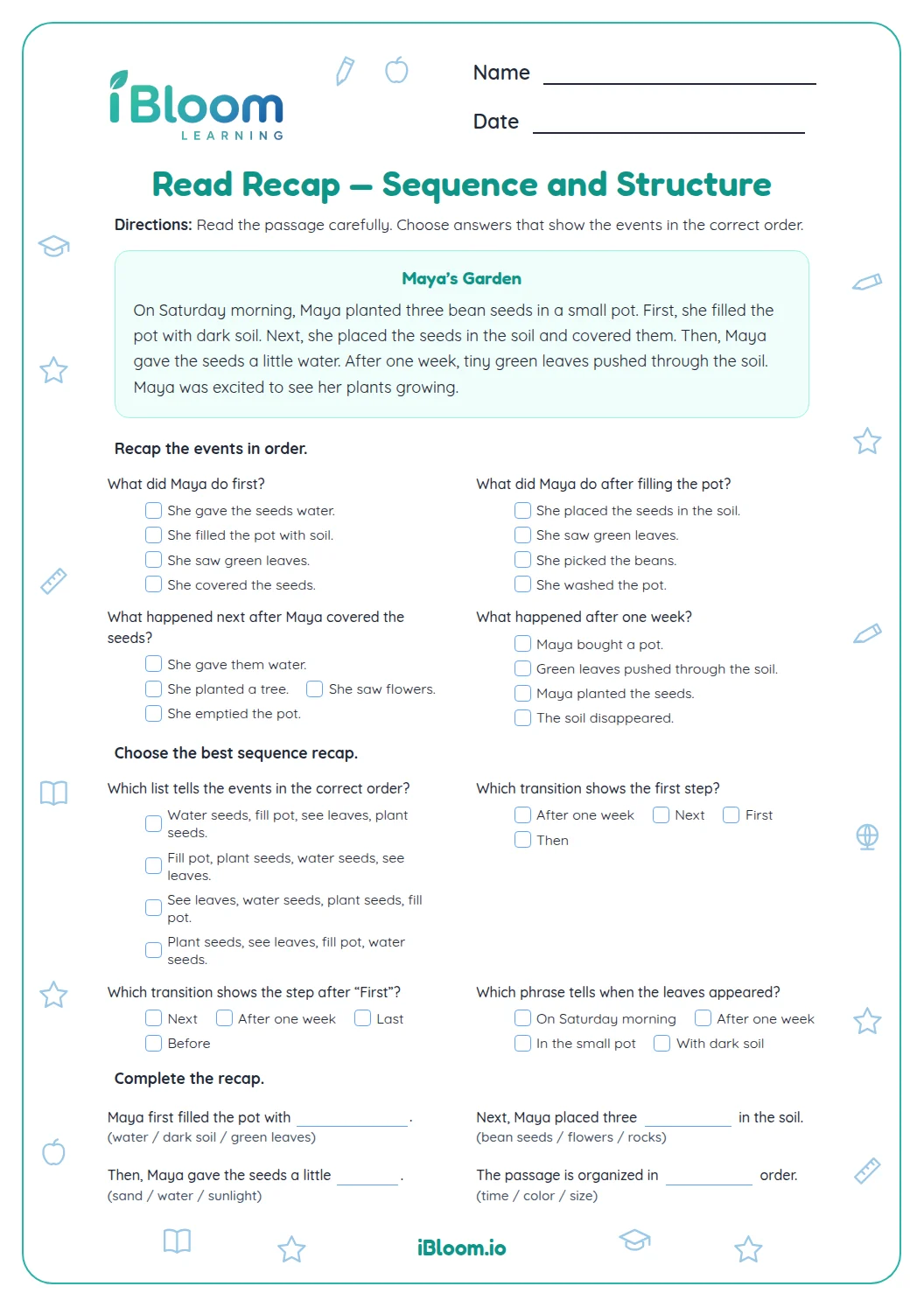
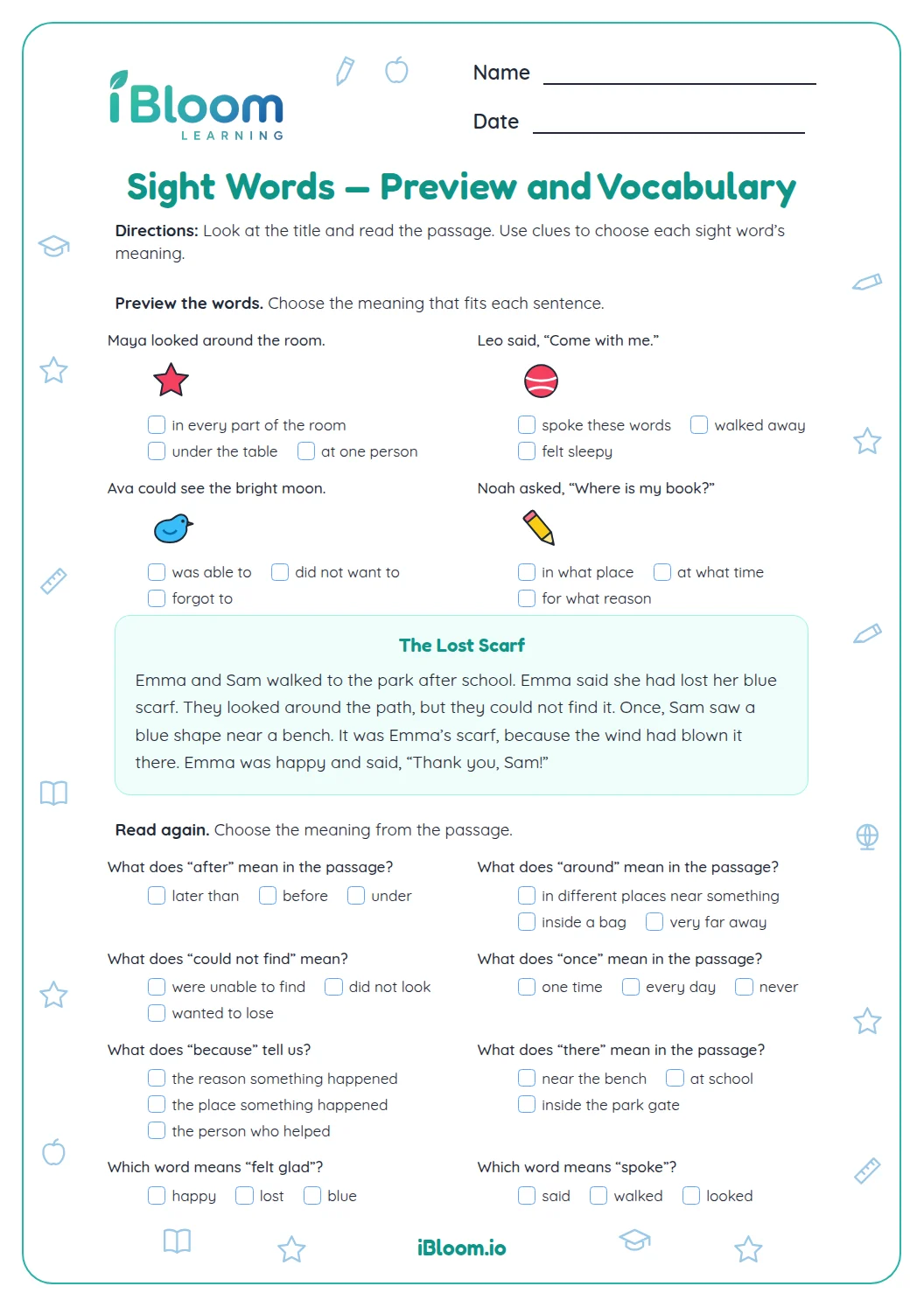
This free printable reading worksheet gives Grade 2 students a short story, “Maya’s Tiny Garden,” and ten multiple-choice questions about it. In Part B, children look at the title and decide what kind of text it is. In Part C, they use context clues to work out what soil, shoots and delighted mean. In Part D, they go back to the story to recall four details. The practice supports Common Core L.2.4.a, using sentence-level context to find a word’s meaning, and RL.2.1, answering questions about key details. An answer key is included.
Aligned to L.2.4.a and RL.2.1
What is on this Grade 2 reading worksheet?
The page opens with “Maya’s Tiny Garden,” a story of about 80 words. Maya plants bean seeds, waits for six days and finally sees green shoots. It is short enough for children to read twice, once for the story and once to look for answers.
The questions come in three parts after the story. Part B asks two questions about the title and the kind of text. Part C asks four questions about the words soil, shoots and delighted. Part D asks four questions about details in the story: how many seeds, when the shoots appeared, who Maya called and what she measured with.
- Part A: the story “Maya’s Tiny Garden”
- Part B: preview the text (questions 1 and 2)
- Part C: use context clues (questions 3 to 6)
- Part D: recall the details (questions 7 to 10)
What does it mean to preview a text?
Previewing means looking at the title and the way a text is set out before reading closely. A title often tells what the text is about, and the shape of the text, such as paragraphs of sentences with a character’s name, shows that it is a story.
Previewing gives children a first idea to check as they read. If a child expects a story about a small garden, the words seeds, soil and shoots will make sense when they appear.
- 12) From the title, what will the text be about?
- 2Title: “Maya’s Tiny Garden” → tiny means small, and garden is a place for plants → A small garden
How do context clues help with words like delighted?
Context clues are the words and sentences near a new word. Often the story shows what a word means without a dictionary. In this story, the sentences before delighted tell what Maya did: she clapped her hands and grinned, and she called out, “They are growing!”
Questions 5 and 6 work as a pair. Question 5 asks what delighted means, and question 6 asks which words in the story gave the clue. Answering both helps children say how they know, not only what they chose.
- 15) What does delighted mean? → Very happy
- 26) Which words are a clue? → She clapped and grinned (people who clap and grin are happy)
Why go back to the text to answer recall questions?
Recall questions ask about key details: who, what, when and how many. The answers are written in the story, so children should find them there instead of guessing. The wrong choices are things that could happen in a garden but are not in this story.
Question 8 is a good one to try together. Children can find the answer by looking for the word morning or seventh, and then checking that the choice matches the text.
- 18) When did the shoots appear?
- 2Story: “On the seventh morning, tiny green shoots pushed up…” → On the seventh morning
How to use this worksheet at home or in class
- 1Look at the title together before reading, and ask your child what kind of text they expect.
- 2Read the story aloud once, then let your child read it again quietly with a finger or pencil under each line.
- 3Do Part B, then read the Part C heading aloud: “Reread the sentence. Look for clues nearby.”
- 4For each vocabulary question, have your child point to the clue in the story before choosing an answer.
- 5For Part D, ask your child to find each answer in the story and underline it before filling in the bubble.
- 6Check with the answer key, and ask your child to retell the story in three sentences.
Common mistakes and quick fixes
The mistake
Choosing Water for soil in question 3 because the word water is in the same sentence.
The fix
Ask what Maya gave the soil. Water is what she gave, so soil must be something else. Later the shoots push up out of the dirt, which is a clue.
The mistake
Choosing Very tired for delighted in question 5 because Maya waited a long time.
The fix
Have your child read the sentences right after the waiting. Maya clapped and grinned, which are things people do when they are happy.
The mistake
Answering a recall question from what happens in a real garden, such as choosing On the third day in question 8.
The fix
Remind your child that the answer must be in the story. Have them put a finger on the line where they found it.
Common Core alignment
Most US states teach reading with the Common Core standards or a close state version. These Grade 2 standards name the word-meaning and detail skills that this page practices.
Use the sentences around a word as a clue to what it means.
On this sheet: Part C asks what soil, shoots and delighted mean and which words in the story give the clue.
Show the official wordingHide the official wording
Use sentence-level context as a clue to the meaning of a word or phrase.
Answer who, what, when and how many questions about a story.
On this sheet: Part D asks about how many seeds, when the shoots appeared, who Maya called and what she used to measure.
Show the official wordingHide the official wording
Ask and answer such questions as who, what, where, when, why, and how to demonstrate understanding of key details in a text.
What to practice next
Make more practice
Further reading
Questions parents and teachers ask
What does preview the text mean for a second grader?
Previewing means looking at the title and how the text looks before reading closely. It helps a child guess what the text is about. On this worksheet, the title “Maya’s Tiny Garden” suggests a small garden, and the paragraphs with a character’s name show that it is a story.
How do I help my child find the meaning of delighted?
Ask what Maya did just before the word appears. She clapped her hands and grinned, and she called out, “They are growing!” Those actions show a big, happy feeling. Then ask your child to find a word that means the same thing, which is very happy.
Why do the questions come after the story?
The story comes first so children can read it in full, then go back to find clues and details. Part B asks about the title, Part C about three words from the story and Part D about key details. All ten questions can be answered by looking at the story.
Is the story too long for Grade 2?
The story has about 80 words in two short paragraphs, and most sentences are short. A child who needs more support can read it aloud with a grown-up and then read it again alone. The words soil, shoots and delighted are the ones that may be new.
Can my child write answers instead of choosing them?
Yes. After circling an answer, ask your child to say or write one sentence that starts with “I know because the story says…” This works especially well for questions 6 and 8, where the answer points to words in the story, and it builds habits for longer texts.
What should my child do after this worksheet?
Ask your child to draw Maya’s seeds on day one and the shoots on day seven, then label each picture with a sentence from the story. The Question Answers and Read and Recap worksheets give more practice with short passages, and Match Text and Pictures continues the idea.