





About this worksheet
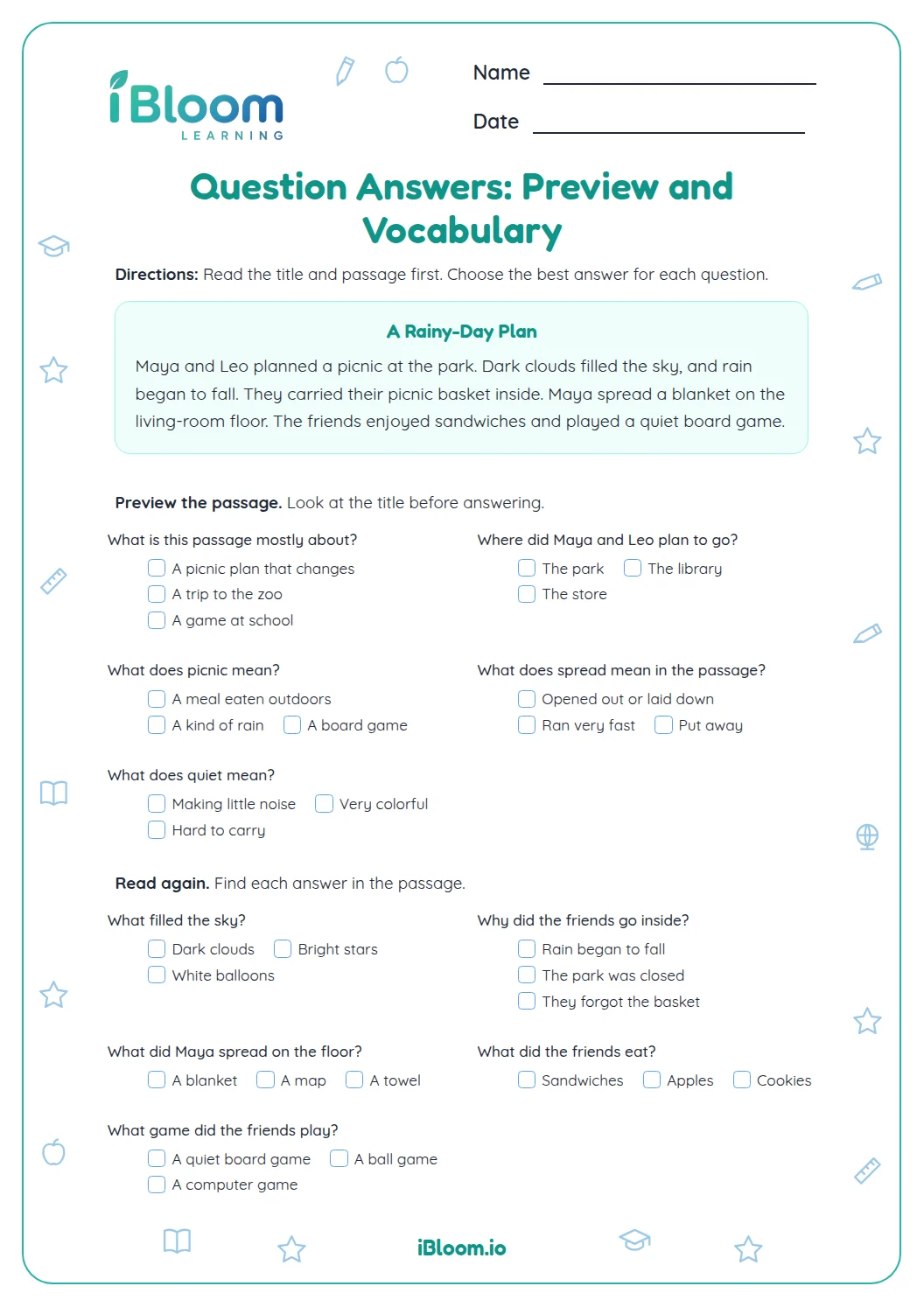
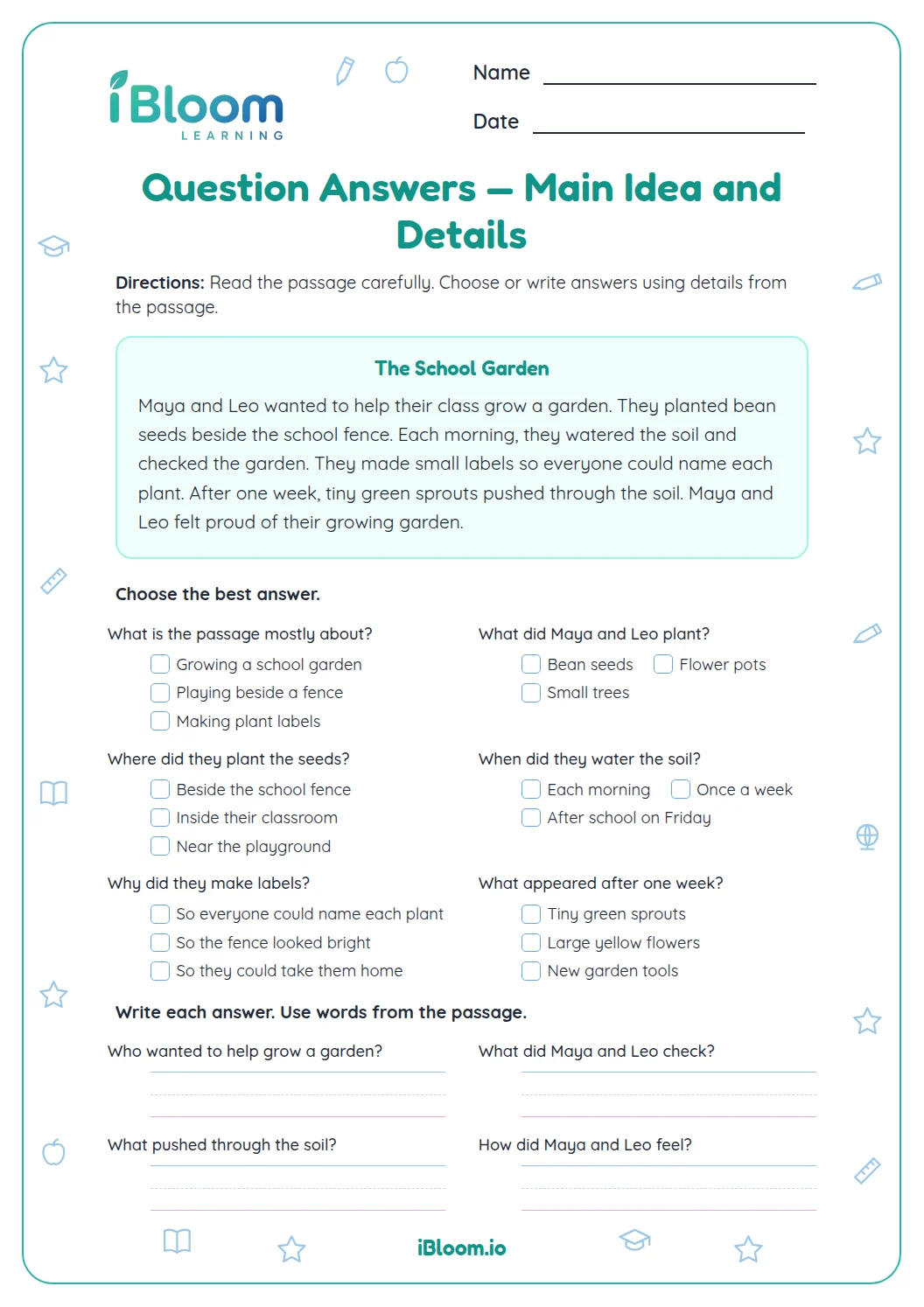
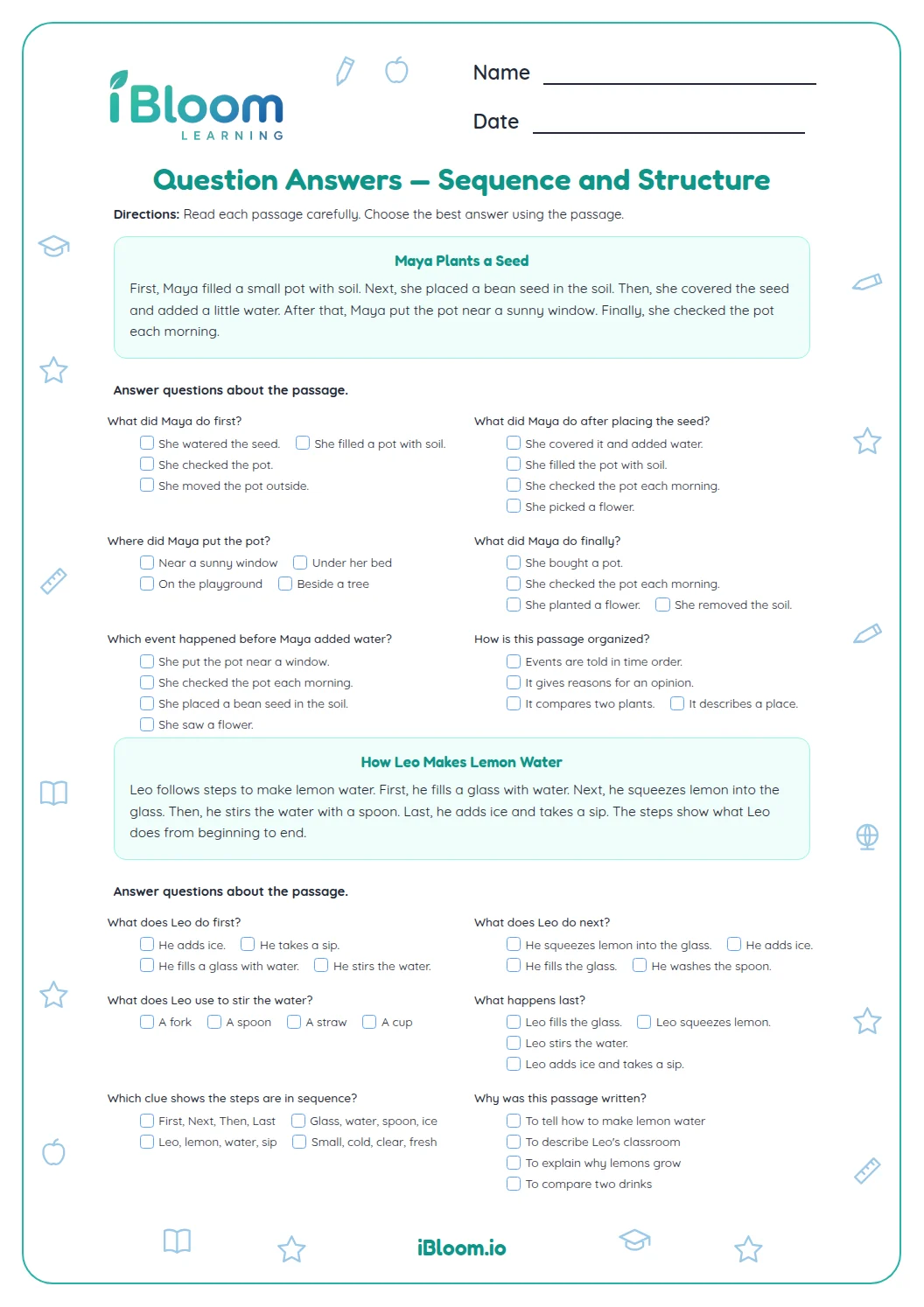
This free printable worksheet helps Grade 2 students get ready to read, learn new words from the story, and then recap what happened. The story, “Maya Finds a Trail,” is about a girl and her dog who find a thirsty bird near a pond. In Part B children preview the text from its title. In Part C they use the sentences around five words to choose a meaning. In Part D they answer who, what, why and where questions. The practice supports Common Core RL.2.1 and L.2.4.a, and the answer key gives every answer.
Aligned to RL.2.1 and L.2.4.a
What is on this worksheet?
The worksheet has a 105-word story and 11 questions in three parts. The story is Part A, so the question parts are B, C and D.
Part B uses the title to preview the story. Part C asks what trail, sniffed, thirsty, pond and nest mean in the story, and the last of these is chosen from three pictures. Part D asks for short written answers about who walked in the park, what Sam found, why Maya filled the cup and where the bird went.
- Part A: the story “Maya Finds a Trail”
- Part B: preview the text, 2 questions (1 and 2)
- Part C: five word meanings, one with pictures (3 to 7)
- Part D: recap with who, what, why and where answers (8 to 11)
- Answer key with every answer
Why preview a story and its words before recapping it?
Looking at the title and thinking about what the story might be about helps children read with a purpose. “Maya Finds a Trail” suggests a person who finds a path or tracks, so a reader can expect to follow something.
Thinking about the kind of text matters too. A story has characters and events, which is a different job from a recipe or a letter, and that tells a reader what to listen for when recapping.
How can children work out a word from the sentences around it?
The story never defines thirsty, but it shows it: the bird’s beak is open, it looks tired, Maya gives it water and it takes a long drink. Together those clues point to a need for a drink.
Children can test each choice by putting it back into the sentence. If it does not make sense, it is not the meaning.
- 15) In the story, thirsty means…
- 2Clues: open beak, tired, water, a long drink
- 3Needing a drink fits. Feeling sleepy does not explain the water.
How do the recap questions work?
Each recap question starts with a question word and points to one place in the story. Who is in the first sentence. What Sam found is in the first paragraph. Why is in the second, where the bird’s thirst is described. Where is in the last lines.
Children write short answers, and a few words are enough. If they are not sure, they can put a finger on the story and look for the question word’s clue.
How to use this worksheet at home or in class
- 1Read the title aloud and ask what your child thinks the story will be about, then do the two preview questions.
- 2Have your child read the story once, then again with a pencil, underlining the five words in Part C.
- 3For each word, ask your child to say the sentence with the meaning put in place of the word.
- 4Do the picture question about a nest, then talk about where the bird went at the end.
- 5Let your child write the recap answers in short phrases, pointing to the part of the story that gave each answer.
- 6Check with the key and ask your child to retell the whole story in three sentences.
Common mistakes and quick fixes
The mistake
Choosing “ran very fast” for sniffed (question 4) because Sam pulled on his leash.
The fix
Put each choice back into the sentence: “Sam ran very fast the ground” does not work, but “Sam smelled the ground” does.
The mistake
Answering “a kind of bird” for pond (question 6) because a bird is in the story.
The fix
Reread “small, wet footprints near the pond.” The footprints are wet because of the pond, so a pond is a small body of water, not an animal.
The mistake
Answering “She had a cup in her bag” for why Maya filled the cup (question 10).
The fix
That tells what Maya had, not why she used it. Look for the sentence about the bird: its beak was open and it looked tired, so it was thirsty.
Common Core alignment
Most US states teach reading with the Common Core standards or a close state version. These two Grade 2 standards name the skills on this page.
Answer who, what, why and where questions about the story.
On this sheet: Part D asks who, what, why and where questions that children answer from details in the story.
Show the official wordingHide the official wording
Ask and answer such questions as who, what, where, when, why, and how to demonstrate understanding of key details in a text.
Use the sentences around a word to work out what it means.
On this sheet: Part C gives five words from the story and asks children to choose each meaning from its context.
Show the official wordingHide the official wording
Use sentence-level context as a clue to the meaning of a word or phrase.
What to practice next
Make more practice
Further reading
Questions parents and teachers ask
Why does the worksheet teach words before the recap questions?
Words like trail, sniffed and thirsty carry the story’s meaning, so a child who misunderstands them may answer recap questions wrongly. Part C checks the five key words from the story first. Children then recap with a clearer picture of what happened, and the recap answers come more easily.
What does “preview the text” mean?
It means looking at the title and thinking about what the text will be about before reading it in detail. On this worksheet, the title “Maya Finds a Trail” points to a girl following a path, and children also decide what kind of text it is. Previewing helps readers know what to look for.
How can my child learn a new word without a dictionary?
Reading the sentences around it gives clues. Thirsty is never defined in the story, but the bird has an open beak, looks tired and gets water, which shows what thirsty means. Ask your child to put the possible meaning back into the sentence and see whether it makes sense.
Is the story at the right level for Grade 2?
It is 105 words long, with short sentences and everyday words such as park, dog and water. A few words need context, such as trail, sniffed and thirsty, and those are the ones the worksheet asks about. Children who read it comfortably can try the questions on their own.
How long should the recap answers be?
A few words are enough. For example, “a trail of footprints” answers what Sam found, and “The bird was thirsty” answers why Maya filled the cup. If your child writes a full sentence, that is fine too. The key shows sample answers, and similar wording that gives the same information is correct.
What should my child do after this worksheet?
Ask your child to retell the story to you in three sentences using the words first, then, and at the end. After that, try the Read Recall or Question Answers worksheets for more short texts, or Read Illustrate to draw what happened in a new story.